Straight talk about the 2011-12 University of Washington budget

For the fiscal year beginning July 1 2011, the University of Washington has again taken a massive hit to its state budget.  This will largely (but by no means entirely) be offset by tuition increases.  The chart below shows state support and tuition revenues over the past 5 years:

You see that state support has dropped almost exactly 50% since 2007-08:  from $433 million to $216 million annually.  (Interestingly, state support in 1990-91 – 20 years ago – was $419 million (in constant dollars), about the same as in 2007-08, the year before the start of the current plummet.)

You also see that recent increases in tuition have not been sufficient to fully offset decreases in state funding.

The drop in state funding is even more stark on a per-student basis (due to modest enrollment increases over the past 5 years), as shown in the next chart:
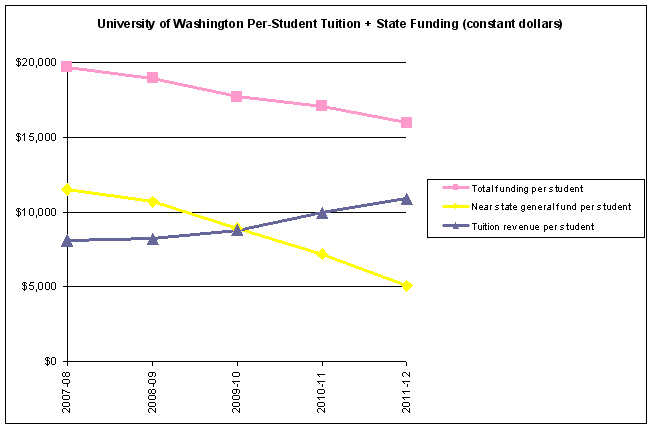
On a per-student basis, state support has fallen 56% since 2007-08.  (Per-student state support has fallen 64% since 1990-91, in constant dollars.)  Total funding per student – tuition + state support – has fallen 19% since 2007-08.

This has inevitably caused significant budget reductions in academic units.  Across the campus, the net effective cut to academic units over the past three years has been 16.2%.

The College of Engineering, where Computer Science & Engineering is housed, has suffered exactly this campus-wide average net effective cut:  16.2%.

However, there has been some differentiation across academic units.  For example, the College of Arts & Sciences, whose permanent budget is nearly three times as large as that of the College of Engineering and which delivers many of the lower-division core courses for the University at large, saw a significantly smaller cut over the past three years – a net effective cut of only 5.5%, roughly 1/3 the campus-wide average.  Some professional schools, such as the Information School, saw greater-than-average cuts.  Overall, there is a disturbing trend of insufficient funding per student for the highest-impact STEM disciplines such as engineering and computer science, which are expensive to offer due to intensive upper-division laboratory experiences.

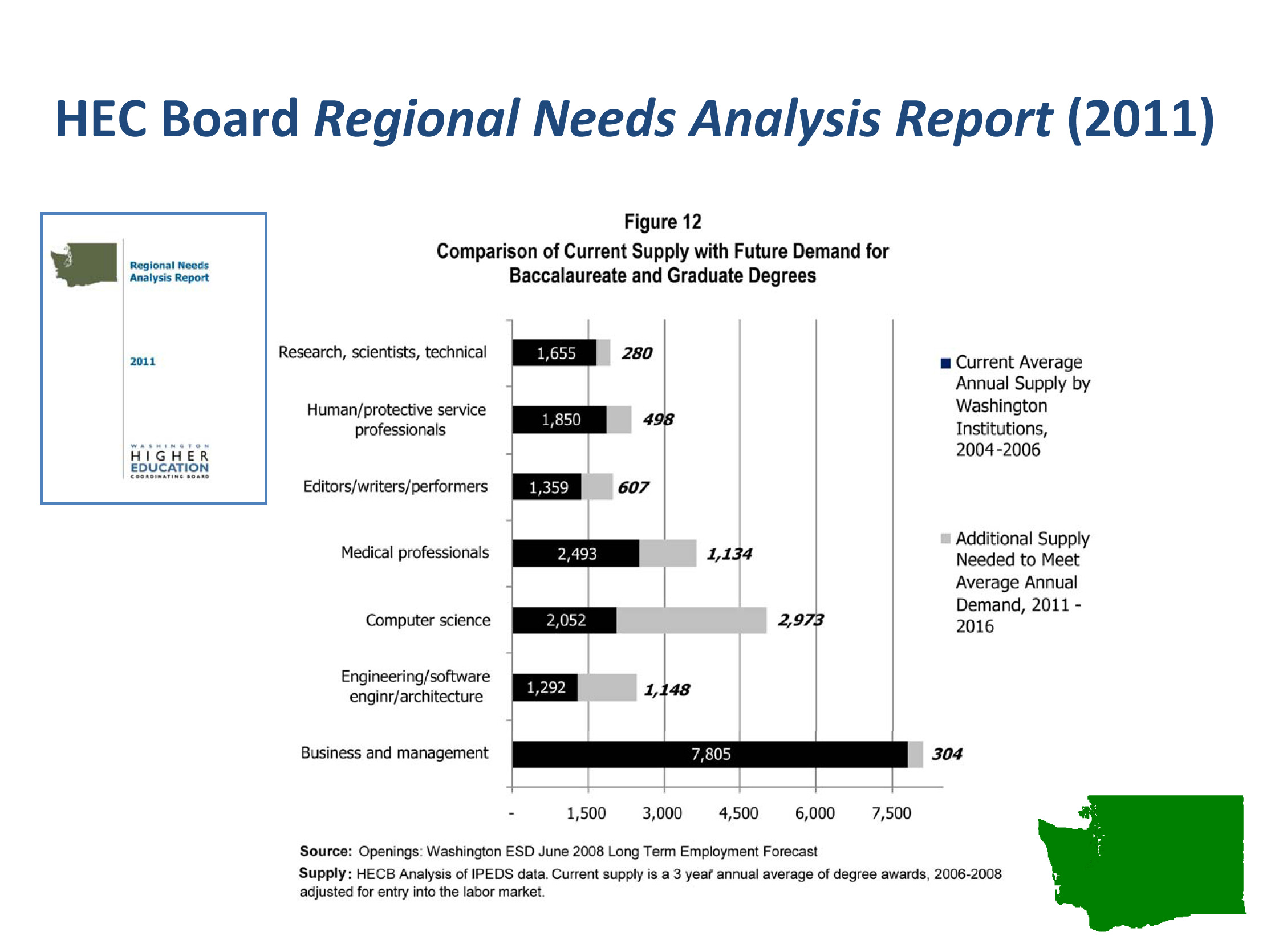
In this context, we again note the most recent regional and national workforce gap projections from (respectively) the State Higher Education Coordinating Board (citing ESD and IPEDS data) and the President’s Council of Advisors on Science and Technology (citing BLS and NSF data):
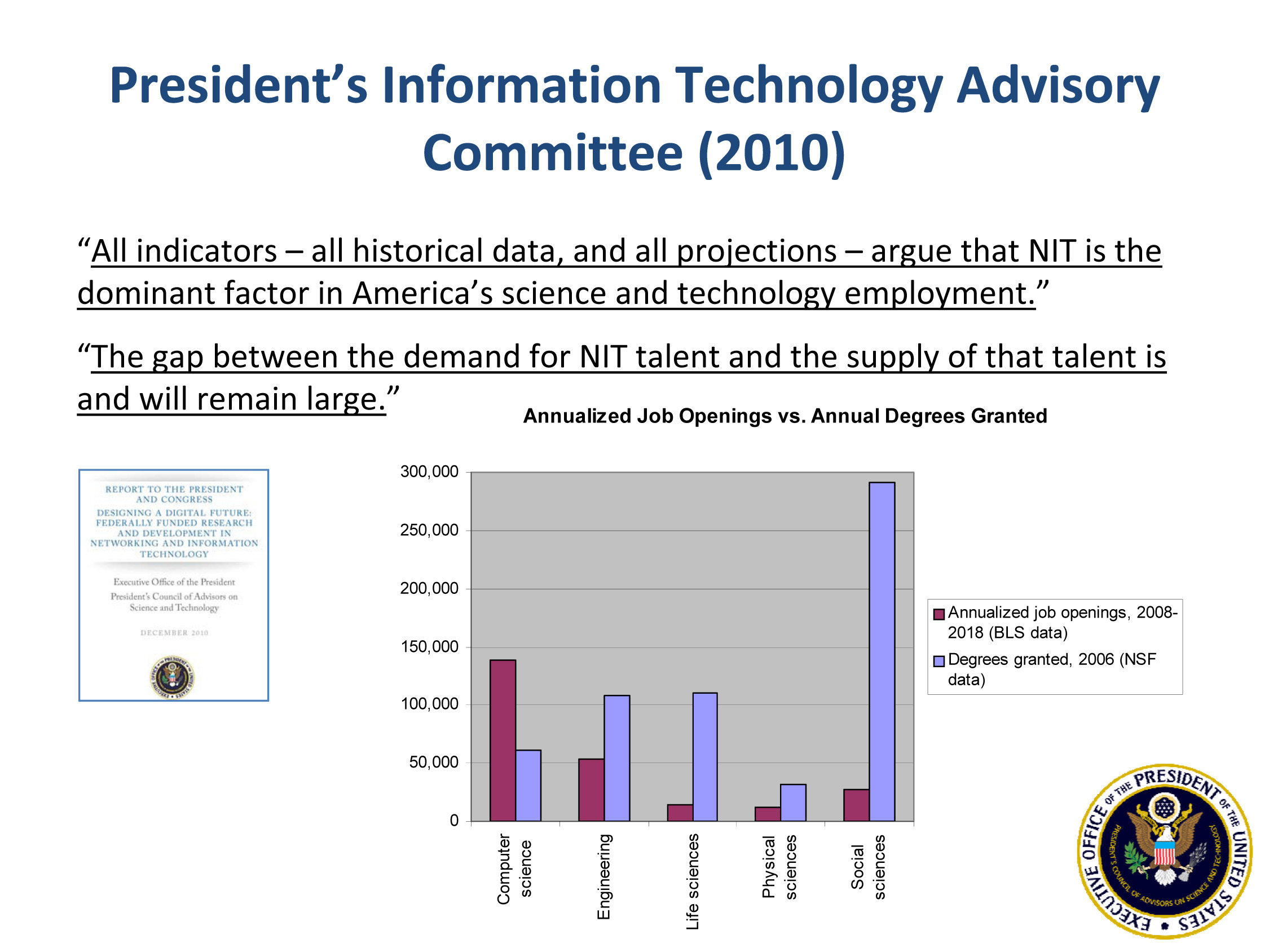
(Additional information on the transformational role of Computer Science, and on student demand and employer demand, can be found here and here.)

Opinion [Ed Lazowska]: There is only one way forward:  The University of Washington must institute differential tuition: differential by field (because engineering fields are more expensive to teach than, e.g., the humanities and social sciences), and differential by year (because upper-division students are more expensive to educate than lower-division students).  Additionally, units must be able to retain the vast majority of the tuition revenue that they generate, rather than having it retained centrally for re-distribution.

Only through these steps will it be possible for the State of Washington to have a UW College of Engineering, and a UW Department of Computer Science & Engineering, of the size and quality necessary for our collective future.

[GeekWire re-post here.]
Read more →

Decide.com on AllThingsD, GeekWire, NY Times

“Ever wonder if you should buy a new digital camera, or wait for a better one just around the corner?

“Even worse, did you buy the brand new HDTV right before 3-D came out?

“A new electronics shopping service is launching today to eliminate buyer’s remorse, by providing consumers with enough information to help them make a better decision.

“The Seattle-based Decide.com is the brainchild of the same folks behind Farecast.com, which helped predict whether it was the right time to buy an airline ticket or if a price drop was coming.

“Farecast, which was purchased by Microsoft three years ago for $115 million, is now Bing Travel. …

“The company was co-founded by Oren Etzioni, who is also a computer science professor at the University of Washington. It has raised $8.5 million from Maveron, which was started by Starbucks’ Howard Schultz, and Madrona Venture Group, which was founded by one of the original investors in Amazon.”

Read more in AllThingsD, GeekWire., and the New York Times (“Decide.com – The Farecast for Electronics!”).

Etzioni comments:

“While Decide isn’t a spinout of UW technology, it has some remarkable ties to UW and to CSE:

  • Founders are myself and 4 UW alums (3 have their degrees from CSE)
  • Our Chief Scientist and our 2 other PhDs all received their Ph.D.s from CSE
  • Our CEO (Mike Fridgen) is a UW alum
  • Roughly 80% of our employees are UW alums”
Read more →

CSE’s Hoifung Poon wins UAI 2011 “Best Paper” award

CSE’s Hoifung Poon has won the “Best Paper” award from the 2011 Conference on Uncertainty in Artificial Intelligence (UAI 2011), to be held July 14-17 in Barcelona, for the paper “Sum-Product Networks: A New Deep Architecture,” co-authored with his Ph.D. advisor, CSE’s Pedro Domingos.

It’s the third major-conference “Best Paper” award in as many years for Hoifung, who successfully defended his Ph.D. dissertation yesterday.

Congratulations Hoifung! Read more →

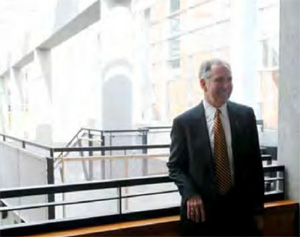
Michael Young in the Allen Center

Columns, the University of Washington alumni magazine, captures new UW President Michael Young in what we hope will become his natural habitat – the Microsoft Atrium of the Paul G. Allen Center for Computer Science & Engineering! Read more →

Kinect programming boot camp at UW CSE

Dan Fernandez

UW attendees

John Davis

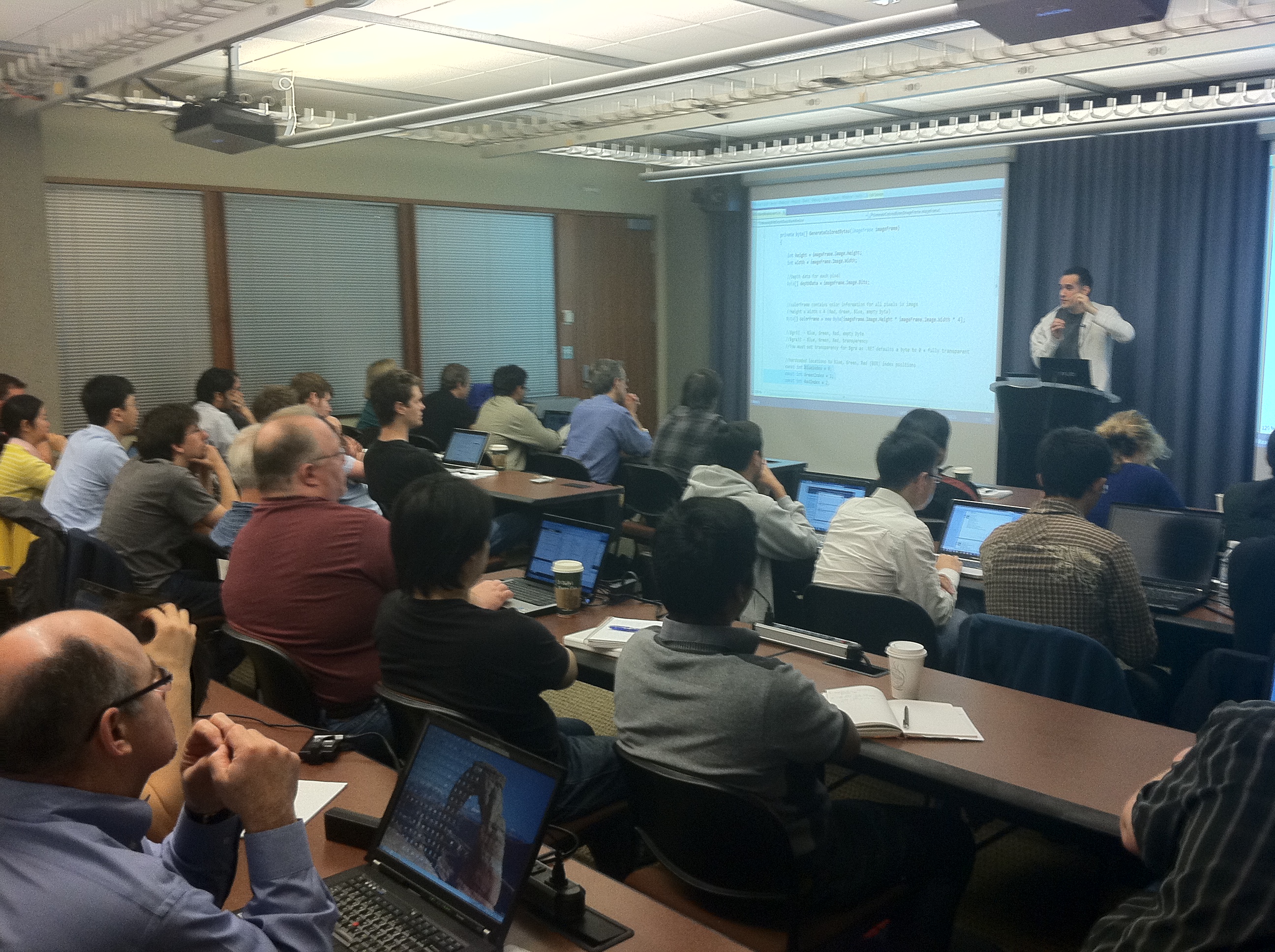
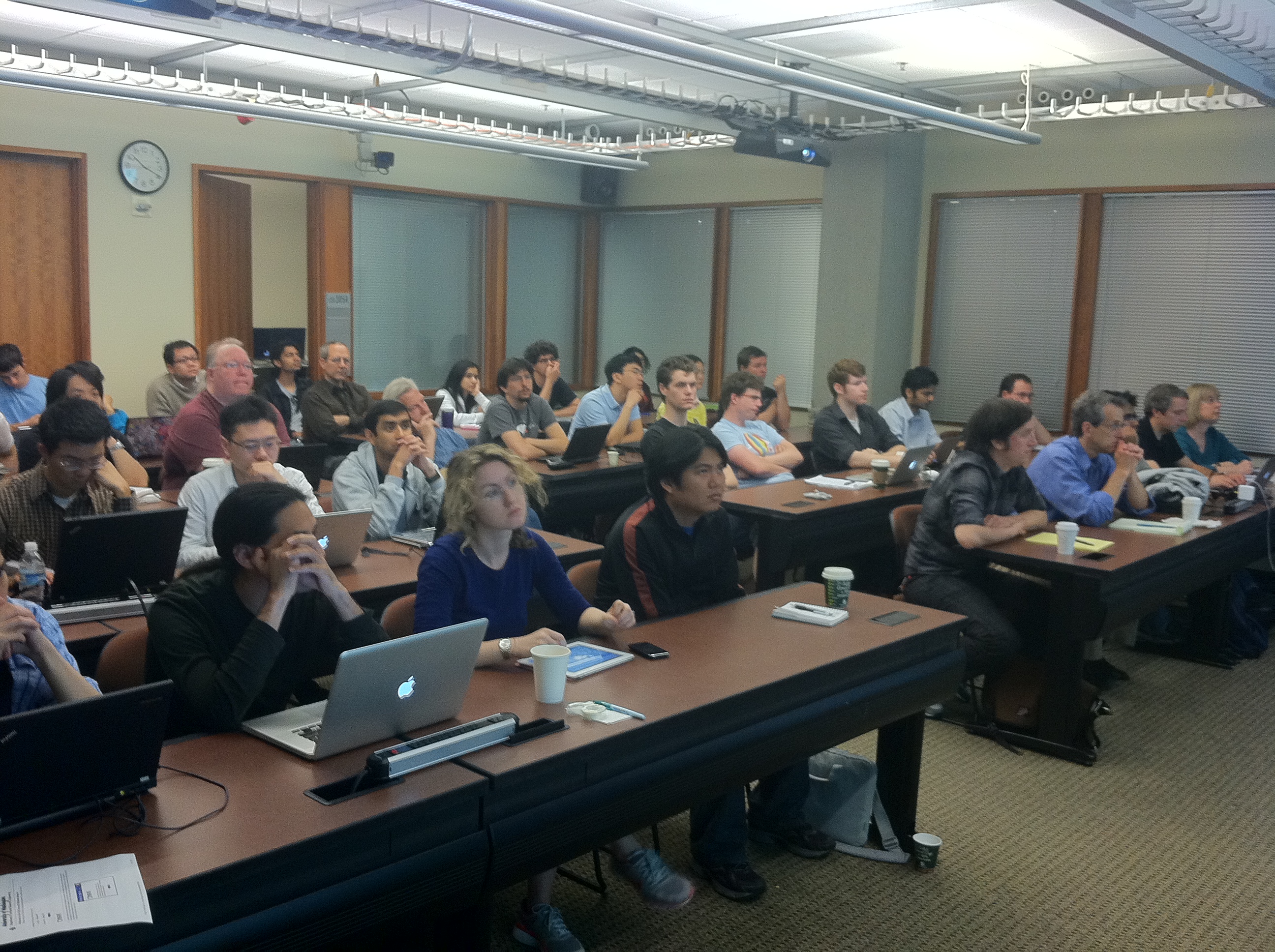
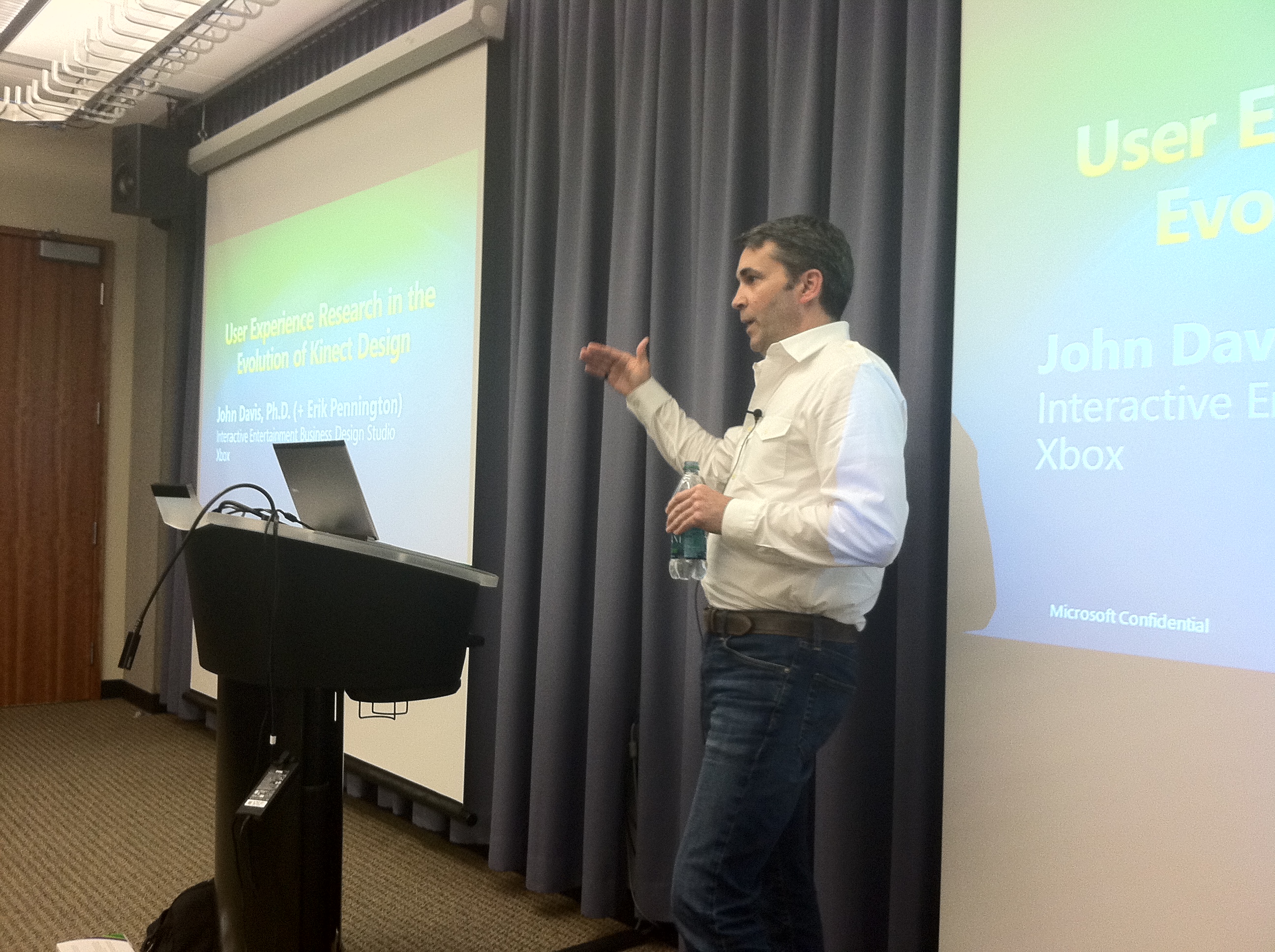
Microsoft’s Kinect for Xbox 360 has taken the gaming world by storm.  On Thursday, Microsoft Research rolled a Kinect SDK, making full-functionality Kinect programming available for any non-commercial use.  On Friday, Microsoft ran a Kinect programming boot camp for 40 UW CSE students, staff, and faculty, helping to bootstrap the UW CSE Kinect developer community.

Thanks to Stewart Tansley (Microsoft Research, and organizer of the event – who had gone 40+ hours without sleep but clearly had drunk plenty of coffee), Dan Fernandez (Microsoft Channel 9), John Davis (Microsoft Xbox), and Kent Foster (Microsoft Studios), for a great event.  (And thanks also for leaving some Kinects behind!)

Useful links:

Now, let’s see some apps! Read more →

“A motley group of 16 ‘open data geeks'”

UW CSE’s Brian Ferris – creator of OneBusAway and recently praised by Seattlest as “oh mighty one … the God of Metro” – was brought to the White House last week as one of “a motley group of 16 ‘open data geeks'” honored as part of the “Champions of Change” program, which celebrates the fact that “Every day in communities across the country, ordinary individuals are doing extraordinary things to improve the lives of others and strengthen their communities.”

Read a Government Technology post on the event here.

Assuming he can fit it into his busy schedule, Brian will defend his Ph.D. thesis – “OneBusAway: Improving the Usability of Public Transit” – on Thursday, June 23 at 2:30 p.m. in room 503 of UW’s Paul G. Allen Center for Computer Science & Engineering. Read more →

“Seattle area 15-year-old sells startup to ActiveState”

Daniil Kulchenko

Paul Kulchenko

GeekWire reports:

“Some entrepreneurs wait a lifetime to experience the thrill of selling their startup companies. Daniil Kulchenko, a Seattle area high school student, accomplished that milestone at the age of 15. Kulchenko today announced that he’s sold his startup, a cloud-based computing company known as Phenona, to Vancouver, B.C.-based ActiveState in a deal of undisclosed size.”

Daniil is the son of UW CSE graduate student Paul Kulchenko, known for the development of SOAP::Lite and for a robot that juggles ping pong balls.

Read the GeekWire post – a great article – here.  Daniil also is featured in the GeekWire podcast, here – and a transcript re-post here. Read more →

GeekWire on the red-hot tech job market

“The market remains red-hot for talented software developers and engineers.  Brian Bershad, the Google site director in Seattle, told computer science faculty at a meeting on the University of Washington campus last week … ‘We are not limited the in the number of positions that we have. We are limited in the number of people that we can find that are very, very good …  If you were graduating 1,500 (computer science students) per year … we’d probably be hiring in the order of 200 to 300 people.'”

Read the GeekWire post here. Read more →

“Computer Science’s ‘Sputnik Moment'”

Following up on an excellent article this past Saturday about rising enrollments in computer science, The New York Times has just published a fabulous “Room for Debate” essay series titled “Computer Science’s ‘Sputnik Moment’?”:

“Computer science is a hot major again. It had been in the doldrums after the dot-com bust a decade ago, but with the social media gold rush and the success of ‘The Social Network,’ computer science departments are transforming themselves to meet the demand.”

The series features eight short opinions (they’re quick reads!) including pieces by UW CSE’s Ed Lazowska and CMU’s Jeannette Wing, as well as a sociologist, entrepreneur, lawyer, and tech editor.

Under the heading “Software as Self-Expression,” Wing writes:

“Today’s students have grown-up tech savvy. They live in a world of exploring the Web and of personalizing their devices. Cyberspace is the anytime, anywhere laboratory where you can design and run your own experiments by writing just a little software. It’s affordable by anyone with access to the Internet. And each piece of software is an individual’s expression of creativity, much like poetry or music. Computer science can be fun and empowering …

“When people talk about the smart grid, smart vehicles, and smart buildings — what makes them ‘smart’? Computer science. When people talk about personalized medicine and personalized learning, how do you think personalization is possible? Computer science. We’re not there yet, but the next generation of computer scientists can help us realize these visions — with immeasurable benefits to society and the economy.”

Under the heading “A Key to Critical Thinking,” Lazowska writes:

“As more fields become information fields… “computational thinking” is necessary for success in just about any endeavor …

“Computer science is a superb preparation for just about anything. And within technology industries, there are plentiful jobs. Those who choose to work in the computing field find it characterized by highly interactive teams that are focused on solving real life problems. The Dilbert stereotype is surely dead …

“For students who want to change the world, there is no field with greater impact or leverage than computer science. Just take a look at the 2010 report by the President’s Council of Advisers on Science and Technology, which characterized computer science as ‘arguably unique among all fields of science and engineering in the breadth of its impact’ …

“Despite all of this good news, we need a national re-commitment to education, innovation, science and engineering. All the facts suggest that we are losing our edge.”

Read all the essays here. Read more →

Shwetak Patel is July Wired magazine cover story

The research of UW professor Shwetak Patel is prominently featured in the cover story of the July issue of Wired magazine.

The focus of the story is feedback loops that modify human behavior.  Shwetak’s work on clever, cost-effective monitoring of the home environment (electricity, gas, water) and feeding this information back to residents to influence their behavior is the prime example (beginning halfway through the attached article.

Read the article here.  Learn more about Shwetak and his work here.  UW sustainability sensing effort is described here. Read more →

« Newer PostsOlder Posts »