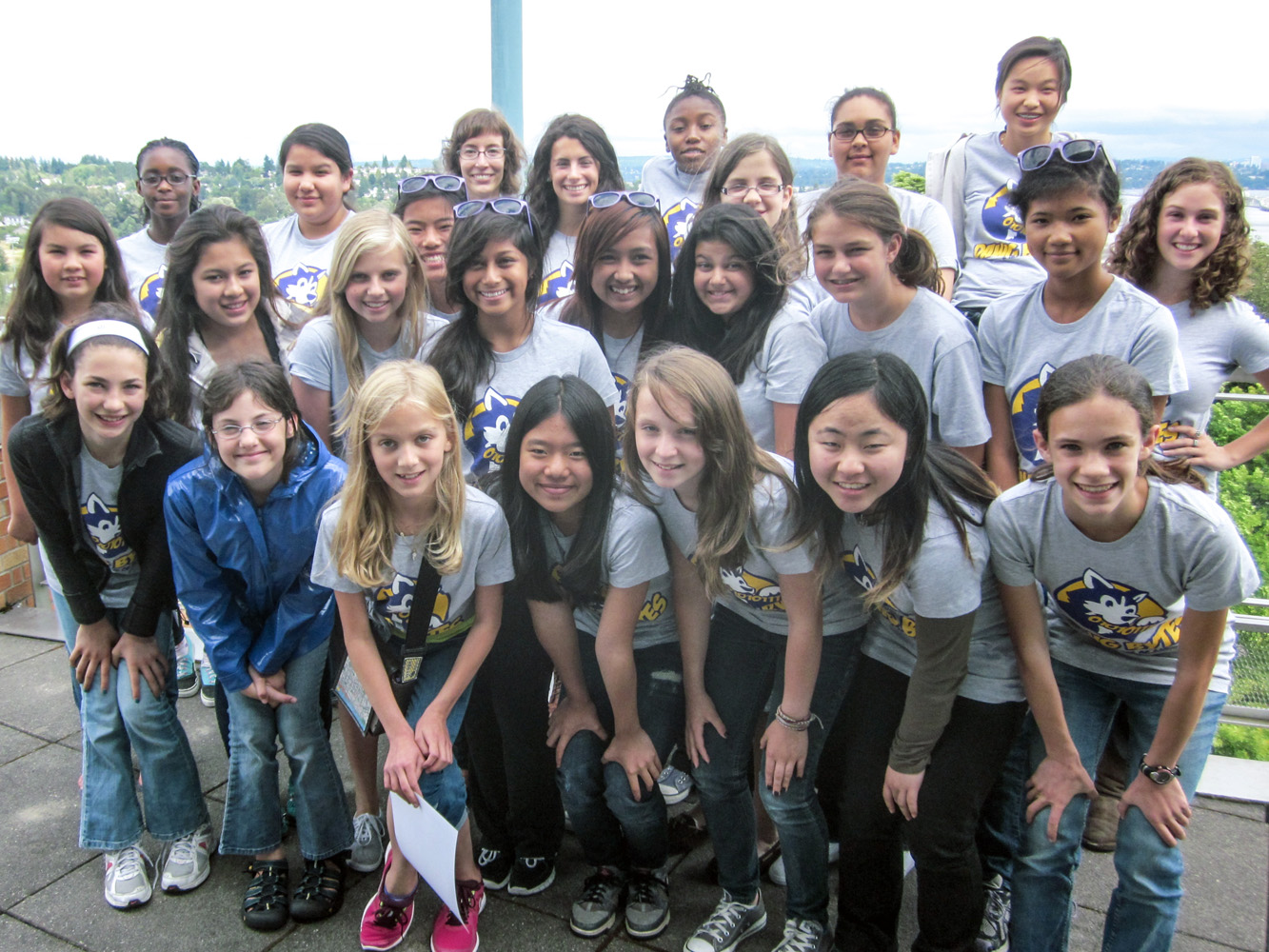
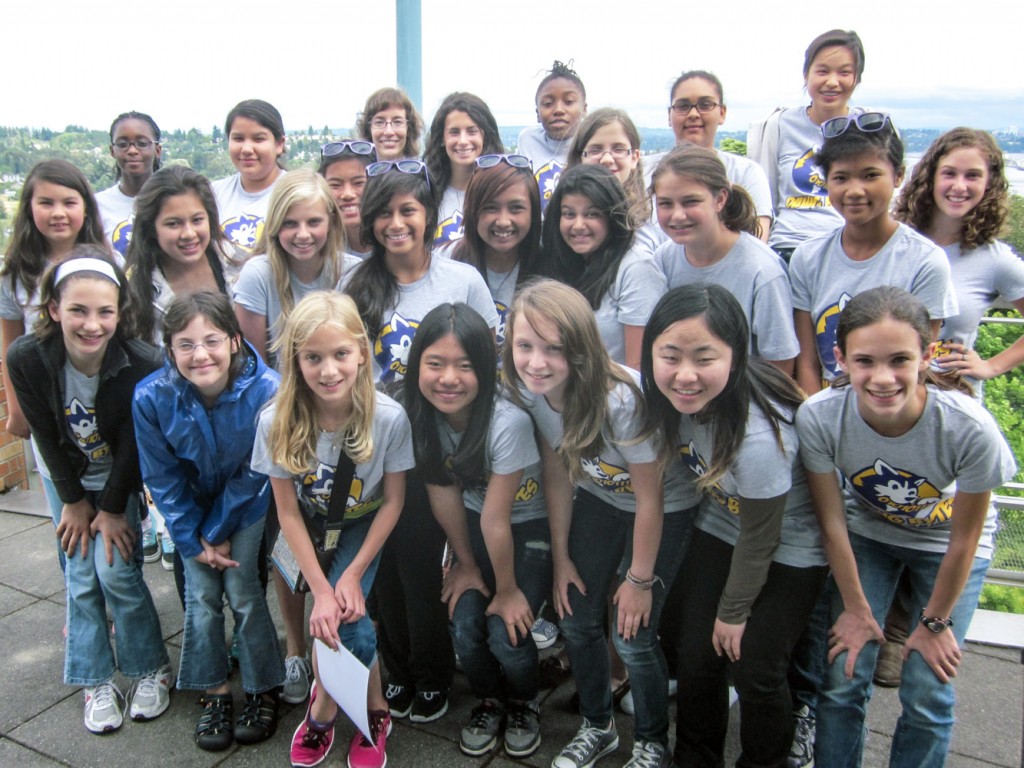
 Twenty-one 7th, 8th, and 9th grade girls from fourteen Seattle-area schools spent the past week at UW CSE’s daycamp for middle schoolers – our first of three daycamps this summer.
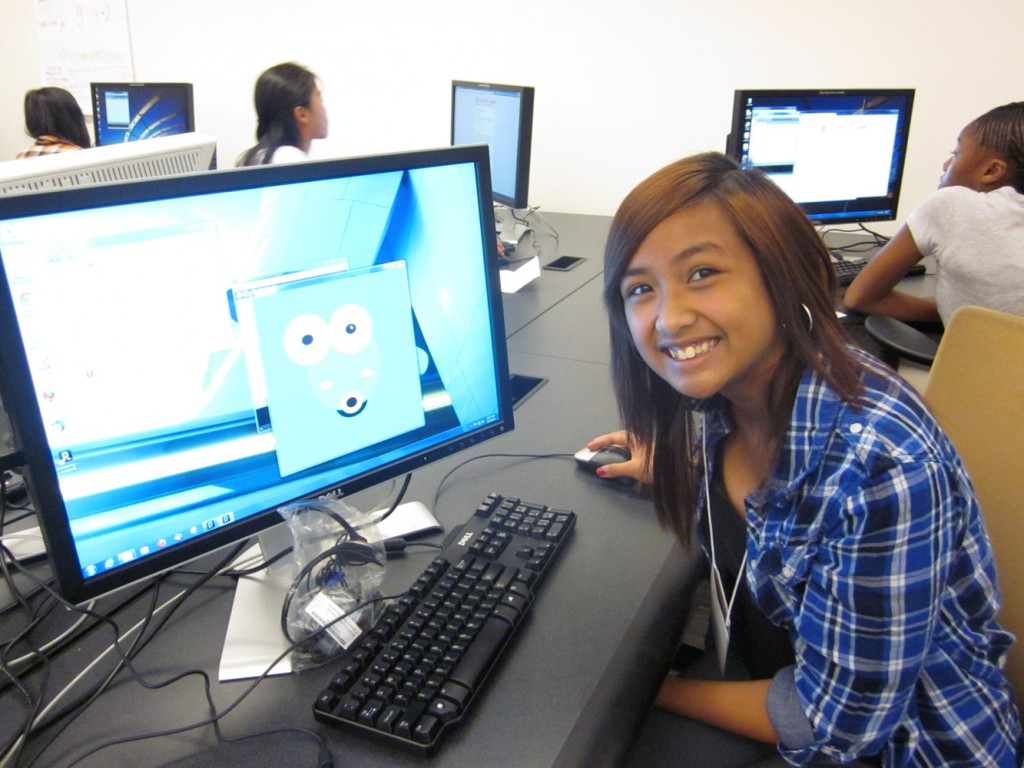
During the week, participants heard from members of the UW CSE community, discussed big ideas in computer science, and completed projects in Processing, a Java-based programming environment for artists and designers. The first project was to design a face made of basic geometric shapes and then animate it based on ambient noise. For example, many students made their faces’ mouths grow as the volume increased so that the faces looked like they were singing along to songs or talking back to them as they talked. Other projects included a paint program with creative custom brushes and image manipulation filters – programs put on Android phones.
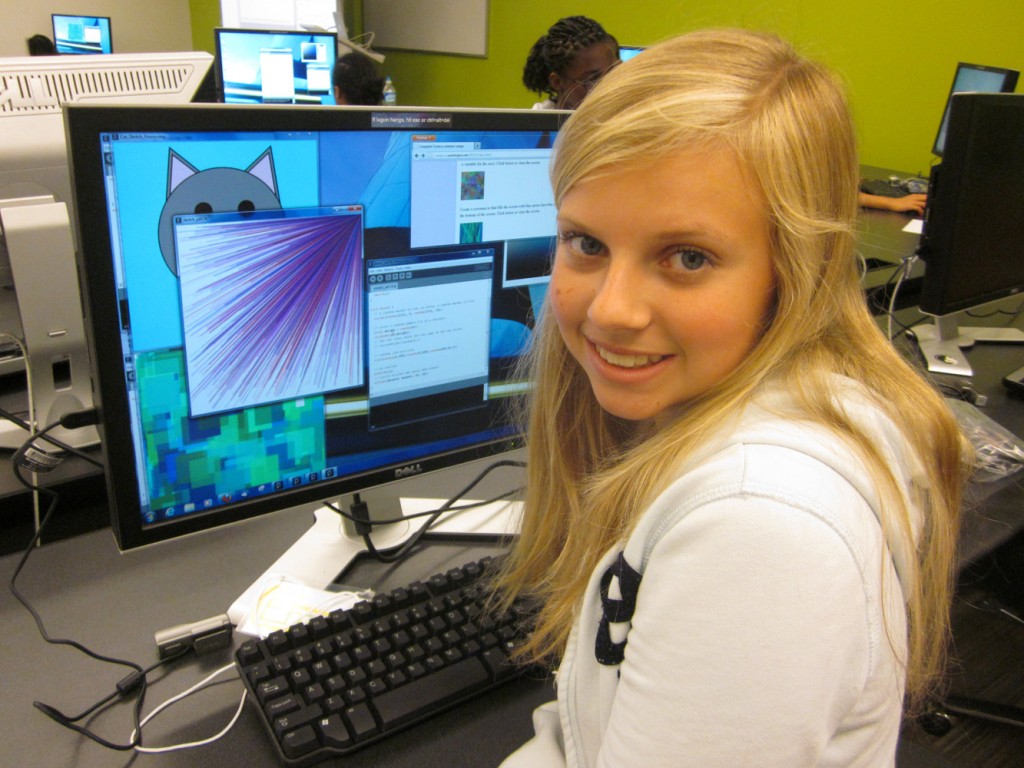 Parents joined the girls for a demo day on Friday. The place was vibrating!
Congratulations to the girls for all they achieved, and thanks to CSE faculty member Helene Martin, who is masterminding the daycamps, and to Garfield High School alums Quynh Huynh (soon to be a sophomore at UW), Sierra Kaplan-Nelson (soon to be a freshman at Stanford), and Jane Singer (soon to be a sophomore at Emory) who are serving as counselors at the camps.
More information about what the students learned last week can be found here. Information on CSE’s overall middle school and high school summer daycamp program here. Overview of DawgBytes, CSE’s broad K-12 outreach program, here.
 Read more →
 In what CNN calls “the Oscars for hard-core computer hackers,” UW CSE has been officially nominated in two categories for the upcoming 6th annual Pwnie Awards!
Most Innovative Research: Comprehensive Experimental Analyses of Automotive Attack Surfaces
“Many hackers have been complaining about the extinction of unmitigated vanilla stack buffer overflows. It turns out that they are not extinct at all, they have all just migrated to YOUR CAR. Stephen Checkoway and the rest of his team identified and exploited these vulnerabilities through a burned CD, paired BlueTooth device, unpaired BlueTooth device, and through a phone call to the car’s internal GSM cell phone. Yes, they can call up your car and install malware on it, which they actually implemented (how non-Academic of them). The future is a very scary place. Luckily, the majority of the Pwnie Award judges don’t drive. Or use computers. Or phones.”
Best Song: The UW CSE Band for “Click Me”
The UW CSE Band has the unique distinction of being the first Best Song nominee that is sung (not rapped) by someone who can actually sing on key. This song, a cover of The Cranberries’ ‘Zombie,’ gives us flashbacks to the mid-90’s when server-side remotes and raver pants were plentiful.”
Winners will be announced at the awards ceremony this Wednesday at the Black Hat conference in Las Vegas. Read more →
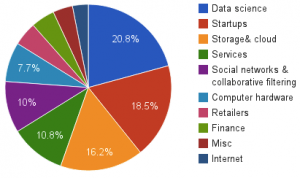 Carlos Guestrin, soon to join UW CSE from Carnegie Mellon, recently hosted the First GraphLab Workshop on Large-scale Machine Learning. A Computing Community Consortium blog post describes the landmark event:
“The scale and complexity of data on the web continues to grow at a tremendous rate. A recent New York Times article compared Big Data to an economic asset for companies, like currency and gold. But, in order to extract value from 6 billion Flickr images, 900 million Facebook users, 24 million Wikipedia articles, or the 72 hours of video uploaded to YouTube per minute, we need machine learning techniques that can scale to these huge datasets. The First GraphLab Workshop on Large-scale Machine Learning, held in San Francisco on July 9th, sought to bring together folks from industry and academia to explore the state of the art on this fundamental challenge.”
Read the CCC blog post here. Learn about the workshop here. Learn about GraphLab here. Read more →
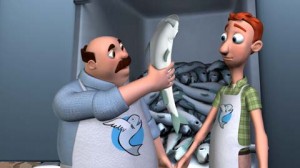 “Catch and Release,” UW CSE’s 2011 animation capstone film, has been selected for screening at th DC Shorts Film Festivals, the largest short film event on the East Coast. Catch and Release will be screened in the Family Friendly Showcase on September 8th and again on September 15th. More information may be viewed here.
“Catch and Release” and “Nebbish,” the 2010 animation capstone film, will be screened at Bumbershoot’s 1 Reel Film Festival curated by SIFF (September 1-3, 2012). Schedule information for Bumbershoot here. “Catch and Release” is in Films4Family at 12 noon on Saturday, September 1. “Nebbish” is in Flashes of Funny at 2 pm on Saturday, September 1.
Congratulations to Barbara Mones and the entire “Catch and Release” and “Nebbish” crews!
See all of UW CSE’s animation productions here. Read more →
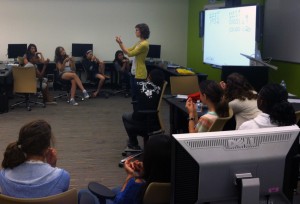
Helene Martin engages the throngs at UW CSE’s daycamp for middle school students
UW CSE, in collaboration with UW’s Women in Computer Science & Engineering and Society of Women Engineers organizations, is sponsoring three weeklong daycamps for middle school and high school students. The first is underway this week.
Learn more about the daycamps here. Learn about DawgBytes, UW CSE’s K-12 outreach program, here. Read more →
 The School Leadership 2.0 blog reports on an interview with Bill Gates and Vicki Philips (Bill & Melinda Gates Foundation) during a recent visit to Atlanta.
“Now the foundation is working with the Center for Game Science at the University of Washington on a free, online game called Refraction. As students play, their progress is visible to the teacher on his or her computer, allowing the educator to see instantly what concepts students understand.
“The idea is that in coming years, there could be a digital mall full of low-cost or free online games teachers could download to use with the entire class or individual students.
“‘Part of what we’re trying to do is make more robust the array of things teachers have access to at their fingertips that are aligned to standards, that are high quality, that engage kids though technology and let [teachers] be the orchestra leader,’ Phillips said.
“It’s early in the development phase, and the foundation is still trying to figure out how to do this game-based technology well, Gates said.
“The foundation will play a role in researching and developing this new technology, work that isn’t likely to be done at the federal or state level.
“‘It’s definitely going to make a contribution,’ Gates said. ‘Motivation is such a huge part in what ends up differentiating student outcomes. Everyone has the ability to do fantastic work at a high school level. It’s just without the right teacher and the right motivation you don’t always get there.'”
Read more here. Learn about UW’s Center for Game Science here. Read more →
 The San Francisco Chronicle picks up Nick Wingfield’s New York Times profile of UW Computer Science & Engineering:
“Some budding entrepreneurs and computer whizzes based in the Pacific Northwest are starting to turn heads down in Silicon Valley …
“Although Stanford is considered the Hogwarts of techdom, UW has quietly established itself as the other West Coast nexus of the information economy. And while Seattle-area tech icons like Microsoft and Amazon have long relied on UW – pronounced “U-dub” by locals – as an incubator of talent and ideas, the Valley’s hottest companies have been getting the message, too.
“Their executives have begun streaming up the coast to Seattle, fueled by a talent arms race for programmers. Facebook, Zynga and Google have opened offices in the area, trying to woo UW engineers who’d rather live here …”
Read the article here. “What?!?! No photographs?!?!” Read it with photographs here. See more photographs here. Read more →
 Decide.com, a Seattle startup created by UW CSE professor Oren Etzioni and four students, is featured in today’s New York Times:
“If you are thinking about buying a new laptop, stop thinking and do it. At least that’s what the algorithms at Decide.com say to do.
“Decide.com is a Web site created by artificial intelligence experts that tracks millions of price changes on consumer electronics and appliances and uses algorithms to to predict when buyers are most likely to get a deal. The site claims 77 percent accuracy since its inception in June 2011.”
Read the rest here. Read more →
 “Imagine if kids poured their time and passion into a video game that taught them math concepts while they barely noticed because it was so enjoyable. We’ve been supporting the Center for Game Science at the University of Washington, which has developed a free, on-line game called Refraction. The goal of the game is to rescue animals whose ships are stuck in outer space. The ships require different amounts of fuel, powered by lasers. So the players have to manipulate fractions to split the lasers into the right amount of fuel.
“As the kids play the game, the teachers watch a dashboard on their computer that tells them how each student is doing, so they know instantly if the student is getting it or not. Teachers no longer have to wait for the unit test to find out if their kids understand the material.
“Teachers have not had these tools before.”
Read Gates’s speech in the Atlanta Journal-Constitution here. Learn about UW CSE’s Center for Game Science here. Play Refraction here. Read more →
 “For decades, Silicon Valley has provided Oregonians a powerful demonstration of the impact of higher education muscle on high-tech economic outcomes …
“Now, Oregon is seeing another massive expansion much closer.
“As The New York Times reported Sunday, the University of Washington computer science and engineering program – with substantial assistance from corporations such as Microsoft and Amazon and individuals such as Bill Gates and Paul Allen – has become the seventh-ranked graduate program in the country …
“Recently, the program scooped up hot new faculty members from Carnegie Mellon, Penn and Stanford – with the aid of professorships newly endowed by Amazon.
“And the state, which had been battering the university in the past few years of budget crisis, left the UW budget intact this round – on condition that the university increase the engineering program’s budget by $3.8 million.”
Read the rest of this editorial here. Read more →

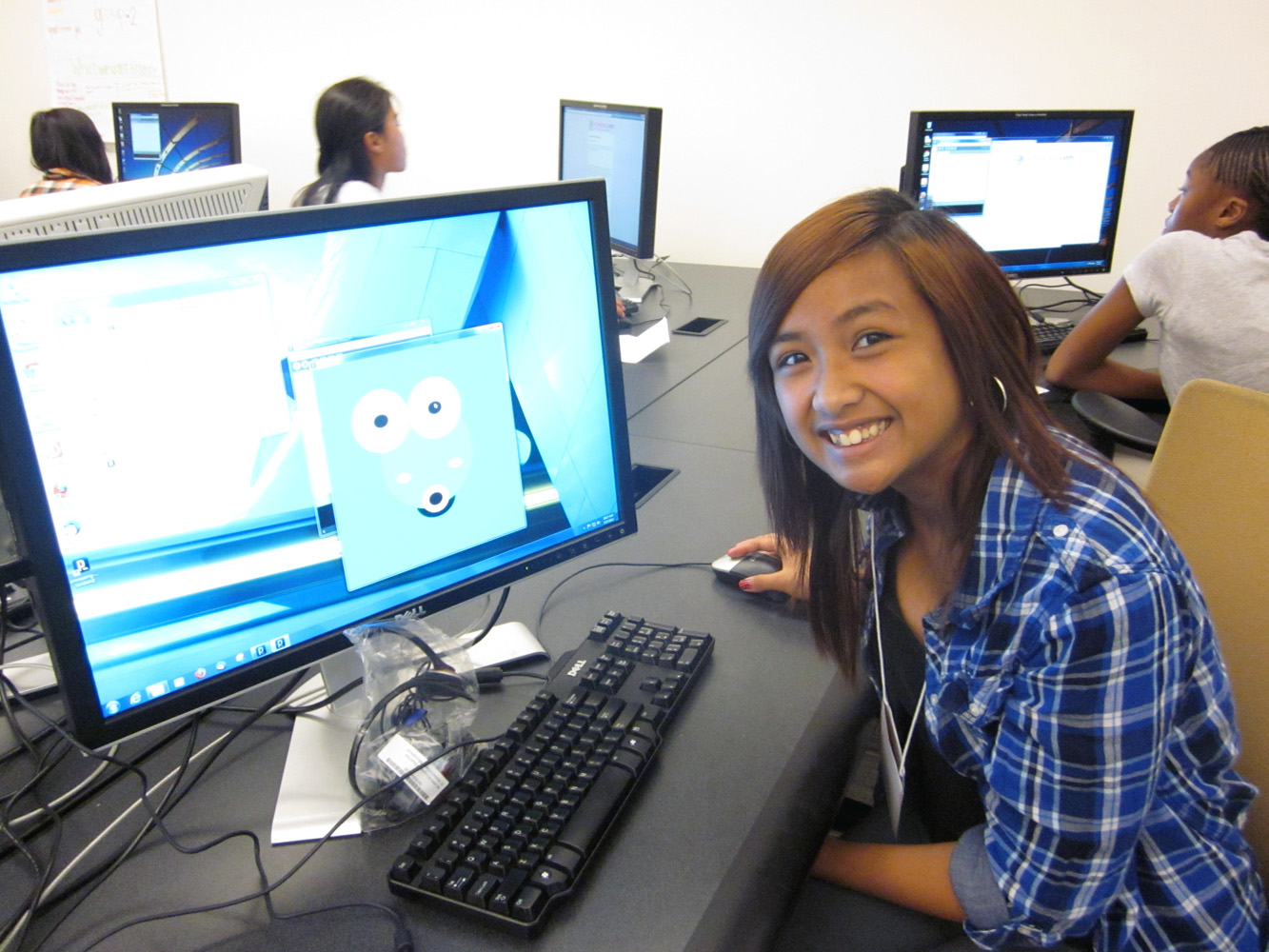 Twenty-one 7th, 8th, and 9th grade girls from fourteen Seattle-area schools spent the past week at UW CSE’s daycamp for middle schoolers – our first of three daycamps this summer.
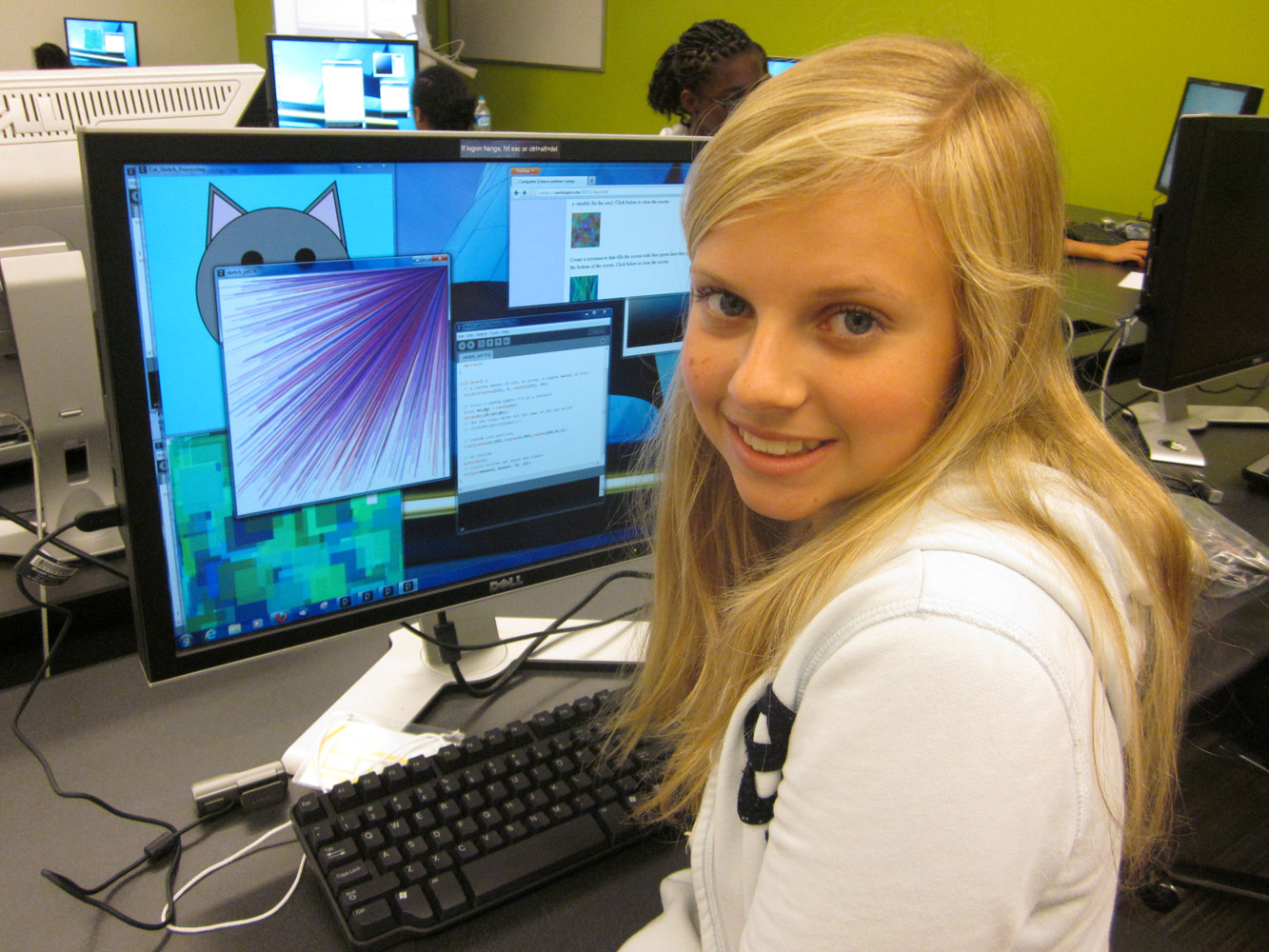 Parents joined the girls for a demo day on Friday. The place was vibrating!