UW CSE “DawgBytes” summer day camp for high school girls, Session 2

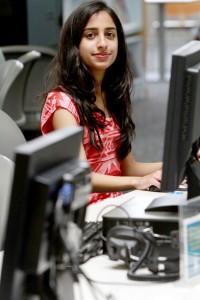
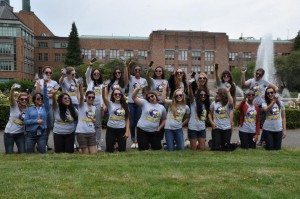
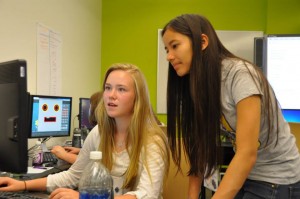
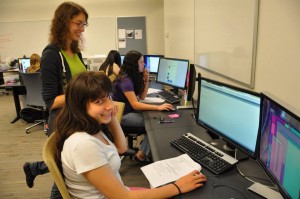
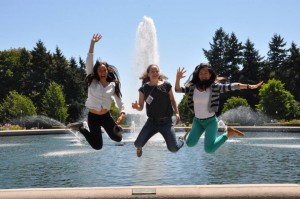
hsgirls1 hsgirls2 hsgirls3 hsgirls4July 8-12 marked the second session of this summer’s UW CSE summer day camps for high school girls.  A fantastic group of 21 students joined us for a week of computing fun!  Many thanks to Google for donating Android phones for project work.

This was the second of eight UW CSE summer day camps.  In addition to two week-long day camps for high school girls, we are hosting two week-long day camps for middle school girls.  In addition, there are three co-ed day camps focused on building apps for Android phones – 3-day and 5-day camps for middle school students, and a 3-day camp for high school students.  Finally, there will be a 4-day co-ed day camp for high school students focused on physical computing.  Plus, there is CS4HS, a 3-day workshop for middle school and high school math and science teachers.

Learn more about our summer day camp program here.

Learn more about DawgBytes, UW CSE’s outreach program, here.  And follow the action as it happens on the DawgBytes Facebook page here.

Three cheers for UW CSE faculty member Hélène Martin, who leads our K-12 outreach efforts!
Read more →

CSE’s Sam Hopkins: “A Triple Threat in Math, Philosophy, and Computing”

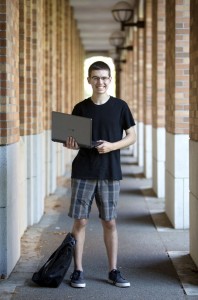
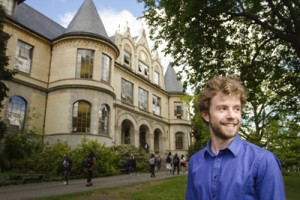
Undergrad student and Dean's Medalist Samuel Hopkins outside DenCSE senior Sam Hopkins is the recipient of the 2013 UW Arts & Sciences Dean’s Medal for the Natural Sciences, awarded to the top graduating student in the Natural Sciences division of UW’s College of Arts & Sciences.  Sam – the son of long-time UW Chemistry chair Paul Hopkins – entered UW at age 15 through the Early Entrance Program, and will head to Ithaca in the fall as a computer science graduate student at Cornell.  Sam is the 11th CSE student since the year 2000 to receive a Dean’s Medal in Arts & Sciences or Engineering – an extraordinary record by CSE’s extraordinary students.

There’s a lovely profile of Sam in this month’s Arts & Sciences newsletter, Perspectives, here. Read more →

“Al Qaeda Behind The Wheel”

foxUW CSE professor (and UCSD Ph.D. alum) Yoshi Kohno, UCSD professor (and UW CSE Ph.D. alum) Stefan Savage, and their students spent two years exploring the security vulnerabilities of modern automobiles and working with vehicle manufacturers and Federal regulatory agencies to address them.

It took Fox News only 4 minutes and 34 seconds to sensationalize it beyond recognition.

Sigh … watch the result here.  Better, read about the research here. Read more →

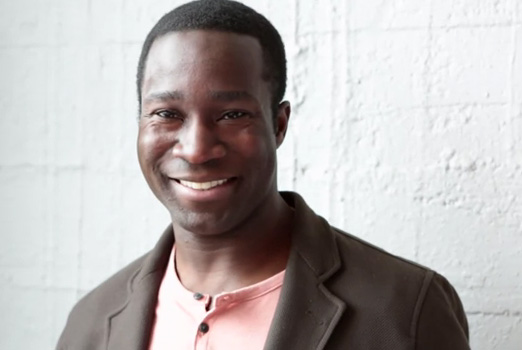
CSE’s Yaw Anokwa, Nafundi, Open Data Kit in Nordstrom ad!

YawYou can’t make up stuff that’s this unlikely!

Recent Ph.D. alum Yaw Anokwa, co-developer of the widely-used Open Data Kit platform for data collection via mobile phones, and co-founder of the Seattle startup Nafundi focused on applications for challenging environments such as the developing world, is featured in an advertisement for Nordstrom’s new “Citizens of Humanity” jeans.

Watch the video!  It provides a superb overview of Yaw’s work.  (And he cleans up really well – good news in light of his July 27 wedding to UW CSE lecturer and K-12 outreach coordinator Hélène Martin.)

Says Yaw:  “Turns out a Ph.D. in computer science can be used to launch a modeling career …” Read more →

Seattle Times features UW CSE alum A.J. Brush in Faculty Summit summary

LoT-hero-redBMonday and Tuesday marked the 14th annual Microsoft Research Faculty Summit.

The Seattle Times devoted much of its coverage to the “Lab of Things” platform created and demonstrated by UW CSE Ph.D. alum A.J. Brush:

“Lab of Things is a platform for research that uses connected devices in the home, allowing researchers who need to collect data from homes for their studies to more easily manage and collect and analyze data.

“Researchers, such as those working in health care or computer interaction, often conduct studies of people in their homes.

“But one of the most limiting factors is how often they are allowed into their subjects home — if, for instance, they must go every time sensor software needs updating, said Arjmand Samuel of Microsoft Research in Redmond.

“Lab of Things should make it easier for researchers to deploy studies in homes. All it requires is a wireless network, and for the researcher to bring in a home hub — a laptop or even a netbook running Windows 7 or 8 — that can talk to the sensors set up in the home.

“When a sensor detects an activity, for example, it can send an email to the researcher. Software updates can be deployed over the air without going into people’s homes.

“All the data collected goes into a cloud owned by the researcher, allowing her to analyze it more easily, said A.J. Brush of Microsoft Research in Redmond.

“Researchers also are able to see what is happening on their mobile devices.

“The beta version of Lab of Things is available for download, and some researchers are already using it, Brush said.”

Read the article here.  Learn about Lab of Things here.

(Ratul Mahajan, who architected the platform and co-leads the project, is also a UW CSE Ph.D. alum.) Read more →

FuSE 2013 (Foundations of Software Engineering) honors David Notkin

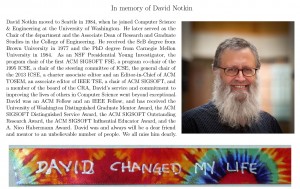
Pages from FuSEProgramWednesday’s Future of Software Engineering symposium – FuSE 2013, held in Redmond WA following the Microsoft Research Faculty Summit – has been dedicated to UW CSE professor David Notkin, who passed away in April.  See the program here.  Watch videos here.  Learn more about David here. Read more →

Ed Lazowska and Tom Daniel compete at WrestleBrania

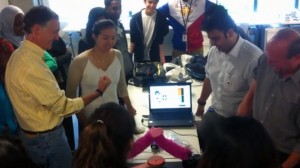
Tom.EdIn WrestleBrania, a sensor on your forearm measures electrical stimuli, driving an electromechanical arm wrestling robot (covered in pink fur).

The fact that this video is on the CSE News page rather than Tom’s Biology News page gives you a hint at the outcome …

Thanks to UW’s Center for Sensorimotor Neural Engineering, which developed WrestleBrania and was demonstrating it for K-12 students (and the occasional faculty passers-by …).

Watch the video here. Read more →

David Notkin’s daughter Emma and son Akiva accept the CRA Habermann Award

ACM_Awards_2013-8976

Akiva, Emma, and CRA’s Andy Bernat

ACM_Awards_2013-8984

Emma offers remarks on behalf of the family

ACM_Awards_2013-8159

Akiva and Emma

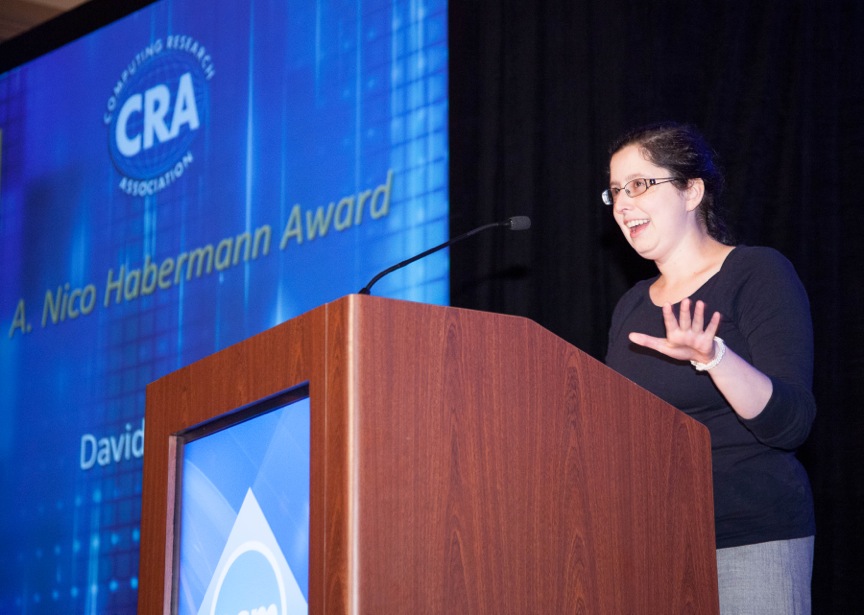
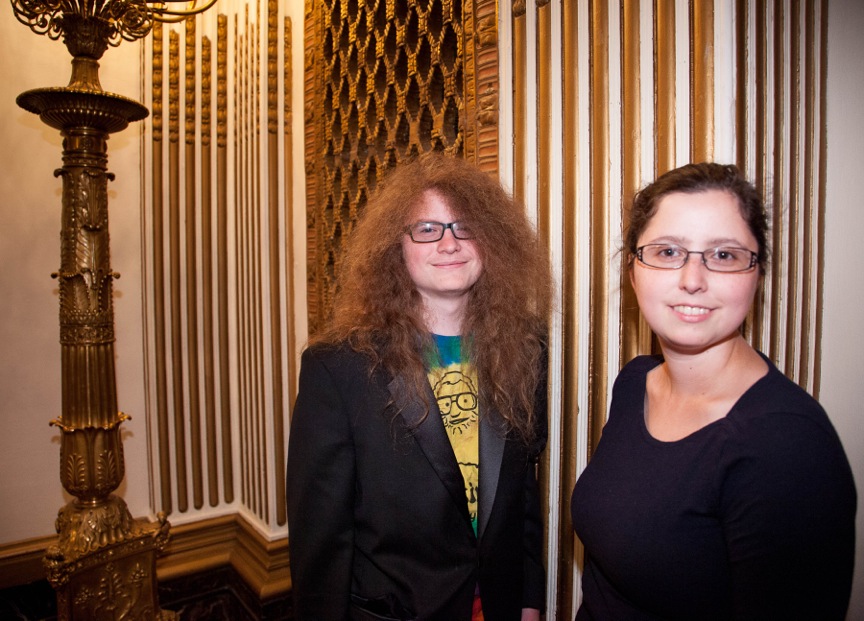
At the ACM Awards Banquet last month, David Notkin’s daughter Emma and son Akiva accepted the Computing Research Association’s A. Nico Habermann Award on David’s behalf.  We just received these photographs from Andy Bernat at CRA.  Thanks once again to ACM and CRA for recognizing David’s tireless efforts to broaden participation in our field.

ACM and CRA’s video tribute to David is here; Habermann Award citation here. Read more →

Ambient Backscatter Communication: Wireless Communication Out Of Thin Air

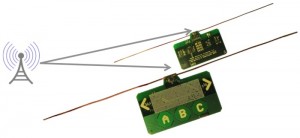
abcAs computing devices become smaller and more numerous, powering them becomes more difficult; wires are often not feasible, and batteries add weight, bulk, cost, and require recharging/replacement that is impractical at large scales. Devices that use ambient backscatter communication solve this problem by leveraging existing TV and cellular transmissions, rather than generating their own radio waves. This novel technique enables ubiquitous communication where devices can communicate among themselves at unprecedented scales and in locations that were previously inaccessible.

The work – by UW CSE’s Vincent Liu, Aaron Parks, Vamsi Talla, Shyam Gollakota, David Wetherall, and Josh Smith – was featured by ExtremeTech.

Read the ExtremeTech article here.  Read the SIGCOMM paper here.  See the project web page here.

Go team! Read more →

Seattle Times: State’s students flocking to computer science programs

Michaela

Michaela Monstream, Holy Names Academy

Payton

Payton Quinn, Seattle Prep

The Seattle Times profiles three entering UW CSE freshmen:

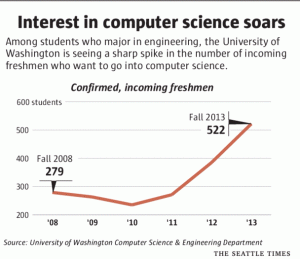
“The number of incoming freshmen who listed computer science as their desired major has more than doubled in just three years at the University of Washington, which has one of the nation’s top computer science schools …

“At the UW, where hundreds of students are turned away from the computer science program every year for a lack of space, the money ‘still won’t meet the demand,’ Lazowska said by email. ‘But every journey begins with a few steps, and these are important steps’ …

“Lazowska said he thinks students are realizing that ‘Computer science has ‘change the world’ potential like no other field’ …

Nirupama

Nirupama Suneel, Skyline High School

Chart“Students are also seeing that both computer science and ‘computational thinking,’ a problem-solving method that uses computer science techniques, is valuable in many fields, Lazowska said. Many of UW’s computer-science grads go on to study such fields as biology, law, medicine and bioengineering, he said.

“And of course, the degree can lead to a good job.”

Read the article here.

Learn more about the field, and about UW CSE, here. Read more →

« Newer PostsOlder Posts »