Spring 2013 “most significant bits” – UW CSE’s alumni newsletter

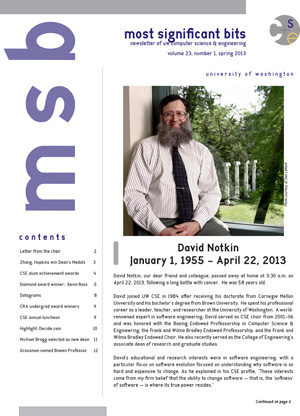
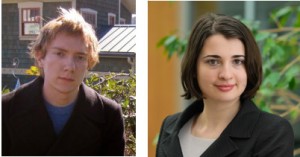
msb23With two days to spare, the Spring 2013 issue of msb has hit the newsstands!  This issue pays tribute to David Notkin, celebrates CSE’s two newest winners of UW Dean’s Medals (Raymond Zhang and Sam Hopkins) and their 13 predecessors, honors Anne Dinning ’84 B.S. and Ed Felten ’93 Ph.D. as the recipients of our 2013 Alumni Achievement Awards, recognizes Kevin Ross ’88 B.S. for winning the 2013 College of Engineering Diamond Award for Public Service for his contributions to Washington’s FIRST Robotics effort, interviews the founders of Decide.com, welcomes new Dean of Engineering Mike Bragg, cheers Dan Grossman as the newly-named College of Engineering J. Ray Bowen Professor for Innovation in Engineering Education, and all sorts of other great stuff!

Read it here!

msb archives here. Read more →

Washington State Algebra Challenge: Early Summary

Here’s a preliminary summary of the Washington State Algebra Challenge, co-sponsored by UW’s Center for Game Science and the Technology Alliance:
logoACTop-level summary

4,192 K-12 students from across Washington participated in the Washington State Algebra Challenge during the first week of June, using an adaptive version of the game DragonBox.  Together, Washington’s students solved over 390,000 equations in a 5 day period!  The total amount of algebra work time during the week was 7 months 11 days and 13 hours!

School participation

80 individuals schools or out-of-school programs participated:

  • 70 public schools
  • 4 independent schools
  •  1 after-school program
  •  10 home school or home school organization.
Percent MasteryOverall equations solved per student in the Challenge

Algebra Challenge participants solved an average of 93.21 equations (regardless of achieving Mastery), with four students solving more than 1000 equations each.

Achieving Mastery in the game

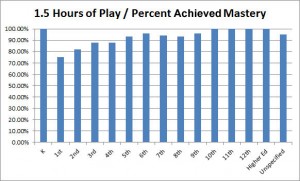
Of those students who played at least 1.5 hours, 92.9% achieved Mastery.  Of those students who played at least 1 hour, 83.8% achieved Mastery.  Of those who played at least 45 minutes, 73.4% achieved Mastery.
Levels to MasteryLevels played to achieve Mastery in the game

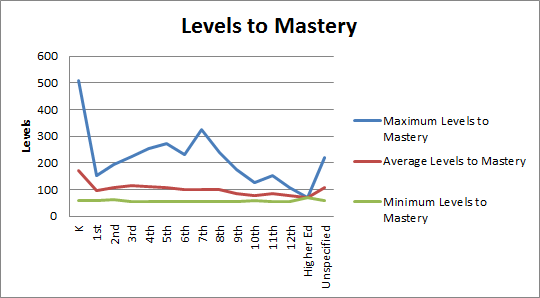
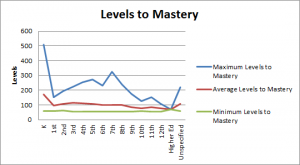
This analysis shows the effectiveness of adaptation – adapting the game to the individual student’s performance – on the overall mastery rate.  Almost everyone required some form of adaptation/remediation (as measured by extra levels from the basic progression), while some 7th graders in extreme cases needed up to 5 times more levels than the basic 60 level progression.  Kindergardeners needed almost 10 times more levels, but as we know from our other studies, young kids are extremely persistent.

Of those students who achieved Mastery, it took students on average 101.87 levels to achieve Mastery in the game.  While it took some students fewer levels to achieve Mastery, it took one persistent student 507 levels before achieving Mastery, which highlights the game’s ability to adapt to each student’s learning needs and support each student to achieve Mastery. For specific grade level averages and range (minimums and maximums) see chart below.
Effort to MasteryTime required to achieve Mastery in the game

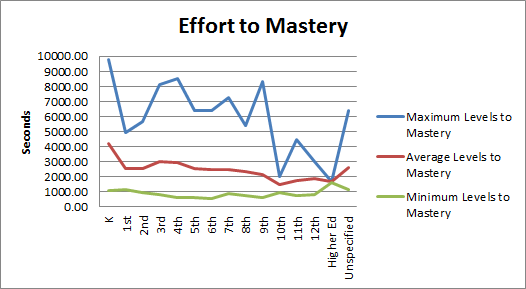
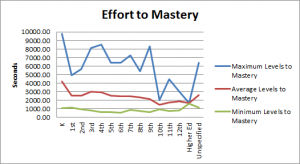
Of those students who acheived Mastery, it took students on average 41 minutes 44 seconds to achieve Mastery. However it is important to note that it took some students less time, while it took one very persistent student 2 hours 43 minutes and 10 seconds to achieve Mastery. Read more →

UW CSE startup Decide.com – incredible reviews in WSJ, ATD

decide“After more than a decade of online shopping, it’s still difficult to comparison shop without doing a lot of detective work. People read consumer-product reviews, troll the Web for prices, ask friends for input and create spreadsheets compiling all of these factors.

“This week, I put my feet up and let an algorithm do the work for me by using Decide.com.

“This website has two main features that help it tell you whether or not you should buy something. First, it gives products a Decide Score out of 100 points based on user reviews, as well as expert reviews from sources like Consumer Reports. Second, it uses a price-predicting technology to tell you whether or not the price is likely to go up or down in the next two weeks, so you don’t have to go through the frustration of buying something only to see the price drop right after.

“Tuesday, Decide.com launched a new category of products that are particularly challenging to buy: Baby & Kids. This category is a significant addition to the site that triples its number of products. Decide.com now covers 135 categories and 2.9 million products. By the end of this year, the company plans to cover 100 million products in every major category found on Amazon.com.”

Read more:  All Things DigitalWall Street Journal. Read more →

CSE’s Adrian Sampson wins Google Global Ph.D. Fellowship

arGoogle has announced the 39 winners of their 2013 Global Ph.D. Fellowships:  2 from Australia, 4 from China, 13 from Europe, 5 from India, and 15 from the United States and Canada.  UW CSE’s Adrian Sampson is among the 15 winners from the United States and Canada.  UW CSE Ph.D. alumna Roxana Geambasu, now on the faculty at Columbia University, is highlighted in the Google press release as a previous winner of the award.

Congratulations to Adrian and Roxana! Read more →

Stefan Savage turns 44

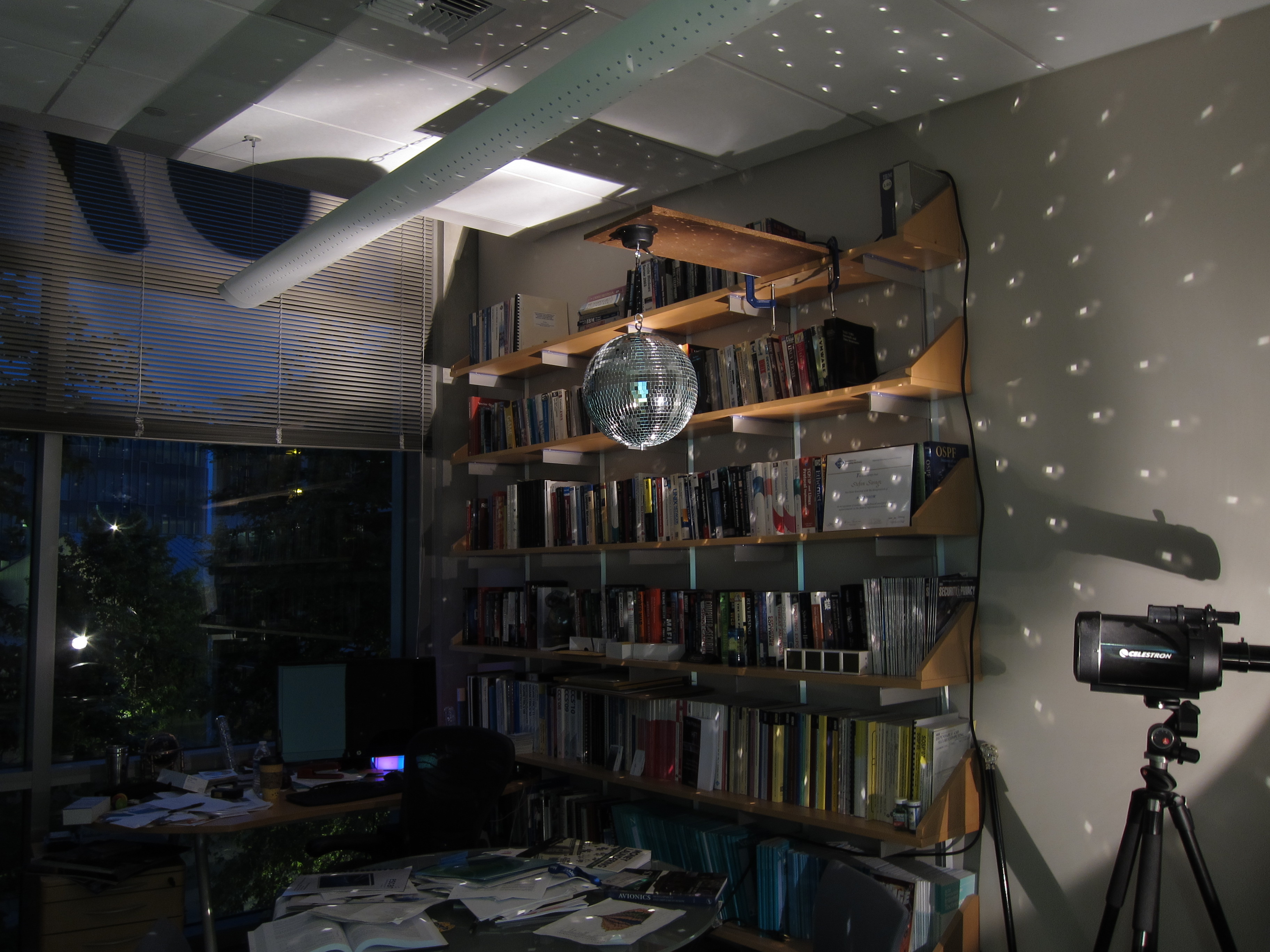
IMG_5156Even in binary it’s not a notable birthday, but if you put too many UW CSE Ph.D. alums in one place (UCSD CSE in this case), you get mayhem.  No faculty office is complete without a disco ball … Happy birthday Stefan!

(Also today:  CSE Ph.D. student Franzi Roesner turned 27, a perfect cube.  And CSE Ph.D. alum and postdoc Dan Halperin turned 29, a prime.  But no disco balls for them.  There’s no justice in this world.) Read more →

UW News: “New tasks become as simple as waving a hand with brain-computer interfaces”

BCI-brain-image-300x168“UW CSE’s Raj Rao and UW collaborators Jeff Ojemann, a professor of neurological surgery, and Jeremiah Wander, a doctoral student in bioengineering, published their results online June 10 in the Proceedings of the National Academy of Sciences.

“In this study, seven people with severe epilepsy were hospitalized for a monitoring procedure that tries to identify where in the brain seizures originate. Physicians cut through the scalp, drilled into the skull and placed a thin sheet of electrodes directly on top of the brain. While they were watching for seizure signals, the researchers also conducted this study.

“The patients were asked to move a mouse cursor on a computer screen by using only their thoughts to control the cursor’s movement. Electrodes on their brains picked up the signals directing the cursor to move, sending them to an amplifier and then a laptop to be analyzed. Within 40 milliseconds, the computer calculated the intentions transmitted through the signal and updated the movement of the cursor on the screen.

“Researchers found that when patients started the task, a lot of brain activity was centered in the prefrontal cortex, an area associated with learning a new skill. But after often as little as 10 minutes, frontal brain activity lessened, and the brain signals transitioned to patterns similar to those seen during more automatic actions.

“‘Now we have a brain marker that shows a patient has actually learned a task,’ Ojemann said. ‘Once the signal has turned off, you can assume the person has learned it.'”

Anyone who would like to have his or her skull drilled for science is invited to contact Rao via email.

Read more here. Read more →

Freshman demand for computer science – OFF THE CHARTS

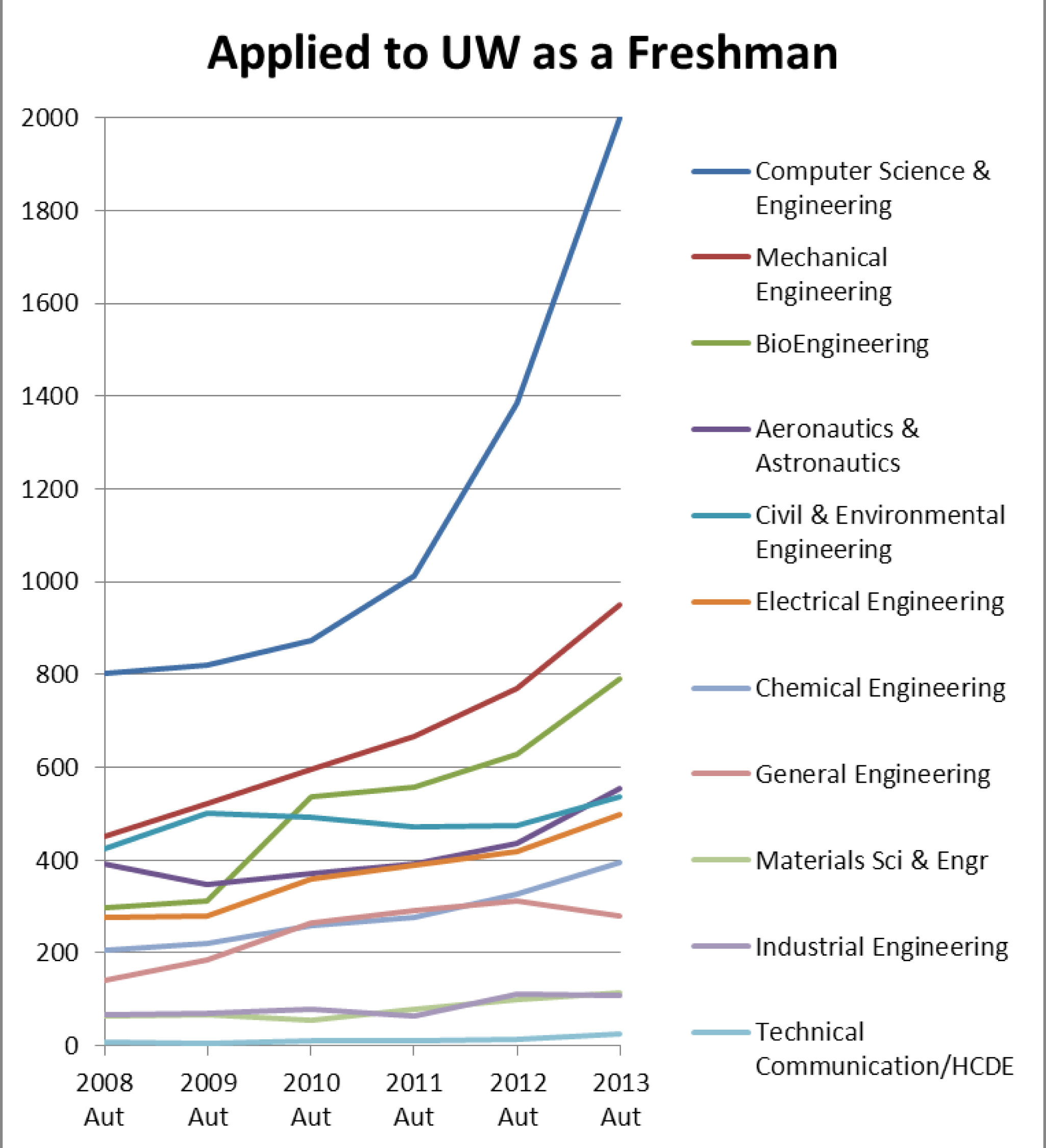
UW College of Engineering Freshman ApplicantsIt’s a national trend – demand for Computer Science is skyrocketing as students recognize that the field is chock full of intellectual challenges, has “change the world” potential like no other, and is central to pretty much any 21st century career.  Plus, there’s only so much creativity you can exercise with asphalt.

The graphic displayed here shows the desired major of freshman applicants to the various Engineering majors at the University of Washington for Fall 2013.  (We recognize that other premier Computer Science programs have even greater numbers of applicants, but still …)

Other graphics:  Intended major of freshman matriculants to the University of Washington College of Engineering for Fall 2013.  (Note that UW CSE’s capacity is only 200 new students per year – tragic.)  Annual enrollment in UW CSE’s two-quarter introductory sequence.

Our terribly constrained situation is not of our own design.  To UW and the citizens of the state, we say “Show me the money!”  Will UW CSE continue to be an engine of opportunity for Washington’s students? Read more →

“Hands down (and hands up), this is the coolest technology of the week”

screenshot-wiseeThe Washington Post praises UW CSE’s WiSee technology:

“Imagine standing in your kitchen preparing dinner, while the TV magically turns on in the living room, the dimmer lights flicker into action, a Netflix movie queues up for your viewing pleasure and the air conditioning adjusts just so. All of that, with just a wave of the hand, a swipe of your finger or a flick of the wrist.

“That’s the technological promise of new WiSee technology, a new gesture-recognition technology being developed at the University of Washington that is able to transform slight changes in the frequency of wireless signals into specific actions.

“What makes WiSee technology all the more extraordinary is that it essentially repurposes existing wireless signals within your home or business—there’s no need to purchase new cameras or sensors to make it work. Your wireless-enabled devices are already communicating with each other using a part of the wireless spectrum that’s unseen and unrecognized by humans. While we may take these wireless signals for granted, they are capable of penetrating through doors and walls (which is why your wireless router in the living room can power tablets or laptops elsewhere in your house or apartment). Any time you move a hand or arm or leg, you are ever-so-slightly changing the frequency of those wireless signals – a phenomenon that the University of Washington researchers refer to as a Doppler frequency shift.”

Read more here. Read more →

Computer Science is Sunday’s “Cool Jobs” panel at the Seattle Science Festival

2013 Seattle Science Festival logoThe 2013 Seattle Science Festival is the region’s only large-scale, community-wide celebration of science and technology.  It brings hands-on exhibits, shows, demonstrations and performances to venues throughout the Pacific Northwest. All events provide experiences that educate, engage and inspire an interest in science and technology and stimulate imagination and innovation.  The festival runs June 6-16, 2013.

SSF features a “cool jobs”‘ series where attendees can learn, first-hand, from successful and dynamic professionals in some of the most promising fields in science and technology. CSE’s Oren Etzioni, Yoshi Kohno, and Hélène Martin will join Code.org’s Hadi Partovi in a panel that highlights the opportunities in computer science:  this Sunday, June 9th, from 7:00 – 9:00 pm, at the Seattle Public Library – Central Library in the Microsoft Auditorium. (The event is free, but registration is required – seattlesciencefestival@pacsci.org.)

Info here. Read more →

UC San Diego CSE lands game-changing $18.5 million alumni gift

ucsdThe largest gift ever made to UC San Diego by one of its alumni was received today by UCSD Computer Science & Engineering.  The gift – from an alum who wishes to remain anonymous – will fund new faculty endowed chairs, top-of-the-line teaching labs, support for graduate students, expanded mentoring and tutoring programs for the next generation of undergraduates, and a more diverse offering of project-based courses.

The UCSD CSE faculty is chock full of UW CSE Ph.D. alumni, including Bill Griswold, Sorin Lerner, Stefan Savage, Steve Swanson, Dean Tullsen, Amin Vahdat (we claim half-credit for Amin, with Berkeley), and Geoff Voelker.  They have returned the favor by sending to our faculty Yoshi Kohno and – soon to arrive – Zach Tatlock.  Undergraduates from both schools populate the graduate program at the other.

Congratulations to our friends in UCSD CSE!  Read more here. Read more →

« Newer PostsOlder Posts »