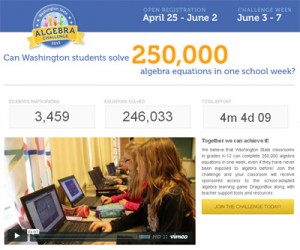
 Can Washington students solve 250,000 algebra equations in one school week? That’s the Washington State Algebra Challenge, a partnership between UW’s Center for Game Science and the Technology Alliance. And with three days down and two days to go, we’re almost there: 3,459 participating students have solved 246,033 equations – and counting!
Follow the action here. Read more →
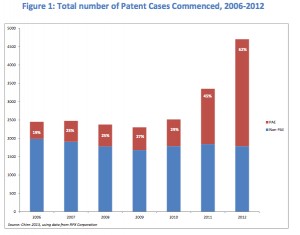 A scary graphic from our friends at GeekWire. The blue segments are infringement lawsuits brought by companies actually practicing their patents. The red segments are infringement lawsuits brought by non-practicing entities – patent trolls. The National Economic Council and the Council of Economic Advisers released a detailed report accusing trolls of having “negative impact on innovation and economic growth.”
Read more here. Read more →
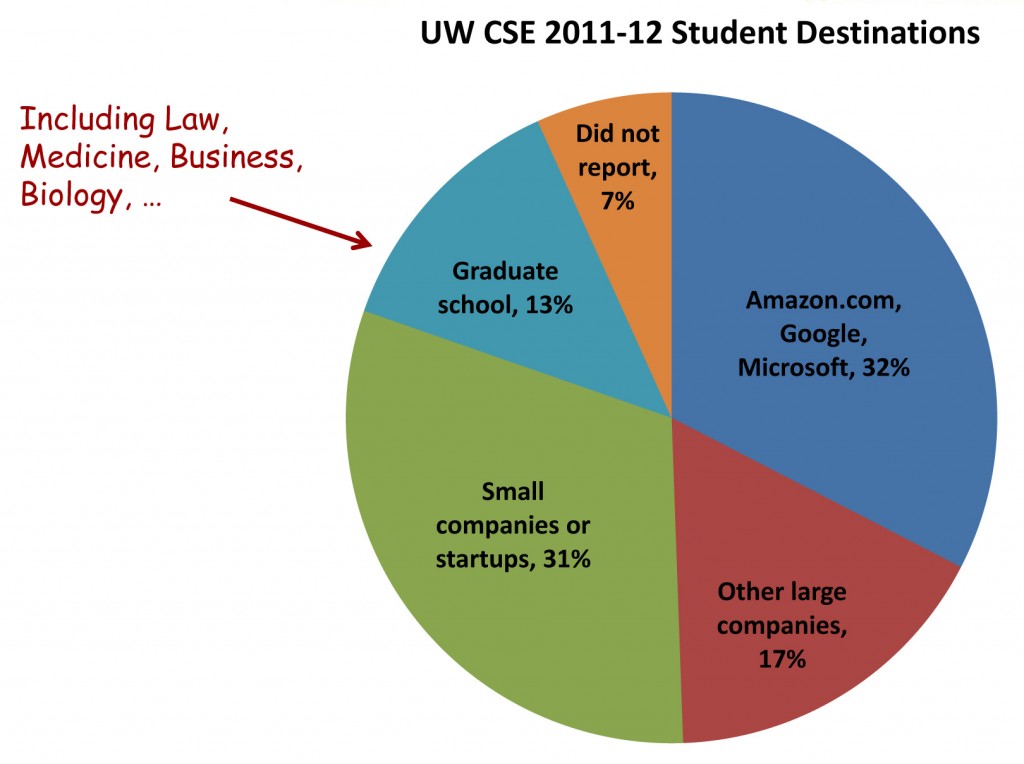 Presentation materials from sessions for high school counselors conducted by UW CSE’s Ed Lazowska and Hélène Martin. Includes information on the nature of the field, workforce demand, and UW CSE’s program.
Check it out here. Learn more about UW CSE’s undergraduate program here. Learn about DawgBytes, our K-12 outreach program, here. Read more →
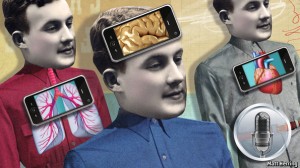 The Economist describes work by UW CSE researchers and collaborators that utilizes mobile phones and signal processing to create medical diagnostic instruments and other novel applications.
“Microphones exist in many shapes and sizes, and work in many different ways … These microphones all do the same thing: they convert sound waves into an electrical signal.
“It turns out, however, that with the addition of suitable software, microphones can detect more than mere audio signals. They can act as versatile sensors, capable of tuning into signals from inside the body, assessing the social environment and even tracking people’s posture and gestures. Researchers have reimagined microphones as multi-talented collectors of information. And because they are built into smartphones that can be taken anywhere, and can acquire new abilities simply by downloading an app, they are being put to a range of unusual and beneficial uses.”
Read the article here. Learn more about SpiroSmart (mobile phone spirometry) here. Learn more about SoundWave (gesture sensing) here. Read more →
 The work of UW CSE’s Qifan Pu, Sidhant Gupta, Shyam Gollakota, and Shwetak Patel is described in this UW News article:
“Forget to turn off the lights before leaving the apartment? No problem. Just raise your hand, finger-swipe the air, and your lights will power down. Want to change the song playing on your music system in the other room? Move your hand to the right and flip through the songs.
“University of Washington computer scientists have developed gesture-recognition technology that brings this a step closer to reality. Researchers have shown it’s possible to leverage Wi-Fi signals around us to detect specific movements without needing sensors on the human body or cameras.
“By using an adapted Wi-Fi router and a few wireless devices in the living room, users could control their electronics and household appliances from any room in the home with a simple gesture.”
Read more here. Learn more about the WiSee research here.
Slashdot noticed! And NBC News! And the LA Times! Also The Verge, The Register, Wired, BBC, GeekWire. Read more →
 “‘We are the ass end of the donkey in providing educational opportunity for our kids, despite this booming economy,’ said Ed Lazowska, who holds the Bill & Melinda Gates Chair in Computer Science & Engineering at UW. ‘It’s absolutely crazy.’
“Lazowska is on a crusade to let the public know that many of these great, yet-to-be-filled tech jobs are going to be taken by college graduates from other states – not from Washington. And that’s because the state isn’t educating its homegrown kids for these homegrown jobs.
“‘The vast majority of states in this country are doing better than we are at educating their kids, and then they are sending them here,’ he said.
“Indeed, per capita, Washington state is number one in the nation when it comes to ‘importing’ talent.”
Read more and watch the report here. Read more →
 Captricity – a service that quickly and easily turns paper information into structured, digital data – has closed a $4.5 million round of funding.
Captricity was co-founded by UW CSE bachelors alum Kuang Chen at the conclusion of his UC Berkeley Ph.D. studies. At UW, Kuang was a double major in CSE and Comparative History of Ideas. His undergraduate research led to the creation of the Seattle startup Teranode, where he worked for four years following graduation. At Berkeley, his research leading to Captricity was advised jointly by Joe Hellerstein and UW CSE Ph.D. alum Tapan Parikh. This research – on how data-centric approaches could help organizations better serve their disadvantaged clients – revealed that one of the biggest barriers to efficient operations was getting data from paper into digital form, the problem that Captricity solves.
Read the full article in Venture Beat here. Read more →
 You find the craziest things in airport gift shops!
Today, for example, CSE chair Hank Levy ran across this bag featuring a December 2007 Business Week cover photograph of 2003 CSE alum Christophe Bisciglia – then a Senior Software Engineer at Google, subsequently co-founder of Cloudera, now co-founder and CEO of WibiData.
Reese Witherspoon … Katherine Heigl … Christophe Bisciglia … Oprah Winfrey … your photo goes here … Read more →
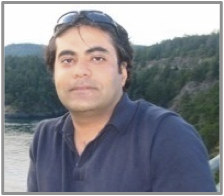 ColdTrace – research by Nexleaf Analytics and UW CSE Ph.D. student Rohit Chaudhri – has won this year’s Vodafone Wireless Innovation Competition.
ColdTrace is a low-cost wireless sensor designed to improve access to vaccines which protect thousands of children against diseases such as tuberculosis and polio. The sensor remotely monitors the temperature of vaccines. It also provides a better understanding of the vaccine cold storage, transportation and distribution infrastructures, particularly in areas where regular records are not maintained.
Nexleaf Analytics is a nonprofit technology company co-founded by UCLA Ph.D. alumna Nithya Ramanathan that provides lightweight sensor technologies for measuring the impact of critical public health and environmental interventions.
Watch a descriptive video here. Read more →
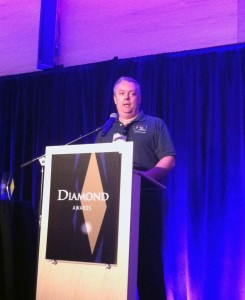 Kevin Ross, a 1988 UW CSE alum, accepted the UW College of Engineering Diamond Award for Public Service at last night’s annual awards banquet. Kevin, a former Microsoft design engineer, founded Washington FIRST Robotics in 2002. WFR today works with over 7,500 students and 2000 volunteers in Washington State and matches student groups with mentors to provide high quality experiences. Their goal is to have a FIRST robotics team available for every student in the state. Kevin and WFR are changing lives across our state — inspiring the engineers of the future.
Congratulations to Kevin! Learn about all of this year’s extraordinary Diamond Award honorees here. Read more →