 University of Wisconsin computer architecture faculty members Mark Hill and Guri Sohi maintain an informal “Hall of Fame” for the International Symposium on Computer Architecture – researchers who have co-authored 8 or more ISCA papers. (UW CSE is tied with Stanford, the University of Illinois, the University of Michigan, and the University of Wisconsin with 5 faculty members on the list.)
Not to be outdone, University of Wisconsin computer systems faculty member Remzi Arpaci-Dusseau has compiled an analogous informal “Hall of Fame” for the two top computer systems conferences: the ACM Symposium on Operating Systems Principles and the USENIX Symposium on Operating Systems Design and Implementation. This one includes researchers who have co-authored 6 or more papers in SOSP and/or OSDI.
UW ranks third behind MIT and Stanford, with 4 faculty members on the list. UW CSE chair Hank Levy is the #2 author, with 16 papers. Former UW CSE faculty member Brian Bershad (now running Google Siberia) is the #3 author, with 14 papers. MIT superstar Frans Kaashoek heads the list.
We reject these sorts of beauty contests unless we fare well, in which case we trumpet them as authoritative.
Go team! Read more →
 A lovely post on Dick Lipton’s blog about the research of UW CSE Ph.D. student David Rosenbaum, who is working withUW CSE faculty members Paul Beame and Aram Harrow:
“David Rosenbaum is right now the world expert on one of my favorite problems, group isomorphism …
“Today I want to talk about his work, which not only advances our understanding of this problem, but also makes progress on other ones …
“The new algorithms that David has found … are based on beautiful ideas that will have impact in other areas, in my opinion. This is why they are so important. Every advance in our understanding of how to create clever algorithms — for any problem — advances our general understanding of computation. And that is good.”
Read more here. Read more →
 Heather Underwood – a 2009 UW CSE bachelors alumna now completing her Ph.D. at the University of Colorado’s ATLAS Institute working with long-ago UW CSE Ph.D. alumnus John Bennett – will be recognized on June 15th at the Association for Computing Machinery’s (ACM) Awards Banquet as the First Place Graduate winner in the ACM Student Research Competition Grand Finals for 2013.
Heather’s research innovation is the PartoPen – an application of digital pen technology to enhance the partograph system used throughout the developing world to monitor labor and reduce labor complications. Every day, 800 women die due to preventable complications of pregnancy and childbirth. 99% of these deaths occur in the developing world. Heather’s interest in ICTD (Information and Communication Technologies for Development) was sparked by research she carried out as a UW undergraduate.
The ACM SRC attracts 200 students worldwide and runs at major conferences. It is made possible by generous sponsorship from Microsoft Research every year for students to travel to these conferences and present their work.
Learn about PartoPen here. Read Heather’s ACM submission here.
Congratulations Heather! Read more →
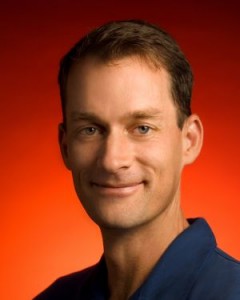 “People of ACM” highlights the unique scientific accomplishments and compelling personal attributes of ACM members who are making a difference in advancing computing as a science and a profession. These bulletins feature ACM members whose personal and professional stories are worthy of sharing with the larger computing community.
Today’s topic highlights UW CSE Ph.D. alum and Google Fellow Jeff Dean.
Read the profile here. Read more →
 An article in Science Careers profiles activities in the University of Washington eScience Institute. Ed Lazowska, Bill Howe, Sarah Loebman, and Jevin West are quoted, as well as Greg Wilson from the Mozilla Foundation who taught a “Software Carpentry” course (a Python bootcamp for scientists) through the eScience Institute:
“Ed Lazowska, who holds the Bill & Melinda Gates Chair in Computer Science & Engineering at UW, believes that data-driven discovery will become the norm, as he told Science Careers in a recent interview. This new environment, he says, will create and reward researchers (like Loebman) who are well versed in both the methodologies of their specific fields and the applications of data science. He calls such people ‘pi-shaped’ because they have two full legs, one in each camp.
“‘All science is fast becoming what is called data science,’ says Bill Howe of UW’s eScience Institute. Today, there are sensors in gene sequencers, telescopes, forest canopies, roads, bridges, buildings, and point-of-sale terminals. Every ant in a colony can be tagged. The challenge is to extract knowledge from this vast quantity of data and transform it into something of value. Lately, Lazowska says, he has been hearing this refrain from researchers in engineering, the sciences, the social sciences, law, medicine, and even the humanities: ‘I am drowning in data and need help analyzing and managing it.'”
Read more here. Learn about the UW eScience Institute here. Read more →
 Washington Governor Jay Inslee today signed into law HB 1472, which directs school districts to award a math or science credit to students who complete an AP Computer Science class.
We disagree with many aspects of the motivation as described in the Governor’s news release – “This bill will help students train for high-paying jobs in the technology industry and start addressing our state’s computer programmer shortage” is one of the least compelling reasons to encourage kids to study computer science” in our view.
But for our own reasons – the deep intellectual substance, “change the world” potential, and ubiquity in the modern world of computer science and computational thinking – we certainly support treating AP computer science as a core element of STEM education.
Read the Governor’s news release here. Read more →
 GraphLab Inc. today announced a $6.75 million Series A funding led by Madrona Venture Group and NEA. GraphLab is innovating on the popular GraphLab open source distributed graph computation framework that is used millions of times per day to deliver recommendations through popular consumer services.
Complex data sets such as those describing social media networks are commonly described as graph datasets. These graphs describe relationships between people, the products they buy, the pages they like, etc. Graph datasets require novel computational methods, machine learning algorithms, and specialized systems in order to effectively and efficiently analyze outcomes. GraphLab provides this.
Founded by leading data scientist, entrepreneur, and UW CSE Amazon Professor of Machine Learning Carlos Guestrin, who began the GraphLab open-source project five years ago, GraphLab Inc. is building a commercial product for applying advanced machine learning to massive graph datasets. The company is based in Seattle and will continue to actively support the open source GraphLab project.
Press:
Read more →
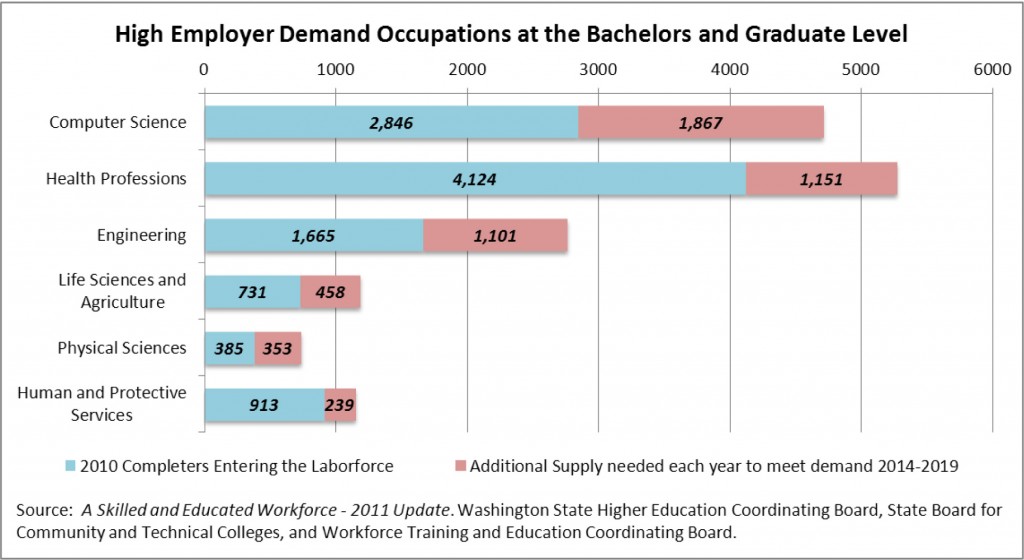 In a Seattle Times Sunday op-ed, UW CSE’s Ed Lazowska sets the record straight on the demand for computer science graduates:
“Technology workforce issues are much in the news these days, stimulated by proposed changes to the nation’s H-1B ‘guest worker’ visa policy …
“Allow me to inject a few facts into the conversation. (As Daniel Patrick Moynihan famously said, ‘Everyone is entitled to his own opinion, but not his own facts.’)
“It’s indeed the case, both nationwide and in our state, that there is no overall shortage of STEM graduates. But this is not news – it’s been the case for many years. This does not mean you shouldn’t major in a STEM field if that’s your passion, any more than that you shouldn’t major in journalism (where the job prospects are far more grim).
“However, nationwide there is a well-documented shortage of graduates in computer science. The Bureau of Labor Statistics projects that 70% of all newly-created jobs across all STEM fields during this decade – across engineering, the physical sciences, the life sciences, and the social sciences – will be in computer science. The field is booming.
“And in Washington there is a well-documented shortage in the health professions and in engineering, as well as in computer science …
“Due to staffing and facilities limitations, UW CSE – ranked among the top ten programs in the nation, along with the likes of Stanford, MIT, Carnegie Mellon, and Berkeley – can accommodate only about 25% of the students who successfully fulfill prerequisite courses and apply to the major. This is a critical issue for Washington’s economy, but more importantly for Washington’s students: 80% of UW CSE undergraduates are Washington residents, and the vast majority remain here after graduation.
“Computer science: It’s where the jobs are. It’s also where the future is.”
Read the op-ed in the Seattle Times here. Can’t surmount the paywall?
Charts of data:
Read more →
 UW CSE’s Center for Game Science has partnered with the Technology Alliance to launch the first Washington State Algebra Challenge.
During the week of June 3-7, students in Washington State K-12 classrooms will attempt to complete 250,000 algebra equations, using the school-adapted algebra learning game DragonBox. Even students who have never been exposed to algebra before will be encouraged to participate!
Learn more about the Washington State Algebra Challenge here. Read a press release here. Learn about the Center for Game Science – inventing next-generation technologies for learning and for scientific discovery – here.
Read a GeekWire post on the Challenge here. Read more →
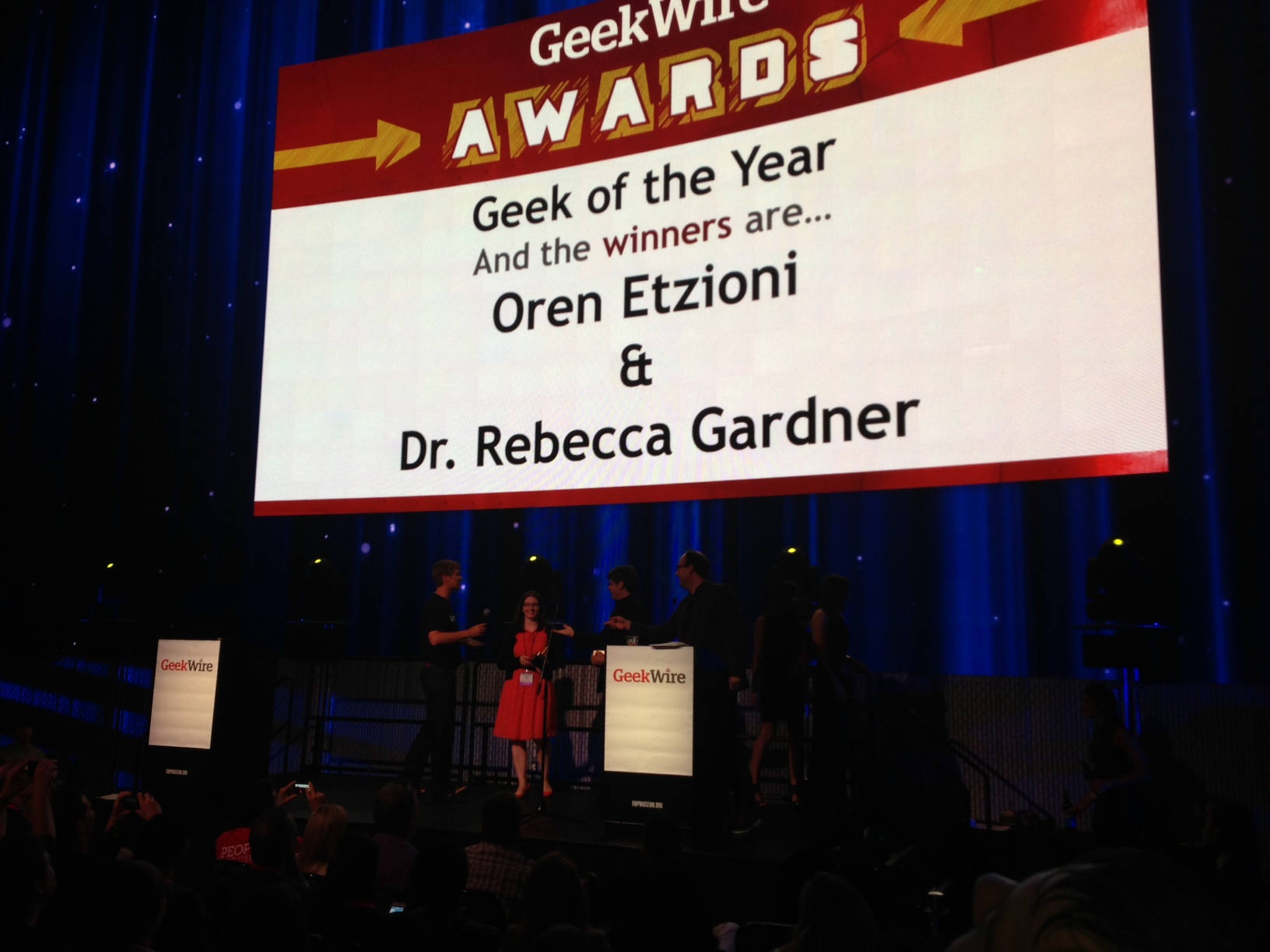
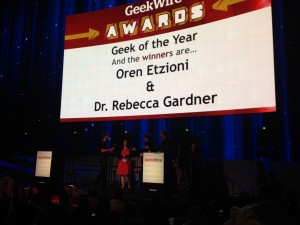 UW CSE’s Oren Etzioni! (Along with a real live geeky physician, in an unprecedented GeekWire Awards tie vote.) Read more →