Die macht des spiels – Seth Cooper. Die macht der daten – Yaw Anokwa.

sethWe don’t know what it means either.  Except for the title – “Innovation Stuntmen” – the entire book is in German.

But it prominently features UW CSE Ph.D. alums Seth Cooper (for his work on the breakthrough protein folding and protein structure calculation game Foldit) and Yaw Anokwa (for his work on the widely-used mobile data collection platform Open Data Kit).

Yaw provides the following translation of the promotional blurb:

“Batman, Superman and Spiderman can yawretire. Because the real superheroes are: Innovation Stuntmen.  Innovation stuntmen are people like us … driven by a fixed idea, which gives them a special power … the power to change the world.”

(Yaw doesn’t speak German either – we figure he just made that up.)

Learn more here.  Or – go ahead, make our day – order the book from Amazon Germany here.

cover Read more →

SpiroSmart at TEDMED

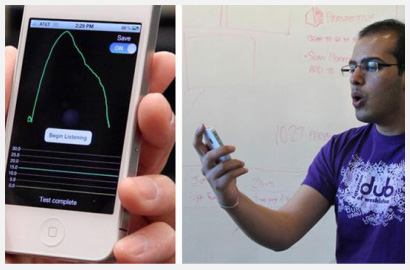
spiroUW CSE’s SpiroSmart will be featured next week at TEDMED:

“SpiroSmart is a mobile phone based platform that allows for the analysis of common lung function measures (FEV1, FVC, PEF). By analyzing lip reverberation SpiroSmart is capable of monitoring pulmonary ailments such as asthma, chronic obstructive pulmonary disease, and cystic fibrosis.”

Read more here and here.  Read the SpiroSmart research paper here. Read more →

UW Daily: “UW Cyber Defense Team to defend national title”

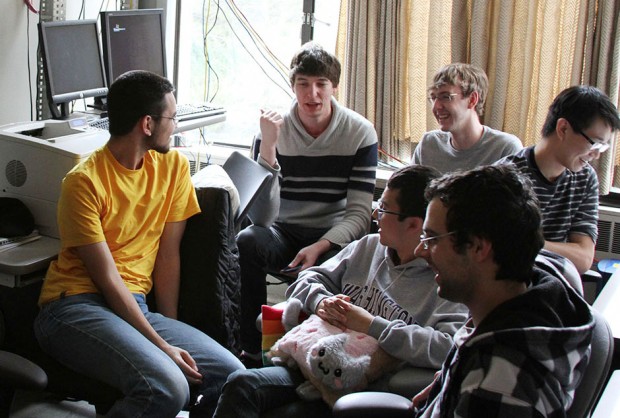
“The UW Cyber Defense Team gathere130411 JK PRCCD4 WEB.fulld in a small room in Sieg Hall. [Editor’s note: They forgot the adjective “Beautiful.”  It’s “Beautiful Sieg Hall.”] The whiteboards were scrawled with strategies for defending against hackers, and each student sat in front of a computer.

“The hum of hardware being tinkered with could barely be heard over the talk of the students, who are less than two weeks away from the National Collegiate Cyber Defense Competition (NCCDC).

“The UW Cyber Defense Team has won the Pacific Rim Collegiate Cyber Defense Competition for the sixth consecutive year. This year, at the national competition that takes place over three days in San Antonio, Texas, the team will attempt to defend its title for the third year in a row.”

Read more here.  Go team! Read more →

NY Times: “Geek Appeal: New York vs. Seattle”

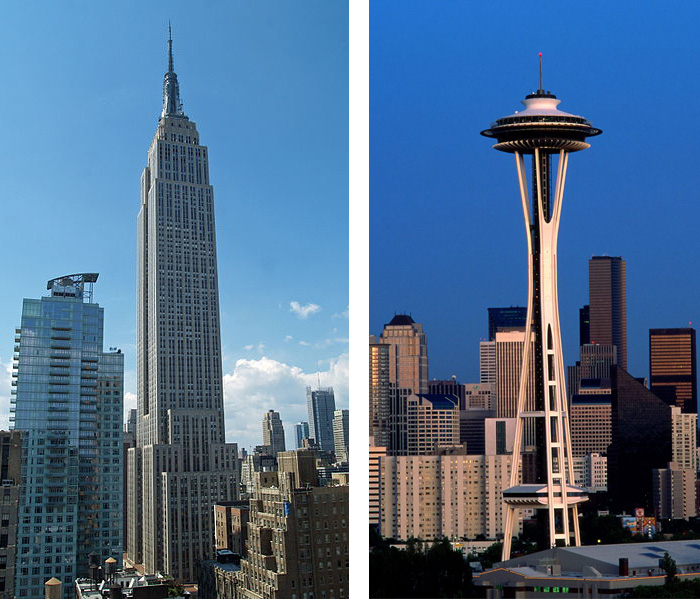
bldgsThe New York Times compares New York and Seattle for Geek Appeal, featuring UW CSE and Carlos Guestrin.

In New York, it’s driven by tens of millions of dollars of civic initiatives led by Mayor Michael R. Bloomberg.

“Meanwhile, in Seattle, with its green hiking trails, coffee culture and tech industry, the University of Washington is making its own pitch.  The university has opened the eScience Institute for studying data across disciplines and has a new Ph.D. program in Big Data.  It also has many rich and powerful neighbors in tech to finance its data initiatives and lure big-name faculty members.

“Since 2000, Microsoft has donated $22 million to the computer science program; Google gives several million dollars a year. And Amazon has endowed two professorships with $2 million; Jeff Bezos, its founder and chief executive, personally recruited Carlos Guestrin for computer science and Emily B. Fox for statistics.

“The companies offer more than just money, said Mr. Guestrin, one of the world’s top machine-learning researchers, previously of Carnegie Mellon. ‘Money helps because students have to eat their ramen, but it’s not just that,’ he said. Companies also lend students their real-world data to crunch. ‘Companies often see big challenges we might not see at that scale or have access to at the university,’ he said, ‘and those connections can be transformative.’

“Like New York, Seattle has draws outside the classroom. ‘It attracts certain geeks like me, nature-loving and into music, food and biking,’ Mr. Guestrin said. But the biggest attraction, he said: ‘The data is on the West Coast.'”

Read more here. Read more →

CSE’s Adrian Sampson, Thierry Moreau win $100,000 Qualcomm Innovation Fellowship

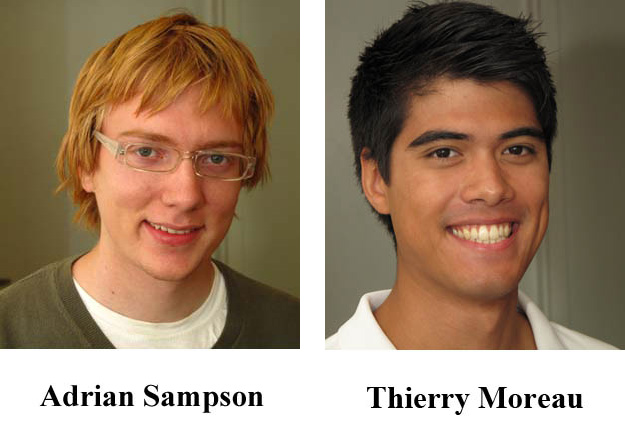
Adrian.ThierryQualcomm invited multiple teams from 15 universities to submit proposals for $100,000 2013 Qualcomm Innovation Fellowships.  From 138 proposals, Qualcomm selected 33 finalist teams who made presentations at Qualcomm’s three R&D Centers.  Today, the 8 winners were announced:  teams from UW, UCLA, Princeton, Cornell, UIUC, UCSD, UCB, and Columbia.

Hearty congratulations to UW CSE Ph.D. students Adrian Sampson and Thierry Moreau, and to their advisors Luis Ceze and Dan Grossman, for winding up on top in this incredibly intense competition.

Read (a bit) more here. Read more →

NY Times: “Data Science: The Numbers of Our Lives”

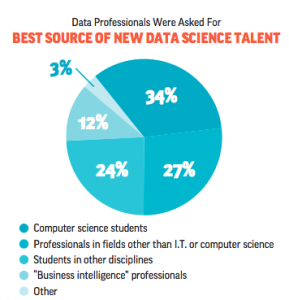
14bigdata-pie-popupThe New York Times discusses the tremendous demand for data science professionals, and the sources of these professionals.  (Mostly computer science programs, of course …)

Bill Howe of UW CSE and the UW eScience Institute gets the last word in the article:

“The question, said Bill Howe, who teaches data science at the University of Washington, is whether it is even possibleto instill in a single person all the skills needed, from statistics to predictive modeling to business strategy. The university’s offerings range from a free online course on Coursera to a nine-month certificate program to a Ph.D. track in Big Data.

“‘It remains to be seen,’ he said, ‘but we’re still of the mind that a curriculum that aims to train data scientists is feasible.’ He added: ‘What employers want is someone who can do it all.'”

Read more here.  Learn about the UW eScience Institute here. Read more →

UW CSE introductory course enrollments continue to boom!

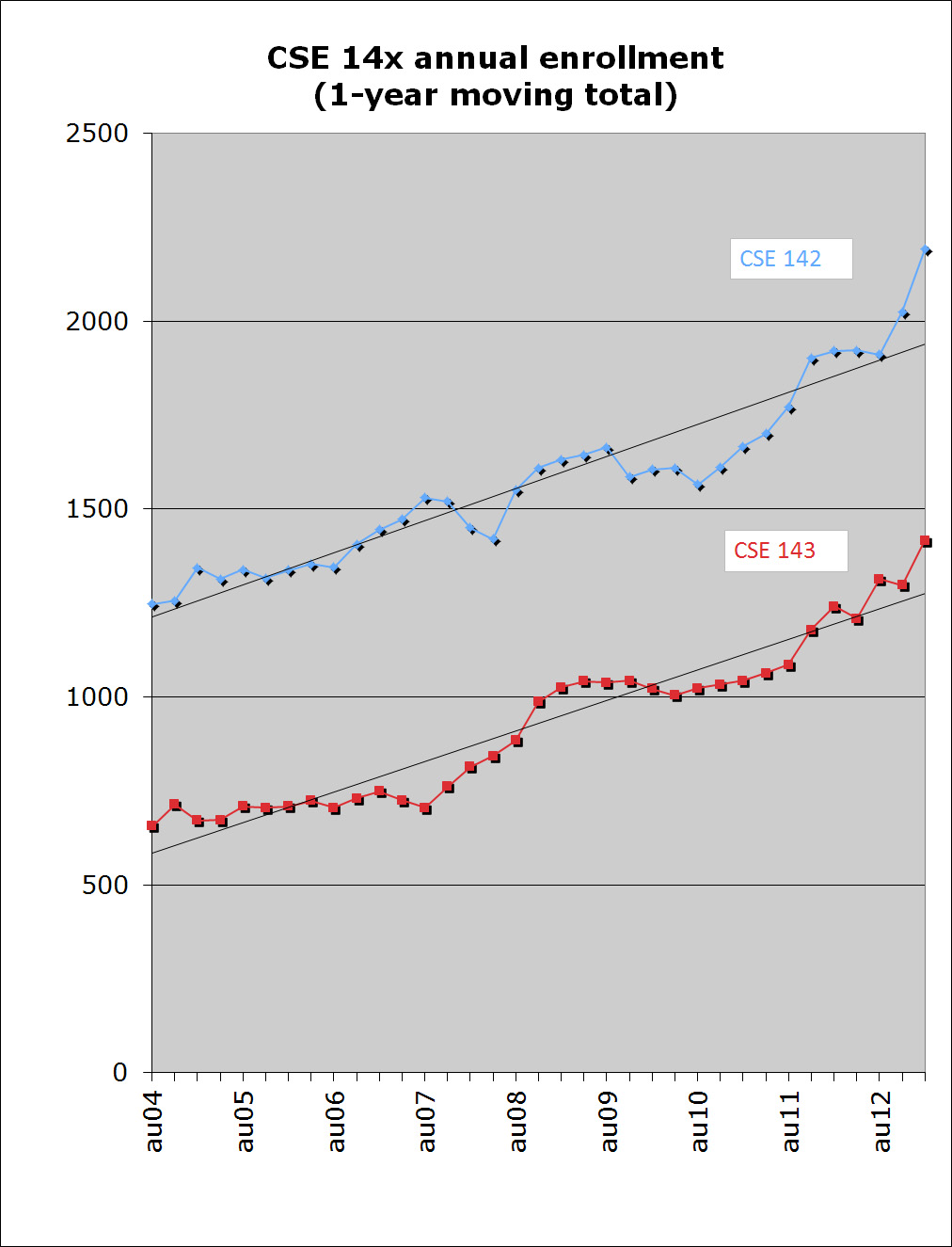
14xAcross the nation, and particularly at the leading programs, student interest in computer science is booming!

UW CSE’s two introductory courses, CSE 142 (“CS 1”) and CSE 143 (“CS 2”), each are offered during all four academic quarters each year.  During the most recent four quarters – the past year – 2192 students took CSE 142 and 1417 students took CSE 143 – astonishing numbers!  (And fully 1/3 of the students in CSE 142 this quarter are women!)

Take a look at the trends! Read more →

UW at the IEEE RFID conference

  • “Hybrid Analog-Digital Backscatter: A New Approach for Battery-Free Sensing,” by Vamsi Talla and Joshua R. Smith
  • “Sensor Enabled Wearable RFID Technology for Mitigating the Risk of Falls Near Beds,” by Roberto Luis Shinmoto Torres, Qinfen Shi, Alanson Sample, and Damith C. Ranasinghe
  • “Minimum Energy Source Coding for Asymmetric Modulation with Application to RFID,” by Farzad Hessar, and Sumit Roy
Vamsi Talla is an EE graduate student, advised by CSE & EE faculty member Josh Smith.  Alanson Sample did his Ph.D. with Smith in EE, and his Postdoc with Smith in CSE.  Farzad Hessar is an EE graduate student advised by EE faculty member Sumit Roy.
The conference keynote speaker is UW EE faculty member Brian Otis.
Read more →

“State falls short in educating for high-tech jobs”

bhThe Bellingham Herald opines:

“To put the problem in a sentence, Washington creates more STEM-related jobs than any other state in the U.S., including California, but ranks in the bottom five states that produce STEM-degree graduates.

“The immediate choke point resides at our two- and four-year higher education institutions. The University of Washington has room to accept only 25 percent of students who apply for its computer science program. It takes only half of those who apply for engineering.”

Read more here.
Read more →

CSE Ph.D. alum Ed Felten interviewed in Wired

feltenUW CSE 1993 Ph.D. alum Ed Felten, Professor of Computer Science and of Public Policy at Princeton and for the past two years the first Chief Technologist of the Federal Trade Commission, is interviewed extensively in Wired:

“For more than a decade now, Felten has promoted an important idea that has sometimes put him at odds with the music industry and big technology companies: the notion that consumers should be able to take apart and learn about the software and hardware on devices that they own.

“He calls this principle the freedom to tinker, and over the years, Felten and his team of Princeton University researchers have tinkered with some pretty interesting things. They’ve uncovered bugs in voting machines and CD copy-control systems. They ripped apart Sony’s notorious computer-crippling rootkit. In 2008, they showed how it’s possible to read data from a computer’s memory, even after it’s been shut down …

“But Felten’s latest project may be his most ambitious yet. He’s investigating what he calls ‘accountable algorithms.’ Felten and his Princeton team are trying to develop ways to test that the computerized algorithms that loom so large over our daily lives. Take, for example, the algorithm the TSA uses to select travelers for extra security checks. Felten wants to develop a way to check that these algorithms are fair.”

Read more of this great interview here.

(This spring, Felten and 1984 bachelors alum Anne Dinning will return to UW to receive our 2013 Alumni Achievement Awards.) Read more →

« Newer PostsOlder Posts »