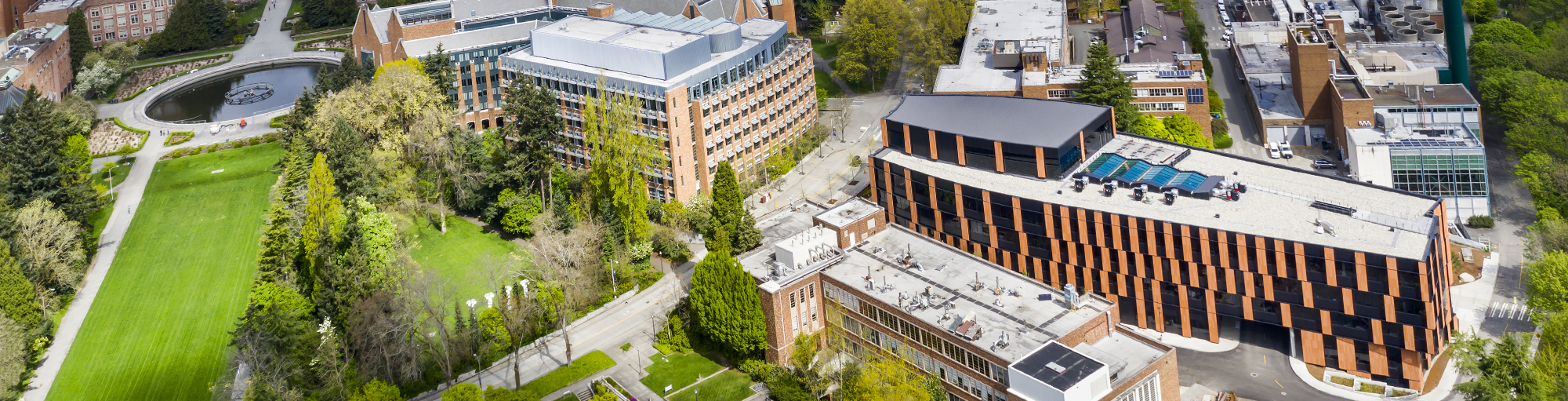
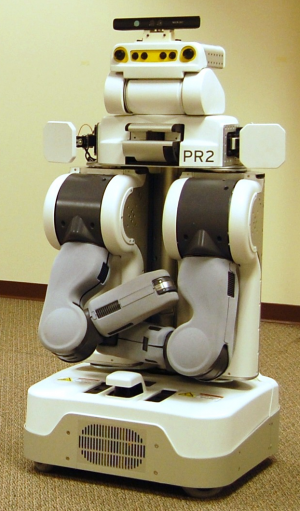
 “New RFID technology helps robots find household objects” is the actual headline of this University of Washington and Georgia Institute of Technology press release describing the work of UW CSE and EE faculty member Matt Reynolds.
If a PR2 takes as long to find car keys as it does to fold laundry, we have three words for you: “Take the bus.”
Actually, we have three additional words for you: “Read more here.”
Addendum: The research paper describing this work – “Finding and Navigating to Household Objects with UHF RFID Tags by Optimizing RF Signal Strength” by Travis Deyle, Matt Reynolds, and Charlie Kemp – was one of 3 Finalists (out of over 1,600 papers submitted) for the IROS 2014 Robocup Best Paper Award! Read more →
 Including … “The University of Washington has invested deeply in its computer science program and recently spent $1.5 million to remodel their Startup Hall.”
Read more here. Read more →
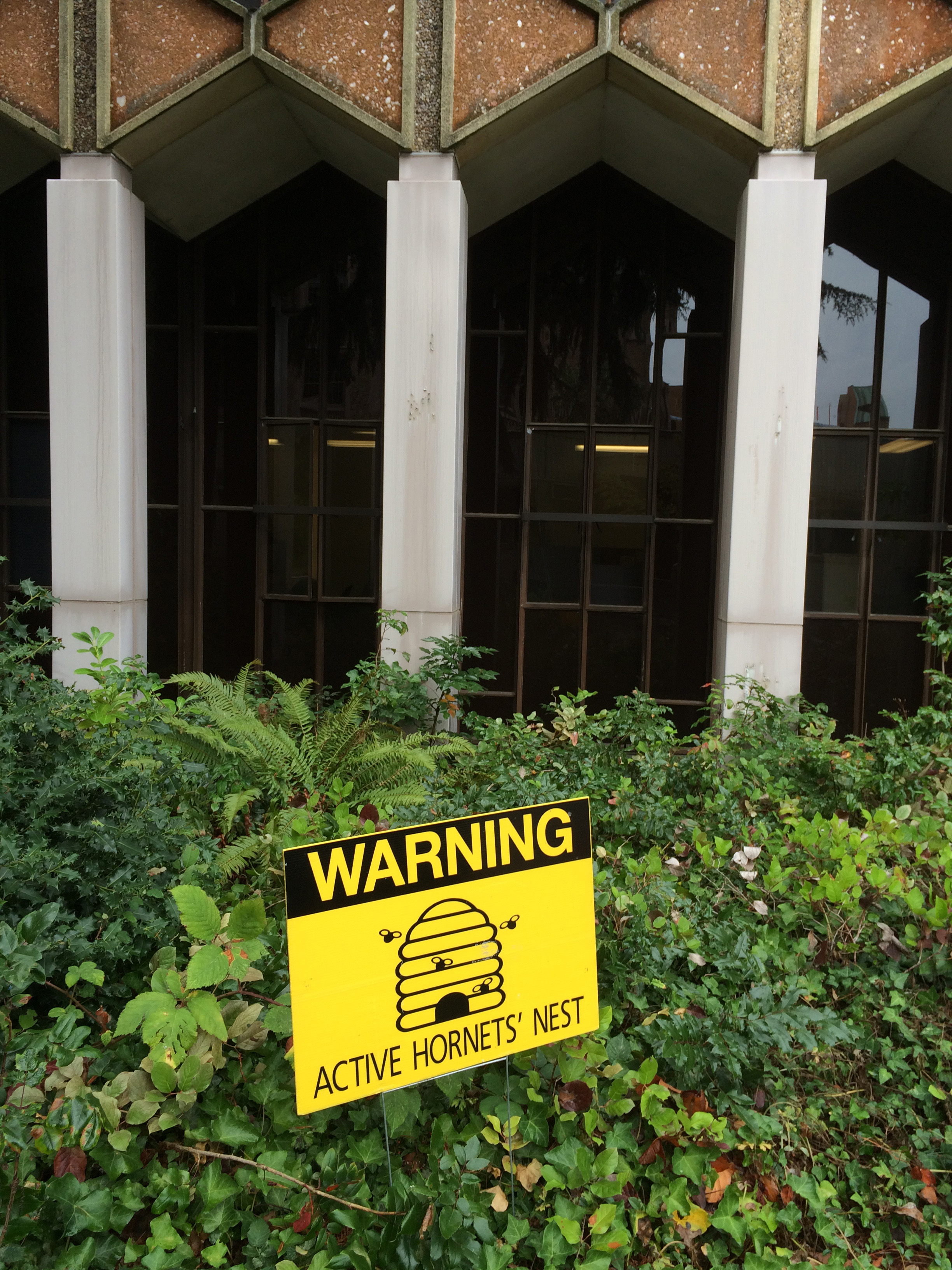
 Beautiful Sieg Hall – home of UW Computer Science & Engineering from 1975-2003 – has been the subject of postcards, the backdrop for Vietnam war protests, the victim of crumbling concrete, the site of an invasion by vines, and, most recently, home to a hornet’s nest. What’s next? Stay tuned! Read more →
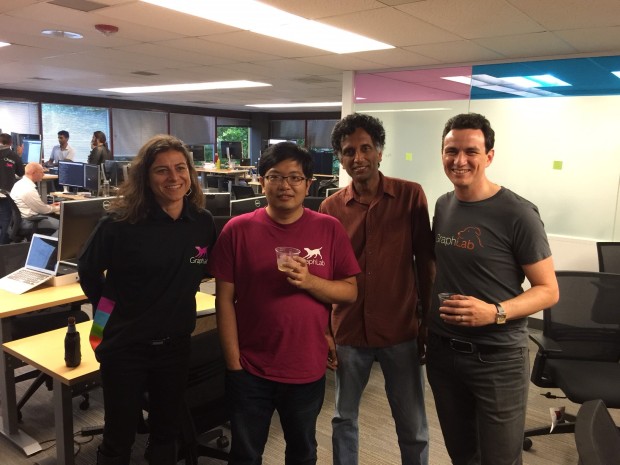
GraphLab VP Marketing Johnnie Konstantas, Chief Architect Yucheng Low, VP Engineering Sethu Raman, and Co-Founder and CEO (and UW CSE Amazon Professor of Machine Learning) Carlos Guestrin
CSE startup GraphLab inaugurated its new office space in Fremont last week. The Seattle Times writes:
“Big-data analytics startup GraphLab may need to use its number-crunching software to manage its seating chart.
“After outgrowing a series of incubation spaces at the University of Washington, the company is now filling up a standalone space down the canal in Fremont …
“GraphLab makes software that companies can use to build predictive applications – the kind that analyze huge data collections to figure out what people are likely to shop for, where crime may occur or what kind of music people may like to hear next. Early users include Zillow, Zynga, Adobe and Exxon.”
Read more here. Learn about the company here. Read more →
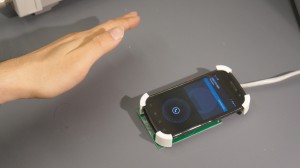 UW News writes:
“With almost all of the U.S. population armed with cellphones – and close to 80 percent carrying a smartphone – mobile phones have become second-nature for most people.
“What’s coming next, say University of Washington researchers, is the ability to interact with our devices not just with touchscreens, but through gestures in the space around the phone. Some smartphones are starting to incorporate 3-D gesture sensing based on cameras, for example, but cameras consume significant battery power and require a clear view of the user’s hands.
“UW engineers have developed a new form of low-power wireless sensing technology that could soon contribute to this growing field by letting users ‘train’ their smartphones to recognize and respond to specific hand gestures near the phone.
“The technology – developed in the labs of Matt Reynolds and Shwetak Patel, UW associate professors of electrical engineering and of computer science and engineering – uses the phone’s wireless transmissions to sense nearby gestures, so it works when a device is out of sight in a pocket or bag and could easily be built into future smartphones and tablets.”
Read more here. Learn more about the project here. (In addition to Matt and Shwetak, project members are graduate students Chen Zhao, Ke-Yu Chen, and Md Tanvir Islam Aumi.) Read more →
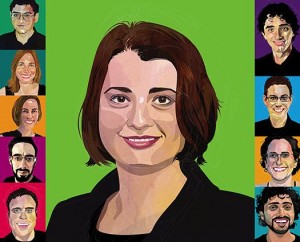 UW CSE Ph.D. alum Roxana Geambasu, now on the Computer Science faculty at Columbia University, has been honored by Popular Science as one of its “Brilliant Ten” for 2014:
“As a computer scientist, Roxana Geambasu of Columbia University says she picks new projects based on what ‘really, really annoys me.’ She hates ceding control of her personal data online, which is why she’s building software that allows people to see where the information they upload to the cloud goes.”
Read more here. Learn more about Roxana and her research here.
Congratulations Roxana!!
(Last year, UW CSE postdoc alum Justin Cappos, now on the Computer Science faculty at NYU-Poly, was among the Brilliant Ten. You’re welcome, NYC!) Read more →
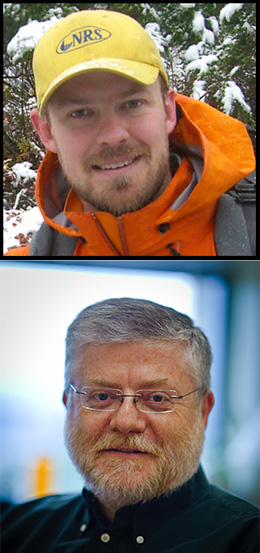 The 2004 research paper “Particle Filters for Location Estimation in Ubiquitous Computing: A Case Study” by UW CSE’s Jeff Hightower and Gaetano Borriello has been recognized with the “10-Year Impact Award” from Ubicomp 2014, the 2014 ACM International Joint Conference on Pervasive and Ubiquitous Computing.
These “test of time” awards are particularly meaningful: they identify the work presented 10 years previously that, with the benefit of that hindsight, has had the greatest impact.
In selecting the paper, the award committee said “The committee is unanimous in awarding you this prize based on the quality of the research and of the paper, and especially the impact the paper has had in terms of citations (both primary and secondary) and inspiration to similar research. The proposed method of particle filters is still a widely used approach and the paper provides very strong empirical evaluations and results.”
Jeff, a 2004 UW CSE Ph.D. alum, is an engineer at Google. At UW he studied with Gaetano, the Jerre D. Noe Professor of Computer Science & Engineering.
Congratulations to Jeff and Gaetano. And while we’re at it, we would be remiss in not noting:
Read more →
 Seattle’s KING5 News aired a feature on Microsoft’s TEALS (Technology Education And Literacy in Schools) program. TEALS enlists computer engineers from Microsoft and other companies to help public schools offer computer science classes. The KING5 piece highlighted an AP Computer Science class that uses the textbook and approach developed by UW Principal Lecturer Stuart Reges for our popular CSE 142 class. Reges also serves on the Advisory Board for TEALS when he isn’t teaching the more than 1,000 students registered for fall CSE 142.
Check out the KING5 story here. Learn more about TEALS here. Read more →
 DawgBytes is UW Computer Science & Engineering’s K-12 outreach program. We introduce students and their teachers to the exciting world of computing.
An update of recent and upcoming activities may be viewed here.
Subscribe to the DawgBytes mailing list here. Read more →
 1989 UW CSE Ph.D. alum Kevin Jeffay has been named chair of the Department of Computer Science at the University of North Carolina.
This is the 50th anniversary year of UNC CS – founded in 1964 by Frederick P. Brooks Jr. as one of the first computer science departments in the US.
Congratulations, Kevin! Read more →