
Although Allen School professor emeritus Richard Ladner started his career as one of the founders of the University of Washington’s theoretical computer science group, he has grown to become a leading researcher in accessible technology and an advocate for expanding access to computer science for students with disabilities. As a child of deaf educators, Ladner is deeply committed to accessibility and disability inclusion, and credits his first-hand experience with making him a more effective researcher.
“Computing technology has changed the world and almost everyone now has a computer in their pocket,” said Ladner. “It is important that future engineers and technologists learn about accessibility so that they can design technology that is accessible so that everyone can use it, and so that they can build things that are particularly useful to people with disabilities such as screen readers.”
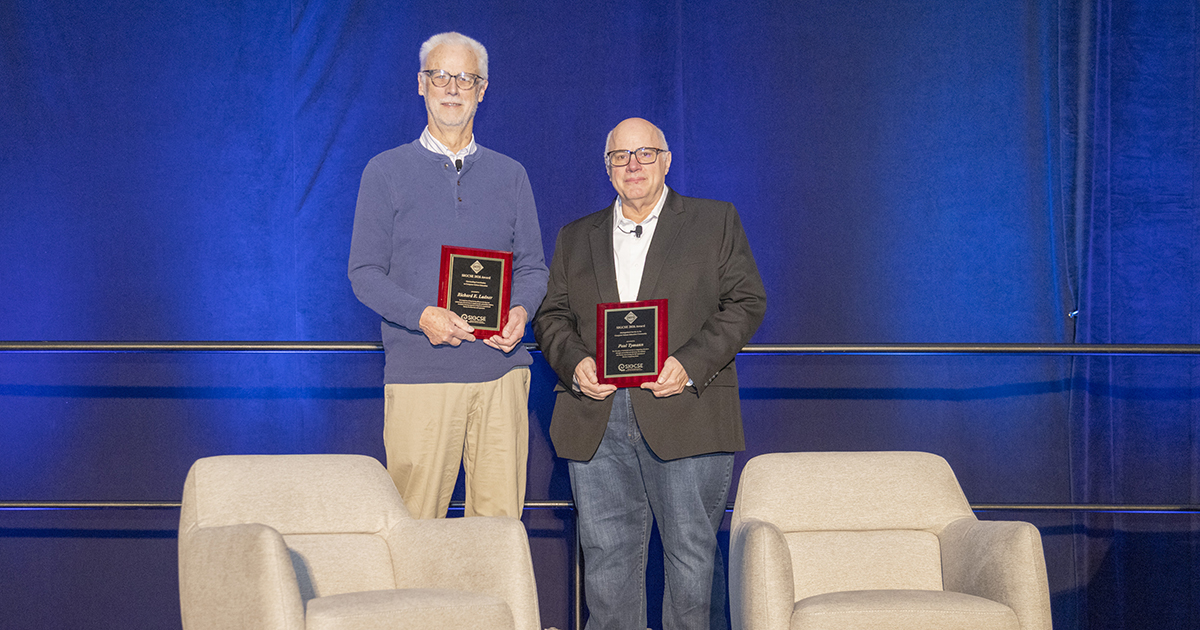
Through mentoring and advocacy, Ladner has also directly helped hundreds of students with disabilities to gain exposure to computing as a potential career path. The Association for Computing Machinery’s Special Interest Group on Computer Science Education (SIGCSE) recently recognized Ladner with the ACM SIGCSE Award for Outstanding Contribution to Computer Science Education. The award honors researchers who have made a long-lasting impact and significant contribution to computing education.
From 2006 to 2024, Ladner led the Alliance for Access to Computing Careers (AccessComputing) — which he co-founded with Sheryl Burghstahler, former director of the UW’s DO-IT Center, with funding from National Science Foundation’s Broadening Participation in Computing program. AccessComputing supports high school, undergraduate and graduate students to build skills and connections with mentors and professional opportunities in computing-related fields. Between 2015 to 2024, program mentors worked with over 1,500 students with disabilities nationwide.
During this same time period, Ladner also led the Summer Academy for Advancing Deaf and Hard of Hearing in Computing. Students enrolled in the program, which ran from 2007 to 2013, jumpstarted their academic careers by spending the summer taking computing courses at the UW’s Seattle campus. Many of the students who went through the summer academy went on to earn bachelor’s and graduate degrees in computer science — including three who became computing faculty themselves. Ladner also partnered with Andreas Stefik, a professor at the University of Nevada, Las Vegas, to launch AccessCSforAll, an initiative that provides accessible computer science curriculum and other resources available to K–12 students with disabilities. Their paper describing the work received the SIGCSE 2019 Best Paper Award in the Experience Reports and Tools Track.
For Ladner, it was not only important that computing education was accessible to students with disabilities, but that teaching about accessibility and disability was included in computer science curricula. In a 2018 SIGCSE paper, Ladner and his collaborators found that around 2.5% of computing and information science faculty nationwide reported teaching about accessibility, with many citing lack of knowledge as a barrier. To help address this gap, in 2024, Ladner co-edited the book “Teaching Accessibility” along with Alannah Oleson, faculty at the University of Denver, and Amy Ko, professor in the UW Information School and adjunct faculty in the Allen School. Covering multiple fields, from robotics to data structures, the book provides computing instructors with the tools and resources to help them incorporate accessibility into their teaching. Ladner has also co-authored several papers on the importance of teaching and learning about accessibility, as well as outlining strategies for integrating accessibility into various computer science courses.
To better understand the impact of these initiatives, Ladner has advocated for the availability of demographic disability data. He encouraged the Computing Research Association (CRA) to report disability data as part of its annual Taulbee Survey, which it has as of 2021. At the same time, he also encouraged the publishers of the State of Computer Science Education report to include data on students with disabilities; they had reported the data annually since 2020. For Ladner, one of the big successes of AccessComputing was getting organizations such as the CRA to “recognize disability as a minoritized group and to collect data about it.”
“Richard is quick to encourage folks who haven’t thought about disability inclusion to find ways to incorporate it in their work — and will have a suggestion for how to do it! Without Richard’s relentless encouragement, accessibility and disability would not be as prominent topics in CS education as they are,” said Brianna Blaser, director of AccessComputing.
Even after his retirement in 2017, Ladner has remained active in accessibility research, mentoring and advocacy. Over the years, he has supervised or co-supervised 30 Ph.D. students as well as more than 100 undergraduate researchers — many of whom sought him out for his expertise in accessibility. One of his students went on to establish the Richard E. Ladner Endowed Professorship, currently held by his faculty colleague Jennifer Mankoff, in his honor. His former students also initiated the Richard Ladner Endowed Fellowship that supports graduate students working in accessibility research.
The ACM SIGCSE Award for Outstanding Contribution to Computer Science Education is one of the many awards Ladner has earned throughout his career. He has also received the Presidential Award for Excellence in Science, Mathematics and Engineering Mentoring (PAESMEM); CRA A. Nico Habermann Award; SIGCHI Social Impact Award; Richard A. Tapia Achievement Award for Scientific Scholarship, Civic Science, and Diversifying Computing; SIGACCESS Award for Outstanding Contributions to Computing and Accessibility; Harrold and Notkin Research and Graduate Mentoring Award; Broadening Participation in Computing (BPC) Community Award; and the National Science Board Public Service Award. Ladner has been elected a Fellow of the American Association for the Advancement of Science (AAAS), as well as a Fellow of both the ACM and the IEEE.
“Whether students with disabilities, or committed allies, Richard has supported and empowered others to be disability justice advocates in industry, academia and communities. Much of his mark is in the exponentially growing network of scholars, educators, and advocates that he’s supported for decades,” said Ko.
Read more about the ACM SIGCSE Award for Outstanding Contribution to Computer Science Education here.