Xconomy reports on the OVP Venture Partners Technology Summit.
“Seattle can be a very politically correct place, and one very un-PC thing to say is that we’re a second-rate burg when it comes to spawning innovative industries of the future. But Ed Lazowska, one of Seattle’s gutsiest public intellectuals, let it rip yesterday in front of a small gathering of about 100 technology elites at the Four Seasons Hotel.
“‘We’re very smug and self-satisfied,’ said Lazowska, the Bill & Melinda Gates Chair of Computer Science & Engineering at the University of Washington … ‘We think of ourselves in the innovation big leagues, but we are, in fact, in the minors compared to the real big leagues of the San Francisco Bay Area and Boston’ …
“This was easy to say in front of an audience of venture capitalists and entrepreneurs who travel a lot, and know all these points to be true. One of the things that baffles me about Seattle – after having lived in Boston and San Francisco – is that so few public officials here would ever dare utter such an obvious truth about how far Seattle lags behind the world-leading clusters for biotech and high tech. If they can’t do that, there’s no way they can engage in serious discussion with the general public about systemic ways this region can improve.”
Read the full Xconomy article here. Read more →
 UW CSE Ph.D. student Jeff Bigham has been recognized as the 2009 UW College of Engineering “Student Innovator: Research” in the Community of Innovators award competition.
UW CSE Ph.D. alumnus Scott Hauck, now a faculty member in UW EE, has been recognized as the “Faculty Innovator: Teaching and Learning.”
Congratulations to Jeff and Scott! Read more →
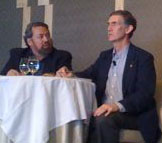 “University of Washington computer science professor Ed Lazowska is known as a straight talking rabble-rouser who doesn’t pull many punches. And he certainly lived up to that reputation today at the OVP Venture Partners Technology Summit …
“Lazowska – who appeared on stage with the equally opinionated Mark Anderson of the Strategic News Service – reserved his toughest comments for a Lake Wobegon mentality in the state where everything appears to be above average.
“‘It seems to me that the issue with this state is that we are one big happy family in which everybody is doing extremely well. Everyone’s college program is above average. And everyone’s company is above average. And everyone’s venture fund is above average. And if you go a little bit more above average than the next guy, then they get all Dirty Harry and whack you down. It’s the State of Whac-a-Mole … I worry that those who excel, and excel honestly, aren’t celebrated in this state'”
Read the full TechFlash article here. Read more →
UW’s Foldit protein folding game received nice coverage in a Computerworld article on human computation (and more generally the importance of human-computer symbiosis).
“You can play a video game called Foldit on the Web while making important contributions to science. Understanding how 3-D proteins ‘fold’ into their optimum structures is critical to understanding disease, but it’s difficult computationally because there are an astronomical number of possible folds for most proteins.
“The thousands of people who play Foldit use their pattern-recognition and puzzle-solving skills to predict protein structures in a way computers can’t easily duplicate. ‘Teenaged gamers are beating the pants off Ph.D. biochemists,’ says Ed Lazowska, a computer science professor at the University of Washington, where Foldit was created.”
See the full Computerworld article here. Read more →
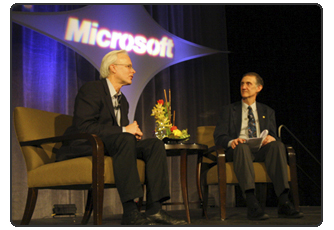 A conversation between UW CSE’s Ed Lazowska and Microsoft Chief Software Architect Ray Ozzie keynoted the annual State of Technology luncheon hosted by the Technology Alliance.
More than 700 attendees heard Ozzie discuss topics such as collaborative software, cloud computing, the leadership team at Microsoft, cultural differences between large and small companies, special-purpose vs. general-purpose digital devices, intellectual property in a Web world, and the differences between Boston and Seattle as innovative regions.
Xconomy article here. TechFlash article and videos here. Seattle Times article here. CIO article here. Forbes article here. Webwereld (The Netherlands) article here. Read more →
 The New York Times‘s Steve Lohr discusses smart infrastructure.
“Smart infrastructure is a new horizon for computer technology. Computers have proven themselves powerful tools for calculation and communication. The next step, experts say, is for computers to become intelligent instruments of control, linking them to data-generating sensors throughout the planet’s infrastructure. ‘We are entering a new phase of computing, in which computers will be interacting with the physical world as never before,’ said Edward Lazowska, a professor of computer science at the University of Washington.”
Read the full article here. Read more →
 The BBC reports on CSE professor Raj Rao‘s efforts to use machine learning techniques to support the hypothesis that the Indus Script is a written language.
“The Indus people lived around 4000 years ago, on what is now the border between Pakistan and India. They are said to have been extremely advanced in the fields of science and maths but arguments still rage over whether they had a written language. We look at new research into the symbols they left behind.”
Broadcast begins at 16:30 here. Read more →
 A really engaging Wired article about Foldit, the protein folding game designed by David Baker, Zoran Popovic, David Salesin, and their collaborators.
“More than 100,000 people have downloaded Foldit since last summer, turning the game into massively multiplayer competition – global online molecular speed origami …
“Baker’s lab is developing targets for cancer, AIDS, and Alzheimer’s, and the folders’ task is to build a small protein drug with the right shape and binding properties. This isn’t just an intellectual exercise. Baker says he will synthesize the most promising structures and test them in his lab. These proteins could actually have therapeutic value in the real world, outside the game. And if they do, the Foldit players will share the credit. It might be the first time that a computer game’s high score is a Nobel Prize.”
Read the article here! Read more →
 Xconomy reports on the major UW presence at the IEEE/ACM International Conference on Information and Communication Technologies and Development, in Qatar.
“Seattle-area researchers, specifically from the UW, made quite a showing at the meeting. Several Microsoft projects were presented too, and Bill Gates showed up to give the keynote talk.”
“‘Technology is naturally mixing with global health as there is much low-hanging fruit where a little tech can make a big difference,’ Gaetano Borriello, a University of Washington computer science professor, said in an email. ‘Seattle is a hub for both, so it is a natural place for this new development to be happening.'”
Read the full article here. Read more →
 The New York Times offers a followup to a previous article regarding Amazon.com’s temporary de-listing of more than 50,000 books a week ago.
“‘Whenever something like this happens, people immediately blame it on conspiracy,’ said Ed Lazowska, professor of computer science and engineering at the University of Washington. ‘There are all kinds of ways for things to go wrong that are what I would call unintended consequences of either computer algorithms or human behavior.'”
Unfortunately, however, in typical “he said, she said” fair-and-balanced style, the article still gives weight to a number of conspiracy theorists. “If it bleeds, it leads.” See the full article here. Read more →