Entrepreneurship: Company-Building from Formation to Successful Exit

ENTRE course

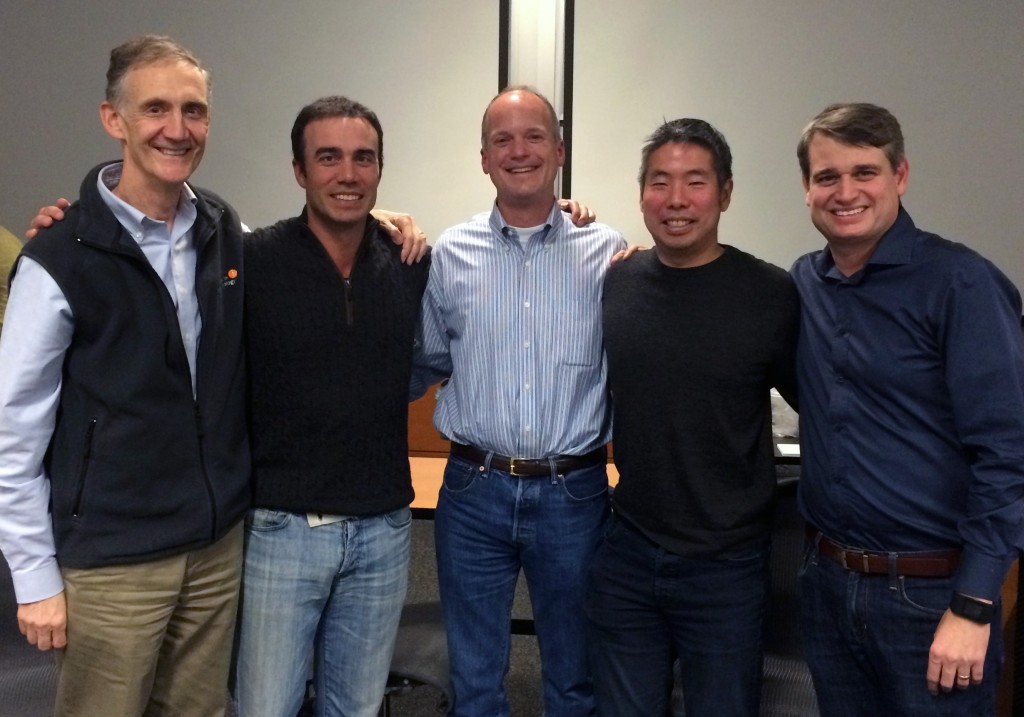
Ed Lazowska, Aber Whitcomb, Geoff Entress, Andy Liu, and Greg Gottesman

Tonight was the final class session of Greg Gottesman‘s phenomenal course “Entrepreneurship: Company-Building from Formation to Successful Exit.” The course this quarter had a bit more than 60 students: UW CSE undergraduate and graduate students, and Foster School of Business MBA students.

Right on schedule, tonight’s topic was “Exits,” featuring a presentation by UW alum Aber Whitcomb (co-founder of MySpace, currently CTO of Social Gaming Network), followed by a panel discussion moderated by Greg and including Aber and top Seattle angel investors Geoff Entress and Andy Liu.

Many thanks to Greg and to all of the phenomenal presenters he engaged this quarter! Read more →

College-bound? Washington Monthly’s “The Other College Guide” is must reading!

indexWashington Monthly‘s “The Other College Guide” is chock full of great advice:

“Other books cater mostly to students from well-to-do families trying to get into the most exclusive, priciest schools. The Other College Guide is for every student …

“Other books … rank schools based on how many students they turn away, or how much money they raise and spend, or how other college presidents rate them. But these metrics … are mostly measures if inputs, not outcomes. So The Other College Guide ignores such criteria and instead ranks colleges based on the best available data about what really matters (or should matter) to you …

“Other books are full of happy talk about how wonderful America’s higher education system is and how every college has something to offer. Baloney! There are a lot of terrible colleges out there …

“Other books only profile the most prestigious colleges or the ‘Best Party Schools.'”

Best-Bang-For-The-Buck in the Western US:  #1, out of 233 schools ranked: The University of Washington. (UW-Bothell is #13. UW-Tacoma is #22. Evergreen is #29. Western is #30. Eastern is #37. Central is #44. WSU is #68.)

50 Schools You Should Know About:  #1 in the West, out of 10 schools listed: The University of Washington. (UW-Bothell is #5. Evergreen is #8. Western is #9.)

Troubled Waters: The Community College Transfer Swamp: “If you intend to earn a four-year degree and you’re starting at a two-year college, the truth is that you’re in for a challenge. Three-fourths of students who start at a community college with the intention of earning a degree or transferring to a four-year institution end up doing neither after six years.”

Best Community Colleges: Washington colleges listed, among 50 nationwide, are Grays Harbor College (#15), Cascadia Community College (#22), Green River Community College (#44), Tacoma Community College (#46), and Highline Community College (#47). Congratulations to these five Washington community and technical colleges for doing well at the things that matter!

Read this book! Get it at Amazon (paperback or Kindle) here. Read more →

Michael Schutzler in GeekWire: “Computer science education is key to our future”

computer-science-classshutterstock_92873875-620x414WTIA CEO Michael Schutzler writes in GeekWire:

“The Seattle area is home to more software development engineers than any metropolitan area in the country. More than Boston. More than New York. More than San Francisco.

“When it comes to software, we are number one. Our deep talent pool in this field is one of the reasons why Apple, Google, Facebook, and so many other global tech powerhouse companies have opened large offices here.

“The impact on our region has been extraordinary. Each software engineering job has led to seven other jobs in the wider economy. Hundreds of thousands of jobs have been created in a time when most communities across the nation have struggled to maintain jobs.

“Thanks to our entrepreneurial vitality, we now create software engineering jobs about ten times faster than we produce grads qualified to take those positions. This makes us a top recruiter of software talent in the nation.

“Our investment in public education, however, has not kept pace. As a result, we have an access dilemma.

“One example of limited access is the University of Washington Computer Science program, one of the best in the world and the largest in our state by far. UW graduated less than 300 combined bachelors, masters and PhD students last year. Nearly 1000 students were interested and qualified to pursue a degree in Computer Science – but we did not have the classrooms or faculty available to teach them …

“Legislators must now fund additional computer science capacity. In the near term, the focus must be on doubling the University of Washington Computer Science program and sensible expansion at a few other universities. Next, we must make computer science available to all Washington public school students at least in high school if not before. And our job is not complete until our software engineering workforce reflects the diversity in our community.”

Read more here.

Learn about two recent initiatives to address the issue here and here. Read more →

UW CSE’s summer daycamps for middle and high school students: registration opens March 9!

2013camp-headerCurious about computer science? UW CSE’s summer daycamps introduce middle and high school students to computer science through programming projects, magic tricks and faculty presentations.

2015 camp dates are now posted! Registration opens on March 9. Please note: These camps are meant for students who are new to computing and have not completed a previous camp.

Girls Camps

  • Grades 7-9: Aug 10 – 14 or Aug 17 – 21
  • Grades 10-12 and pre-college freshmen: July 27 – 31 or Aug 3 – 7

150px dawg logoCo-ed Camps

  • Building Android apps, for grades 7-9: July 21 – 24 or Aug 11 – 14
  • Physical Computing, for grades 10-12 and pre-college freshmen: June 29 – July 2 or July 7 – 10

Lots more information here.

Learn more about UW CSE’s extensive K-12 outreach program, DawgBytes, here. Read more →

Reps. Drew Hansen, Chad Magendanz address Governor’s STEM Education Innovation Alliance

IMG_4862Today, State Representatives Drew Hansen (D – Bainbridge Island) and Chad Magendanz (R – Issaquah) addressed the Governor’s STEM Education Innovation Alliance, which includes UW CSE’s Ed Lazowska among it’s ~20 members.

Reps. Hansen and Magendanz have spent two years gaining a deep understanding of STEM in our state, and forging a bipartisan alliance to address key gaps. Among their findings:

  • Knowledge of Computer Science and “computational thinking” is a key capability for all citizens in this century. Access to Computer Science must be expanded in K-12; professional development for teachers is a key component of this.  HB/SB 1813, which they have co-sponsored, addresses this.
  • Focusing on higher ed, by far the largest workforce gap in our state is in computer science – the only other “field” with any significant gap between “jobs available” and “degrees granted” is all of Engineering lumped together (Electrical, Mechanical, Aerospace, Civil, Chemical, Materials, …), and the gap in Computer Science is 2.5X the gap in Engineering. Within Computer Science, UW CSE, Washington State University EECS, and Western Washington University CS are the only programs in the state that feed significant numbers of students to leadership companies. Reps. Hansen and Magendanz will be advocating a targeted investment to grow these programs.

Thank you, Reps. Hansen and Magendanz, for being smart, hard-working, focused, bipartisan, and data-driven! Read more →

HB 1813 – K-12 computer science – passes WA House 91-7

drew

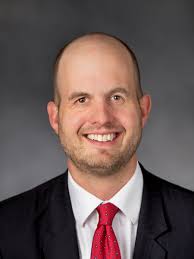
Rep. Drew Hansen

HB 1813, a bill to invest in K-12 computer science education, yesterday was passed by the Washington State House of Representatives by the overwhelming vote of 91-7. We don’t know who the 7 were, but it’s presumably the same folks who don’t like puppies.

The bipartisan measure was sponsored by Reps. Drew Hansen, D-Bainbridge Island, and Chad Magendanz, R-Issaquah.

“We want every student in the state to have the opportunity to learn computer science” said Hansen.

chad

Rep. Chad Magendanz

“Seventy percent of job growth is in computer science, yet only ten percent of our high schools offer computer science classes,” noted Magendanz. “This is the most significant thing we can do to increase the opportunity for our children, our next generation, our future workforce …”

Read more here and here. Read more →

“The best universities in the world are now judged by the quality of their computer science departments”

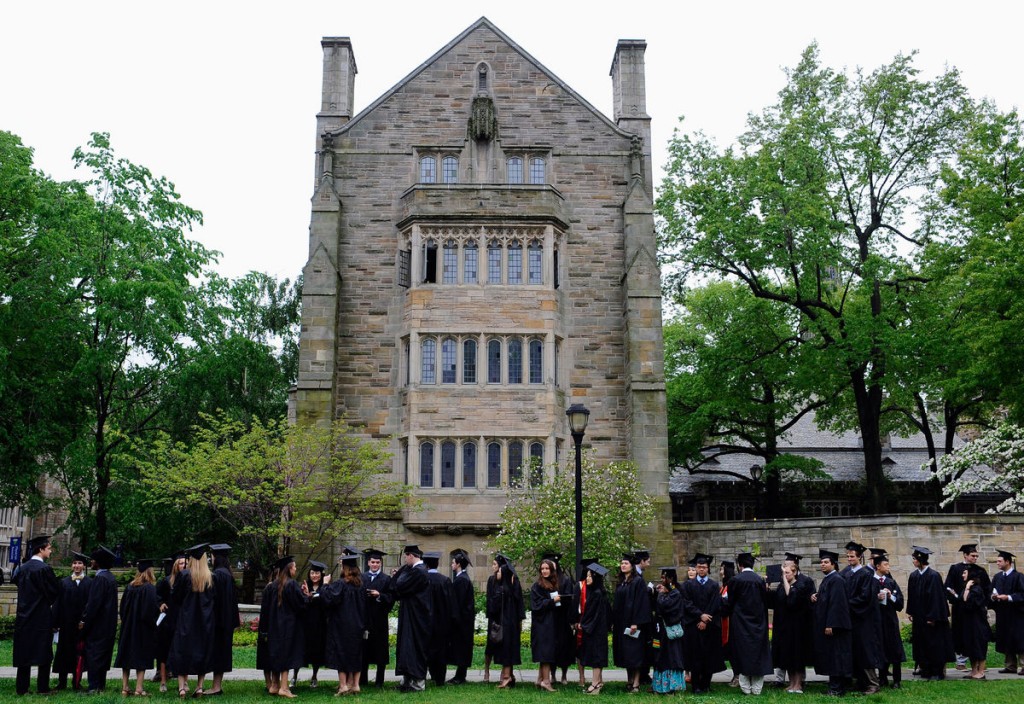
Or so says a petition being circulated at Yale, where students are pushing for increased investment in the field.

yaleBloomberg Business writes:

“Want a Job in Silicon Valley After Yale? Good Luck With That …

“Yale, one of the world’s top universities in most respects, has fallen behind in computer science. It doesn’t crack the highest tier of schools measured by the number of graduates in software companies or by salaries for majors in the discipline; it’s struggling to educate throngs of students with a faculty about the same size as three decades ago; top students in the field are opting to enroll elsewhere; the head of its computer science department is publicly complaining; and undergraduates are circulating a petition in protest …

“‘These are skills needed by anyone in the modern age,’ says Jeannette Wing, who oversees research labs worldwide for Microsoft. All students should learn programming, even those studying such fields as archeology and English, she says …”

“It’s a fine smaller program,” says Ed Lazowska, a computer science professor at the University of Washington, one of the top-ranked programs in the country.”

Read more here. Read more →

Leaders write in support of K-12 Computer Science in WA

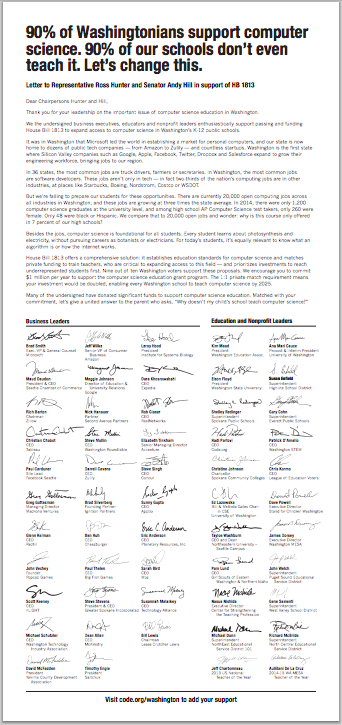
unnamedA group of top business, education, and non-profit leaders – including Ana Mari Cauce and Ed Lazowska from UW – have written in support of HB 1813, stating:

“House Bill 1813 offers a comprehensive solution: it establishes education standards for computer science and matches private funding to train teachers, who are critical to expanding access to this field – and prioritizes investments to reach underrepresented students first. Nine out of 10 Washington voters support these proposals. We encourage you to commit $1 million per year to support the computer science education grant program. The 1:1 private match requirement means your investment would be doubled, enabling every Washington school to teach computer science by 2025.”

Read more here.

And check out a related op-ed in today’s Seattle Times by Code.org’s Hadi Partovi:

“When I was 9, my father gave my brother and me a life-changing gift: a Commodore 64 computer. It didn’t have any games, so I would learn to make my own. A world of opportunity and creativity opened up to me when I began learning how to program that computer.

“By my teenage years, I landed jobs as a computer programmer when my friends were baby-sitting or waiting tables. I graduated with a job at Microsoft and went on to enjoy a successful career in technology. As an immigrant, I’m living the American dream.

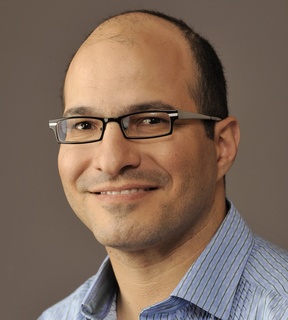
hadi_partovi“Yet, 30 years after I came to the United States, I look around and wonder, why aren’t America’s schools offering the opportunity I had to every 21st-century child?”

Read more here.

And be sure to check out a related letter regarding partial funding for an expanded facility for UW Computer Science & Engineering, signed last week by 23 leaders – here. Read more →

UW CSE’s Ed Lazowska on current efforts in the WA legislature to increase computer science educational opportunities

Picture 110UW CSE’s Ed Lazowska writes in the WTIA blog:

“Our industry creates a wide variety of jobs, employing people with a wide variety of preparation.  But at its heart, our industry (and our state’s overall economic growth) is powered by the “essential ICT occupations” as defined  in WTIA’s recent ICT Economic & Fiscal Impact Study

“There are several moves afoot in the current legislative session that would make a real difference if enacted.

“One is H.B. 1813, introduced by Reps. Drew Hansen and Chad Magendanz, which includes a number of smart provisions related to computer science in K-12.

“A second is the Governor’s request, in his capital budget, for partial funding of a second building to accommodate growth for UW CSE …

“A third is work by Reps. Hansen and Magendanz that will hopefully lead to operating funds enabling expansion of the computer science programs at UW CSE, WSU EECS, and WWU Computer Science – the three programs that leading employers have told these legislators are their principal in-state suppliers of talent.”

Read more here. Read more →

“Insight to Impact: Transforming Washington’s Industries Through Big Data”

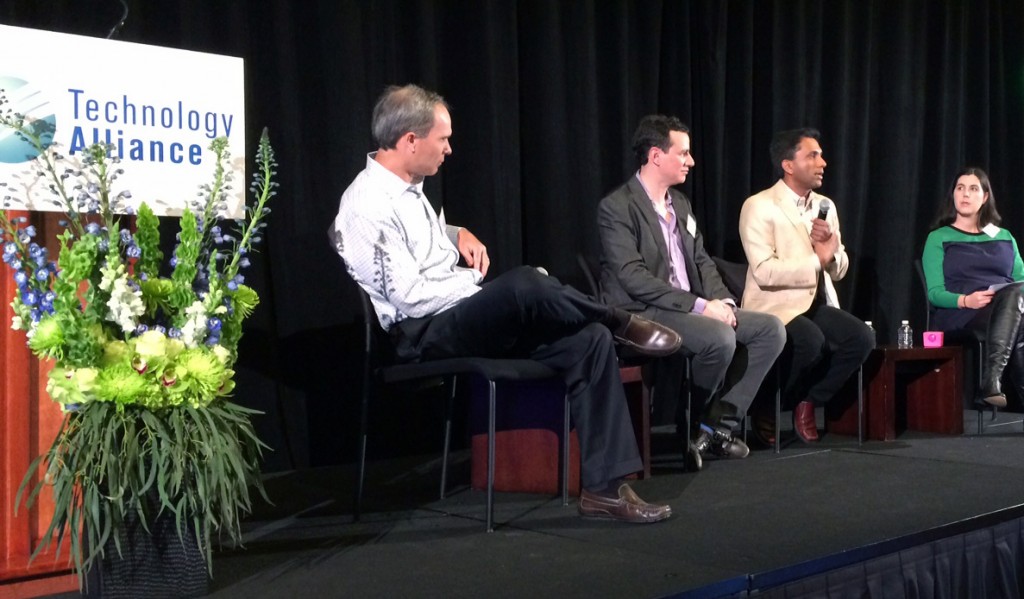
TAMatt McIlwain (Madrona Venture Group), Carlos Guestrin (UW CSE and Dato), Joseph Sirosh (Microsoft), and Dina Bass (Bloomberg News) engage the audience at “Insight to Impact: Transforming Washington’s Industries Through Big Data,” co-sponsored by the Technology Alliance and UW CSE.

More about the event here. Read more →

« Newer PostsOlder Posts »