The announcement read:
This Friday, 5/8 at 4:30 in the Atrium, we will be holding the 3rd annual Notkinfest TGIF to celebrate the life of former CSE chair David Notkin! Come, eat, drink, and enjoy exciting beard-related activities, which in past years have included “Make your own Notkin beard” and “Pin the beard on the Notkin.” There will be prizes in benson store credit** for “Best Beard” and “Most Creative Beard.”
Check out pictures from Notkinfest 2014 and from the 0th annual Notkinfest (on David’s retirement as chair).
**$43 will be split between the winners to honor the impressively low number of times David wore a tie as CSE chair. He wore a tie only 43/1672 days as chair, for an average of 38 no-tie days for every day wearing a tie. Check out his
complete list of tie occasions.
We were particularly pleased that David’s wife Cathy and daughter Emma were able to join this year’s activities!
We miss you, David! Read more →
 We missed April’s announcement of “Best Papers” at the 2015 ACM Conference on Human Factors in Computing Systems (CHI 2015). Three had UW CSE ties:
Sangeet Swara: A Community-Moderated Voice Forum in Rural India, by UW CSE Ph.D. student Aditya Vashistha, MSR India researcher Ed Cutrell, the late UW CSE professor Gaetano Borriello, and MSR India researcher Bill Thies.
From User-Centered to Adoption-Centered Design: A Case Study of an HCI Research Innovation Becoming a Product, by University of Waterloo Management Sciences faculty member (and UW iSchool Ph.D. alum) Parmit Chilana, and UW iSchool faculty members (and UW CSE Adjunct faculty members) Andy Ko and Jake Wobbrock.
Unequal Representation and Gender Stereotypes in Image Search Results for Occupation, by UW CSE Ph.D. student Matthew Kay, UW CSE Ph.D. alum (and UMBC faculty member) Cynthia Matuszek, and UW HCDE faculty member (and UW CSE Adjunct faculty member) Sean Munson.
Congratulations! Read more →
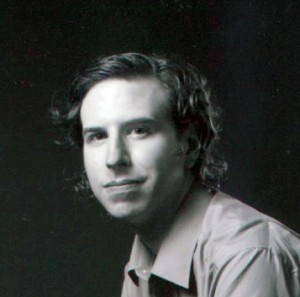 Noah Smith has not yet arrived in Seattle as a member of the UW CSE faculty, but we’ll over-reach and claim partial credit for his “Best Paper” Award at the 2015 Conference of the North American Chapter of the Association for Computational Linguistics – Human Language Technologies (NAACL HLT 2015).
The paper – Retrofitting Word Vectors to Semantic Lexicons – describes “retrofitting,” a new way to improve any vector encodings of words in English (or any language) using existing semantic lexicons that link words with similar or related meanings.
Noah’s co-authors include UW CSE undergrad alum (and CMU Ph.D. student and soon-to-be UW CSE visiting Ph.D. student) Jesse Dodge, and CMU co-authors Manaal Faruqui, Sujay Kumar Jauhar, Chris Dyer, and Eduard Hovy. Read more →
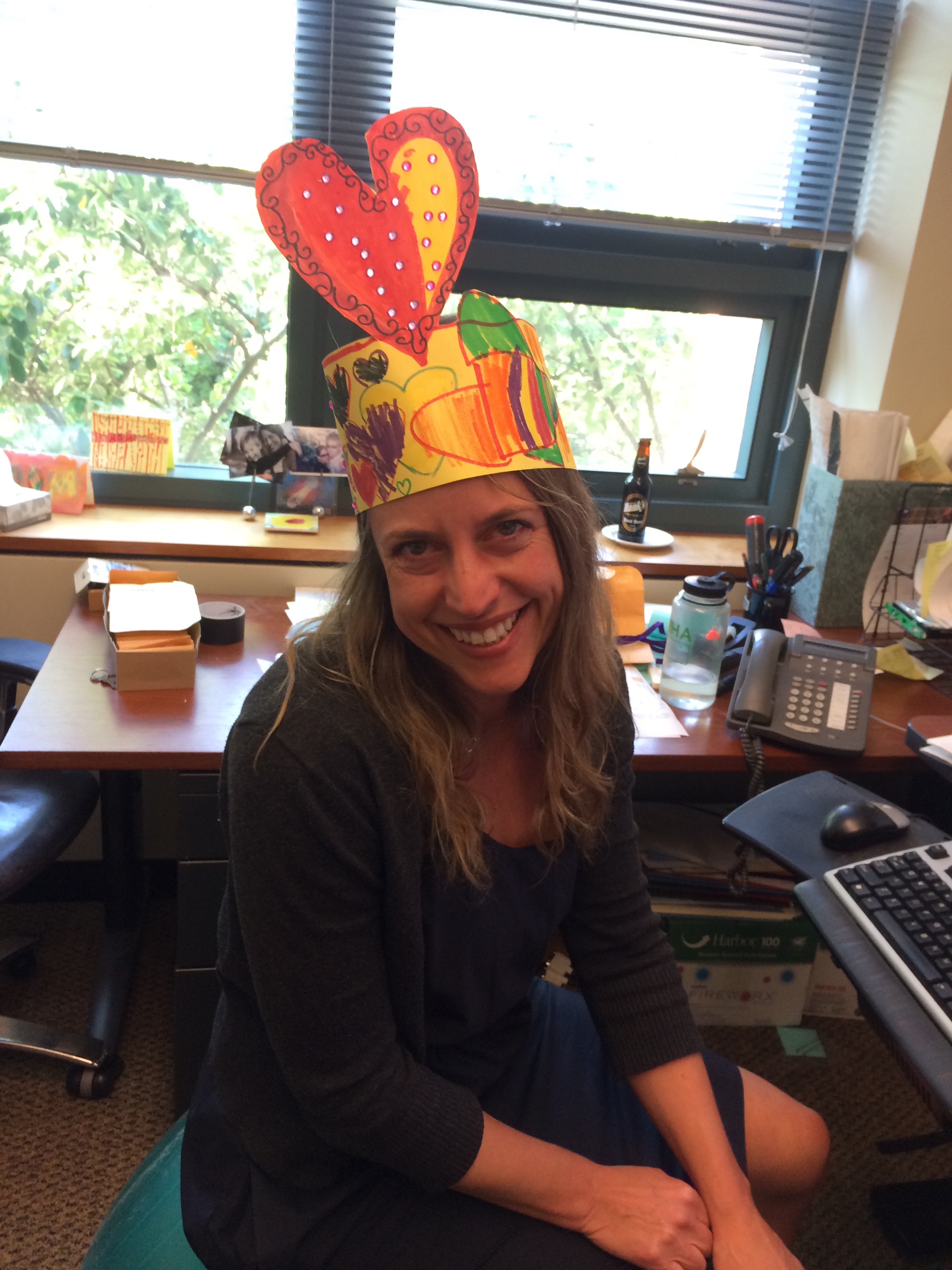 Did your son make you a Mother’s Day hat and ask you to wear it at work? CSE Facilities Manager Tracy Erbeck’s son did! Read more →
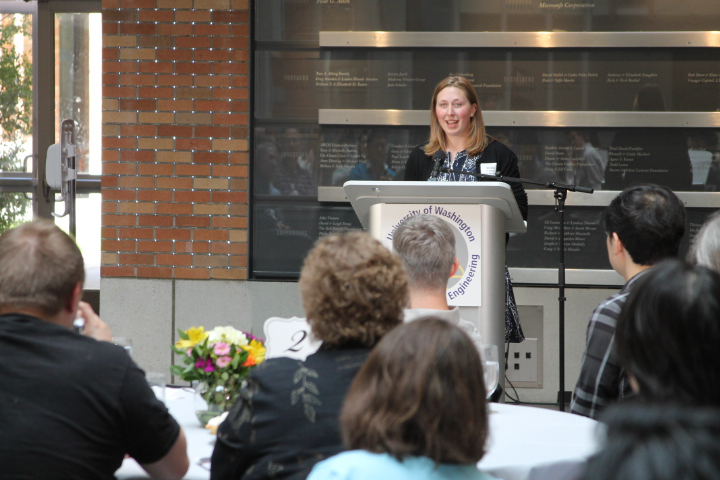
Computer Engineering junior undergraduate Mattie Carlson speaks to attendees at UW CSE’s 2015 Donor/Scholar Recognition Luncheon
UW CSE is fortunate to have 28 endowed undergraduate scholarships and 18 endowed graduate fellowships available as departmental awards. Each spring we host a luncheon to recognize the donors of our scholarships and fellowships, and the outstanding students who are the beneficiaries of this generosity. It’s one of our favorite events of the year!
At the undergraduate level, scholarships allow Washington’s top students to get a UW CSE education, regardless of family circumstances. At the graduate level, fellowships allow us to attract to UW CSE the very best students from across the nation and around the world.
Undergraduate student Mattie Carlson (holder of the John Wisniewski Endowed Scholarship) and graduate student Carlo del Mundo (holder of the Dora Zee Ling Endowed Fellowship) represented their fellow students in describing to the donors what these awards mean to them.
Many thanks to our generous donors, and hearty congratulations to our outstanding undergraduate and graduate students!
Check out the luncheon brochure, describing our scholarships, fellowships, donors, and recipients, here. Read more →
 UW CSE has scored a 2014-15 academic year hat trick: “Best Paper” Awards at all three of the “DI” conferences:
Go team! Read more →
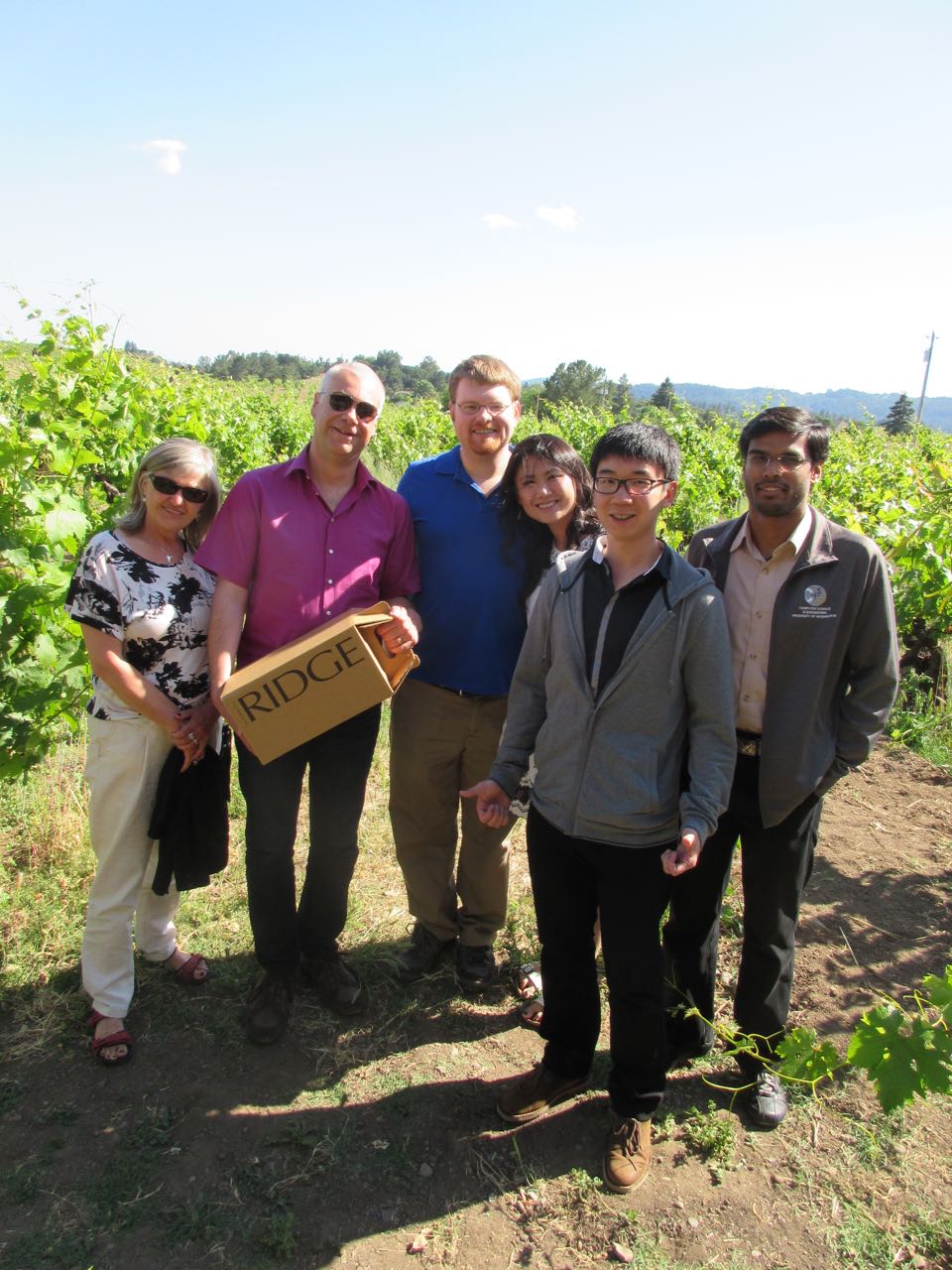
Right-to-left: Naveen Kr. Sharma, Jialin Li, Irene Zhang, Dan Ports, Mothy Roscoe (ETH), Mothy’s partner Elaine Vautier
UW CSE systems lab members (and friends) celebrate their award paper at NSDI with a visit to Ridge, “The Official Winery of UW CSE” – a tradition we inherited from Andrew Birrell and Mike Schroeder during their Xerox PARC CSL and DEC SRC days.
(Ridge was in fact established by engineers who worked at SRI for UW CSE’s founding chair, Jerre Noe. Jerre’s younger son Russ worked at Ridge in high school, which made it impossible for him to drink plonk with his friends in college …) Read more →
 UW CSE graduate student Pavel Panchekha, undergraduate student Alex Sanchez-Stern, graduate student James R. Wilcox, and professor Zachary Tatlock have received a “Best Paper” award at PLDI 2015, the 36th annual ACM SIGPLAN Conference on Programming Language Design and Implementation, for their paper “Automatically Improving Accuracy for Floating Point Expressions.”
The paper describes Herbie, a tool that automatically discovers and applies numerical analysis techniques to improve the accuracy of programs without requiring any specialized knowledge from the user.
Check out the Herbie project web page here.
Congratulations Pavel, Alex, James, and Zach! Read more →
 A team of faculty and students from UW CSE’s Computer Systems Lab today received the Best Paper Award at the 12th USENIX Symposium on Networked Systems Design and Implementation (NSDI ’15) for the paper “Designing Distributed Systems Using Approximate Synchrony in Data Center Networks.” The team was led by UW CSE professor Dan Ports, and included UW CSE graduate students Jialin Li, Vincent Liu, and Naveen Kr. Sharma, and UW CSE professor Arvind Krishnamurthy.
UW CSE has an amazing record of Best Paper Awards in NSDI – the premier venue for presenting distributed systems research. The list now includes:
- NSDI ’15: “Designing Distributed Systems Using Approximate Synchrony in Data Center Networks” by Dan R.K. Ports, Jialin Li, Vincent Liu, Naveen Kr. Sharma, and Arvind Krishnamurthy.
- NSDI ’13: “F10: A Fault-Tolerant Engineered Network” by Vincent Liu, Dan Halperin, Arvind Krishnamurthy, and Tom Anderson.
- NSDI ’10: “Reverse Traceroute” by Ethan Katz-Bassett, Harsha V. Madhyastha, Vijay Kumar Adhikari, Colin Scott, Justine Sherry, Peter van Wesep, Tom Anderson, and Arvind Krishnamurthy.
- NSDI ’08: “Consensus Routing: The Internet as a Distributed System” by John P. John, Ethan Katz-Bassett, Arvind Krishnamurthy, Tom Anderson, and Arun Venkataramani.
- NSDI ’07: “Do Incentives Build Robustness in BitTorrent?” by Michael Piatek, Tomas Isdal, Tom Anderson, Arvind Krishnamurthy, and Arun Venkataramani.
(And Arvind seems to have had his fingers in all five!)
Congratulations Dan, Jialin, Vincent, Naveen, and Arvind! (Check out the “Speculative Paxos” project web page here.) Read more →
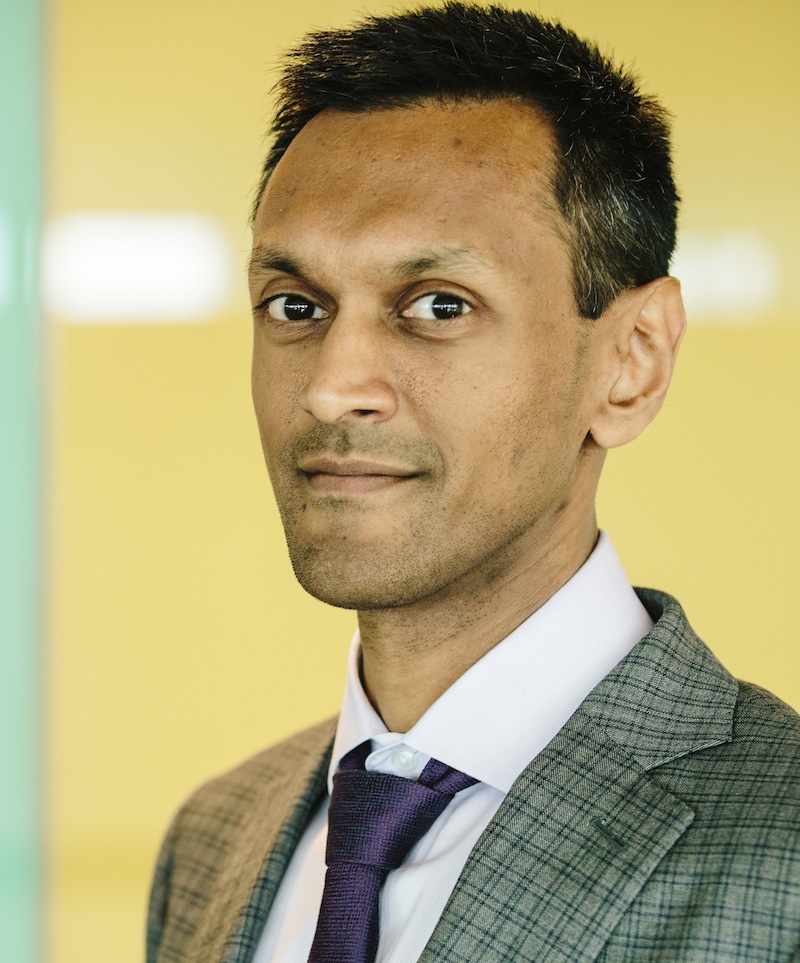 Sham Kakade, a world-class expert in statistical machine learning, will join the University of Washington this fall as the holder of a Washington Research Foundation Data Science Chair appointed jointly in Computer Science & Engineering and Statistics, expanding UW’s excellence in data science and strengthening the connection between these two highly ranked programs.
Sham is currently Principal Research Scientist at Microsoft Research, New England. His research has ranged from economics to neuroscience to applied and theoretical machine learning and their intersection. He has made significant contributions to semi-supervised learning, online learning, reinforcement learning, and learning of latent-variable and hidden Markov models.
Prior to Microsoft Research, Sham was Associate Professor in the Wharton Statistics Department at University of Pennsylvania and Assistant Professor at Toyota Technological Institute, Chicago. He received his Ph.D. at the University College London Gatsby Computational Neuroscience Unit and his B.S. in Physics at Caltech.
Sham joins UW’s outstanding machine learning faculty including Carlos Guestrin, Pedro Domingos, Emily Fox, Daniela Witten, Marina Meila, Jeff Bilmes, Mathias Drton, Maryam Fazel, Noah Simon, and Thomas Richardson. Read more →