The CNN 10: Mind control over the Internet

cnn1CNN manages to sensationalize the research of UW CSE’s Rajesh Rao:

“The idea of mind control usually invokes scenes from sci-fi or horror movies, such as “Star Trek’s” Vulcan mind-meld, spiritual possession, malevolent hypnosis or malfunctioning implants.

“Well, get ready. Human brain-to-brain interfacing – via the Internet, no less – is becoming part real life. And it’s not the stuff of horror at all.

“In August, a team of researchers at the University of Washington managed to connect their brains using non-invasive technology. Rajesh Rao, a UW computer science and engineering professor, put on an electrode-studded cap and watched a video game, ‘playing’ it with his mind. Across campus, UW psychology professor Andrea Stocco wore a swim-style cap that had a portion equipped with a magnetic stimulation coil.

“When Rao thought of hitting a button, a signal was sent online to Stocco’s lab, and his finger twitched on his keyboard. It was long-distance telepathy, of sorts.”

Read more here. Read more →

Washington: “The Most Innovative State” according to Bloomberg

iemrzUdf3gK8A new Bloomberg study ranks Washington #1 among the states for innovation.

The study considers six factors: STEM professionals as % of state population; science and tech degree holders as % of population; utility patents granted as % of US total; state government R&D spending as % of US total; gross state product per employed person; three-year change in productivity; and public tech companies as % of all public companies.

Washington is followed (in order) by California, Massachusetts, and Connecticut.  Oregon, New York, New Jersey, Colorado, Maryland, and Minnesota round out the top ten.

The associated article extensively quotes UW CSE’s Ed Lazowska:

“The state’s strong engineering roots go back to Boeing Co., the airplane manufacturer that was based in Seattle until 2001 and still has extensive manufacturing operations in the Puget Sound area. The company attracted not just employees but also suppliers to the area, said Ed Lazowska, who holds the Bill & Melinda Gates chair in Computer Science & Engineering at the University of Washington in Seattle.

“Microsoft’s 1979 move to the suburbs of Seattle from Albuquerque, New Mexico, attracted computer engineers throughout the 1980s and 1990s, as did other area companies such as Aldus Corp., the maker of publishing-software PageMaker. Nintendo Co. chose Redmond, Washington, as its U.S. headquarters, pulling in game developers, Lazowska said.

matt“Former employees of these companies have gone on to found local startups in and around Seattle. The availability of top engineers has attracted technology firms such as Google, Facebook Inc. and Salesforce.com, which have set up large offices in the area.

“‘These companies move here because we, in fact, have a phenomenal workforce,’ Lazowska said.

“Washington state ‘arguably owns the cloud,’ said Lazowska, referring to computing services delivered via the Web that are offered by companies such as Amazon and Microsoft. The area also boasts a strong presence in segments such as data analytics and storage.

“Internet firms such as Zillow Inc. and Expedia Inc. merge the region’s strength in retail – as seen with local companies such as Nordstrom Inc., Starbucks Corp. and Costco Wholesale Corp. – with technology expertise, Lazowska said …

“While the technology industry benefits the state, residents and lawmakers should have one major concern, said Lazowska – how poorly Washington does educating local students. The economy was built by a labor force educated elsewhere, and Washington rates 49th in the U.S. in the number of students who graduate with bachelor’s degrees from public universities, he said. There aren’t enough spots for university students in areas such as computer science, he said.

“‘It’s a question for the kids that grow up here,’ he said. ‘Are they going to be first-tier participants in this economy, or are they going to be washing people’s cars and selling them cars?'”

The Bloomberg article also quotes Sunny Gupta, CEO of the booming Madrona company Apptio, and before that at Opsware (acquired by HP), iConclude (acquired by Opsware), Mercury Interactive, and Madrona-funded UW CSE startup Performant (acquired by Mercury Interactive):  “‘I am a big believer in the state of Washington,’ said Sunny Gupta, co-founder, president and chief executive officer of software-maker Apptio Inc. in Bellevue, Washington, who said he chose to live in the Seattle region over the San Francisco Bay area. ‘It really comes down to having an incredible network effect, primarily dominated by Microsoft and Amazon but also a lot of great entrepreneurial talent.'”

Slideshow here.

Tabular rankings here.

Full Bloomberg article here.

Bloomberg TV interview with Madrona’s Matt McIlwain here.

GeekWire post here. Read more →

UW CSE, PATH share $1M Gates Foundation Grand Challenges Exploration grant

Untitled-1UW CSE and PATH (Seattle’s international non-profit focused on global health) will share a $1 million grant from the Bill & Melinda Gates Foundation’s Grand Challenges Explorations initiative to expand access to donated breast milk by simplifying human milk banking. The two-year, follow-on grant recognizes successful projects with additional funding, allowing UW CSE and PATH to build on work already under way.

The award will help UW CSE and PATH scale up a novel milk pasteurization monitor as part of a low-cost quality-control system to support the integration of human milk banking with a comprehensive breastfeeding awareness initiative to improve neonatal health. Donated breast milk safely pasteurized and stored at human milk banks can provide lifesaving nutrition for infants whose mothers’ milk is unavailable, especially for infants who are premature or otherwise vulnerable. Working with the Human Milk Bank Association of South Africa, UW CSE and PATH piloted an easy-to-use, mobile phone-based system called FoneAstra that gives users simple audio and visual instructions for safe pasteurization.

Read more here.  Learn about FoneAstra – work by UW CSE’s Rohit Chaudhri, Gaetano Borriello, and Richard Anderson – here. Read more →

UW CSE’s Richard Ladner profiled in livfun

LFp1UW CSE professor Richard Ladner is profiled in livfun, a magazine targeted at seniors:

“He laughed when I asked him about his plans to retire. ‘I have partially retired. I’m no longer teaching. Of course, I’m not paid as much, but I really like working with students on projects. I’m on various boards and doing different things for different organizations.’

“‘Do you want to retire?’ I asked.

“‘Only from things I don’t want to do. It seems like every year something interesting comes up, and I just pursue it.’

“‘It’s almost as if you’re built for the encore career.’

“‘Exactly,’ he said. ‘It’s not that hard to have an encore career if you’re a professor.'”

Read more here. Read more →

UW CSE hosts 246 students for high school programming competition

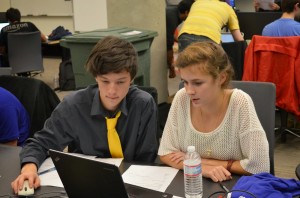
DSC_0968On Saturday – concluding Computer Science Education Week – 246 students on 94 teams representing 24 high schools participated in a Computer Science Education Week high school programming competition held at UW’s Paul G. Allen Center for Computer Science & Engineering and hosted jointly by UW CSE and the Puget Sound chapter of the Computer Science Teachers Association (CSTA).  The event was generously sponsored by Microsoft.

Check out the photographs and results!

Learn about DawgBytes (“A Taste of CSE”), UW CSE’s K-12 outreach effort, here. Read more →

The Hour Of Code: >500M lines of code written by >15M students!

CSEWComputer Science Education Week 2013 was an off-the-scale success, with The Hour Of Code capturing the imaginations of students, teachers, parents, and policymakers nationwide!  More than 15,000,000 students participated in The Hour Of Code, writing more than 500,000,000 lines of code!

The tide is turning!  Computer science, computational thinking, and computer programming are fundamental capabilities for the 21st century!

Be sure to watch the Hour of Code video here. Read more →

US Representative Suzan DelBene discusses UW CSE’s OneBusAway on floor of House

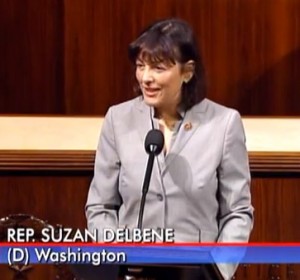
obaRep. Suzan DelBene attacks patent trolls on the floor of the US House of Representatives, using as her example Arrival Star’s lawsuit against King County Metro and a number of other transit agencies alleging infringement of an overly-broad and unpracticed patent by public transit apps including UW CSE’s widely-used and widely-emulated OneBusAway.

Watch the video here. Read more →

Alisha Saxena recognized in 2014 National NCWIT Award for Aspirations in Computing competition

Alisha Saxena cropCongratulations to Alisha Saxena of Bellevue’s Interlake High School, who has been named a Winner in the 2014 National NCWIT Award for Aspirations in Computing.

Alisha, a hugely accomplished student who is a National Merit Semifinalist, is conducting research in UW CSE’s Security and Privacy Research Laboratory, where she is being mentored by Ph.D. student Franzi Roesner and professor Yoshi Kohno. Read more →

Broadband in Seattle

seattlefiber2-1024x682GeekWire reports on the apparent collapse of Gigabit Squared’s efforts to provide high-bandwidth Internet at a reasonable price to Seattle neighborhoods.

“Whether or not Gigabit Squared can pull off the project, the fundamental concept of leveraging the city’s existing fiber network is a good one, Lazowska said. He said ‘the idea of the city making its fiber available to others as an alternative to Comcast and CenturyLink is excellent. There shouldn’t be any debate about that. We have terrible Internet service in Seattle — high price, low bandwidth, limited choices.”

Read more here. Read more →

CSE Martina Unutzer – Honorable Mention in CRA 2014 Outstanding Undergraduate Researcher Award

munutzerUW CSE undergraduate Martina Unutzer has received an Honorable Mention in the 2014 Computing Research Association Outstanding Undergraduate Researcher Award competition, which recognizes undergraduate students in North American colleges and universities who show outstanding research potential in an area of computing research.

Martina’s research, with UW CSE professor Magda Balazinska and UW Astronomy research scientist Ben Williams, has completely transformed the way our astronomy colleagues handle artifacts (due to cosmic rays) in their databases of stars. Magda writes: “I would meet with her not to advise her on what to do but to get up to speed on what she had already done! This is a degree of autonomy that one dreams about in graduate students!”

Engagement in research is a hallmark of UW CSE’s undergraduate program: as of last year, CRA had recognized more students from UW CSE in the past decade than from any other university.

Congratulations to Martina, and to all of our outstanding undergraduates! Read more →

« Newer PostsOlder Posts »