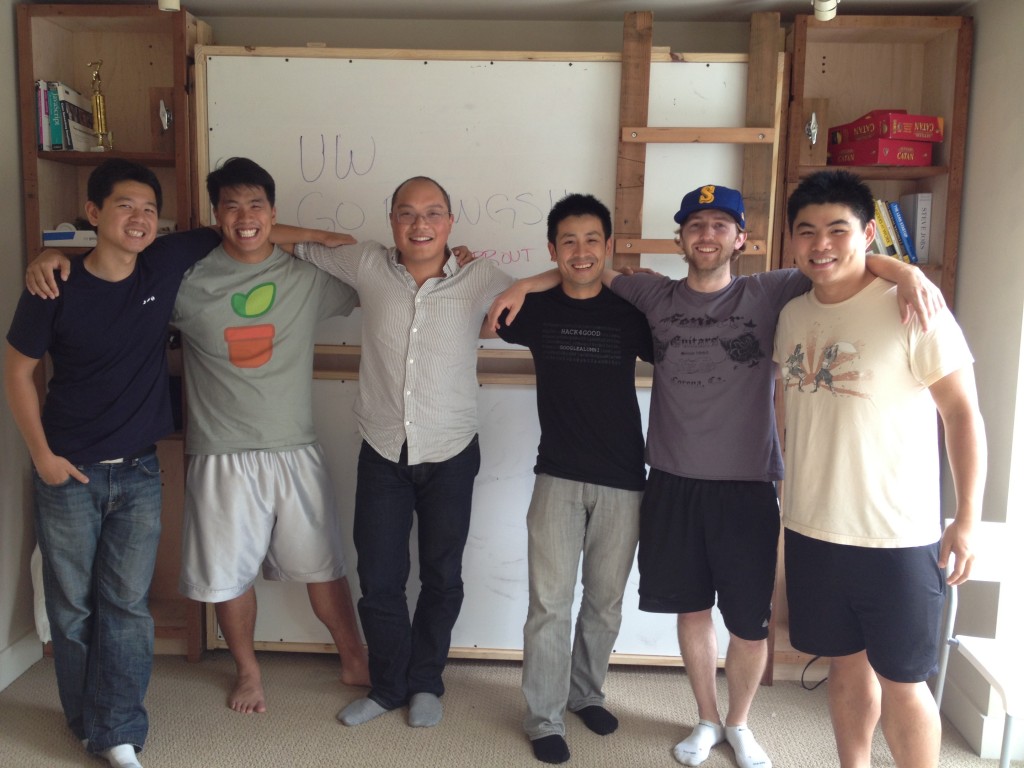
 LearnSprout, a Bay Area startup, is loaded with UW CSE alums. Pictured are Frank Chien, Alex Meng, Jonathan Fung, Anthony Wu, Alex Odle, and Joe Woo. That whiteboard behind them? It converts to a bed – check out the video here. Read more →

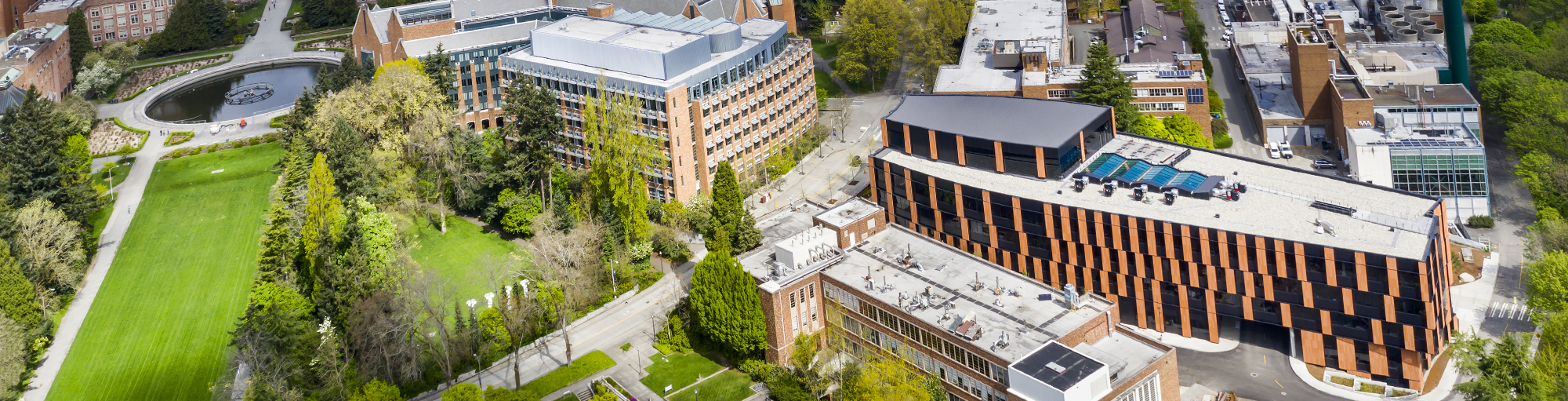
UW CSE @ LearnSprout
Bumper crop of UW CSE seniors heading to graduate school
 It’s been a great year for UW CSE seniors gaining admission to the nation’s top graduate programs:
- David Colmenares, Jesse Dodge, Ekaterina Nepomnyashchaya, and Sor Sukkerd are headed to CMU (David in Mechanical Engineering).
- Sam Hopkins, Jonathan Shi, and Laure Thompson are headed to Cornell.
- Jerry Li is headed to MIT.
- Kevin Clark is headed to Stanford (after a gap year).
- Chris Dentel and Bennett Ng are headed to Berkeley (Bennett in Bioengineering).
- Changhou Han is headed to UCSD.
- Christopher Clark is headed to the University of Edinburgh.
- Melanie Jensenworth is headed to the University of Waterloo.
- Gregory Herman is headed to Colorado State (in Atmospheric Sciences).
- Shanshan Sun is headed to Washington State.
- Alexandre Bykov, Priya Rao Chagaleti, Forrest Coward, Mark Davis, Daryl Hansen, Pingyang He, Mike Hotan, Stephen Jonany, Bryce Kellog, Hye In Kim, Daseul Lee, Ajay Menon, Tyler Rigsby, Jacob Sanders, and Brian Walker will be entering UW CSE’s 5th-year Masters program.
We love being a top supplier of new graduates to Amazon.com, Google, Microsoft, and many smaller Seattle-area companies and startups. But we also love seeing our students heading off to continue their education and pursue careers in research.
Go team! Read more →
CRA and ACM honor David Notkin
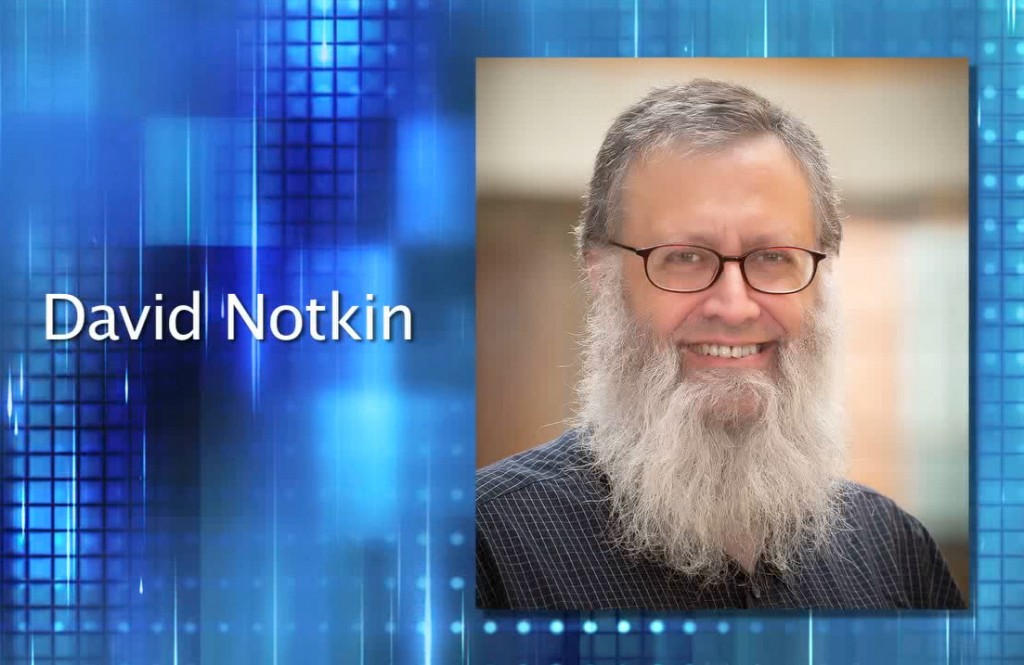 At the ACM Awards Banquet in San Francisco on Saturday, CSE’s David Notkin was posthumously recognized with the CRA A. Nico Habermann Award for his many contributions to advancing members of under-represented groups – particularly women – in computing. The award was accepted by David’s daughter Emma and son Akiva.
This lovely tribute video to David and to his Ph.D. advisor Nico Habermann was produced by ACM and shown at the Awards Banquet.
Thanks to CRA and ACM for honoring David.
Learn more about David’s many contributions, and about other tributes to him, here. Read more →
UW CSE at the ACM Awards Banquet
 UW CSE was well represented on the stage at the 2013 ACM Awards Banquet gala in San Francisco on Saturday evening (coinciding, unfortunately, with UW’s commencement exercises, which were a week later than usual this year):
New faculty addition Shyam Gollakota received the Doctoral Dissertation Award for his MIT dissertation “Embracing Interference in Wireless Systems,” supervised by Dina Katabi.
Ph.D. alum Jeff Dean, along with his colleague Sanjay Ghemawat, received the ACM – Infosys Foundation Award in the Computing Sciences for the conception, design, and implementation of much of Google’s revolutionary software infrastructure.
Faculty member Anna Karlin, former faculty member (and bachelors alum) Hans-J. Boehm, and Ph.D. alum David Grove were elected ACM Fellows for their contributions to the field.
Faculty member David Notkin received the CRA A. Nico Habermann Award posthumously; it was accepted by his daughter Emma and his son Akiva; Emma made some moving remarks, and ACM prepared a lovely video tribute to David which we hope to be able to post shortly.
Congratulations to Shyam, Jeff, Anna, and Hans. David, we are thinking of you. Read more →
A third IEEE Micro “Top Pick” for UW CSE’s Hadi Esmaeilzadeh
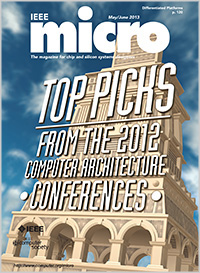 Hadi Esmaeilzadeh transferred from UT Austin to the University of Washington several years ago, when his advisor Doug Burger joined Microsoft Research.
Since his arrival at UW, Hadi has had an extraordinary string of three IEEE Micro “Top Picks” papers – roughly ten papers selected annually as the very best to have appeared in the various computer architecture conferences during the year, and re-printed in a special issue of IEEE Micro.
Hadi’s third “Top Picks” paper has just appeared: “Neural Acceleration for General-Purpose Approximate Programs,” co-authored with fellow UW CSE graduate student Adrian Sampson, and with Hadi’s co-advisors, Burger and UW CSE’s Luis Ceze. The paper proposes an approximate algorithmic transformation and a new class of accelerators, Neural Processing Units (NPUs). NPUs leverage our approximate algorithmic transformation that converts regions of code from a Von Neumann model to a neural model and achieve an average 2.3x speedup and 3.0x energy savings for general-purpose approximate programs. This new class of accelerators show that significant performance and efficiency gains are possible when the abstraction of full accuracy is relaxed in general-purpose computing.
Hadi is completing his Ph.D. and will join the faculty at the Georgia Institute of Technology in the fall as the first holder of the Catherine M. and James E. Allchin Early Career Professorship.
Congratulations Hadi!
Read the paper here. See the IEEE Micro “Top Picks” special issue here. Read more →
“Forget MOOCs – Let’s use MOOA”
 “As colleges begin using massive open online courses (MOOC) to reduce faculty costs, a Johns Hopkins University professor has announced plans for MOOA: Massive Open Online Administrations. Dr. Benjamin Ginsberg … says that many colleges and universities face the same administrative issues every day. By having one experienced group of administrators make decisions for hundreds of campuses simultaneously, MOOA would help address these problems expeditiously and economically. Since MOOA would allow colleges to dispense with most of their own administrators, it would generate substantial cost savings in higher education.
“‘Studies show that about 30 percent of the cost increases in higher education over the past twenty-five years have been the result of administrative growth,’ Ginsberg noted. He suggested that MOOA can reverse this spending growth. ‘Currently, hundreds, even thousands, of vice provosts and assistant deans attend the same meetings and undertake the same activities on campuses around the U.S. every day,’ he said. ‘Imagine the cost savings if one vice provost could make these decisions for hundreds of campuses.'”
Read more here.
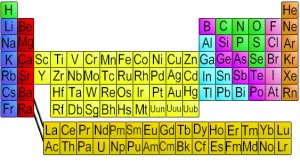 Related: Recall the breakthrough 1988 discovery of Administratium:
“The heaviest element known to science was recently discovered by investigators at a major U.S. research university. The element, tentatively named Administratium, has no protons or electrons and thus has an atomic number of 0. However, it does have one neutron, 125 assistant neutrons, 75 vice neutrons and 111 assistant vice neutrons, which gives it an atomic mass of 312. These 312 particles are held together by a force that involves the continuous exchange of meson-like particles called morons.
“Since it has no electrons, Administratium is inert. However, it can be detected chemically as it impedes every reaction it comes in contact with. According to the discoverers, a minute amount of Administratium causes one reaction to take over four days to complete when it would have normally occurred in less than a second.”
Read more here. Read more →
Maya Cakmak to join UW CSE
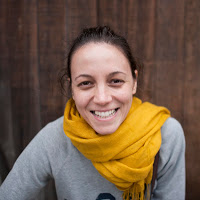 Maya Cakmak – a robotics researcher specializing in Human-Robot Interaction (HRI) and Programming by Demonstration (PbD) – will be joining the UW CSE faculty.
Maya completed her Ph.D. in Robotics at Georgia Tech in 2012. Since then she has been a post-doctoral research fellow at Willow Garage, Inc., manufacturer of personal robots and robot software. A main goal of her research is to enable non-experts to program personal robots by providing demonstrations of what they want. Maya’s work investigates challenges faced by potential users of such programmable robots and develops interaction mechanisms, learning algorithms, and interfaces to make programming by demonstration more efficient and effective.
Welcome Maya! Read more →
Farewell to Marty Stepp
On Wednesday, CSE’s 60+ undergraduate TAs plus the faculty bid a fond farewell to Marty Stepp at a surprise party in the Bill & Melinda Gates Commons. Marty – a truly phenomenal teacher – has decided to take his talents southward. Stanford students, who already benefit from a superb lecturer corps, are in for a treat.
Marty, we’re sorry to lose you – thanks for all you contributed to UW CSE, best of success in the coming years, and remember … when you eventually recognize you made a mistake, there will always be a place for you at UW CSE!

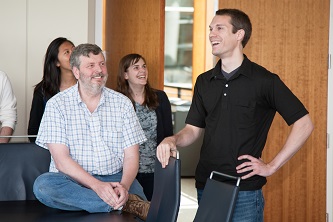

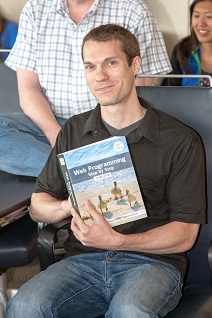
Congratulations to CSE’s 2013 graduates!
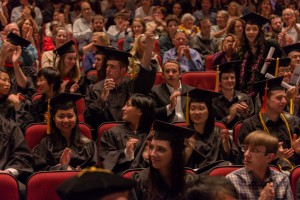
CSE students pack Meany Hall
Saturday June 15 marked the University of Washington’s 138th commencement exercises.
For CSE students, the day began at 9 a.m. with a departmental ceremony that filled Meany Hall, the largest auditorium on campus. The program recognized 203 Bachelors degree recipients in Computer Science and Computer Engineering, 85 Masters degree recipients, and 23 Ph.D. degree recipients – 311 degree recipients in all! The program also recognized the recipients of the ACM Student Chapter Teaching Award (to Magda Balazinska), the Undergraduate Service Award (to Steve Rutherford), the Outstanding Undergraduate Honors Thesis Award (Leeran Raphaely), the Outstanding Computer Science and Computer Engineering Senior Awards (to Stephen Jonany, Sam Hopkins, and Raymond Zhang), the Bob Bandes Memorial Excellence in Teaching Awards (to graduate students Elliott Brossard and Cody Schroeder, honorable mention to Caitlin Bonnar, and to undergraduate students Katlyn Edwards and Zorah Fung, with honorable mention to Michael Farrow), and the CSE Alumni Achievement Award (to Anne Dinning and Ed Felten).
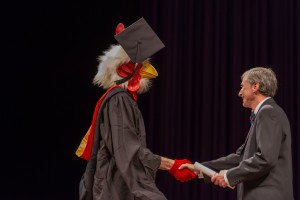
Hank Levy confers degrees
Faculty, students, parents, and friends then joined a reception in the Microsoft Atrium of the Paul G. Allen Center for Computer Science & Engineering.
In the afternoon, hardy souls trooped down to Century Link Field along with 50,000 of their closest friends for the main University of Washington commencement ceremony.
Dozens of Bruce Hemingway photographs:
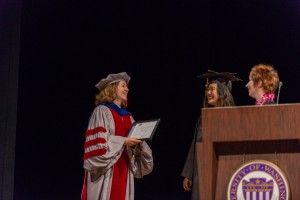
Magda Balazinska receives the ACM Undergraduate Teaching Award
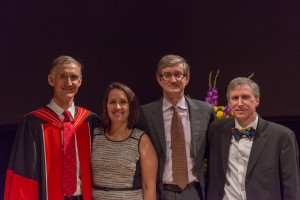
Anne Dinning and Ed Felten are honored with CSE’s 2013 Alumni Achievement Awards
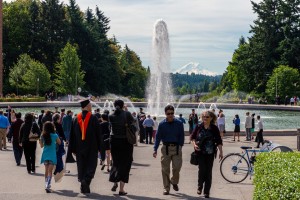
Back to the Allen Center for a reception, on an extraordinary Seattle morning
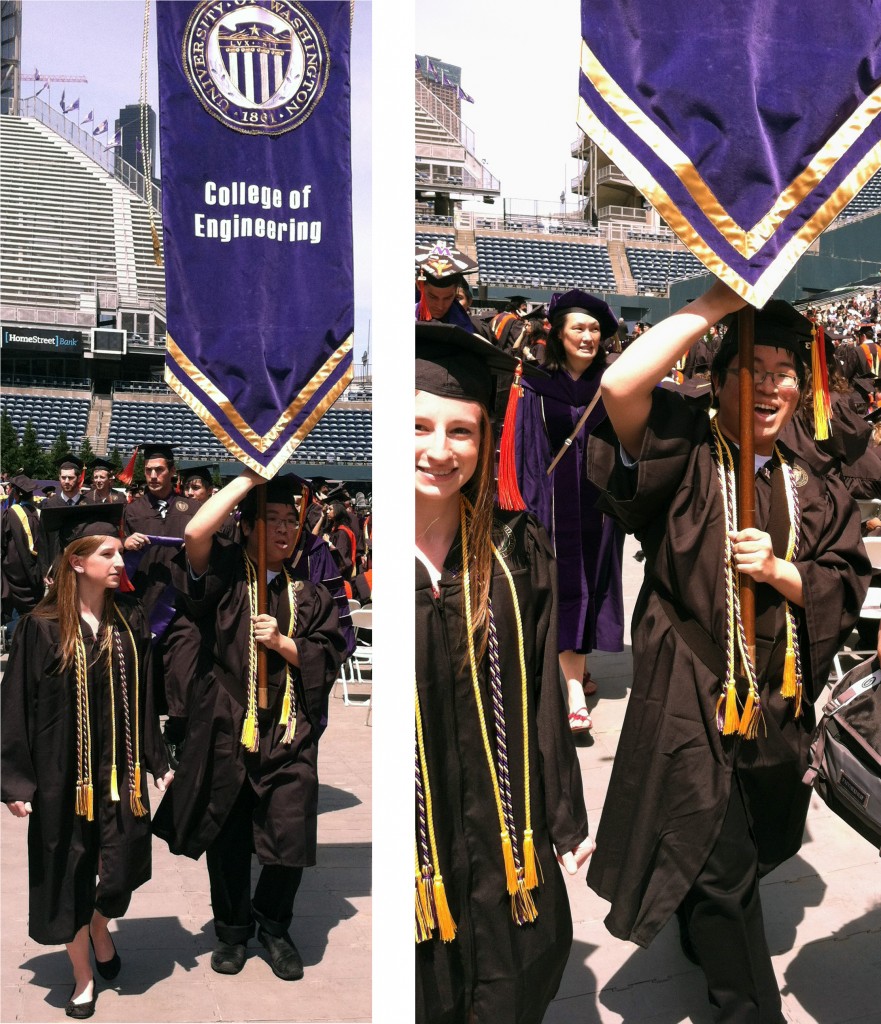
Later, CSE’s Raymond Zhang, 2013 Engineering Dean’s Medalist, leads Engineering graduates into Century Link Field for UW’s commencement ceremonies
Anne Dinning (B.S. ’84) and Ed Felten (Ph.D. ’93) receive UW CSE 2013 Alumni Achievement Awards
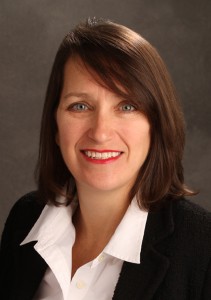 At commencement each spring, UW CSE recognizes two alums with Alumni Achievement Awards.
This year’s recipients – who will join us for a celebratory dinner on Friday June 14 and again at our commencement on the morning of Saturday June 15th – are Anne Dinning and Ed Felten.
Anne received her Bachelors degree from UW CSE in 1984, where she did research with Professor Richard Ladner. After working in Seattle for a year, she moved to New York and received her Ph.D. in computer science from the Courant Institute at NYU. She turned down a number of attractive faculty positions to become an early employee of D. E. Shaw, the hedge fund established by Columbia University computer science professor David Shaw. Today Anne is “first among equals” on the executive committee that oversees D. E. Shaw’s more than 1,000 employees, managing $26 billion in investment capital.
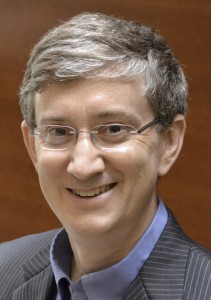 Ed, a Caltech physics undergraduate, worked for several years as an analyst with Caltech’s Concurrent Computing Project before earning his Ph.D. from UW CSE in 1993, where he worked with Ed Lazowska and John Zahorjan. He then joined the computer science faculty at Princeton University, transitioned to computer security as a research area, and developed a strong interest in public policy related to information technology. In addition to being a professor in Princeton’s Department of Computer Science, he is a Professor in Princeton’s Woodrow Wilson School of Public Affairs, and the Director of Princeton’s Center for Information Technology Policy; he recently spent two years in Washington DC on leave from Princeton as the first Chief Technologist of the Federal Trade Commission. Ed was elected to the American Academy of Arts & Sciences in 2011, and to the National Academy of Engineering in 2012.
We thank Anne and Ed for honoring us by joining us this spring to be recognized, and for being members of the ever-growing community of UW CSE alums who accomplish amazing things and make us look good!
Read more in msb here. Read more →