Here’s a preliminary summary of the Washington State Algebra Challenge, co-sponsored by UW’s Center for Game Science and the Technology Alliance:
 Top-level summary
4,192 K-12 students from across Washington participated in the Washington State Algebra Challenge during the first week of June, using an adaptive version of the game DragonBox. Together, Washington’s students solved over 390,000 equations in a 5 day period! The total amount of algebra work time during the week was 7 months 11 days and 13 hours!
School participation
80 individuals schools or out-of-school programs participated:
- 70 public schools
- 4 independent schools
- 1 after-school program
- 10 home school or home school organization.
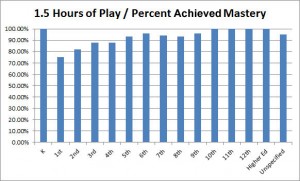 Overall equations solved per student in the Challenge
Algebra Challenge participants solved an average of 93.21 equations (regardless of achieving Mastery), with four students solving more than 1000 equations each.
Achieving Mastery in the game
Of those students who played at least 1.5 hours, 92.9% achieved Mastery. Of those students who played at least 1 hour, 83.8% achieved Mastery. Of those who played at least 45 minutes, 73.4% achieved Mastery.
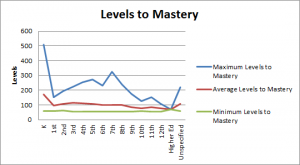 Levels played to achieve Mastery in the game
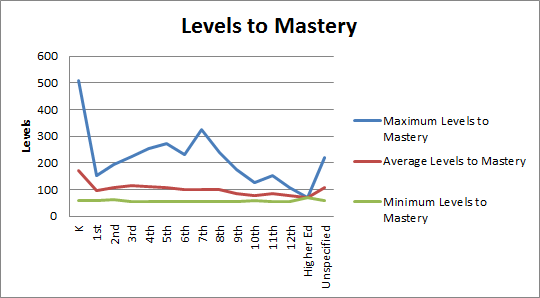
This analysis shows the effectiveness of adaptation – adapting the game to the individual student’s performance – on the overall mastery rate. Almost everyone required some form of adaptation/remediation (as measured by extra levels from the basic progression), while some 7th graders in extreme cases needed up to 5 times more levels than the basic 60 level progression. Kindergardeners needed almost 10 times more levels, but as we know from our other studies, young kids are extremely persistent.
Of those students who achieved Mastery, it took students on average 101.87 levels to achieve Mastery in the game. While it took some students fewer levels to achieve Mastery, it took one persistent student 507 levels before achieving Mastery, which highlights the game’s ability to adapt to each student’s learning needs and support each student to achieve Mastery. For specific grade level averages and range (minimums and maximums) see chart below.
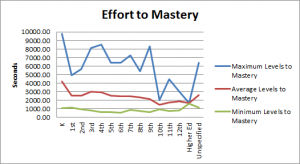 Time required to achieve Mastery in the game
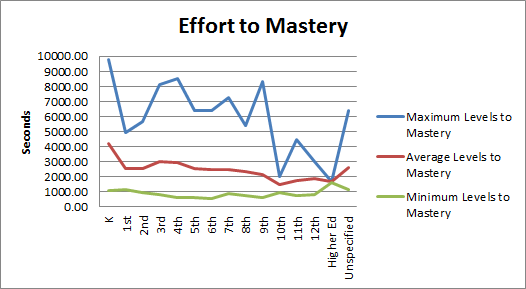
Of those students who acheived Mastery, it took students on average 41 minutes 44 seconds to achieve Mastery. However it is important to note that it took some students less time, while it took one very persistent student 2 hours 43 minutes and 10 seconds to achieve Mastery. Read more →

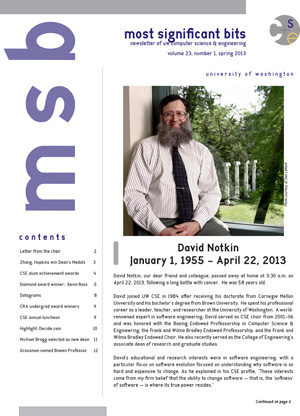 With two days to spare, the Spring 2013 issue of msb has hit the newsstands! This issue pays tribute to David Notkin, celebrates CSE’s two newest winners of UW Dean’s Medals (Raymond Zhang and Sam Hopkins) and their 13 predecessors, honors Anne Dinning ’84 B.S. and Ed Felten ’93 Ph.D. as the recipients of our 2013 Alumni Achievement Awards, recognizes Kevin Ross ’88 B.S. for winning the 2013 College of Engineering Diamond Award for Public Service for his contributions to Washington’s FIRST Robotics effort, interviews the founders of Decide.com, welcomes new Dean of Engineering Mike Bragg, cheers Dan Grossman as the newly-named College of Engineering J. Ray Bowen Professor for Innovation in Engineering Education, and all sorts of other great stuff!