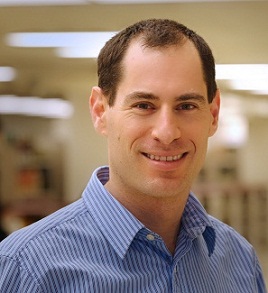
 UW CSE professor Dan Grossman is profiled in a UW Provost’s report on enhancing teaching with technology.
Grossman is teaching one of the UW CSE Coursera MOOCs this quarter: Programming Languages. (Arvind Krishnamurthy, David Wetherall, and John Zahorjan are teaching Introduction to Computer Networks.)
Says Grossman: “For me, it is largely about being passionate about the course material and how to present it. Given this passion, why would I not want the largest rooftop I can find from which to shout? … With so many students, some will have a transformative educational experience, others will learn very little, and most who express some interest will not end up participating. To compare it to a conventional course where students get personal attention, have significant financial investments, and have shared background as part of a coherent curriculum, is difficult. I instead prefer to compare it to writing a textbook. Just as many people touching a book do not read it and those who read it have a wide range of understanding as a result, the learning in MOOCs defies description.”
Read the profile here. Read more →
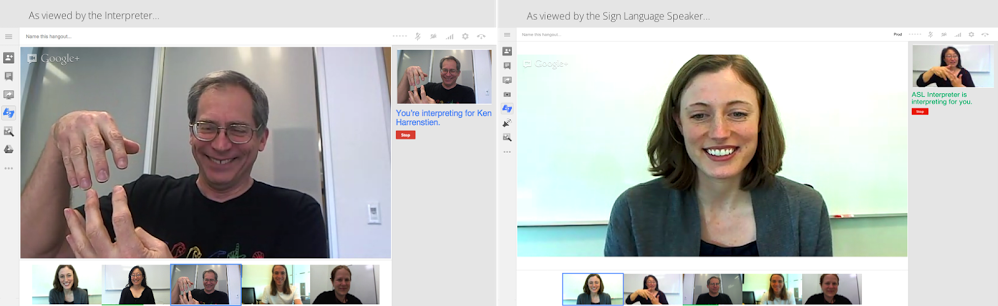 TechCrunch reports on a new Google accessibility initiative, complete with a photo of UW CSE Ph.D. alum Anna Cavender, who works on accessibility at Google’s Seattle engineering office.
“Google announced that it has added a number of accessibility to Chrome, Chrome OS, Gmail and Google Drive that should make using Google suites of web apps a bit easier to use for blind and low-vision users. In addition, Google also launched a new sign language interpreter app and keyboard shortcuts for Hangouts for the deaf and hard of hearing, as well as those who can’t or don’t want to use a mouse while using Hangouts.”
Read more here. Read more →
 Just a small bit of regional crowing: 5 of the top 25 companies on Fortune’s list of the world’s “most admired” companies are Seattle born and raised: Amazon.com (#3), Starbucks (#5), Nordstrom (#16), Microsoft (#17), and Costco Wholesale (#23). Go team! See the list here. Read more →
 We concluded our article “Broadening Participation: The Why and the How” in the March issue of Computer by saying “Neither UW nor the field as a whole is where it needs to be, but many of us are working hard to get there.”
In the context of David Notkin’s receipt of the 2013 Computing Research Association A. Nico Habermann Award for outstanding contributions to supporting underrepresented groups in the computing research community, Lecia Barker of the National Center for Women & Information Technology (we hosted their Washington State Awards for Aspirations in Computing last weekend) sent us the chart to the right, comparing UW CSE’s performance to the national average in granting bachelors degrees to women.
We have a long way to go, but we are at more than double the (dismal) national average, and we are focused intensely on making continued progress.
Computer science is a great field for everyone – it needs everyone.
Learn about DawgBytes, UW CSE’s K-12 outreach program. And check out the inspirational new Code.org video. (UW CSE’s Ed Lazowska is on their 13-member advisory board.) Read more →
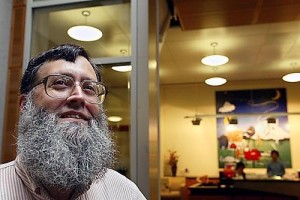 The Computing Research Association makes an award, usually annually, to a person who has made outstanding contributions aimed at increasing the numbers and/or successes of underrepresented groups in the computing research community. The award honors the late A. Nico Habermann, who headed NSF’s Computer and Information Science and Engineering Directorate and who was deeply committed to increasing the participation of women and underrepresented minorities in computing research.
UW CSE’s David Notkin has just been announced as the 2013 recipient of the CRA A. Nico Habermann Award. Quoting from the nomination:
“David was Nico’s Ph.D. student (as well as the graduate advisor of Nico and Marta’s son Frits). For nearly thirty years – as an educator, as a research advisor, as a department chair, and as a member of the national and international computing research communities – David has lived his life in Nico’s image. David has worked tirelessly and with tremendous effectiveness – sometimes locally and sometimes nationally, sometimes in high-leverage settings and sometimes in high-touch one-person-at-a-time settings – to advance the success of all people in our field, but particularly the success of students, and even more particularly the success of women and members of other under-represented groups. With David, it’s all about people – people come first …
“David Notkin, like his Ph.D. advisor Nico Habermann, is a person who works tirelessly to make our field a better place for all; a person who sets an example that each of us should seek to emulate. David has earned this award. Nico would be pleased and proud.”
(David joins UW CSE professor Richard Ladner and UW CSE Ph.D. alum Anne Condon as a recipient of the Habermann Award.)
Congratulations David!
Read the CRA announcement here.
Learn about Notkinfest, a recent event honoring David, here.
April 22 2013: David Notkin succumbed to cancer at 3:30 a.m. Read more →
 Code.org, Hadi Partovi’s nationwide effort to encourage students to learn to code, has rolled out an inspirational new video featuring some of the top names from technology and the world at large – from Bill Gates to will.i.am.
Says GeekWire:
“Seattle entrepreneur Hadi Partovi is on a mission to transform computer science education in the U.S. And Partovi is off to a pretty fast start with Code.org, the nonprofit which he formed last month with his twin brother Ali.
“Among members of Code.org’s newly-formed advisory board are some of the biggest names in technology, including venture capitalist and Netscape founder Marc Andreessen; Square CEO Jack Dorsey; Dropbox CEO Drew Houston; angel investor Ron Conway; Paypal co-founder Max Levchin and many others.
“From the Seattle area, Partovi has enlisted the advisory support of University of Washington computer scientist Ed Lazowska; Microsoft general counsel Brad Smith; and Amazon.com senior vice president Jeff Willke.
“‘I’ve never pitched an idea that has been easier to sell,’ said Partovi when asked about the power brokers he’s lined up behind Code.org.”
Visit Code.org and watch the video here. Read more →
 Which means it’s the best city for good jobs that’s located in a state where anyone in his or her right mind would want to live.
Read more here. Read more →
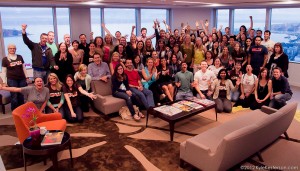 “If you’re a woman and an entrepreneur, there are few better places to be in than Seattle.
“That’s according to a new study from personal finance site Nerd Wallet, who placed Seattle just behind San Francisco as the best place for women entrepreneurs.
“Here’s what they based their rankings on:
- Number of businesses per 100 residents from the U.S. Census
- Percent of businesses that are women-owned from the U.S. Census
- Median income from the U.S. Census (half-weighted)
- Unemployment rate from the Bureau of Labor Statistics (half-weighted)
- Percent of residents 25 years and older who have a Bachelor’s degree”
Read more here! Read more →
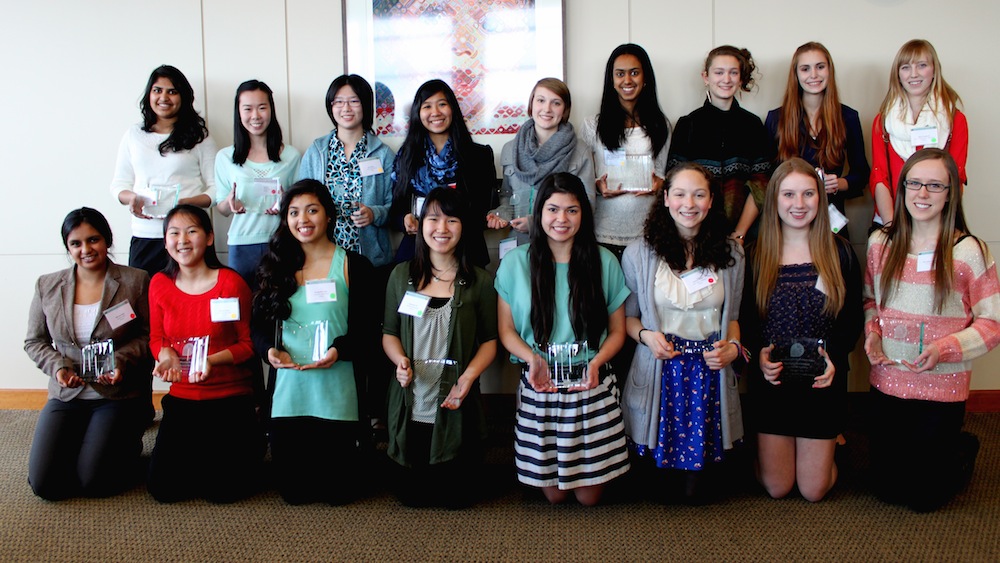
 On February 23rd, twenty high school women from Washington state were honored at UW CSE with Awards for Aspirations in Computing from NCWIT, the National Center for Women & Information Technology. We were also joined by Krista Holden, the national award winner from Washington state, and by Ruthe Farmer, Director of Strategic Initiatives at NCWIT.
The NCWIT Award for Aspirations in Computing honors young women at the high school level for their computing-related achievements and interests. Awardees are selected for their computing and IT aptitude, leadership ability, academic history, and plans for post-secondary education.
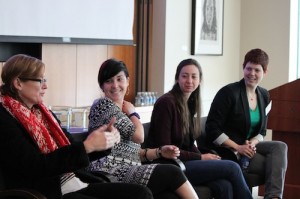 We also recognized Sam Procopio, CS teacher at Holy Names, as the Washington State Educator Award winner. He currently has 54 young women enrolled in his AP Computer Science course and will have 70 next year!
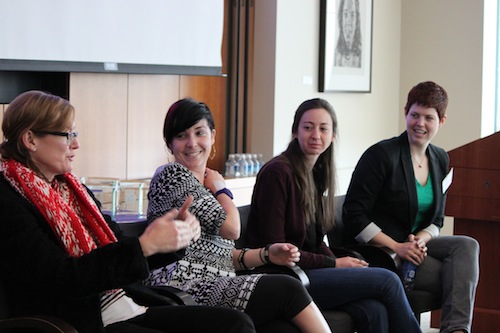
Ira Kemelmacher-Shlizerman gave a fantastic keynote. Steph Burg from Microsoft, Krista Davis from Google (UW CSE alumna), Lilia Gutnik from Socrata and Callie Neylan from Microsoft were a great career panel. Steph Burg, Katie Kuksenok and Franzi Roesner led fun hands-on activities for the girls. Jenny Abrahamson, Ally Gale and Zorah Fung led the girls around the building. 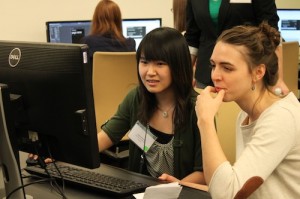 Alyanna Castillo photographed the event. Ed Lazowska spoke to the parents. And Hélène Martin, as always, organized everything! Thanks to all who contributed! And many thanks to Google for sponsoring this event.
Congratulations to the award recipients, their parents, and their teachers. We hope to see you as UW CSE students soon!
(Lots of great photos of the event here.) Read more →
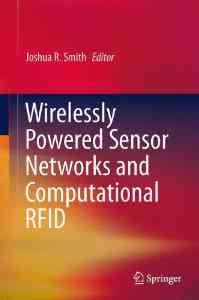 Josh Smith will join the long list of UW CSE book authors when Wirelessly Powered Sensor Networks and Computational RFID is published later this week.
The book describes work by Josh and others at Intel Research Seattle, UW, and other institutions. Josh’s WISP (Wireless Identification and Sensing Platform) is the first of a new class of RF-powered sensing and computing systems. Rather than being powered by batteries, these systems are powered by radio waves that are either deliberately broadcast or ambient. Enabled by ongoing exponential improvements in the energy efficiency of microelectronics, RF-powered sensing and computing is rapidly moving along a trajectory from impossible (in the recent past), to feasible (today), toward practical and commonplace (in the near future). The book is a collection of key papers on RF-powered sensing and computing systems including the WISP. Several of the papers grew out of the WISP Challenge, a program in which Intel Corporation donated WISPs to academic applicants who proposed compelling WISP-based projects. The book also includes papers presented at the first WISP Summit, a workshop held in Berkeley, CA in association with the ACM Sensys conference, as well as other relevant papers. The book provides a window into the fascinating new world of wirelessly powered sensing and computing.
Order the book from Amazon.com here. Learn about Josh’s research here. Read more →