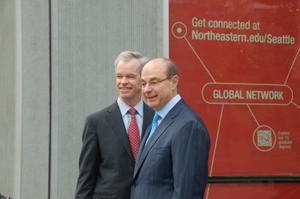
 Northeastern University president Joseph Aoun is visiting Seattle in connection with the inauguration of Northeastern’s Seattle campus, located in South Lake Union. Read the Crosscut article here.
This is what UW CSE’s Ed Lazowska sent to the reporter, in its entirety. (The article represents it perfectly well, but necessarily omits most of the material.)
Our state has a higher education system designed for our 1970 economy. Today, we rank 2nd among the 50 states in the proportion of our workers who are in science and engineering occupations. But we rank 31st in science and engineering Bachelors degree production relative to our population, and 46th in science and engineering graduate program enrollment relative to our population. (Additional data here.) There’s no doubt about it – we are educationally under-served. So any additional high-quality educational opportunities, such as those that Northeastern will provide, are welcome and needed!
Opening a branch in Seattle is a great business move for Northeastern – there’s for sure a market. And it will benefit the region in two ways. First, it will expand Masters degree capacity in some high-impact fields. Second, it will increase the placement of Northeastern’s Boston undergraduates in co-op and internship positions with Seattle tech companies, and these students will be more likely to take permanent jobs here when they graduate. Tayloe Washburn was an inspired choice to lead the effort – he has a long history of civic leadership to increase educational opportunities in our state.
I do worry that citizens and policymakers will mistakenly believe that Northeastern is a Santa Claus that will solve our educational access problems. Northeastern’s color is indeed a jolly shade of red, but there is no Santa Claus. We need to prepare Washington’s students for Washington’s jobs. Before you can get a Masters degree, you need to get a Bachelors degree. How are our kids going to do that? And while it’s good for our tech industry that a greater number of Northeastern’s Boston students are likely to seek employment in Seattle, what about our kids? (Per capita, we are already the #1 state in the nation in the importation of individuals with a Bachelors education or greater!)
At UW, the Computer Science program is ranked among the top ten in the nation, and is a top-five supplier of students to Amazon.com, Google, and Microsoft (as well as being the predominant supplier to many leading-edge smaller companies and startups in the region). Preparing Washington’s students for Washington’s jobs is what we do. Would we like more students to have access to our educational offerings? You bet! There are two dimensions to accessibility: capacity and cost. If our tuition was $40,000/year like Northeastern’s, we’d be able to expand like crazy. But the mission of public universities is to provide a great education at a reasonable cost to students in their regions, driving socioeconomic upward mobility. Historically, taxpayers have felt that subsidizing this education is a great investment in the success of the next generation. Across the nation, though – and most particularly in our state – that contract is being scrapped. To repeat, there is no Santa Claus.
I’d like to emphasize where the gap between supply and demand is greatest in our state: Computer Science. Last year, the Higher Education Coordinating Board (now the Washington Student Achievement Council) did a careful analysis to identify the fields with the greatest gap between workforce demand and educational supply (here – figures 4 and 5). At the Bachelors level, Computer Science was #1, with a gap nearly twice as great as the second place field: all fields of Engineering combined. Third came all of the Health Professions combined, with a gap about half as large as Engineering’s. At the graduate level (Masters and Doctoral), Computer Science and the Health Professions were roughly tied for first, with Engineering third, with roughly half the gap of the first place fields. Information technology – computer science – is a field with all sorts of jobs for all sorts of people with all sorts of educational backgrounds. We, as a state, could choose to prepare more of our kids for these fantastic jobs. Or we could continue to wait for Santa Claus.
Read more →

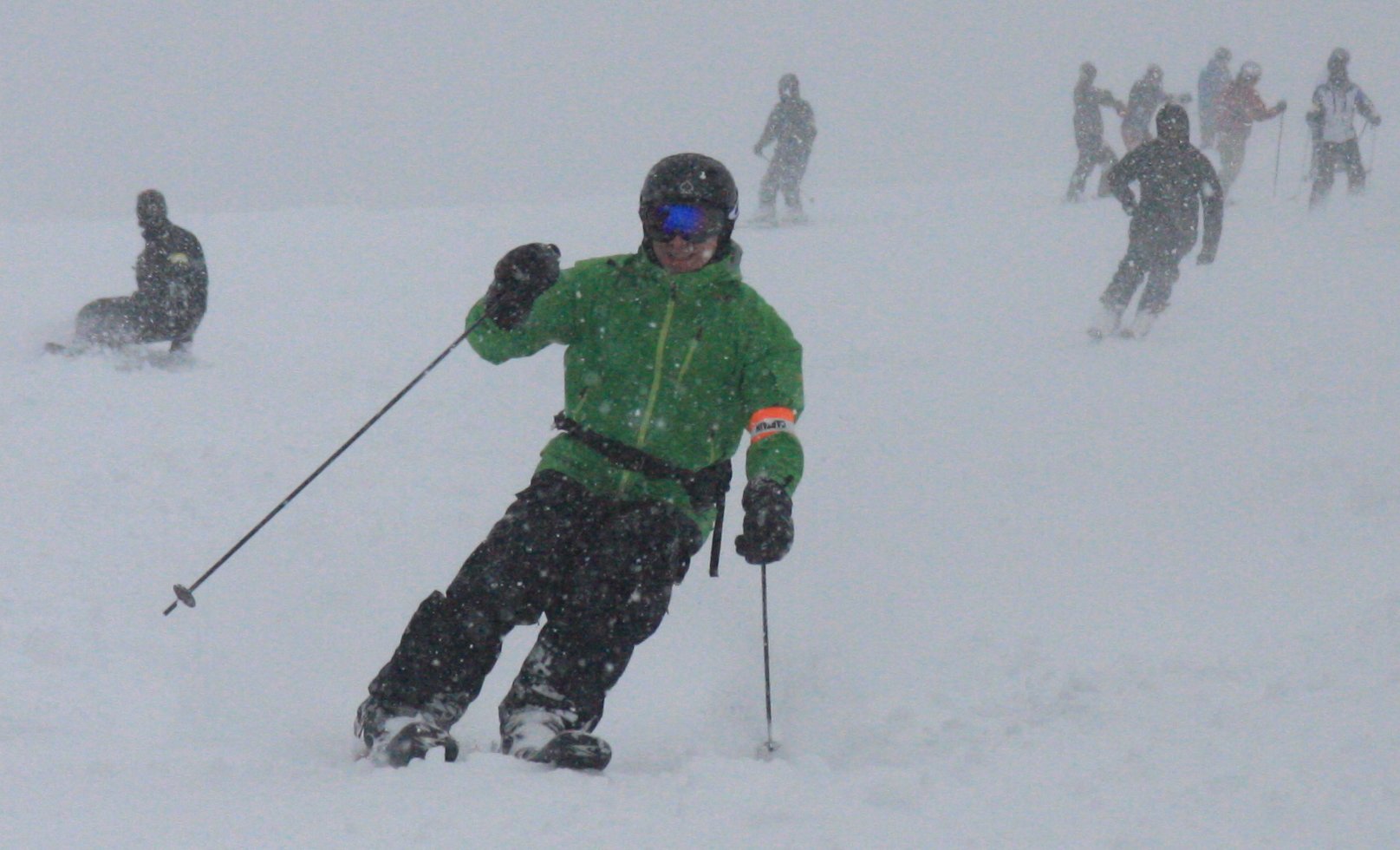 Continuing a tradition begun in the 1960s by Jerre Noe and Hellmut Golde, UW CSE chair Hank Levy led close to 70 CSE graduate student and faculty skiers and boarders on the annual UW CSE Ski Day on Friday February 22.