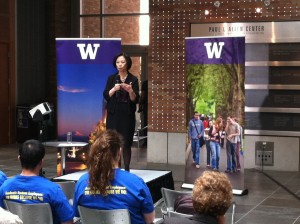
 UW Interim President Phyllis Wise today hosted a “Community Conversation” on the future of the University of Washington in the Microsoft Atrium of the Paul G. Allen Center for Computer Science & Engineering. There was a strong turnout.
We’re delighted that the Allen Center continues to be a prime venue for campus events such as this, and the recent inaugural press conference of incoming UW President Michael Young. Read more →
 Akash Badshah has scored a triple-first: Akash is the first high school student in the nearly 30-year history of the CHI conference (human factors in computing) to serve as lead author, present a paper, or win a “Best of CHI” award.
Akash presented his paper on a self-powered haptic feedback device to a huge crowd at CHI 2011 in Vancouver BC last week. The session was standing-room-only, and the organizers even had to set up an overflow room and pipe video to it. The talk was fantastic. Akash, a high school junior from Bellevue, worked with CSE professor Shwetak Patel last summer as a part of Shwetak’s summer high school research program, where high school students carry out intense 10-week long research projects. Akash is now completing his senior year at Phillips Exeter Academy in New Hampshire.
Learn more about Akash’s research here. Learn more about research in the UW CSE UbiComp lab here. A related article from the Exonian (Philips Exeter Academy’s newspaper) here.
Read more →
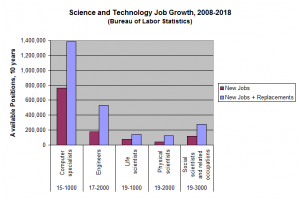 An Xconomy article on the Seattle area job market for computer scientists, with lots of UW CSE examples, such as this quote from an undergraduate:
“I’ve been completely blown away by how well interns are treated within our industry. It’s incredible that CSE students still in school can earn summer salaries twice as high as students from other majors can expect to earn after graduation. My most unique experience has been my opportunity to travel. Last summer I worked for [top tech company] in Seattle. At some point I realized that they had offices in awesome cities all over the world: Sydney, Dublin, Zurich, Paris, London. I told the recruiters I wanted to work at one of these offices. They were able to secure me a position in London. I’ve always wanted to study abroad, but I was worried how well it would fit with computer science. As it turns out, I got a better deal than studying abroad: working abroad. Now all of my study abroad dreams are being fulfilled more wildly than I ever expected: I’m being paid to travel; I’m not losing time, I’m working for an industry leader; and, best yet, I don’t have homework. I don’t think many other students get opportunities like this.”
Read the article here.
Related: Here’s a terrific letter from Google regarding the threatened termination of Western Washington University’s Computer Science Department:
“Google is growing at a rapid rate … The Seattle sites are pure R&D sites … Our headcount is up 45% from last year to approximately 1,000 employees … About one third of our current Washington engineering staff came through the University of Washington’s CSE program …”
Read it here. Read more →
 Here’s an excellent letter from the Technology Alliance to the President of Western Washington University:
“Closing down a well-respected computer science program that prepares students for high-impact, rewarding careers and that supplies our innovative industries with high-caliber talent that enables them to grow and thrive does not serve the people of Washington or the students of WWU. It clearly will harm our communities by eroding access to high-demand programs for our students and further depriving our fast-growing technology industries of a locally educated workforce.”
Attachmate, an international software company headquartered in Seattle with a Bellingham R&D center, also wrote, saying:
“Over the past decade, we have employed more than fifty successful WWU graduates, including Shaun Wolfe, former CEO and President of WRQ. We have employed nearly twenty WWU interns, twelve of whom we hired as full-time employees. Today, 10 percent of Attachmate’s global product development experts hold a Computer Science degree from your university. Many of those graduates work in our R&D office in Bellingham.”
And a terrific letter from Google:
“Google is growing at a rapid rate in the State of Washington … The Seattle sites are pure R&D sites … Our headcount is up 45% from last year to approximately 1,000 employees … The discussion of the termination of WWU’s CS department concerns me. Google relies heavily on the state’s CS programs to produce qualified canddidates … Google is not alone among high tech companies attempting to grow their presence in the state.”
See a previous post here for background information.
Update: Slashdot is on it — more than 200 comments in the first 12 hours. And GeekWire continues to follow the story. Read more →
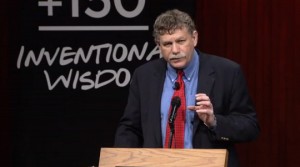 A two-day symposium “Computation and the Transformation of Practically Everything” was held on April 11-12 in celebration of the 150th anniversary of MIT (April 10 2011). There were more than two dozen phenomenal talks (plus one by UW CSE’s Ed Lazowska). The most phenomenal, though, was given by Eric Lander – Professor of Biology at MIT, Professor of Systems Biology at the Harvard Medical School, Founding Director of The Broad Institute at MIT, and Co-Chair of the President’s Council of Advisors on Science and Technology.
Listen to Eric’s talk – “Biology as Information.” It will be the best 20 minutes you’ve spent this month. Read more →
 You’ve read about the threatened demise of Western Washington University’s Computer Science Department, here and on GeekWire.
You’ve watched the KING5 video on the red-hot computer science job market in the Puget Sound region.
You’ve marveled at the bureaucratic gibberish from the administrative brainiacs at WWU in an email and a GeekWire interview.
In the “What’s new?” department, here’s an excellent letter to WWU from the Washington Technology Industry Association. The email message transmitting it said:
“Washington’s inability to fill the demand for educated tech workers is the number one pain point for most of our tech companies in an industry representing 43% of the state’s employment base. On behalf of the board of the WTIA and the association’s 125,000 tech employees in 1,000 member companies, we hope you will preserve the Computer Science program at WWU and limit budget cuts to STEM programs.”
Additionally, the WWU Computer Science faculty has written an excellent letter outlining the apparent position of the WWU administration (compare it to the GeekWire interview linked above … when people change their stories, we get twitchy), and stating their response. Read it here. It concludes as follows:
“According to the Mission Statement for Western, our number one Strategic Goal is: ‘Build upon Western’s strengths to address critical needs in the State of Washington.’ It is an established fact that computer science will be the most pressing need from higher education for the State of Washington in the foreseeable future. This indicates to us that the Administration of Western has made some mistakes in judgment, and we only hope they can be persuaded to change their minds before they do irreparable harm to WWU, and to the businesses and people of the State of Washington.”
GeekWire continues to follow the story … but John Cook, as a professional journalist, is more polite than we are – you won’t be treated to any “bureaucratic gibberish from administrative brainiacs” or “Must … Take … Shower …” in his posts … zzzzz … Read more →
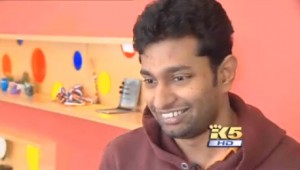
Graduating UW CSE Ph.D. student John P. John
KING5 News profiles the red-hot Seattle market for computer science grads, focusing on Google, mentioning Zynga, and interviewing graduating UW CSE Ph.D. student John P. John and CSE undergraduate Cullen Walsh. (The far-sighted bureaucrats at WWU also get a mention.)
“The demand for computer scientists and computer engineers is unprecedented …” “This is a great time to be a computer scientist …” “Some people have gone to prestigious companies making 6-digit salaries immediately upon leaving UW …” “The idea of creating innovative products is even more attractive …” “The ability to have that sort of impact keeps me looking forward to graduating …”
Watch this great video here! Related GeekWire post here. Read more →
 Each year, the International Symposium on Computer Architecture – the premier forum for computer architecture research – presents the “Test of Time Award” to “the paper from the ISCA Proceedings 15 years earlier that has had the most impact on the field (in terms of research, development, products or ideas) during the intervening years.”
For the second year in a row, a paper describing UW CSE research on Simultaneous Multithreading (SMT) has won this award!
This year’s award goes to the ISCA 1996 paper “Exploiting Choice: Instruction Fetch and Issue on an Implementable Simultaneous Multithreading Processor” by Dean Tullsen, Susan Eggers, Joel Emer, Hank Levy, Jack Lo, and Rebecca Stamm.
This paper was a successor to last year’s ISCA Test of Time Award winner, “Simultaneous Multithreading: Maximizing On-Chip Parallelism” by Dean Tullsen, Susan Eggers, and Hank Levy.
Congratulations to Susan and Hank, and to their then-students Dean Tullsen (now at UCSD) and Jack Lo (now at VMware), and their collaborators Rebecca Stamm and Joel Emer!
The ISCA “Test of Time Award” has been given annually since 2003 – 9 times in total. Three of those awards have gone to UW CSE papers – the two SMT papers, recognized in 2010 and 2011, and the paper “On the Inclusion Properties for Multi-Level Cache Hierarchies” by Jean-Loup Baer and his student Wen-Hann Wang (now at Intel), which received the inaugural ISCA “Test of Time Award” in 2003. Read more →
 Western Washington University has placed its Computer Science Department on the chopping block in a budget reduction effort.
This move seems particularly goofy – even by the standards of education policy in Washington State – given the extreme demand for computer science graduates regionally and nationally, the fine record of WWU’s program, the fact that major programs such as those at the University of Washington, Stanford, and Carnegie Mellon are reporting all-time-record student interest, and reports that newly-minted University of Washington graduates are receiving salary offers north of $100K and signing bonuses as high as $30K. You’ve gotta wonder what programs WWU’s leadership is choosing to preserve while threatening to axe Computer Science. “What will they think of next?”
The 1,000 attendees at yesterday’s “State of Technology” luncheon in downtown Seattle – which included the Governor, her Secretary of Commerce, and Federal CTO Aneesh Chopra – were dazed and amazed when Technology Alliance Chair Jeremy Jaech read the GeekWire headline from the stage.
Read the GeekWire post here.
Update: We received a “form email” response from WWU’s VP for University Relations. It’s a full page of administrative gibberish. Or, as our Webmaster said, “Must … Take … Shower …” We recommend not bothering with it, but if you need late-night entertainment, it’s here. Read more →
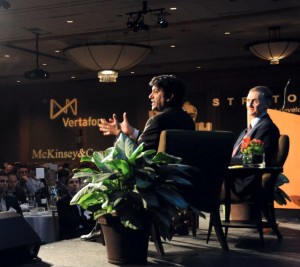
Ed Lazowska interviews Aneesh Chopra at the Technology Alliance luncheon (Annie Laurie Malarkey photo)
Aneesh Chopra, the Federal Chief Technology Officer, was interviewed by UW CSE’s Ed Lazowska at the Technology Alliance “State of Technology” luncheon on Tuesday.
From GeekWire: “Chopra discussed everything from how to increase the number of women entrepreneurs to the expansion of broadband services to President Obama’s policy on net neutrality to cybersecurity efforts. But it was Chopra’s passion for the entrepreneurial process which stood out.”
Chopra also participated in roundtables with regional tech leaders on “Innovation in Customer Relations,” “Innovation in Global Health,” and “Innovation in Cloud Computing,” and visited Microsoft, PATH, and the Institute for Systems Biology.
Read the GeekWire post here. Read more →

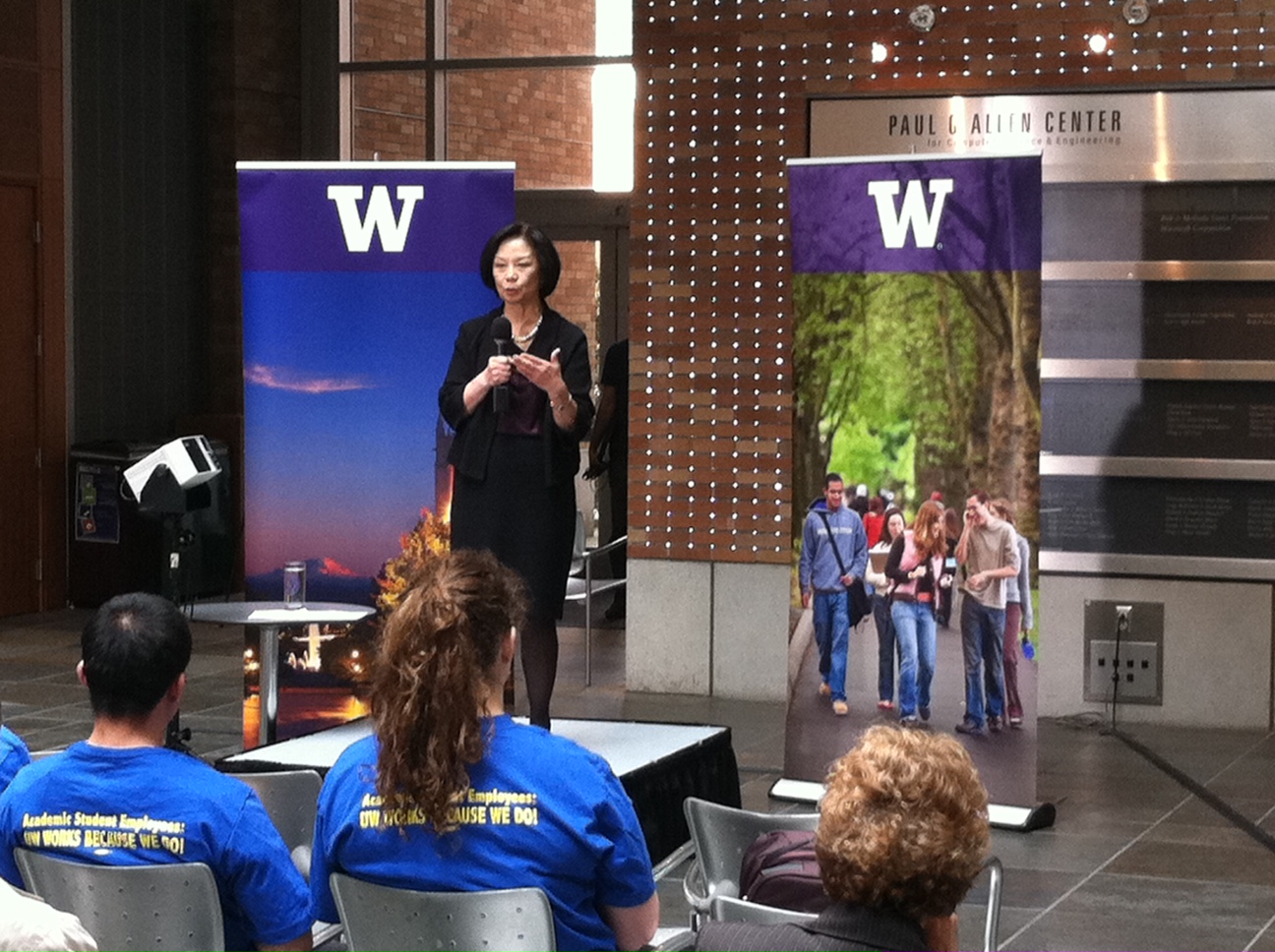 UW Interim President Phyllis Wise today hosted a “Community Conversation” on the future of the University of Washington in the Microsoft Atrium of the Paul G. Allen Center for Computer Science & Engineering. There was a strong turnout.