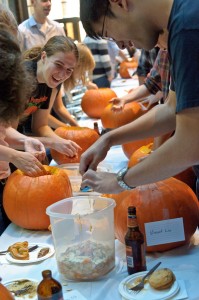
 Halloween is near, and that means it’s time for the annual UW CSE pumpkin carving TGIF. Eyuccch! Photos here. Read more →

Annual UW CSE pumpkin carving TGIF
“Influx of Silicon Valley branch offices churns up hot competition for Puget Sound talent”
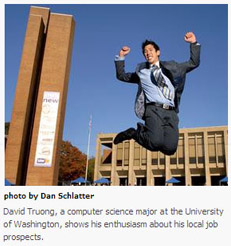 The Puget Sound Business Journal and its partner TechFlash report on the computer science job market.
“David Truong, a 21-year-old University of Washington student from Kirkland, faces an uncertain future as he looks ahead to entering the workforce, hoping the remain in the region where he grew up. His biggest challenge: choosing among the multiple companies interested in hiring him. … Truong is a computer science major who has already started making his mark with internships at Intel, Lockheed Martin and Microsoft. And the competition for people like him is only becoming more fierce. …
“Speaking after a recent UW appearance, Microsoft CEO Steve Ballmer acknowledged that the new influx of Silicon Valley firms will be looking to lure engineers from his company. ‘Why would anyone open up in Seattle, Washington?’ Ballmer said. ‘Answer: Microsoft and the University of Washington.’”
Read the full article in TechFlash here. PSBJ version here (pdf). Read more →
Photos from the UW CSE Industrial Affiliates Meeting
Alumni and Affiliates

Keynote by UW VP Linden Rhoads
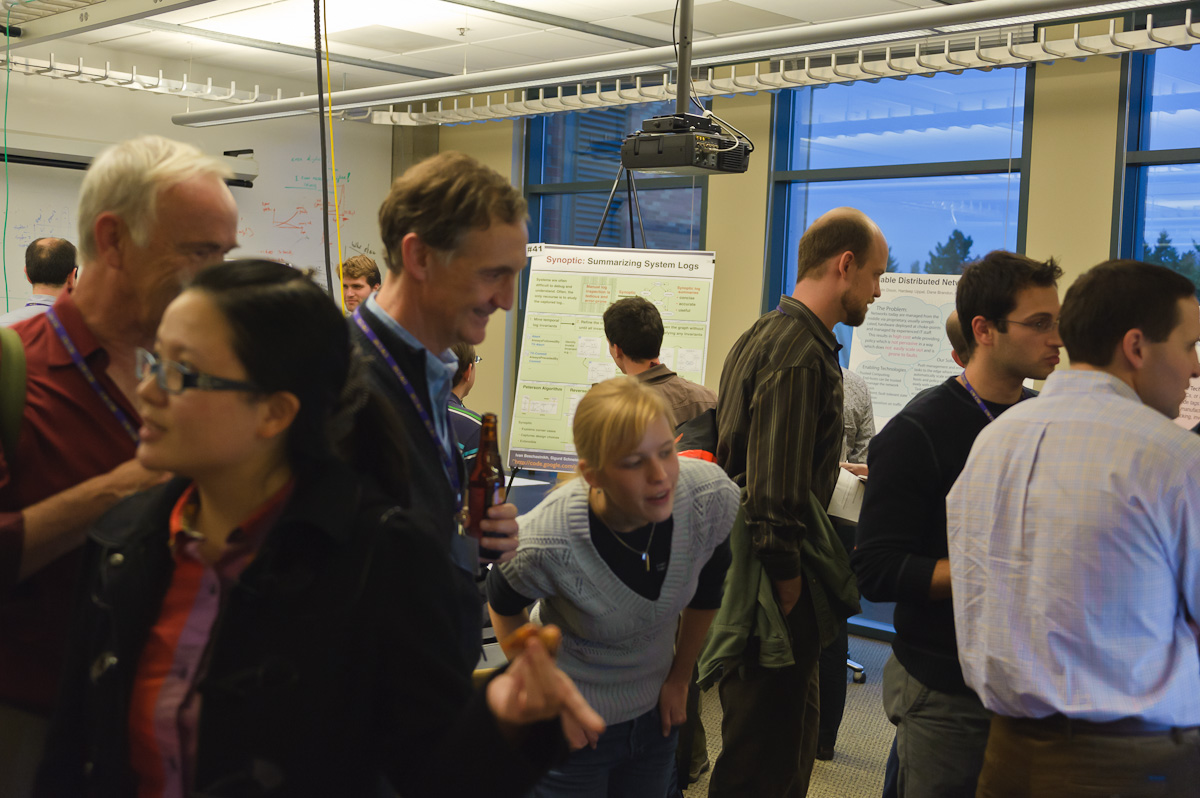
Posters and Demonstrations

Career Fair
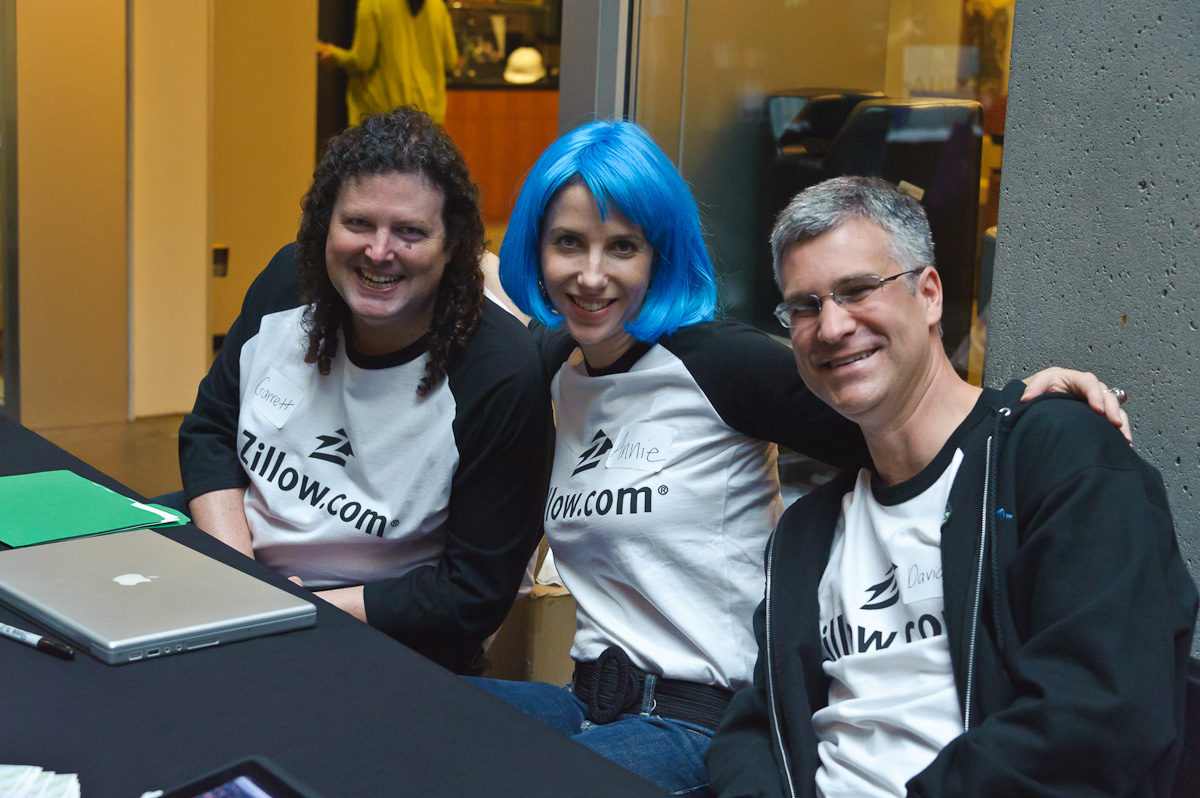
Zillow
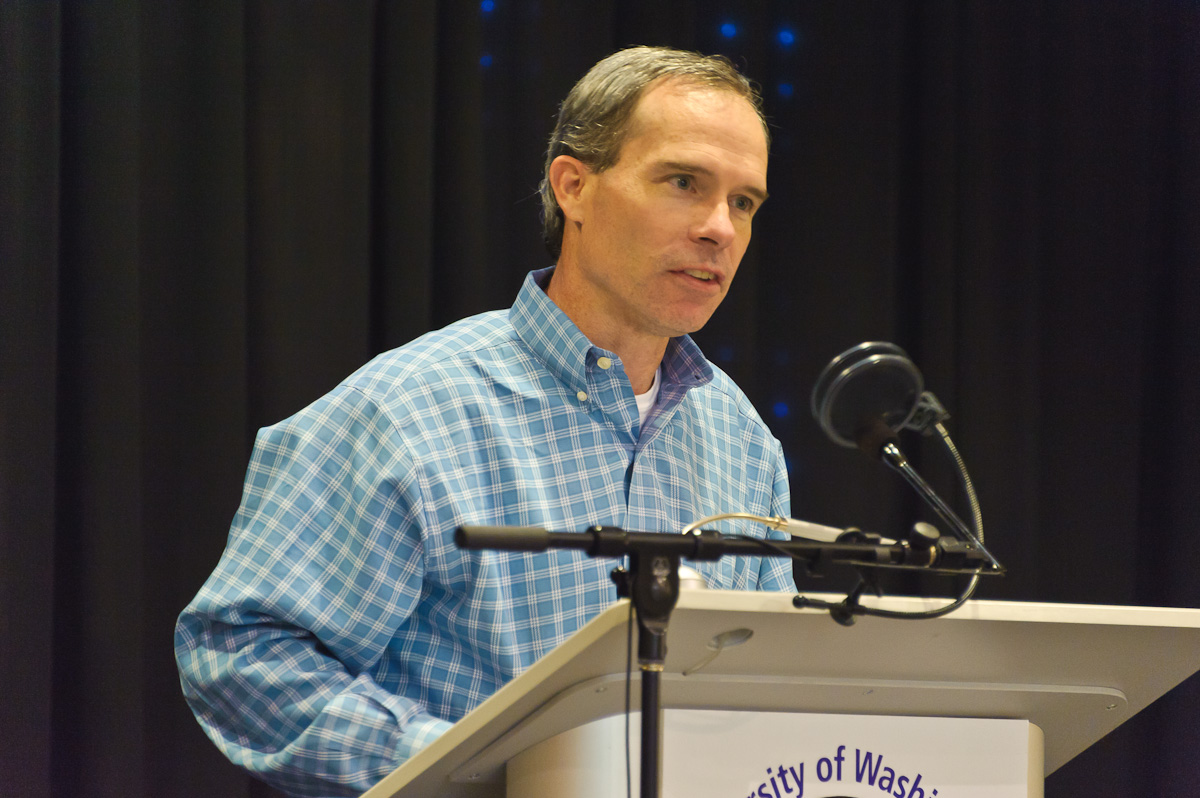
Matt McIlwain presents the Madrona Prize
The annual UW Computer Science & Engineering Industrial Affiliates Meeting took place on October 27th and 28th.
On the 27th, more than 100 representatives from Affiliates companies participated in a day of research presentations, as well as a keynote presentation by Linden Rhoads, UW Vice Provost and head of the Center for Commercialization.
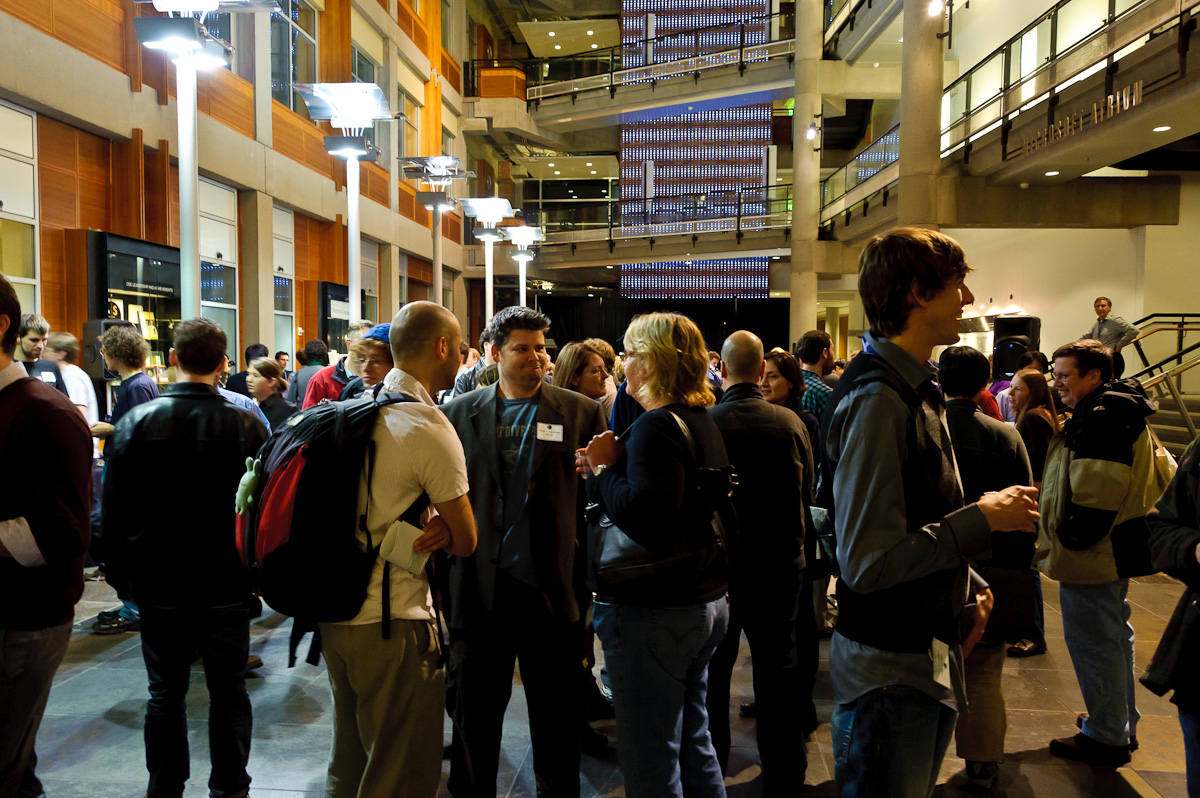
That evening, more than 250 Seattle-area alumni joined for an evening of posters, demonstrations, and fellowship.
On the 28th, 42 companies recruited UW CSE undergraduate and graduate students.
Additional photographs of the 27th here; of the 28th here. (Thanks to UW CSE faculty member Bruce Hemingway for the photography!) Read more →
Got jobs?
 It’s a zoo at the UW Computer Science & Engineering Industrial Affililates’ recruiting fair, held on Thursday October 28th in conjunction with the UW CSE Industrial Affiliates meeting. 42 companies, from Adobe to Zynga, all looking to recruit UW CSE students.
See additional photos of the event here. See information on national job projections here. Read more →
Computer Science is for everyone!
Would you consider a job at a tech startup that posted on Craigslist with the headline:
Need a bikini booth babe for UW Career Fair
If so, then you and LetsDivvy deserve each other. This sort of offensive, degrading, misogynistic, sophomoric nonsense has no place in our society, in our field, or on our campus.
Read the full Craigslist post here (pdf) – it only gets worse. (This is a pdf of the original post, which was dated October 26th. The post was revised on October 28th.)
Some related reading here (pdf).
[LetsDivvy has asked us to note that no one in a bikini actually worked their booth at the UW SEBA career fair. Their revised Craigslist post is here [post no longer exists].] Read more →
Tom Mitchell, CMU, in UW CSE Distinguished Lecturer Series
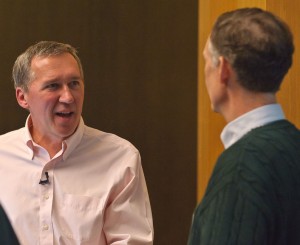 Tom Mitchell, head of the Machine Learning Department in CMU’s School of Computer Science and Ph.D. advisor of UW CSE professor Oren Etzioni, spoke in the UW CSE Distinguished Lecturer Series on October 21 on the subject of “Never-Ending Learning.”
Talk abstract and video here. New York Times article on Tom’s NELL system here. Read more →
“Realizing that change takes more than sweat”
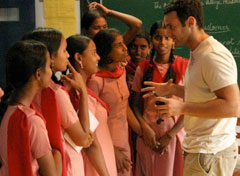 UW CSE bachelors alumnus Paul Javid is one of three students profiled by the UW Office of Undergraduate Academic Affairs in an article on the impact of international experiences on undergraduates.
Paul worked with UW CSE professor Ed Lazowska, UW CSE Ph.D. student Tapan Parikh (now a faculty member at UC Berkeley), and Microsoft Research on a number of projects in rural India. Paul graduated from UW CSE in 2006, and is now completing dual graduate degrees at UC Berkeley in public health and business.
Read the profile here. Read more →
Shwetak Patel, Top Innovator!
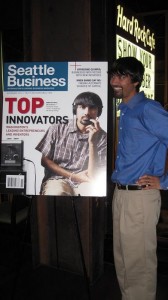 Seattle Business magazine has announced the winners of its 2010 Top Innovators Awards. And the cover boy is … UW CSE’s Shwetak Patel!
“You probably don’t know it yet, but each appliance in your home sings its own particular song. Recognizing that song could help households cut their energy consumption. Shwetak Patel and his students at the University of Washington have developed intelligent in-home sensors that are able to differentiate between different appliances … Using such devices, consumers can see what appliances are using energy and take measures to reduce their use … The technology can also help utilities create incentives …”
Read the article here. See the cover here.
Congratulations Shwetak! Read more →
UW CSE and the AI Journal
 Elsevier’s journal Artificial Intelligence is arguably the top journal venue in the AI field.
Three of the top five “most cited” papers in the past 5 years of the journal have UW CSE authors!
- #1: Unsupervised named-entity extraction from the Web: An experimental study. Volume 165, Issue 1, 2005, Pp 91-134. Etzioni, O. | Cafarella, M. | Downey, D. | Popescu, A.-M. | Shaked, T. | Soderland, S. | Weld, D.S. | Yates, A. (all authors are UW CSE)
- #4: Learning and inferring transportation routines. Volume 171, Issue 5-6, 2007, Pp 311-331. Liao, L. | Patterson, D.J. | Fox, D. | Kautz, H. (Patterson is a 2005 UW CSE Ph.D. alum; others are current)
- #5: Explorations in engagement for humans and robots. Volume 166, Issue 1-2, 2005, Pp 140-164. Sidner, C.L. | Lee, C. | Kidd, C.D. | Lesh, N. | Rich, C. (Lesh is an Etzioni Ph.D. alumnus)
Check it out here (click the “Top 10 Cited” tab). Read more →
“Robots are stealing our jobs and the love of our children”
 Another report on the work of UW’s Andy Meltzoff, Rechele Brooks, Aaron Shon, and Raj Rao.
“So yeah, it looks like the first wave of the robot uprising won’t be skull-headed killbots — the initial deployment will be adorable cyber-dwarf saboteurs, whose adorable, belly-pointing antics will win the hearts and minds of the youth.”
How can you not love the press? Read the article here. Read the paper here. Read more →