During the week of September 19th, NRC provided pre-release access to its long-delayed “Data-Based Assessment of Research-Doctorate Programs in the United States,” scheduled for public release during the week of September 26th.
We, along with colleagues in other computer science programs nationally and colleagues in programs in other fields at the University of Washington, quickly discovered significant flaws of three types in NRC’s data:
- Instances in which the data reported by NRC is demonstrably incorrect, sometimes by very substantial margins.
- Instances in which the accuracy of the data cannot easily be checked, but it does not pass even a rudimentary sanity check.
- Instances in which institutions interpreted NRC’s data reporting guidelines differently, yielding major inconsistencies.
The widespread availability of the badly flawed pre-release data within the academic community, and NRC’s resolve to move forward with the public release of this badly flawed data, have caused us and others to urge caution. For our program – and surely for many others – the NRC assessment is based on data that is clearly erroneous and the results are therefore meaningless.
Quoting the Computing Research Association: “NRC Doctoral Rankings for Computer Science not ready for prime time … CRA has serious concerns about the accuracy and consistency of the data being used in the evaluation of the Computer Science discipline.”
See further information here. Read more →
 Incoming UW CSE grad student, Seungyeop Han, and his co-authors recently received the best poster award for their poster “Accelerating SSL with GPUs,” which proposes using the computing capabilies of the Graphical Processing Units on computer video cards to cheapen the considerable computational cost of wrapping HTTP communications with SSL encryption. SIGCOMM 2010 was held in New Delhi, India, August 30-September 3, 2010.
More information on the conference may be viewed here. Read more →
 UW CSE’s Zoran Popovic talks with NPR’s David Green about Foldit. As we have reported previously, Foldit is a game in which players compete at protein folding (as improbable as that sounds!). The results give researchers new approaches as they seek to cure diseases like Alzheimer’s and Parkinson’s.
The interview (4:33 audio with transcript) is here.
See earlier news coverage here. Read more →
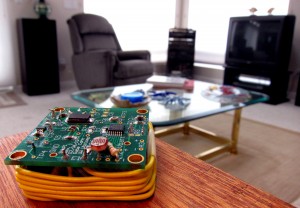 UW CSE’s Shwetak Patel and colleagues at UW and the Georgia Institute of Technology have developed a way to dramatically increase the battery life of sensors in the home, making their use far more practical.
The approach is called SNUPI — Sensor Nodes Utilizing Powerline Infrastructure. The “trick” is to utilize the electrical wiring in the home as a gigantic antenna, picking up very low power wireless signals from sensors and carrying them to a monitoring computer.
SNUPI, which could be used in home automation or medical monitoring, will be presented this month at the Ubiquitous Computing conference in Copenhagen, Denmark. It originated when Patel and co-author Erich Stuntebeck were doctoral students at Georgia Tech and worked with thesis adviser Gregory Abowd. They discovered that home wiring is a remarkably efficient antenna at 27 megahertz. Since then, Patel’s team at the UW has built the actual sensors and refined this method. Other co-authors are UW’s Gabe Cohn, Jagdish Pandey and Brian Otis.
Read the UW News release here. Additional news coverage: TechFlash. Seattle Times. Popular Science. International Business Times. inhabitat. Slashdot. TechNewsDaily. Gizmag. R&D Magazine. Technology Review. Read more →
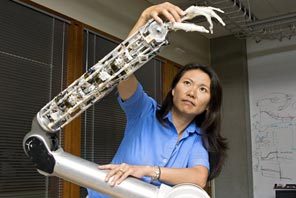 Yoky Matsuoka, the Torode Family Endowed Career Development Professor in Computer Science & Engineering, has been recognized by UW Medicine as the 2010 Emerging Inventor of the Year. Yoky will be honored at a reception on October 26th.
“Dr. Matsuoka pursues a broad range of activity that, in the ultimate application, would lead to the development of artificial devices that augment human capabilities under neural control. In a very important step along this path, she is developing an anatomically correct robotic hand to investigate the neural control of human hand movements. The goal of this work is a prosthetic hand capable of executing detailed hand movements autonomously or with natural neural signals. Her work is highly interdisciplinary, including the development of chronically implantable neural interfaces, as well as the mechanical, electrical, and computer systems needed to operate and control such devices.”
Announcement of Yoky’s selection here. Information on the recognition event here. Information on Yoky’s research here. Read more →
 Dub — UW’s cross-campus alliance of faculty and students exploring Human-Computer Interaction and Design — will have another strong showing at Ubicomp 2010 this year, a top Ubiquitous Computing conference. There are 6 accepted papers from dub members, two of which have been nominated for the best paper award. Congratulations to all of dub, the authors of these 6 papers, and their collaborators at other institutions:
- Augmenting On-Screen Instructions with Micro-Projected Guides: When it Works, and When it Fails (UW: Shaun K. Kane, Jacob O. Wobbrock / Intel Research: Daniel Avrahami / CMU + Intel Research: Stephanie Rosenthal)
- ElectriSense: Single-Point Sensing Using EMI for Electrical Event Detection and Classification in the Home (Nominated for Best Paper) (UW: Sidhant Gupta, Shwetak Patel / Duke: Matt S. Reynolds)
- SNUPI: Sensor Nodes Utilizing Powerline Infrastructure (Nominated for Best Paper) (UW: Gabe Cohn, Jagdish Pandey, Brian Otis, Shwetak Patel / GA Tech: Erich Stuntebeck, Gregory D. Abowd)
- WATTR: A method for self-powered wireless sensing of water activity in the home (UW: Timothy Campbell, Ramses Alcaide, Eric Larson, Shwetak Patel)
- The Wi-Fi Privacy Ticker: Improving Awareness & Control of Personal Information Exposure on Wi-Fi (UW + Intel: Jaeyeon Jung / Intel: Sunny Consolvo, Ben Greenstein, Pauline Powledge, Daniel Avrahami / UC Davis: Gabriel Maganis)
- TCBI: The Design and Evaluation of a Task-Centered Battery Interface (UW: Julie Kientz, Amanda Fonville / UToronto: Khai Truong, Alyssa Rosenzweig, Tim Smith / Nokia: Timothy Sohn)
Read more →
 “The educators involved argue that beyond filling the shoes of retiring scientists, broadening the range of perspectives can help create better technological solutions for everyone. Indeed, the technologies behind such innovations as the Segway and voice-recognition software were originally created for people with disabilities. ‘Great ideas come from diversity, not from single-mindedness,’ [UW CSE’s Richard] Ladner points out. ‘If you look at bigger companies like IBM and Microsoft, they pride themselves on having diverse workforces. They’re hiring people who are blind and deaf and in wheelchairs because they know they’ll do great things.'”
Read the full article here. Learn about Ladner’s Access Computing Alliance here. Read more →
 Google marked today’s second anniversary of the Chrome browser with a web retrospective: “Back to the future: two years of Google Chrome.”
“Looking back today on Chrome’s second anniversary, it’s amazing to see how much has changed in just a short time. In August 2008, JavaScript was 10 times slower, HTML5 support wasn’t yet an essential feature in modern browsers, and the idea of a sandboxed, multi-process browser was only a research project …”
The “research project” linked from the Google post was a Hotnets talk by UW CSE’s Charlie Reis — now a Ph.D. alumnus and Google Seattle employee — describing work he did with UW CSE professors Steve Gribble and Hank Levy, “Architectural Principles for Safe Web Programs.” Aware of the work, Google Seattle site director Brian Bershad invited Charlie to join the Chrome team, where Charlie contributed to Chrome’s process structure as part of his Ph.D. work. The fact that Chrome was an open source project meant that the arrangement was no mess, no fuss, no bother — just lots of benefit for all concerned. Read more →
 Crosscut discusses women in computer science, featuring a number of UW CSE students.
“‘The most important thing is not to take the gains of recent years for granted …,’ said Ed Lazowska, the Bill and Melinda Gates chair in computer science at the University of Washington.”
Read the article here. Read more →
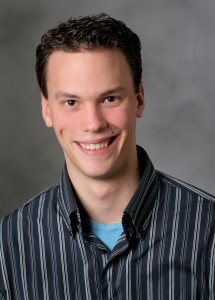 UW CSE Ph.D. alum Scott Saponas has been named to this year’s Technology Review TR-35. “Since 1999, the editors of Technology Review have honored the young innovators whose inventions and research we find most exciting; today that collection is the TR35, a list of technologists and scientists, all under the age of 35. Their work –spanning medicine, computing, communications, electronics, nanotechnology, and more — is changing our world.”
“Fingers flicking through the air, T. Scott Saponas is rocking a solo in the video game Guitar Hero — without a guitar. A soft band around his forearm monitors the muscles moving his fingers and hand. The band hides a ring of six electrodes that pick up the weak electrical signals produced by active muscle tissue. The signals are relayed to a computer, which in turn controls the game …
“Saponas created the software as a graduate student at the University of Washington. Now working at Microsoft Research, he is interested in combining the muscle interface with other sensors, including accelerometers and gyroscopes, to provide additional precision.”
Read the TR-35 article here. Read more →