 In 2010 ACM SIGMETRICS, the ACM Special Interest Group for the computer systems performance evaluation community, inaugurated a “Test of Time Award.”
In steady-state, the SIGMETRICS Test of Time Award will recognize annually one performance evaluation paper whose impact is still felt 10-12 years after its initial publication in the proceedings of the ACM SIGMETRICS conference.
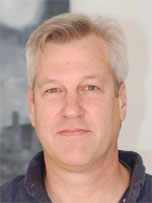
John Zahorjan
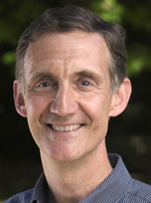
Ed Lazowska
To bootstrap the process, the inaugural ACM SIGMETRICS Test of Time Award recognizes three papers published between 1973 and 1999 – essentially, the three papers of greatest impact from the first 27 years of ACM SIGMETRICS. The authors of these papers were recognized on June 17 at the ACM SIGMETRICS 2010 conference in New York.
One of the three papers is “A Comparison of Receiver-initiated and Sender-initiated Adaptive Load Sharing,” which was presented at the 1985 ACM SIGMETRICS conference by UW CSE’s Ed Lazowska and John Zahorjan along with their frequent collaborator Derek Eager from the University of Saskatchewan. (Eager, Lazowska and Zahorjan had the same thesis advisor at the University of Toronto, Kenneth C. Sevcik.) In a series of papers during that time frame, Eager, Lazowska and Zahorjan laid the foundation for policies that improve performance by distributing the computational load among the hosts in locally distributed systems. Read more →
 UW CSE alum Loren Carpenter, Chief Scientist at Pixar, was interviewed by TechNewsWorld in connection with his receipt of a UW College of Engineering Diamond Award for alumni achievement.
“Carpenter, a graduate of the University of Washington, was in Seattle recently to accept a Diamond Award honoring UW alumni for their contributions to the field of engineering. With the release of ‘Toy Story III’ set for June 18, TechNewsWorld sat down with Carpenter for an interview and asked him about the future of computer-generated film technology, the art of storytelling in animation, Steve Jobs’ role at Pixar and the current 3-D movie craze.”
Read the interview here. Read more →
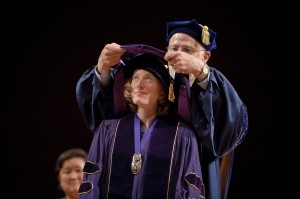
Richard Ladner "hoods" Anna Cavender as Lindsay Michimoto looks on
A lovely set of Bruce Hemingway photographs of the June 12 UW CSE graduation ceremony:
Read more →
 Most Significant Bits, the newsletter of UW Computer Science & Engineering, has leapt into the 21st century with an online html version, as well as an email version.
Online html version of the Spring 2010 issue here.
Traditional pdf version here.
Sign up to get the email version of MSB the day that it’s published by sending an email to msb at cs.washington.edu.
Get CSE news, events, etc., via email, RSS, Twitter, Facebook, etc., here. Read more →
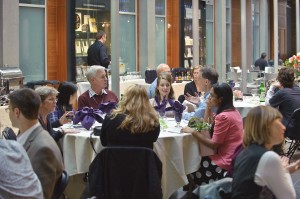 Each year, UW CSE invites students to nominate “inspirational teachers” from secondary school or community college – teachers who shaped their perceptions of themselves as students. We host those teachers, their spouses/guests, and the students who nominated them at a dinner in the Allen Center. We have three goals: to honor the teachers for their contributions; to re-acquaint them with some of their favorite students; and to encourage them to send us more great students!
Photos from this year’s “Inspirational Teacher” dinner may be found here.
Congratulations to our 2010 “Inspirational Teachers”:
- Cathy Ames, Oliver M. Hazen High School, Renton, WA
- Christian Balmy, Burlingame High School, Burlingame, CA
- Michael Bannow, Mountain View High School, Vancouver, WA
- Deirdre Duffy, Bothell High School, Bothell, WA
- Jan Estep, Pullman High School, Pullman, WA
- Jared Fernandez, Issaquah High School, Issaquah, WA
- Jason Heinze, Olympic College, Bremerton, WA
- Dale Hoffman, Bellevue College, Bellevue, WA
- Bill Iverson, Bellevue College, Bellevue, WA
- Charlie Jackam, Hockinson High School, Brush Prairie, WA
- 3ric Johanson, Hackerbot Labs, Seattle, WA
- Al Ko, Skyline High School, Issaquah, WA
- George Lee, Kamiakin High School, Kennewick, WA
- Francois LePeintre, Seattle Central Community College Seattle, WA
- Mark Morrow, Bellevue High School, Bellevue, WA
- Aaron Noble, Mercer Island High School, Mercer Island, WA
- Ted Nutting, Ballard High School, Seattle, WA
- Vince Offenback, North Seattle Community College, Seattle, WA
- Bertrand Parks, South Seattle Community College Seattle, WA
- Dave Pevovar, Central Kitsap High School, Silverdale, WA
- Michael Quillin, Bishop Blanchet High School, Seattle, WA
- Dennis Schaffer, North Seattle Community College Seattle, WA
- Richard T. Shamrell, Clark College, Vancouver, WA
- Hearan Shim, Skyline High School, Issaquah, WA
- Jeannine Sieler, Bellevue High School, Bellevue, WA
- David Stacy, Bellevue College, Bellevue, WA
- Melissa Storms, North Seattle Community College Seattle, WA
Teachers recognized in previous years are listed here. Read more →
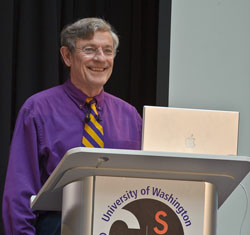 After more than 25 years on the UW CSE faculty (preceded by stints at Purdue and Yale), Larry Snyder marked his retirement with a valedictory lecture on June 2 2010, attended by more than 100 friends and colleagues.
Larry advertised the talk, “A Micro-Century of Computational Miscellany,” as follows:
“A micro-century (uC) is 52.6 minutes, the optimum length for a college lecture in the opinion of people who worry about such things. A valedictory lecture, a concept with a British pedigree, is a ponderous speech on an arcane topic of no apparent interest to anyone but the speaker. (Retiring academics, after several thousand micro-centuries in the classroom, are wonderfully well prepared to deliver them.) Miscellany, of course, is a collection of diverse things, odds and ends with no unifying theme.
“In this decidedly non-technical talk, I describe interesting odds and ends about computing that have caught my attention over the years, because, unfortunately, the dog ate my notes for the originally planned lecture: ‘Apposition or Opposition: Dialectic Analysis of ‘binary’ in Post-modernist Computer Science Thought.'”
Thanks to Larry for nearly three decades of contributions to UW CSE! See photos of the event here. Read more →
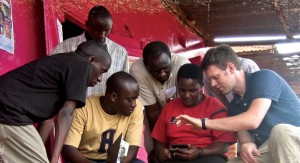 The June issue of Columns – the University of Washington alumni magazine – includes three articles describing UW CSE research projects utilizing mobile phones in ways that have broad societal impact.
A feature article, “Phoning It In: Changing the World,” describes work by UW CSE professor Gaetano Borriello and his students on Open Data Kit, a software infrastructure focused on the use of mobile phones as data collection devices in the developing (and developed) world.
Shorter articles describe the work of UW CSE professor Richard Ladner and his students on mobile applications for the disabled (“Making Mobile Apps for the Disabled“) and the work of UW CSE graduate student Brian Ferris on the “One Bus Away” application to increase the utility of public transit (“UW-Designed Tool Finds Buses and Awards“). Read more →
 Several families of blue herons are nesting this spring in the Sylvan Grove, which the Paul G. Allen Center for Computer Science & Engineering overlooks. From the sixth floor, one nest in particular is easily visible, and neither the proud parents nor the nestlings seem to mind if we monitor their progress. And monitor it we are:
1. Point your web browser at www.cs.washington.edu/heroncam to get a live view of the nest from our cambot.
2. CSE faculty member Bruce Hemingway, our unofficial department photographer, has created and is continuing to add to a wonderful photo album of high-quality photographs. Click on the image at right to visit it.
3. For those of you on a multicast-capable “research network” (all of UW, plus some large companies, but probably not your home internet service), CSE staff member Fred Videon has established a stunning hi-def video feed. To view the feed, you might use the free VideoLAN Project vlc program. (1) Select Media:Open Network Stream. (2) Select UDP as the stream, enter 233.0.73.67 as the IP address, and use port 1234 (the default). (3) Press “play.”
Those of us with upper-floor offices facing the Grove are having a lot of fun watching the nestlings and their proud parents, and we invite everyone in the CSE community to join us. Read more →
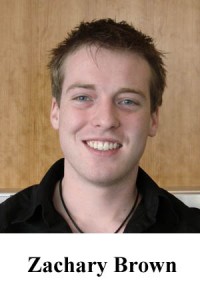 Each year, roughly a half dozen outstanding UW undergraduates are awarded Bonderman Travel Fellowships to spend time abroad. CSE student Zachary Brown has been named a 2010 Bonderman Travel Fellow. Read about Zachary’s plans here. Read about all of the 2010 Bonderman Travel Fellows here. Read more →