 Each year, Microsoft bestows three “Technical Recognition Awards”:
- “Career Achievement” for exceptional and lasting contributions that span a lifetime.
- “Outstanding Technical Achievement” to a team for a high-impact contribution.
- “Outstanding Technical Leadership” for spearheading a breakthrough initiative.
As with many awards, the Microsoft Technical Recognition Awards involve both recognition and a prize. An innovative aspect is that the prize is given to a charitable organization designated by the individual.
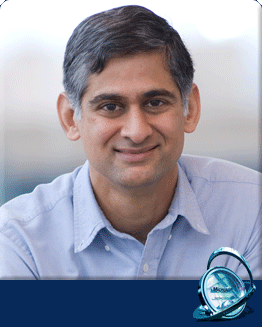
This year, Russ Arun was honored with the Outstanding Technical Leadership Award. We’re extremely grateful that Russ and his wife Radhika chose to direct a portion of their prize to UW Computer Science & Engineering. Congratulations to Russ, and thanks to Russ and Radhika.
The Microsoft Technical Recognition Awards are now in their fourth year, and in each of those years, one of the recipients has directed a portion of his prize to UW CSE!
Thanks to Microsoft, and to our many friends there! Read more →
 “Reverse Traceroute,” a paper describing a UW CSE network measurement innovation, has been named the “Best Paper” of this year’s USENIX Symposium on Networked Systems Design & Implementation (NSDI). The paper was authored by UW CSE graduate students Ethan Katz-Bassett and Harsha Madhyastha (now a postdoc at UCSD); UW CSE undergraduates Justine Sherry, Colin Scott, and Peter van Wesep; UW CSE faculty members Arvind Krishnamurthy and Tom Anderson; and University of Minnesota graduate student Vijay Kumar Adhikar.
Traceroute is the most widely used Internet diagnostic tool today. Network operators use it to help identify routing failures, path inflation, and router misconfigurations. Researchers use it to map the Internet, predict performance, geolocate routers, and classify the performance of ISPs. However, traceroute has long had a fundamental limitation that affects all these applications: it does not provide reverse path information. Although various public traceroute servers across the Internet provide some visibility, no general method exists for determining a reverse path from an arbitrary destination, without control of that destination. Reverse Traceroute addresses this longstanding limitation. Read more →



 Tom Anderson rises to #1! Hank Levy and Brian Bershad remain in the top 5. Ed Lazowska clings by his fingernails to #10. What’s the methodology? We don’t give a rip — we think it’s fantastic, whatever it is. Let Berkeley, MIT, Stanford, and CMU delve into it! Check it out here. Cleaned-up pdf, saved for posterity, here.
( Hal Perkins’s observation on the value of citation statistics as a measure of scientific worth: “Some Turing Award winners on that list: Liskov at 34, Lampson at 38, Gray at 43, Dijkstra at 210, Knuth at 372, Hoare at 399.”) Read more →
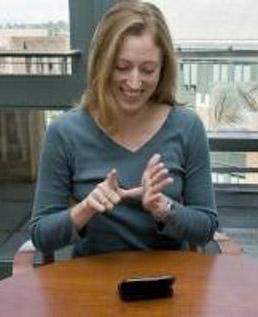 UW CSE’s Anna Cavender, completing her Ph.D. with professor Richard Ladner, has been awarded the 2010 University of Washington Graduate School Medal.
The Graduate School Medal is given annually “to recognize Ph.D. candidates whose academic expertise and social awareness are integrated in a way that demonstrates an exemplary commitment to the University and its larger community.” UW CSE’s Vibha Sazawal, now a professor at the University of Maryland, received the UW Graduate School Medal in 2004.
Congratulations Anna! Read more →
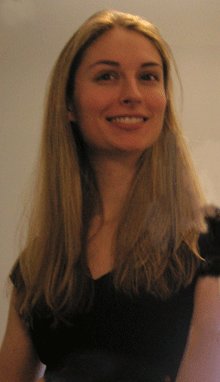
Lydia Chilton
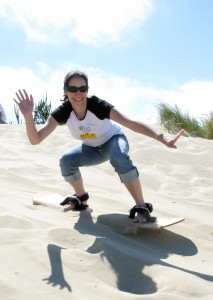
Kristi Morton
Each year, roughly 30 top women enrolled in computer science graduate programs in the US are named Google Anita Borg Memorial Scholars. Among the 2010 Anita Borg recipients are UW CSE’s Lydia Chilton and Kristi Morton.
Anita Borg, who received her Ph.D. from Courant, was a research engineer for Nixdorf, DEC WRL, and Xerox PARC, and also was a hugely effective advocate for the inclusion of women in technology fields (she launched the Systers online community, co-founded the Grace Hopper Celebration of Women in Computing, and established the Institute for Women and Technology, among many other accomplishments; she was a mentor to hundreds and an inspiration to thousands). Anita died of cancer in 2003.
Kristi is a UW CSE Ph.D. student working with Magda Balazinska and Dan Grossman on databases and programming languages. She’s an alumna of Rice University and the University of Texas at Austin, and a former employee of Motorola/Freescale Semiconductor in Austin, Texas. She’s the drummer in the CSE band on those rare occasions when it’s allowed to play.
Lydia is a UW CSE Ph.D. student working with James Fogarty and James Landay on human computer interaction. She’s an alumna of MIT and a Trekkie.
UW CSE graduate student Juliet Bernstein and UW CSE undergraduate student Sanjana Prasain were named Finalists and also received scholarship awards.
Congratulations Lydia, Kristi, Juliet, and Sanjana!! Read more →
Dean Tullsen
Hank Levy
Susan Eggers
Each year the International Symposium on Computer Architecture – the leading conference in the field – bestows the ISCA Influential Paper Award on “the paper from the ISCA Proceedings 15 years earlier that has had the most impact on the field (in terms of research, development, products or ideas) during the intervening years.”
The 2010 award, for a paper presented at ISCA in 1995, has been bestowed on the paper “Simultaneous Multithreading: Maximizing On-Chip Parallelism” by Susan Eggers, Hank Levy, and their Ph.D. student Dean Tullsen (a professor at UCSD since receiving his UW Ph.D. in 1996). The award will be presented at ISCA 2010 in Saint-Malo, France, in June.
Simultaneous Multithreading allows independent threads to issue instructions to multiple functional units in a single cycle, combining facilities available in both superscalar and multithreaded architectures. It was commercialized by Intel as HyperThreading.
Congratulations to Susan, Hank, and Dean!
(The inaugural ISCA Influential Paper Award was presented in 2003 (for ISCA 1988) to UW CSE’s Jean-Loup Baer and his Ph.D. student Wen-Hann Wang (currently Vice President of Intel Labs and director of Circuits and System Research for Intel Corporation) for their paper “On the Inclusion Properties for Multi-Level Cache Hierarchies.”) Read more →
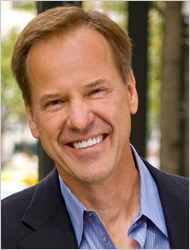 The Sunday New York Times profiles UW CSE alumnus Jeremy Jaech – co-founder of Aldus and Visio, and currently CEO of Verdiem.
“Now I am running Verdiem, which has 55 employees and provides software to reduce energy consumption of PC networks. The company monitors, measures and manages information technology energy use and related greenhouse gas emissions.
“I believe that Verdiem, like Aldus’s desktop publishing and Visio’s diagramming on the PC, is another opportunity to create a new market, this time in green computing. There’s a need there that no one’s filled yet.
“My favorite nonprofit I work with today is the University of Washington, which is a fantastic research institution and has an excellent basketball team, too.”
Read this wonderful profile here. Read more →
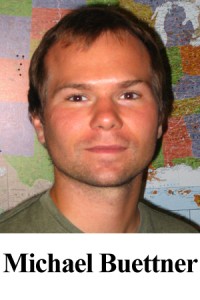 UW CSE Ph.D. student Michael Buettner has been selected as an Intel Ph.D. Fellowship winner for the 2010-11 academic year. Michael works with David Wetherall on wireless systems.
Congratulations Michael! Read more →
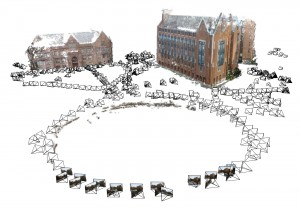 PhotoCity – a research effort and online game developed by faculty and students at the University of Washington and Cornell to capture a virtual 3D world from millions of cell phone photographs – was most recently featured in Xconomy.
“Building on a previous program called Photo Tourism [the core technology of Microsoft’s Photosyth] that pieces together photos culled from Flickr into virtual 3D models, PhotoCity is a ‘capture the flag’-esque game that re-creates sections of campuses or city blocks, or, eventually, entire cities, from user-generated photos.”
Photocity is the work of UW graduate students Kathleen Tuite and Dun-Yu Hsiao, UW undergraduate students Nadine Tabing and Sylvia Tashev, UW faculty members Zoran Popovic and Steve Seitz, and Cornell faculty member and former UW graduate student Noah Snavely.
Read the Xconomy article here. Read more →
 “Typically, robots respond well to precise instruction sets but they are flummoxed if their instructions are given in the fuzzy, everyday language so beloved by humans. Now, a team at the University of Washington in Seattle has developed translation software which could enable robots to understand a set of natural-language directions …
“Cynthia Matuszek and her colleagues used the principles of machine translation – commonly used online to translate text of one language into another – to develop a navigation program for robots. Machine translation tools are designed to learn from previous efforts, improving their accuracy through experience.”
Read “Parlez-vous robot?” here. Read more →