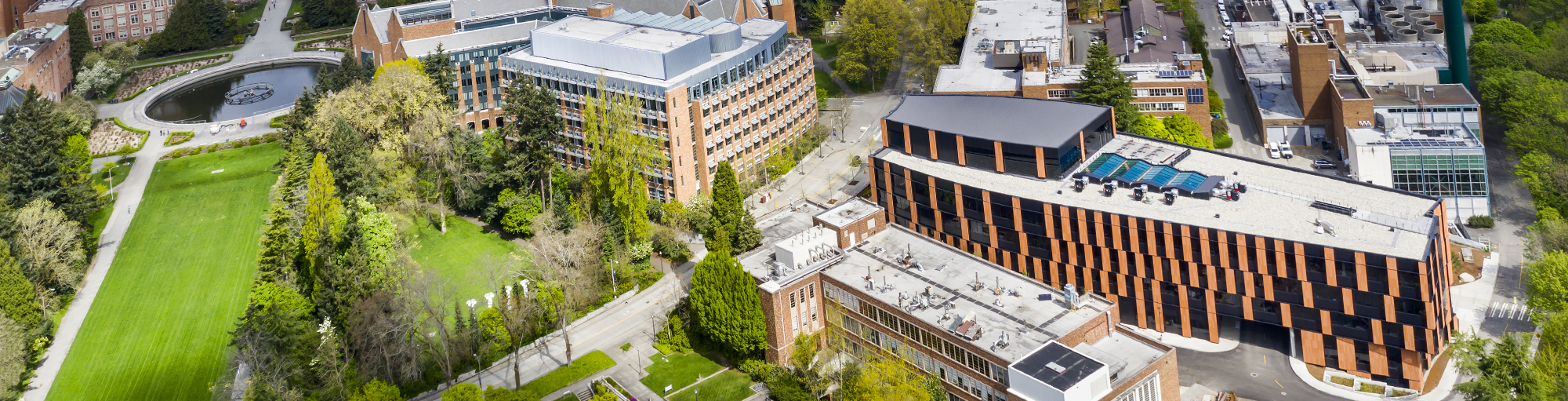
 UW CSE’s Ed Lazowska writes in Xconomy about the remarkable performance of the University of Washington in securing research funding under the American Recovery and Reinvestment Act.
“Why R&D as part of the stimulus? Because it employs people (that’s what we do with federal research grant funding), but more importantly, because it lays the foundation for America’s world leadership.”
Read the full article here. Read more →
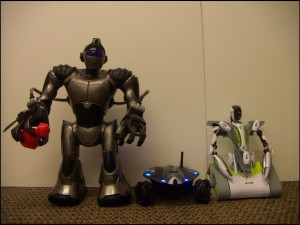
People are increasingly using household robots for chores, communication, entertainment and companionship. But, according to a new UW CSE study, security and privacy risks of information-gathering objects that move around our homes have not been adequately addressed.
UW CSE’s professor Yoshi Kohno, grad students Tamara Denning, Cynthia Matuszek, and Karl Koscher, and affiliate faculty member Joshua Smith discovered security weaknesses in all three domestic robots they examined. They presented their findings at the International Conference on Ubiquitous Computing.
Read an article about the study on the UW News site here. See the full study here. PCWorld here. Slashdot here. Popular Science here. UPI Science News here. gizmag here. Globe and Mail here. Wired here. Read more →
 Mobile phones are becoming pervasive in developing regions, creating an opportunity to address data collection needs. Existing paper-based approaches are often slow and incomplete when compared to mobile phone based data collection methods.
To address this problem, UW CSE’s grad students Yaw Anokwa, Carl Hartung, and Waylon Brunette, along with Professor Gaetano Borriello, have built Open Data Kit (ODK), a set of mobile phone-based tools to help organizations collect, aggregate and visualize their data. The ODK project was featured in the October issue of IEEE Computer.
ODK tools have only been available for a few months, but uptake has been fast and broad. Examples include HIV counseling and testing in Kenya (as shown), deforestation monitoring in the Amazon, decision support for pediatric patients in Tanzania, and documenting war crimes in the Central African Republic.
Read the full article here. You can find more about the project here. Read more →
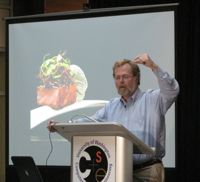 TechFlash reports on a presentation in UW CSE’s Distinguished Lecturer Series by Nathan Myhrvold and Chris Young of Intellectual Ventures.
“What do you do if you’re a wealthy technologist and are interested in food? Take some classes at the Cordon Bleu, right? Well, if you’re Nathan Myhrvold — former CTO of Microsoft and founder of Intellectual Ventures — you take it a step further. Myhrvold hired a team of 15 people, including a chef from a famous London restaurant, who are helping him write a 1,500-page tome on the science of cooking. Today he showed off his culinary research in a lecture at the University of Washington, and treated the crowd to almond ice cream made with liquid nitrogen.”
Read the full post here.
On-demand video of this terrific presentation here. Read more →
 The Computing Research Association and the Computing Community Consortium have selected UW CSE’s Rome in a Day project as the Computing Research Highlight of the Week.
“Several years ago, a collaboration between computer graphics and computer vision researchers at the University of Washington and Microsoft yielded Photosynth, a revolution in organizing and navigating digital photographs.
“Now, that same collaboration has yielded Rome In A Day, which reconstructs entire cities from images harvested from the web, in less than a day of computation time per city.”
Read the full post here. More about the project here. Read more →
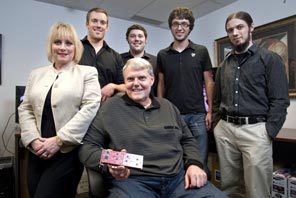 “Gary and Pamela Hammer did more than help their son Jeremy find a job when he graduated from the University of Washington three years ago.
“The Hammer family decided that was a good time to start a technology company, employing Jeremy, two of his classmates and another son who had been working at Fluke in Everett.
“Now their company, Kirkland-based Ceton, is releasing a gadget that has caught the imagination of digital-media enthusiasts and could find its way into the homes of millions of cable-TV subscribers within a few years.”
Jeremy Hammer, Austin Foxley, and Alex Faucher are UW CSE students.
Read the full article here. Read more →
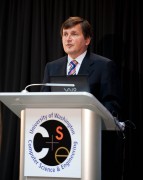 Xconomy reports on Charles Simonyi’s kickoff of the 2009-10 UW Computer Science & Engineering Distinguished Lecturer Series.
“Simonyi, the father of Microsoft Word and Excel, and now head of Bellevue, WA-based Intentional Software, regaled the crowd of a couple hundred students, faculty, and guests with stories and videos from his second trip to space last March. Simonyi rode a Russian Soyuz rocket to the International Space Station (ISS), docked and spent some time there, and returned safely to Earth, looking none the worse for wear. He is an outspoken proponent of space tourism, and he pointed out that Guy Laliberté, the founder of Cirque du Soleil, is currently making his way aboard the space station as ‘the first clown in space’ (and the seventh space tourist ever).”
Read the whole article here.
UW CSE Distinguished Lecturer Series here.
On-demand video of this terrific presentation here. Read more →
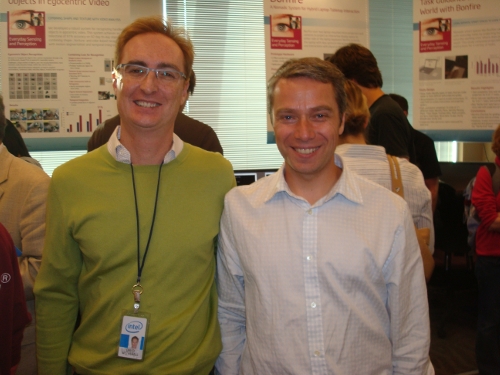 UW CSE’s Dieter Fox is the fourth director of Seattle’s Intel Labs, officially succeeding UW CSE’s David Wetherall two weeks ago. At Intel Labs Seattle’s open house yesterday afternoon, Xconomy’s Gregory Huang had a chance to talk to both about the lab’s role in shaping the future of computing.
“‘Our role with respect to Intel is performing what they call disrupting research that is off-roadmap, but essentially our task is also to surprise Intel,’ Fox says. ‘If we show what can be done with future computing systems, then we are serving our purpose. And beyond surprising Intel, we also want to surprise consumers by what can be done. It’s becoming more and more important that these computational systems are going to be observing the environment, using sensors. Today’s smartphones all have GPS, accelerometers, and all that. The key question is, how can we extract relevant information to make it more interesting for users?'”
Read the full article here. Xconomy article regarding projects highlighted at the open house here. Brier Dudley’s blog here. Read more →
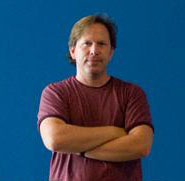 Voice of San Diego profiles UW CSE Ph.D. alumnus and UCSD CSE faculty member Stefan Savage.
“The poster outside the third-floor office in the University of California, San Diego’s computer sciences building depicts Doc Savage, the big-muscled, bald-headed, fearsome-faced comic book hero. Inside the office sits a different Doc Savage.
“Stefan Savage is a pale-faced, 40-year-old, T-shirt-and-shorts-wearing college professor. But in the world of cybercrime fighting — where the strength of your code, not your biceps, is what matters — this Doc Savage cuts quite the imposing figure.”
Read it! Read more →