Amazon Catalyst: Inspiring grassroots innovation at UW

catalystToday our friend and neighbor Amazon announced Amazon Catalyst, a grant program to inspire grassroots innovation at the University of Washington.

The program is open to all members of the UW community – all people, all fields.

It’s a partnership with huge potential!  Thank you Amazon!

Learn more here.

GeekWire here. Seattle Times here. Read more →

UW CSE’s Yoshi Kohno, Franzi Roesner and Tamara Denning co-author policy primer on augmented reality

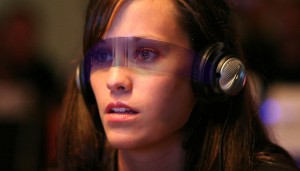
Augmented realityUW CSE professors Yoshi Kohno and Franzi Roesner and Ph.D. alum Tamara Denning (now on the faculty at the University of Utah) are among the lead authors of a new white paper that examines policy issues associated with emerging augmented reality technologies. The paper is the first of its kind published by the UW’s Tech Policy Lab, which brings together faculty and students from UW CSE, the School of Law, the iSchool and other units on campus to explore the potential implications of emerging technologies in a way that is useful for policy makers.

From the UW media release:

“Though still in its relative infancy, augmented reality promises systems that can aid people with mobility or other limitations, providing real-time information about their immediate environment as well as hands-free obstacle avoidance, language translation, instruction and much more. From enhanced eyewear like Google Glass to Microsoft’s wearable HoloLens system, tech, gaming and advertisement industries are already investing in and deploying augmented reality devices and systems.

“But augmented reality will also bring challenges for law, public policy and privacy, especially pertaining to how information is collected and displayed. Issues regarding surveillance and privacy, free speech, safety, intellectual property and distraction — as well as potential discrimination — are bound to follow.”

The report was co-authored by School of Law professor Ryan Calo, iSchool professor Batya Friedman, Tech Policy Lab associate director Emily McReynolds, iSchool alum Bryce Newell, iSchool student Lassana Magassa and School of Law alum Jesse Woo.

Read the full release here, and read the white paper, “Augmented Reality: A Technology and Policy Primer,” here.

Kohno will be joined by his Tech Policy Lab co-directors, Calo and Friedman, for a panel discussion tonight on “responsible innovation” and the impact of new technologies on security and privacy. Learn more about the event, which is the final installment of the UW Alumni Association’s 2015 Engineering Lecture Series, here. Read more →

Seattle Times on UW faculty unionization effort

UW ExcellenceThe Seattle Times reports opinions pro and con on the effort by the Service Employees International Union (SEIU) to unionize UW’s faculty. The article quotes CSE’s Ed Lazowska, and references a website created by Lazowska and Chemistry professor Paul Hopkins. Read the article here.

CampusReform.org focuses on the con, again quoting Lazowska. Read the article here.

A complex issue. While individual UW CSE faculty members have opinions and voice them, UW CSE itself is careful to express no opinion. Read more →

UW CSE alum Brandon Lucia recognized for “Valor” at OOPSLA 2015

Brandon LuciaUW CSE alum Brandon Lucia (Ph.D., ’13), now on the faculty at Carnegie Mellon, collected a Distinguished Paper Award and a Distinguished Artifact Award at OOPSLA 2015 last week for the paper, “Valor: Efficient, Software-Only Region Conflict Exceptions.”

Valor is a novel, software-only region conflict detection analysis that achieves high performance by eliminating the costly analysis on each read operation required by previous approaches. Existing techniques either modify hardware or slow programs dramatically, precluding always-on use. As the first region conflict detector to provide strong semantic guarantees for racy program executions with less than 2X slowdown, Valor represents the state of the art in always-on support for strong behavioral guarantees for data races. With Valor, Brandon and his fellow researchers address a fundamental barrier to providing well-defined programming language specifications and to writing correct shared-memory, multithreaded programs.

Read the winning paper, which was co-authored by Swarnendu Biswas, Minjia Zhang and Michael Bond of Ohio State University, here.

Congratulations to Brandon and his colleagues on the double win! Read more →

The New York Times on Paul Allen’s philanthropy

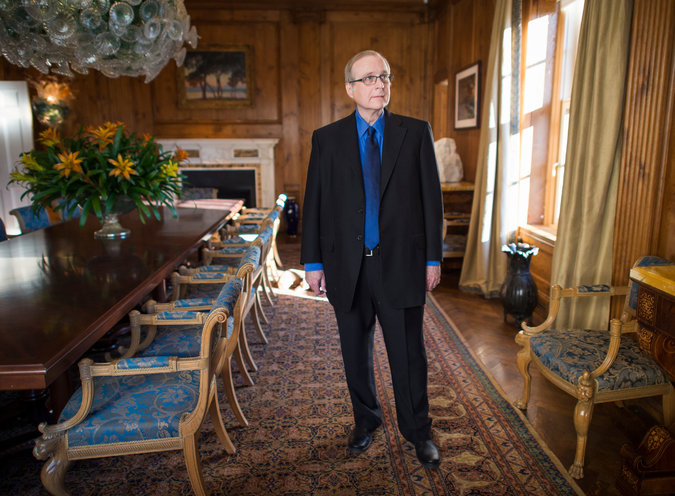
08MOGUL-master675“‘It always comes back to what you are passionate about,’ said Mr. Allen, 62. Through philanthropy, he said, ‘you are transmitting your hopes, and keeping them going in the future.'”

Oren Etzioni – UW CSE professor and CEO of the Allen Institute for Artificial Intelligence – is quoted.

Terrific article – read it here. Read more →

UW’s eScience Institute to co-lead new big data innovation hub

UW eScience Institute logoThe National Science Foundation (NSF) announced that the University of Washington – a recognized leader in data management and visualization and data-intensive discovery – will co-lead the new Big Data Regional Innovation Hub for the western United States. Members of the UW’s eScience Institute and UW CSE faculty will partner with colleagues at the University of California, San Diego and UC Berkeley on the new initiative, which is one of four university-led hubs established by NSF to catalyze big data solutions to real-world problems.

From the UW media release:

“The ability to access, analyze and draw insights from massive amounts of data is already driving innovation in fields from medicine and manufacturing to the way cities are managed. To accelerate this emerging field, the NSF is establishing four ‘Big Data brain trusts’ to catalyze new collaborations among university researchers, tech companies, national labs, local and state government and non-profits.

“‘Our selection to help lead the West’s Big Data Hub affirms our position as a leader in data science and our track record in building successful partnerships,’ said Ed Lazowska, the Bill & Melinda Gates Chair in Computer Science & Engineering and director of the UW eScience Institute. ‘The Puget Sound region in particular is an excellent laboratory for this.'”

Lazowska is joined by Bill Howe, associate director and senior data science fellow at the eScience Institute; data scientist Ariel Rokem; and program director Sarah Stone on the UW’s hub leadership team. The western hub will focus on promoting collaborations and advancing solutions in five areas: big data technologies, managing natural resources and hazards, precision medicine, metro data science, and data-enabled scientific discovery and learning.

Read the full UW announcement here, and the NSF announcement here.

Check out the White House Office of Science and Technology Policy’s blog post on the new initiative here, and the Seattle Times article here. Read more →

UW CSE friends and family among Seattle Magazine’s “Most Influential People of 2015”

seam_logo_blknobox_0The November issue of Seattle Magazine contains its annual list of “Seattle’s Most Influential People” – a list that was particularly kind to UW CSE friends and family this year. Among those recognized:

  • “Nurturing Knowledge” – Brad Smith, President and Chief Legal Officer of Microsoft
  • “Game Changer” – Ana Mari Cauce, President of the University of Washington
  • “Leading the Causes” – Paul G. Allen, Benefactor
  • “Package Deal” – Amazon
  • “The Trailblazer” – David Brewster, Civic Activist
  • “Sick Leave” – Chris Murray, Director, UW Institute for Health Metrics and Evaluation
  • “The Tracker” – Brian Ferris, OneBusAway Creator and Google Transit Engineer
  • “Cracking the Code” – Hadi and Ali Partovi, Founders, Code.org
  • “Leaning In” – Jonathan Sposato, Angel Investor and Seattle Entrepreneur
  • “Reinventing Real Estate” – Redfin’s Glenn Kelman and Zillow’s Spencer Raskoff

Read about these, and more, here. Read more →

The Most Common Job in Each State

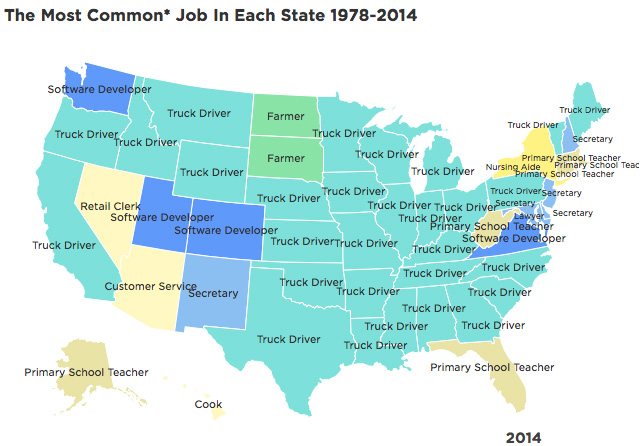
mapHere’s a terrific interactive map produced by NPR’s “Planet Money” based on US Bureau of Labor Statistics data. It shows the most common job in each state, biennially from 1978 through 2014.

As of 2014, in Washington, Utah, Colorado, and Virginia, it’s “Software Developer.” (In the majority of the states, it’s “Truck Driver.”

Check it out here! And think about what we need to do in order to sustain this advantage, and ensure that our own kids are the beneficiaries of Washington’s booming tech economy! Read more →

Catch part two of “Lunch Break” featuring UW CSE’s Ed Lazowska

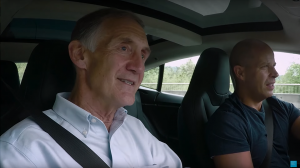
Ed Lazowska on Lunch BreakLast week, we shared a video of Brad Anderson, corporate vice president at Microsoft, conducting a lunchtime interview on the go with UW CSE professor Ed Lazowska. That was part one; today, we bring you part two, which covered topics ranging from preparing students to succeed in a technology-driven world, to changing the world through computer science (and many other topics in between).

Watch this week’s episode of Lunch Break here, and check out Brad’s blog post here. Read more →

UW CSE’s software verification research proves a hot topic at JavaOne

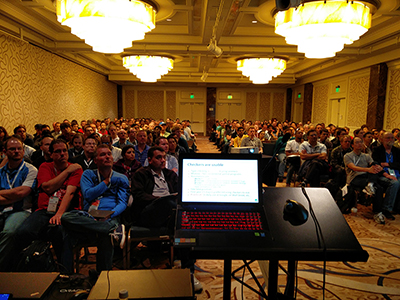
JavaOne audienceUW CSE professor Michael Ernst and former postdoc Werner Dietl (now a professor at the University of Waterloo) killed it at Oracle’s JavaOne conference in San Francisco this week, delivering three well-received talks that drew upon UW CSE research: “Preventing Errors Before They Happen,” “Collaborative Verification of the Information Flow for a High-Assurance App Store” (about the SPARTA project), and “Using Type Annotations to Improve Your Code.”

The common theme of the three talks was lightweight software verification. Ernst, Dietl and colleagues at UW CSE have created widely-used tools for verifying Java programs. In the course of their work, they observed that the usual approaches to verification are powerful but impractical. While the main success of formal verification is type systems, the built-in type system of a language like Java permits too many incorrect programs.

Checker Framework logoTo address this, the UW team devised new ways to strengthen type systems, such as making them flow-sensitive, while retaining their speed and ease of use. They also created a tool called the Checker Framework that makes it easy to create a type system for all of Java.

The Checker Framework ships with dozens of powerful type systems that are very effective at finding bugs. More importantly, these type systems give a guarantee: if a type system does not issue any warnings, then the program contains no bugs (of a certain variety). The type systems are used at companies from Wall Street to Silicon Valley (Google runs them on hundreds of projects every day). Oracle was so impressed with the Checker Framework that they added syntactic support for it to the Java 8 language, enabling 9 million programmers to improve their code. The type systems are also backward compatible with previous versions of Java.

If you want to improve your Java code, download the Checker Framework here. Read more →

« Newer PostsOlder Posts »