 Allen School researchers took home multiple Best Paper and Outstanding Paper Awards from the 61st Annual Meeting of the Association for Computational Linguistics (ACL) held in Toronto last month. Their research spanned a number of projects aimed at enhancing the performance and impact of natural language models, including how artificial intelligence (AI) processes humor, the impact of built-in political biases on model performance, AI-assisted cognitive reframing to support mental health, identifying “WEIRD” design biases in datasets and how to imbue language models with theory of mind capabilities. Read more →

Can AI take a joke? Allen School researchers recognized at ACL 2023 for tackling this and other questions at the nexus of human and machine understanding
Allen School researchers took home multiple Best Paper and Outstanding Paper Awards from the 61st Annual Meeting of the Association for Computational Linguistics (ACL) held in Toronto last month. Their research spanned a number of projects aimed at enhancing the performance and impact of natural language models, including how artificial intelligence (AI) processes humor, the impact of built-in political biases on model performance, AI-assisted cognitive reframing to support mental health, identifying “WEIRD” design biases in datasets and how to imbue language models with theory of mind capabilities. Read more →
Distinctions with a difference: Allen School researchers unveil ContrastiveVI, a deep generative model for gleaning additional insights from single-cell datasets
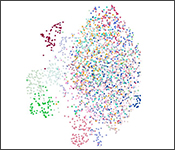 In the days before single-cell RNA sequencing, researchers investigating the mechanisms and treatment of disease had to make do with running experiments on bulk cell profiles created by taking tissue samples and grinding them up. Nowadays, researchers can take measurements at the level of individual cells, enabling the exploration of such finer-grained distinctions and advancing our understanding of various biological functions. But without the right computational tools, even single-cell datasets can yield distinctions without a difference. In a paper published this week in Nature Methods, a team in the Allen School’s AIMS Lab led by professor Su-In Lee introduced ContrastiveVI, the first deep learning model designed for applying a powerful technique called contrastive analysis to single-cell data. Read more →
Allen School team earns ACM PODS Alberto O. Mendelzon Test-of-Time Award for helping scientists better understand complexity behind parallel database query processing
 A chance encounter helped Paul Beame, Paris Koutris (Ph.D., ‘15) and Dan Suciu create a model that aids scientists in understanding some of the deeper nuances surrounding big data management. Their paper "Communication Steps for Parallel Query Processing" earned the 2023 ACM PODS Alberto O. Mendelzon Test-of-Time Award for providing a deeper understanding of the complexity behind database query evaluation. Read more →
Allen School professor and Smale Prize recipient Shayan Oveis Gharan on counting without counting, his drive to solve TSP and cooking up methods from scratch
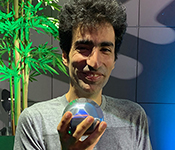 Shayan Oveis Gharan, a professor in the Allen School’s Theory of Computation group, combines all the essential ingredients of a trailblazing researcher who, as his colleagues will attest, also happens to be a genuinely nice guy. The combination has proved to be a genuine recipe for success, as he has racked up a series of accolades in theoretical computer science. His most recent honor, the Stephen Smale Prize from the Society for the Foundations of Computational Mathematics (FoCM), celebrated Oveis Gharan’s “breakthrough results on the applications of algebraic and spectral methods to the design of algorithms and to combinatorial optimization.” Read more →
Seeing is believing: Linxing Preston Jiang and Rajesh Rao earn Best Paper Award at COGSCI for developing a new approach to understanding human visual perception
 There is an old saying that perception is everything, and with regard to human senses and computer models that attempt to demonstrate how human sensory systems work, everything is highly complex. This includes our system of visual perception, which allows humans to interact with the dynamic world in real time. Allen School Ph.D. student Linxing Preston Jiang and professor Rajesh Rao have developed a computational model to simulate how humans process visual information. Their paper, “Dynamic Predictive Coding Explains Both Prediction and Postdiction in Visual Motion Perception,” earned a Best Paper Award in the Perception and Action category at this year’s COGSCI conference. Read more →
College of Arts & Sciences Dean’s Medalist Meghna Shankar strings together success and scholarship as a dual major
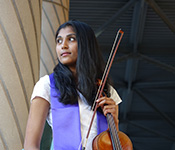 The possibility of a greener future inspired Meghna Shankar to study alternative energy and help wean society off of fossil fuels. The recent Allen School alum, who also spent four years as part of the UW Symphony Orchestra, was named a 2023 Dean's Medalist in the Natural Sciences by the College of Arts & Sciences in recognition of her many scholastic achievements. Read more →
Super 8: How the Allen School’s most recent NSF CAREER Award-winning faculty are reimagining the future of computing
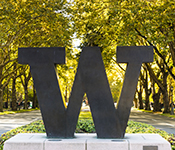 For faculty members who are at the start of their research journey, the National Science Foundation’s CAREER Awards are one of the most prestigious honors recognizing early-career scholarship and supporting future leaders in their respective fields. The latest Allen School recipients are no exception. From using machine learning to fight implicit bias to devising new architectures that bridge electronics and biology, here are eight rising stars who are advancing the field of computing at the University of Washington and reaching new heights. Read more →
Allen School student entrepreneurs behind AI-powered college advising platform place first at 2023 Dempsey Startup Competition
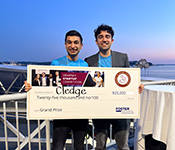 Ayan Gupta and Faraz Qureshi are the co-founders of Cledge, a college advising platform that uses artificial intelligence to help students plan their path forward. The pair recently led their young startup to the Herbert B. Jones Foundation Grand Prize of $25,000 at the 26th annual Dempsey Startup Competition organized by the UW Buerk Center for Entrepreneurship. Read more →
‘Take advantage of the doors that open’: Allen School celebrates the Class of 2023
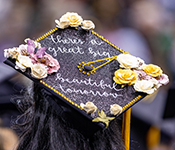 On Friday, June 9, more than 4,000 family and friends from near and far gathered on the University of Washington campus to celebrate the Allen School’s 2023 graduates. The celebration commenced with a casual open house and meet-and-greet with faculty and staff in the Paul G. Allen Center and Bill & Melinda Gates Center. It culminated in a formal event in the Hec Edmundson Pavilion at the Alaskan Airlines Arena, where graduates made the brief journey across the stage to mark the start of a new journey as Allen School alumni. Read more →
Making a difference, one symphony at a time: Concert piano or computer, Allen School undergraduate Michael Gu strikes the right key
 Allen School undergraduate Michael Gu balances performing as a concert pianist with coding as a computer science student. The winner of the UW School of Music's annual concerto competition is using his creative talents, both in the classroom and beyond, to help his community. Read more →