Seattle Tech Meetup @ UW CSE

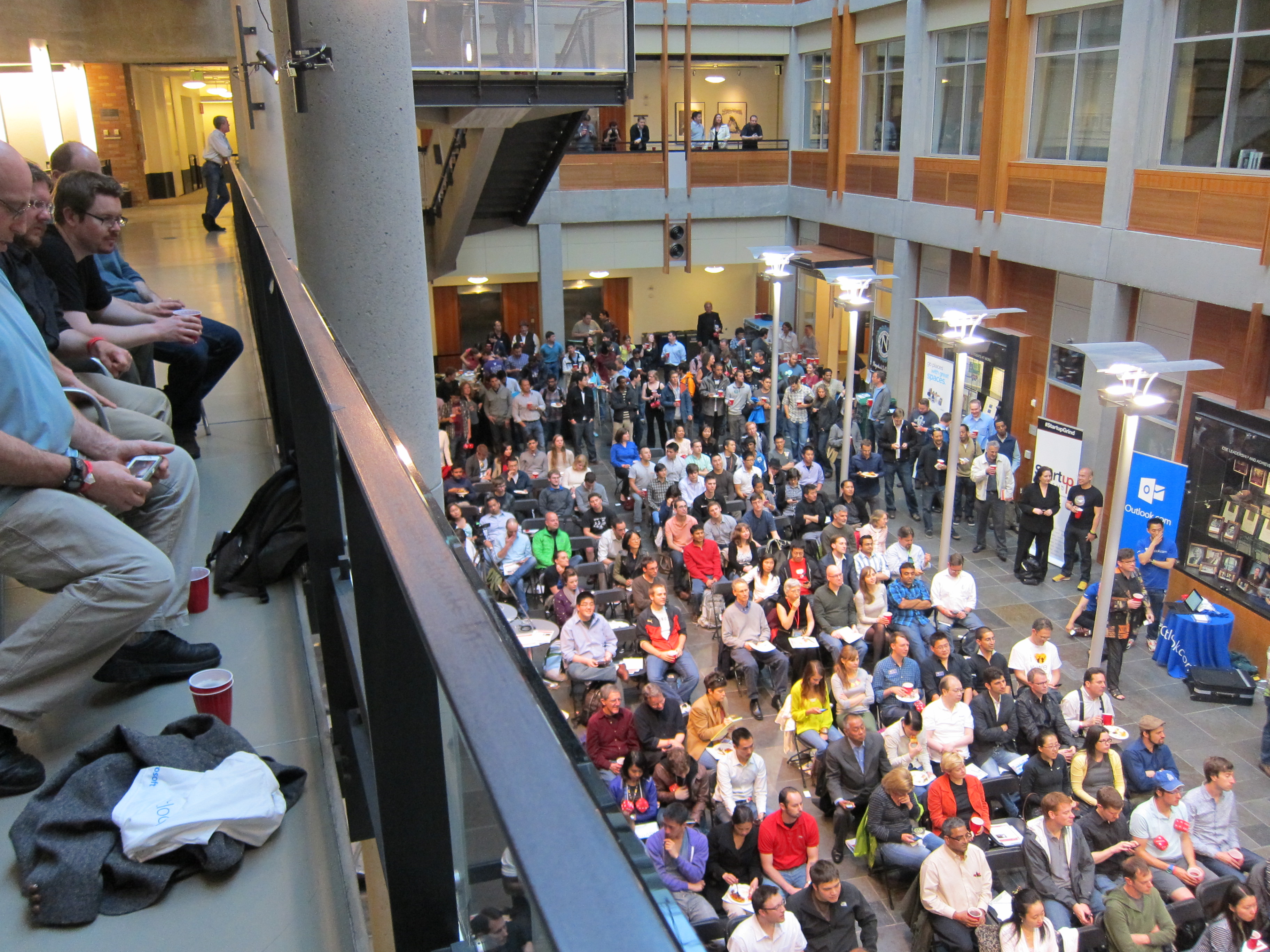
IMG_0243God-knows-how-many-hundreds of mostly-young Seattle technologists visited UW CSE on Tuesday evening for Seattle Tech Meetup – a monthly gathering of the younger Seattle tech community clan, organized by Red Russak and Brett Greene.

See UW CSE’s Ed Lazowska’s presentation here. Read more →

Ars Technica: 10th anniversary of UW CSE alum Brad Fitzpatrick’s memcached

bf“This week, memcached, a piece of software that prevents much of the Internet from melting down, turns 10 years old.  Despite its age, memcached is still the go-to solution for many programmers and sysadmins managing heavy workloads. Without memcached, Ars Technica would likely be unable to serve this article to you at all.

“[UW CSE alum] Brad Fitzpatrick wrote memcached for LiveJournal way back in 2003 (check out the initial CVS commit here). While waiting for new hardware to help save the site from being overloaded, Fitzpatrick realized that he had plenty of unused RAM spread across LiveJournal’s existing servers. He wrote memcached to take advantage of this spare memory and lighten the load on the site.

“memcached is a distributed in-memory key-value store that uses a very simple protocol for storing and retrieving arbitrary data from memory instead of from a filesystem.”

Read more here.  Go Brad! Read more →

Forbes: “A Very Short History of Big Data”

ForbesAn article in Forbes recognizes the impact of a Computing Community Consortium white paper authored by UW CSE’s Ed Lazowska, along with Randy Bryant (CMU) and Randy Katz (Berkeley):

“December 2008 Randal E. Bryant, Randy H. Katz, and Edward D. Lazowska publish ‘Big-Data Computing: Creating Revolutionary Breakthroughs in Commerce, Science and Society (PDF).’  They write: ‘Just as search engines have transformed how we access information, other forms of big-data computing can and will transform the activities of companies, scientific researchers, medical practitioners, and our nation’s defense and intelligence operations…. Big-data computing is perhaps the biggest innovation in computing in the last decade. We have only begun to see its potential to collect, organize, and process data in all walks of life. A modest investment by the federal government could greatly accelerate its development and deployment.'”

Read the Forbes article here. Read more →

Xconomy: Tableau IPO Underscores Seattle Big Data Leadership

tableaulogosq“Tableau Software continued producing visually stunning stock charts during its second day of trading, shining a favorable light on both the Seattle tech industry, and on big data companies …

“As a reminder, Tableau’s DNA is Silicon Valley, and Stanford University, in particular.  But 10 years ago, the company’s founders decided they needed a change of scenery and chose the ‘mountains and salmon and coffee and rain’ of Seattle, in what CEO Christian Chabot has called one of the best decisions the company has made.

“It’s an unequivocal endorsement of the Seattle area as a place to build technology companies in general, and of the region’s leadership in big data.

“‘Seattle is in the catbird seat—because of the ‘big guys’ (Amazon, Microsoft, and a significant Google presence) and also because of smaller companies like Tableau, Zillow, Inrix, Sage Bionetworks, and many others,’ says University of Washington computer science professor Ed Lazowska in an email. ‘We can ‘own’ this.’

“The UW, too, is a driver of regional leadership in big data—the broad effort to collect, manage, and make sense of fast-expanding quantities and types of data.  High-profile hires over the last year have added to an already deep pool of expertise in machine learning and other disciplines underpinning big data technologies.”

Read more here. Read more →

NCWIT establishes David Notkin Mentorship Award

Notkin41-20120301-_BRH6386-EditAt its meeting today, the Board of Directors of the National Center for Women & Information Technology passed unanimously the following resolution:

“NCWIT will create the David Notkin Mentorship Award in memorial to Professor David Notkin, late of the University of Washington Department of Computer Science & Engineering.   David Notkin’s career was emblematic of the principles that guide NCWIT.  Among many other initiatives, David was the founding co-director of the NCWIT Academic Alliance.  The David Notkin Mentorship Award will be presented annually after an open nomination process directed by the NCWIT leadership.  The award will consist of a cash prize funded by philanthropy, and such other recognition as NCWIT considers appropriate.”

The UW CSE family, and David’s family, thank NCWIT for recognizing David in this extraordinarily meaningful way.  Mentorship was everything to David.

Read more about David here. Read more →

New York Times: “How to Be a ‘Woman Programmer'”

19WOMEN-popupThis is really thoughtful opinion piece that should be required reading for at least three reasons:

  1. Threaded throughout are wonderful nuggets that clearly differentiate “software engineering” from “coding” – nuggets such as:
  2. “The first requirement for programming is a passion for the work, a deep need to probe the mysterious space between human thoughts and what a machine can understand; between human desires and how machines might satisfy them.

    “The second requirement is a high tolerance for failure.  Programming is the art of algorithm design and the craft of debugging errant code.  In the words of the great John Backus, inventor of the Fortran programming language:  ‘You need the willingness to fail all the time.  You have to generate many ideas and then you have to work very hard only to discover that they don’t work.  And you keep doing that over and over until you find one that does work.’ …

    “According to the Bureau of Labor Statistics, women comprise 29.4 percent of people working in ‘Computer and Software,’ a subcategory of ‘Commercial Equipment.’  Since this broad (and vague) designation might include everyone from system designers to office assistants, it tells us nothing about the participation of women at the deeper technical and theoretical levels.  By ‘deeper’ I mean computer science, hardware and software engineering, the creation of operating systems and deep algorithms — in short, the levels at which the future of technology is being defined.”

  3. It provides clear reminders that, despite strong efforts by many, gender bias still exists in the field, as it does in nearly all other fields – reminders such as:
  4. “At a meeting, he kept interrupting me to say, ‘Gee, you sure have pretty hair.’  By then I realized he was teaching me a great deal about computing.  It would be a complicated professional relationship, in which his occasional need for male dominance would surface.

    “So, on that day of my pretty hair, I leaned to one side and said, ‘I’m just going to let that nonsense fly over my shoulder.’  The meeting went on.  We discussed the principles of relational databases, which later led me to explore deeper reaches of programming, closer to operating systems and networks, where I would find my real passion for the work.  My leaning to one side, not confronting him, letting him be the flawed man he was, changed the direction of my technical life.”

  5. It provides some tips for surviving and surmounting – tips such as:
  6. “What will save you is tacking into the love of the work, into the desire that brought you there in the first place.  This creates a suspension of time, opens a spacious room of your own in which you can walk around and consider your response.”

    Read it here. Read more →

CSE’s Michael Kutz elected ASUW President

KutzWho says computer scientists are apolitical?

ASUW – the Associated Students of the University of Washington – is UW’s undergraduate student governing body.  In the recently-concluded ASUW elections, CSE major Michael Kutz was elected ASUW President for the coming year.

Congratulations to Michael!  UW Daily article here. Read more →

Congratulations to Tableau!

Tableau-ipoSeattle has a new billion dollar tech IPO:  Tableau Software.

The photo shows co-founders Chris Stolte (Chief Development Officer), Christian Chabot (CEO and Chairman), and Pat Hanrahan (Chief Scientist), along with board member Scott Sandel (NEA), at the NYSE bell-ringing this morning.

There’s a lovely interview with Christian in GeekWire:

“We’ve been working our whole lives to become an overnight success … This has been a journey, and it started when I moved the company from Silicon Valley to Seattle in 2003 during our first year.  We were just the three founders at that time when we moved to Seattle. We’ve been hiring great team members, mostly from Seattle, over the years …

“The thing I now know, 10 years later, and I’d probably tell my younger self in a dream, is that the most rewarding thing you can do in life is work with a team of people you respect, towards a goal you all believe in …

“Moving the company from Silicon Valley to Seattle turned out to be one of the best decisions we ever made.  We are really grateful to be in the Seattle technology ecosystem, and we hope to be there for many years to come.”

Read the interview in GeekWire here. Read more →

“Words of Wisdom to the Graduating Engineers of 2013” from WibiData

??????????WibiData – founded by UW CSE alum Christophe Bisciglia and UW CSE student-on-leave Aaron Kimball, with UW CSE alum Garrett Wu also on the leadership team – today published a list of “Top 10 Tips for New Engineering Grads”:

“Just because school is over, doesn’t mean the learning is. As you move into the next stage of your career, remember:  asking questions, trying new things and expanding your skill set should be a continuous cycle that is never fully complete. But most of all, seek opportunities that align with your passion.  Don’t settle for a paycheck, strive for a great opportunity.”

Read the list here.  See Christophe when he worked for Google and couldn’t afford to visit the barber here. Read more →

Research publication beauty contest of the day: NSDI

arvindkrishnamurthy_lgWe report here on an outbreak in Pittsburgh of the major-conference publication-counting beauty contests that have plagued the state of Wisconsin recently (see recent posts concerning SOSP/OSDI and ISCA).

CMU faculty member David Anderson has tallied an informal “Hall of Fame” consisting of the authors with 5 or more papers in NSDI, the USENIX Symposium on Networked Systems Design and Implementation.  The list has 34 researchers, including UW CSE faculty members Arvind Krishnamurthy, Tom Anderson, David Wetherall, and Steve Gribble, and UW CSE Ph.D. alums Albert Greenberg, Ratul Mahajan, Emin Gün Sirer, Geoff Voelker, Alec Wolman, and Stefan Saroiu (plus Amin Vahdat, for whom we split credit with Berkeley).

UW CSE Ph.D. alum Mike Piatek comments on Anderson’s post:  “The sudden burst of paper counting lately does not help to defuse the notion that people are evaluated on the basis of counting papers … For junior researchers, the implied message is clear, and it might not be the message you want to send.”

We agree, but we’re reporting this anyway, because bogus or not, “We’re #1.” Read more →

« Newer PostsOlder Posts »