 Xconomy writes:
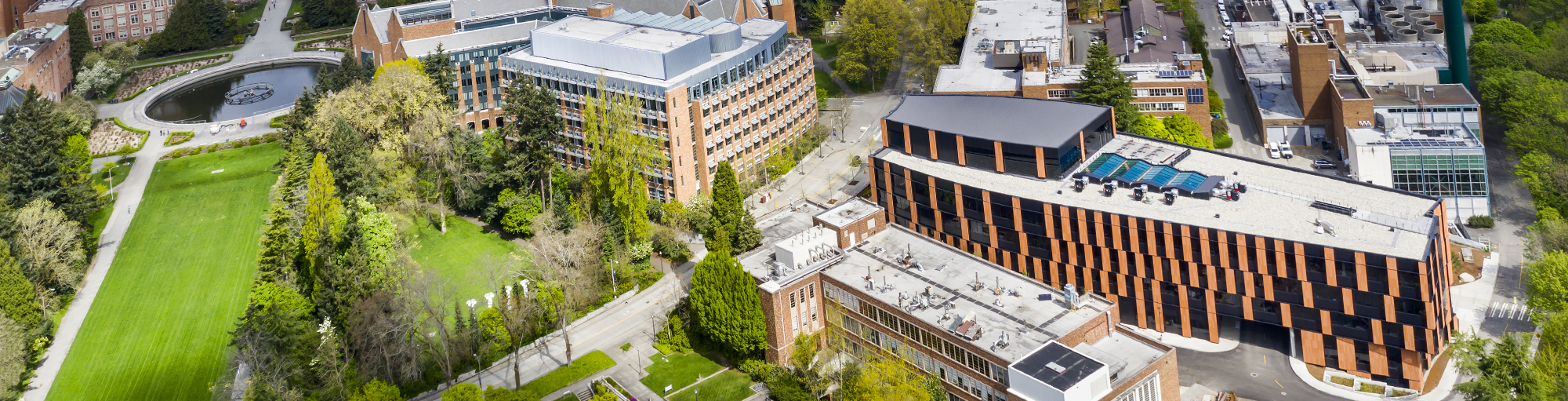
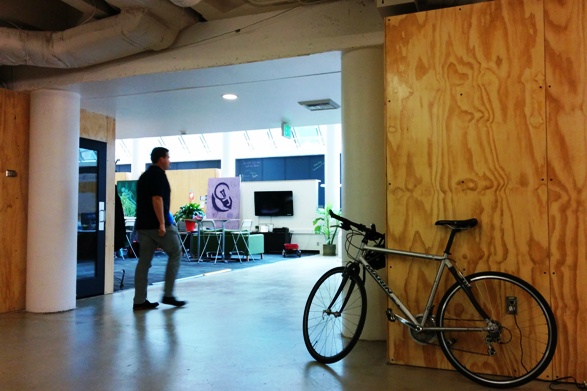
“The second floor of what used to be known only as Condon Hall – and the University of Washington’s ugliest building [editorial note: Sieg Hall is offended by this!] – holds seeds of a re-invented neighborhood where students, researchers, and entrepreneurs learn, work, and live; where tech startups and established companies build businesses with the technology and talent flowing from the university; and where professionals zip to jobs downtown on light rail …
“Chris DeVore is barefoot at his stand-up desk.
“DeVore, who manages to come across in conversation as simultaneously relaxed and intense, is partner at Founders’ Co-op, director of Techstars Seattle, and a key arranger of the unique deal that brought Startup Hall into being …
DeVore said the strengths and needs of the startup community and the university complement each other well. ‘Talent is the most important ingredient for building an innovation company, and the U is the most open platform for pulling in and developing talent in the Northwest,’ he said.”
Read more here. Read more →
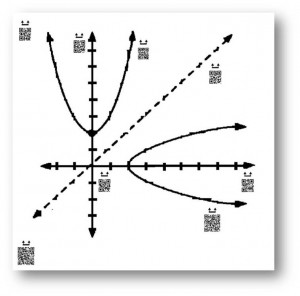 The paper “Tactile Graphics with a Voice: Using QR Codes to Access Text in Tactile Graphics” has been named Best Student Paper at ASSETS 2014, the 16th International ACM SIGACCESS Conference on Computers and Accessibility. The authors are UW CSE graduate students Catherine Baker and Lauren Milne, UW CSE staff member Jeffrey Scofield, UW HCDE graduate student Cynthia Bennett, and UW CSE faculty member Richard Ladner.
Tactile graphics are a major way for blind people to access figures and diagrams in books and documents. Tactile Graphics with a Voice (TGV) allows text within tactile graphics to be accessible by using a talking QR code reader app on a smartphone. The paper explores different picture taking guidance techniques for blind users: 1) no guidance, 2) verbal guidance, and 3) finger pointing guidance. A study with blind users indicates that there is no clear preference so that all techniques should be available as options in TGV.
This recognition continues UW CSE’s leadership in accessibility technology. UW CSE students and faculty received the Best Paper Award at ASSETS 2013 and ASSETS 2012; UW CSE Ph.D. student (now alum) Anna Cavender won the Best Student Paper Award at ASSETS 2006. Read more →
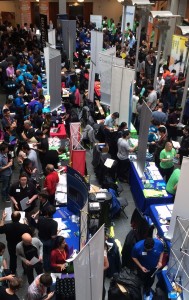
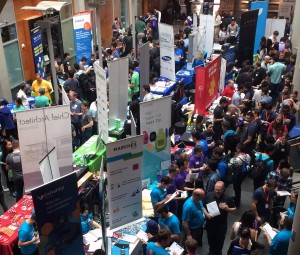 60 great companies (our maximum physical capacity), from Adobe and Amazon to Zillow and Zulily, are recruiting today at UW CSE’s annual Industry Affiliates autumn recruiting fair. We’d like to thank the fire marshal for being on vacation … And we’d like to thank these companies for supporting UW CSE and our students!
Next chance: UW CSE’s winter recruiting fair, January 21 (for startups) and 22 (for established companies). Read more →
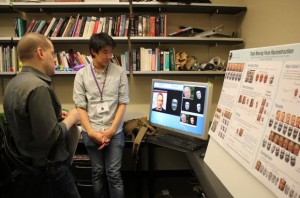 GeekWire reports on the Madrona Prize and the People’s Choice Award at Wednesday’s UW CSE Industry Affiliates Meeting and Open House:
“Computer science students at the University of Washington shared research projects — science fair-style — during an annual meeting of industry representatives on Wednesday.
“Nearly 100 research projects were on display as part of the Computer Science and Engineering Industry Affiliates Meeting …
“Each year, Madrona Venture Group awards prizes to presentations with commercial viability. ‘CSE has been this unbelievable source of innovation for the whole region,’ said Tim Porter, managing director of Madrona. ‘It’s so important for the overall ecosystem and we want to help support and recognize the great research here, specifically things we think have commercial applicability.'”
Read more here. Read more →
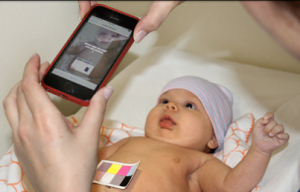 Each year at UW CSE’s Industry Affiliates Meeting, we award the People’s Choice Prize to the student project that our alumni and Industry Affiliates think is the coolest, without regard to what the experts may think!
This year’s winner: BiliCam: Using Mobile Phones to Monitor Newborn Jaundice – Lilian de Greef, Mayank Goel, Min Joon Seo, Eric C. Larson, James W. Stout MD MPH, James A. Taylor MD, Shwetak N. Patel.
Congratulations!
Read more →
 Each year at the UW CSE Industry Affiliates Meeting, the Madrona Prize is awarded to the student projects deemed most likely for entrepreneurial success. This year’s winners:
Third Place: Total Moving Face Reconstruction – Supasorn Suwajanakorn, Ira Kemelmacher-Shlizerman, Steven M. Seitz.
Second Place: WiBreathe: Estimating Respiration Rate Using Wireless Signals in Natural Settings in the Home – Ruth V. Ravichandran, Elliot N. Saba, Ke-Yu Chen, Mayank Goel, Sidhant Gupta, Shwetak N. Patel.
First Place: Arrakis: The Operating System is the Control Plane – Simon Peter, Jialin Li, Irene Zhang, Dan R.K. Ports, Doug Woos, Arvind Krishnamurthy, Thomas Anderson, Timothy Roscoe.
Congratulations! And thanks to our friends at Madrona Venture Group!
Read more →
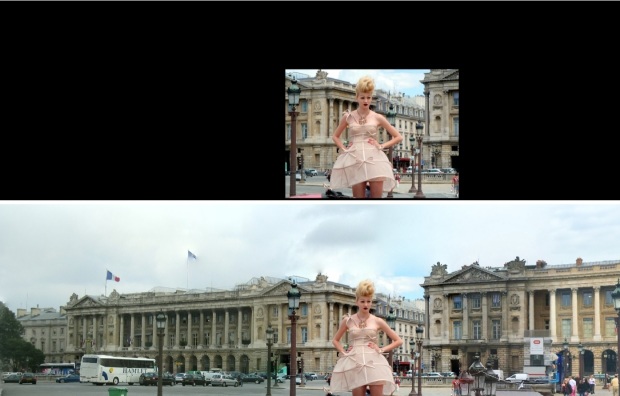 Many thanks to Brier Dudley of the Seattle Times for wonderful coverage of today’s UW Computer Science & Engineering Industry Affiliates Meeting!
“Qi Shan was remarkably calm demonstrating his advanced photo-manipulation research Wednesday at the University of Washington.
“Shan’s ‘photo uncrop’ technology was among dozens of demos that students presented during the Computer Science & Engineering Department’s annual showcase for industry partners. The audience included recruiters, investors and researchers, including representatives of big tech companies such as Microsoft, Intel and Samsung. Some flew across the country to see what and who are emerging from the labs.
“Demos were just part of the event. The agenda included several recruiting session and activities highlighting research that seems ready for commercialization …
“As part of Ph.D. work he expects to complete in early 2015, Shan developed technology that can assemble a panoramic image, pixel by pixel, with ‘computational photography.’ He worked on the project with UW CSE faculty members Brian Curless and Steve Seitz, along with Google employee Carlos Hernandez and Yasutaka Furukawa, a former UW researcher who worked on Google Maps and is now an assistant professor at Washington University in St. Louis.
“With the technology, an image of a person standing in the doorway of a cathedral could be expanded to include the rest of the building and the block on which it sits. The expanded picture would be generated through an analysis of imagery found online, including aerial images and photo collections such as Flickr …
“When I asked Shan whether the technology could end up with a company such as Adobe, Google or Microsoft, he said Google is a possibility – especially since he was heading there for a job interview a few hours after finishing the demo.”
Read more – and watch a video – here. Read more →
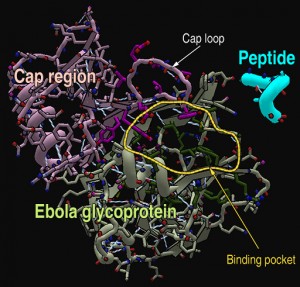 Foldit , a protein folding and protein structure game from UW CSE’s Center for Game Science in collaboration with the Baker Lab in UW Biochemistry, has reached 1000 puzzles today, thanks to the hard work of CGS’s scientists and community. CGS’s scientists have posted a few past puzzles in which they have asked players to design peptides and small proteins that are able to bind to a binding site on the Ebola binding protein.
Read up on Foldit’s continuing commitment to Ebola in this excellent summary post by scientist Vikram Mulligan discussing the current status of research, as well as a spotlight on previous puzzles tackled by the hard-working Foldit community.
Get familiar with Foldit’s 1000th puzzle titled, “Breach Ebola’s Defences!” and join the research efforts today! Read more →
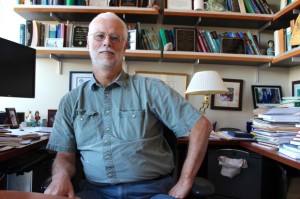 GeekWire writes:
“Inside a small office on the sixth floor of the University of Washington’s computer science building, Richard Ladner starts talking about Google’s self-driving cars. The longtime professor is so excited about the innovation that he lets out a big laugh.
“But Ladner isn’t joking around – rather, he’s jazzed up about a better future for people with disabilities.”
Read more here. Read more →
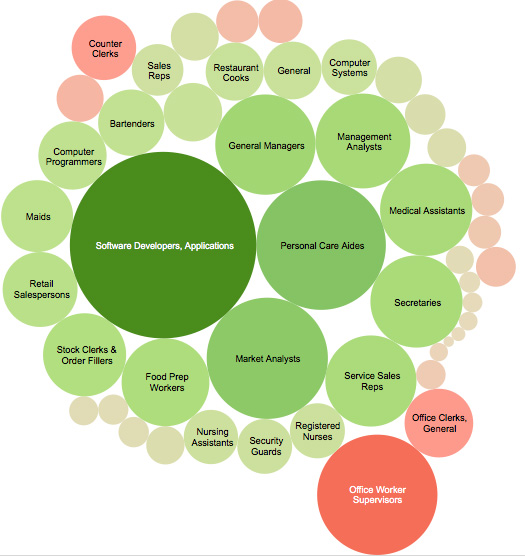 Some interesting visualizations of data drawn from the Washington State Employment Security Department.
And the winner is … Software Applications Developers.
Duh.
Check it out here. Read more →