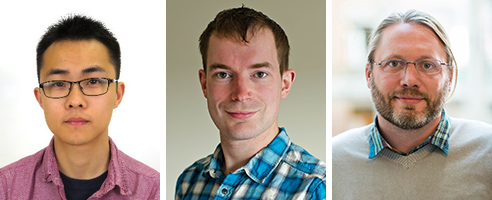
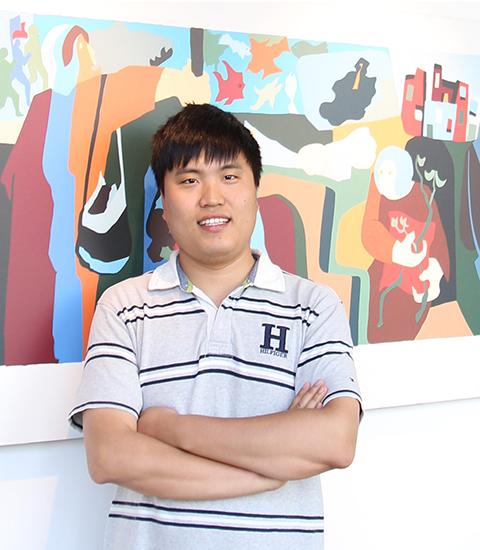
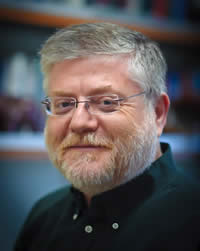
The winning paper describes an approach for learning a recursive neural network for CCG parsing — a core subproblem in broad coverage semantic analysis of text. The model is not only state of the art in terms of accuracy but also provides optimality certificates, nearly always proving a proof that the best parse was found under the learned model. It is the first neural parser of any kind to provide such guarantees.
The paper is one of only two selected for Best Paper recognition from more than 900 submissions. The team will present its findings at the EMNLP conference in Austin, Texas early next month. This is the second year in a row that the UW NLP group has won at EMNLP, with Lee and Zettlemoyer repeating their feat from 2015.
Each fall, UW CSE organizes a series of events aimed at current undergraduates hoping to snag an internship to gain practical experience or to line up their first job looking ahead to graduation. To help them put their best foot forward and get the most out of the recruitment process, we ask UW CSE alums to pass on the wisdom they have gained from years in gainful employment, and local recruiters to share their insights and advice for students experiencing the process for the first time.
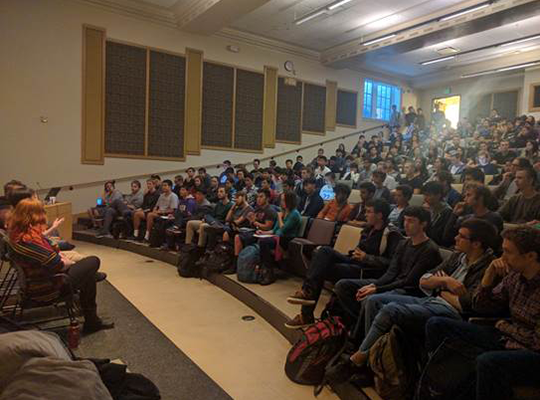
Last week, three alums – Victoria Wagner (B.S., ’14), Allison Wilbur (B.S., ’12), and Albert Wong (B.S., ’04) – joined Facebook recruiter Vince Sison in front of a packed house of more than 200 students for a panel discussion on how to land the job or internship of their dreams. Wagner completed internships at LinkedIn and Facebook while a student at UW CSE and has spent the past two and half years as a software engineer at Tableau. Wilbur began her career with the Fulfillment by Amazon team before moving on to positions at Zulily and Madrona Venture Labs; this past summer, she joined local startup ReplyYes as a software engineer. Wong began his career as a software developer at Amazon before joining Google. There, he spent 10 years working with various teams in the Kirkland, Beijing and Seattle offices, mentoring several engineers along the way. In 2014, Wong made the move from private to public sector, becoming a consultant for the United States Digital Service. All three offered a wealth of insights to students who are about to embark on their own career paths.
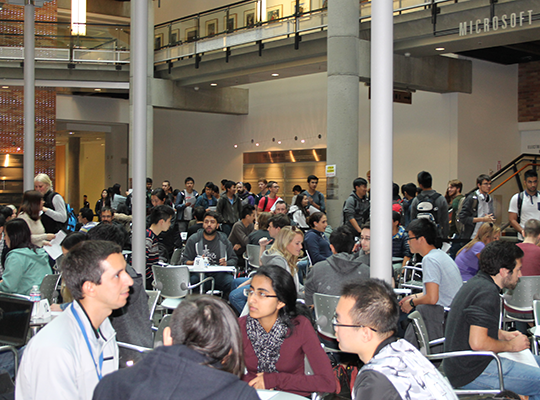
Students speak with volunteers at our résumé review workshop.
This week, 27 volunteers, including another proud UW CSE alum, Babak Dabagh (B.S., ’14), took over the atrium of the Allen Center for our résumé review workshop. Roughly 200 students went through the process — some of them multiple times! — to obtain feedback from recruiters and tech leaders from more than a dozen local companies, including Amazon, Ericsson, Facebook, Google, Indeed, Marchex, Microsoft, Qualtrics, Qumulo, RealSelf, Redfin, RetailMeNot, Whitepages, and Zillow.
Sandwiched between the two fairs is UW CSE’s annual research day and open house on Wednesday, October 19th. That day, we invite members of the community to learn more about the people and projects that make UW CSE great. If you haven’t marked your calendars to join us next Wednesday, please do! You can RSVP to the open house here.
Thank you to our terrific alumni and volunteers who have spent time with our students the past two weeks! Read more →
The Wall Street Journal reports today on the latest project to emerge from UW CSE’s Networks & Mobile Systems Lab: the ability to transmit passwords through the human body instead of over the air, where they are vulnerable to hacking. Such on-body transmissions would make it possible to open electronic smart locks or securely connect to wearable medical devices, such as glucose monitors, using the fingerprint sensors and touchpads commonly found on smartphones and laptops.
“Like an errant pass from an NFL quarterback, passwords sent through the air via Wi-Fi or Bluetooth can be intercepted, sometimes with disastrous consequences. Passwords are also a hassle to remember, which is why we tend to opt for simpler ones—but that, too, creates big security risks.
“Now researchers at the University of Washington have found a way to eliminate the airtime and the hassle—by using the human body as a conduit for passing security codes from one device to another….
“The technology involves no physical keys or cards that could be lost, stolen or copied—and unlike some biometric systems, it doesn’t require a digital fingerprint stored at the door (from which it might be stolen). Passwords for each door could be unique yet easily shared with a roommate or spouse. Since these passwords would rely on your device’s memory, not your own, they could be very complex and strong.”
UW EE Ph.D. students Mehrdad Hessar and Vikram Iyer developed the system working with UW CSE professor Shyam Gollakota. The team presented its results in a research paper at the UbiComp 2016 conference in Heidelberg, Germany last month.
As Gollakota explained in the UW News release, “Fingerprint sensors have so far been used as an input device. What is cool is that we’ve shown for the first time that fingerprint sensors can be re-purposed to send out information that is confined to the body.”
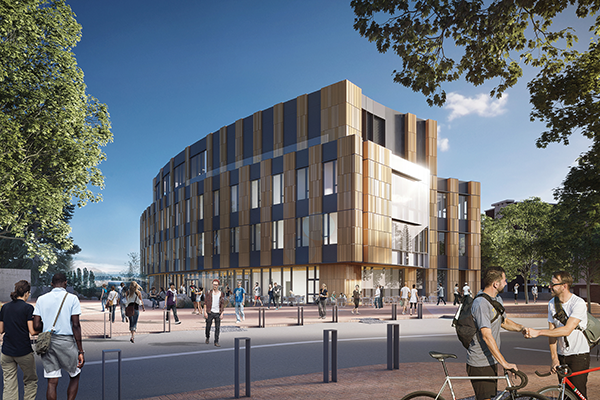
Amazon and the University of Washington announced today that the company has committed $10 million to support the construction of a second building for UW CSE. The new facility, affectionately dubbed “CSE2,” will provide sufficient space for UW CSE to double annual degree production.
“The University of Washington is a world-class institution, and we are lucky to have thousands of UW graduates inventing and pioneering in Seattle – including right here at Amazon,” said Jeff Bezos, founder and CEO of Amazon.
“We’re proud to support UW as they expand their computer science program, which will benefit the whole community.”
In recognition of Amazon’s generosity, UW CSE will name the 250-person auditorium and gallery on the ground floor of the building after the company.
The gift is the latest in a history of strategic investment by the company in the UW—and CSE in particular—including funding the Amazon Professorships in Machine Learning to recruit two highly sought-after faculty members to Seattle: CSE professor Carlos Guestrin and Statistics professor and CSE adjunct Emily Fox.
David Zapolsky, senior vice president and general counsel at Amazon, wrote on the company blog today about the need to expand our capacity to educate more of tomorrow’s innovators.
“We want to make sure that UW continues to educate inventors of tomorrow, and one of the best ways to do that is making sure more young people have access to high quality STEM education….we’re proud to help with a $10 million donation towards development of a new, state of the art Computer Science and Engineering (CSE) building that will double the number of graduates each year.”
The new building will be located across the street from the existing Paul G. Allen Center for Computer Science & Engineering on the UW’s Seattle campus. In addition to Amazon’s gift, major commitments to the project include $10 million from Microsoft, $32.5 million from the Washington State Legislature, and $9 million from the UW. LMN Architects, which designed the Allen Center, is nearing completion of the design for CSE2. Together, the two facilities will enable UW CSE to provide an unparalleled education and research experience.
UW CSE professor Ed Lazowska observed, “Over the past 20 years, Amazon has grown into one of the leading and most innovative companies in the world, UW CSE has grown into one of the leading and most innovative computer science programs in the world, and Seattle has grown into one of the one of the leading and most innovative technology hubs in the world. Amazon’s gift will help make it possible for UW CSE to prepare more of Washington’s students for careers in Washington’s booming technology sector. It’s an investment in our collective future.”
UW CSE recently welcomed Yuliang Wang as a research professor working with our Computational & Synthetic Biology group. Wang brings a wealth of computational expertise imbued with a deep knowledge of relevant biology that, as CSE professor Larry Ruzzo notes, is really rare in “computational” people.
Wang obtained his B.S. in Bioengineering from Tianjin University in China. He earned his M.S. in Applied Statistics and a Ph.D. in Chemical and Biomolecular Engineering from the University of Illinois, Urbana Champaign—a top-10 program in its field. He was a student of Dr. Nathan Price, who is now at the Institute for Systems Biology in Seattle and a CSE affiliate professor. As part of his Ph.D. thesis, Wang developed breakthrough computational tools for modeling metabolic networks. Before his arrival at UW CSE, Wang held a postdoctoral fellowship at Sage Bionetworks in Seattle and was a Senior Research Associate in the Computational Biology Program at Oregon Health & Science University.
Wang is spending approximately half of his time in CSE and the other half at the UW Institute for Stem Cell and Regenerative Medicine, a world-class research group in a cutting-edge area of biomedicine mostly located at the university’s South Lake Union campus. He will bring value-added to both groups—forwarding the efforts of stem cell biologists, while also bringing knowledge and skills that complement CSE’s computational biology group and building additional bridges to our artificial intelligence and machine learning groups. We have no doubt that he will help us to identify new and important problem areas where CSE can make a tangible difference—and advance computational methods that will benefit not only UW CSE research, but the field at large.
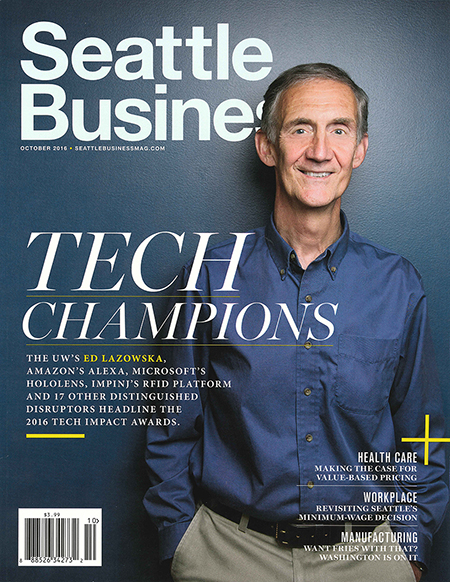
UW CSE was center stage last night at Seattle Business magazine’s annual Tech Impact Awards gala honoring the people and companies driving innovation and economic prosperity in the Puget Sound region. Professor Ed Lazowska was honored as the 2016 Tech Impact Champion for his achievements and advocacy on behalf of the tech community, while Impinj and Turi—UW CSE spin-outs that recently celebrated a successful IPO and acquisition, respectively—were highlighted for their groundbreaking innovations.
Lazowska, who graces the cover of the magazine’s October issue, is lauded for his vision, enthusiasm, and just plain persistence in positioning UW CSE among the upper echelon of computer science programs—including his role in recruiting leading faculty to the region. The magazine also credits him with leading the charge to position the University of Washington and Seattle at the forefront of cloud computing and the data science revolution, and notes that he has earned the admiration of students, colleagues and collaborators across the board for his commitment to elevating not only Washington’s flagship public university and its technology sector, but its people.
“Our job,” he tells the magazine, “is to provide socioeconomic mobility for bright kids in this region.”
Since Lazowska arrived in Seattle 39 years ago—when the local tech sector consisted largely of airplanes, medical devices, and test instruments, and Microsoft was 12 people in Albuquerque—the Emerald City has come into its own as a region with tremendous capacity for innovation in a range of industries. As Seattle Business put it, “With his trademark enthusiasm for the UW and the local tech sector, this celebrated educator, researcher, adviser and booster has played an important role in that transformation.”
Impinj, started by then-UW CSE professor Chris Diorio, was honored in the Emerging Technology/Productivity category for its RAIN RFID technology. Since its founding in 2000, Impinj has grown to more than 200 employees and its product was used on more than five billion items last year. Diorio tells Seattle Business that Impinj is “giving digital life to everything in your everyday world, extending the reach of the internet by a factor of 100.” With a successful IPO, a market cap of around $350 million, and 95 percent of the apparel market yet to be tapped, Impinj’s future growth is something else worth tracking.
Machine learning startup Turi, led by UW CSE professor Carlos Guestrin, collected the award for the Intelligent Applications category. The company, which was recently acquired by Apple, developed the GraphLab platform to enable data scientists to create their own intelligent applications for recommendation engines, fraud detection and customer management. As competition judge Matt McIlwain of Madrona Venture Group commented, “Carlos Guestrin is a unique talent in both his deep understanding of machine learning and artificial intelligence.”
A unique talent, fittingly enough, who was recruited to the region thanks in part to the advocacy efforts of fellow honoree Lazowska.
Read more about this year’s Tech Impact Award honorees at Seattle Business magazine here. Congratulations, Ed, Chris and Carlos!
Photo credits: John Vicory/Seattle BusinessRead more →
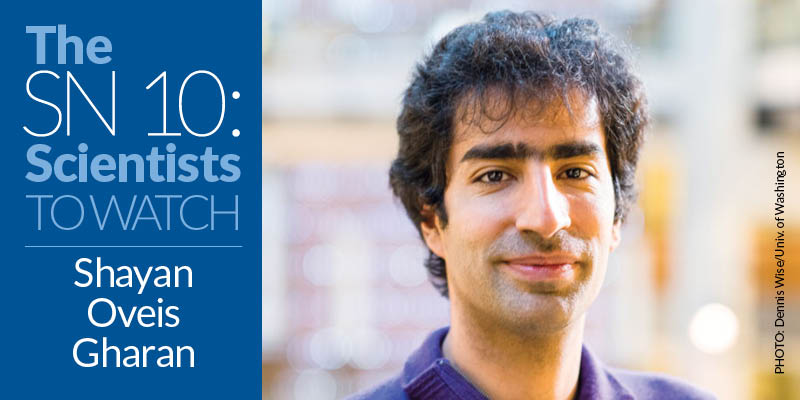
UW CSE professor Shayan Oveis Gharan was named one of 10 Scientists to Watch by Science News this week. The list celebrates early- and mid-career scientists under the age of 40 who are well on their way to transforming their respective fields. Oveis Gharan, a member of UW CSE’s Theory group, was featured for his contributions to solving the infamous traveling salesman problem.
“It’s a problem that sounds simple, but the best minds in mathematics have puzzled over it for generations: A salesman wants to hawk his wares in several cities and return home when he’s done. If he’s only visiting a handful of places, it’s easy for him to schedule his visits to create the shortest round-trip route. But the task rapidly becomes unwieldy as the number of destinations increases, ballooning the number of possible routes.
“Theoretical computer scientist Shayan Oveis Gharan…has made record-breaking advances on this puzzle, known as the traveling salesman problem. The problem is famous in mathematical circles for being deceptively easy to describe but difficult to solve. But Oveis Gharan has persisted. ‘He is relentless,’ says Amin Saberi of Stanford University, Oveis Gharan’s former Ph.D. adviser. ‘He just doesn’t give up.'”
Science News points to Oveis Gharan’s ability to take inspiration and techniques from other areas of computer science and mathematics to advance research in his own field. In one example, he and colleague Nima Anari (then of UC Berkeley) were able to draw a connection between the traveling salesman problem and what, to that point, appeared to be an unrelated problem in mathematics and quantum mechanics known as the Kadison-Singer problem.
As Oveis Gharan says, “Once someone is exposed to many different ideas and ways of thinking on a problem, that will help a lot to increase the breadth of problem-attacking directions.”
“Context is everything,” or so the saying goes, which may be why artificial intelligence has a long way to go to in order to match, let alone replace, human intelligence. While computer vision researchers have made impressive advances in image recognition, the ability to not only identify objects but recognize situations and predict what will happen next is still the preserve of humans.
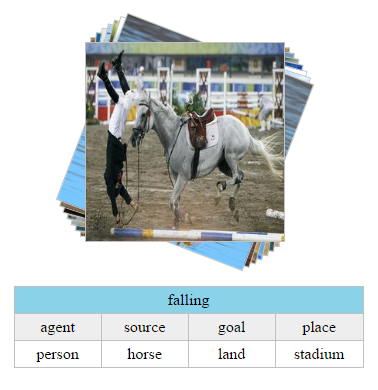
Researchers at UW CSE and the Allen Institute for Artificial Intelligence (AI2) are trying to help computers make that leap from content to context with the development of the ImSitu situation recognition tool. The New York Times published an article today examining the present limitations of computer vision in application such as self-driving cars — and took ImSitu out for a spin.
From the article:
“Today, computerized sight can quickly and accurately recognize millions of individual faces, identify the makes and models of thousands of cars, and distinguish cats and dogs of every breed in a way no human being could.
“Yet the recent advances, while impressive, have been mainly in image recognition. The next frontier, researchers agree, is general visual knowledge — the development of algorithms that can understand not just objects, but also actions and behaviors….
“At the major annual computer vision conference this summer, there was a flurry of research representing encouraging steps, but not breakthroughs. For example, Ali Farhadi, a computer scientist at the University of Washington and a researcher at the Allen Institute for Artificial Intelligence, showed off ImSitu.org, a database of images identified in context, or situation recognition. As he explains, image recognition provides the nouns of visual intelligence, while situation recognition represents the verbs. Search ‘What do babies do?’ The site retrieves pictures of babies engaged in actions including ‘sucking,’ ‘crawling,’ ‘crying’ and ‘giggling’ — visual verbs.
“Recognizing situations enriches computer vision, but the ImSitu project still depends on human-labeled data to train its machine learning algorithms. ‘And we’re still very, very far from visual intelligence, understanding scenes and actions the way humans do,’ Dr. Farhadi said.”
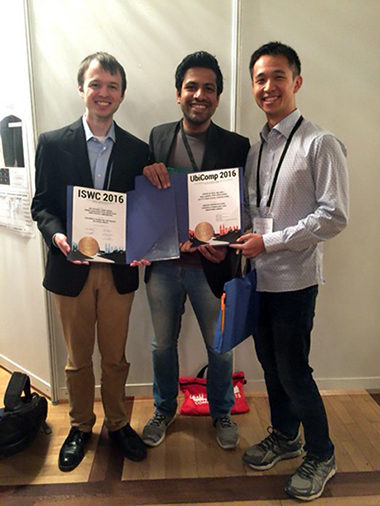
Best Paper Award winners Eric Whitmire (left) and Edward Wang (right), with UW CSE Ph.D. alum Mayank Goel
Members of UW CSE’s UbiComp Lab led by CSE and EE professor Shwetak Patel are celebrating not one but two Best Paper wins this week: “HemaApp: Noninvasive blood screening of hemoglobin using smartphone cameras” earned a Best Paper Award at the International Joint Conference on Pervasive & Ubiquitous Computing (UbiComp 2016) in Heidelberg, Germany, while “EyeContact: Scleral coil eye tracking for virtual reality” took home the Best Paper prize from the co-located International Symposium on Wearable Computers (ISWC 2016). And once again – for the third year in a row – the late CSE professor Gaetano Borriello was recognized with UbiComp’s 10-Year Impact Award for work submitted a decade ago that, looking back, has had the greatest impact on the field.
HemaApp, which measures blood hemoglobin to screen patients with anemia and other blood disorders, is the latest in an impressive line of mobile health projects from the UW that will benefit communities around the world. The paper—which was co-authored by EE Ph.D. student and lead author Edward Wang, undergraduate EE student William Li, Doug Hawkins of Seattle Children’s Hospital, Terry Gernsheimer and Colette Norby-Slycord of UW Medicine, and Patel—captured one of five Best Paper Awards bestowed upon the top 1% of submissions to UbiComp this year. Check out the recent UW News release on HemaApp here and a related blog post here.
EyeContact, which earned the sole Best Paper Award at ISWC, is a magnetic eye tracking system using scleral search coils for virtual and augmented reality applications. Unlike existing systems that rely on large generator coils—too large for a person to walk around—the EyeContact headset enables high-speed, high-accuracy mobile eye tracking without limiting the user’s movement or requiring instrumentation of the environment. UW CSE Ph.D. student and lead author Eric Whitmire and Patel co-authored the winning paper with researchers Laura Trutoiu, Robert Cavin, David Perek and Brian Scally of Oculus and Facebook, and James Phillips of UW Medicine.
The late UW CSE professor Gaetano Borriello
Gaetano Borriello and his fellow researchers were recognized with a 10-Year Impact Award for the 2006 conference paper, “A Practical Approach to Recognizing Physical Activities.” The paper was co-authored by then-UW EE Ph.D. student and lead author Jonathan Lester, and Borriello’s Intel Seattle colleague at the time, Tanzeem Choudhury. This is the third year in a row that one of Borriello’s papers has been recognized with a UbiComp 10 Year Impact Award—yet more evidence of his lasting contributions to the field of ubiquitous computing.
Way to go, team! (We miss you, Gaetano.) Read more →
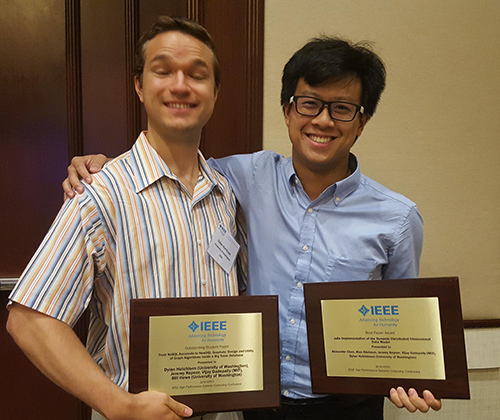
UW CSE’s Dylan Hutchison (left) and MIT’s Alex Chen
We like our Best Paper Awards around here, but UW CSE Ph.D. student Dylan Hutchison took it to a new level this week by contributing not one, but two Best Papers at IEEE’s High Performance Extreme Computing Conference (HPEC 2016). Hutchison, a member of UW CSE’s Database group, collected the Best Student Paper Award as lead author of “From NoSQL Accumulo to New SQL Graphulo: Design and Utility of Graph Algorithms inside a BigTable Database.” He also co-authored the Best Paper winner, “Julia Implementation of the Dynamic Distributed Dimensional Data Model.”
In the first paper, Hutchison and his colleagues illustrate how Graphulo—a library for executing graph algorithms inside Apache Accumulo—enables the execution of GraphBLAS kernels in a BigTable database. The team, which includes UW iSchool professor and CSE adjunct Bill Howe, and MIT researchers Jeremy Kepner and Vijay Gadepally, compared the performance of two graph algorithms implemented with Graphulo to that of two main-memory matrix math systems. Their work yields new insights into whether it is faster to execute a graph algorithm inside a database versus an external system, showing that memory requirements and relative I/O are critical factors.
The second paper, which was co-authored by a group of MIT researchers that includes student and lead author Alex Chen, professor Alan Edelman, Kepner and Gadepally, details implementation of D4M in Julia, a new language for writing data analysis programs that are easy to implement and run at high performance. The team illustrated that D4M.jl matches or outperforms its Matlab counterpart, thanks to Julia’s well-structured syntax and data structure.