UW research on battery-free camera networks featured at UbiComp 2015

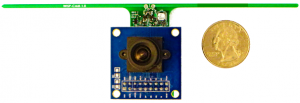
WISPCamUW faculty and student contributions to UbiComp 2015 are so extensive, we can barely keep up. The latest news to come out of the conference that puts UW innovation in the spotlight: technology from the Sensor Systems Laboratory led by UW CSE and EE professor Josh Smith that enables the creation of smart networks of self-localizing, battery-free cameras.

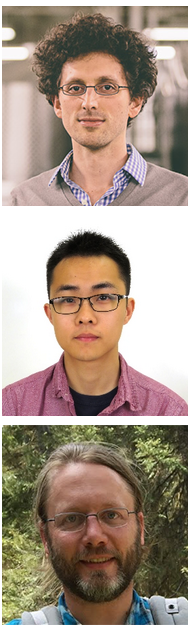
A team that includes Alanson Sample (a UW EE Ph.D. alum who also completed a postdoc in CSE before joining Disney Research), current CSE Ph.D. student Jim Younquist, and EE Ph.D. students Saman Naderiparizi and Eve Zhao devised a system in which battery-free RFID sensor tags enhanced with on-board cameras, known as WISPCams after the Wireless Identification and Sensing Platform on which they are built, are able to determine their location and orientation in relation to other cameras using LEDs.

From a Disney Research press release:

“Previous work at UW has produced battery-free RFID tags called WISPs with enhanced capabilities such as onboard computation, sensing, and image capture capabilities. WISPs operate at such low power that they can scavenge the energy needed for operation from radio waves. The new work shows that these WISPs with onboard cameras, or WISPCams, can use optical cues to figure out where they are located and the direction in which they are pointed. The ability of each node to determine its own location makes deployment of autonomous sensor nodes easier and the sensor data they produce more meaningful.

“‘Once the battery free cameras know their own positions it is possible to query the network of WISPCams for high level information such as all images looking west or sensor data from all nodes in a particular area,’ said Alanson P. Sample, a research scientist with Disney Research who previously was a post-doctoral researcher on the UW team that developed the WISP platform and the WISPCam.”

Having come up with a method to efficiently and precisely localize each camera optically – without the need for extra circuitry or components – the team envisions hundreds of WISPCams working together to measure their location with optical cues or localize and track objects of interest in 3D.

Read the full press release here, and the research paper here. Nice work, team! Read more →
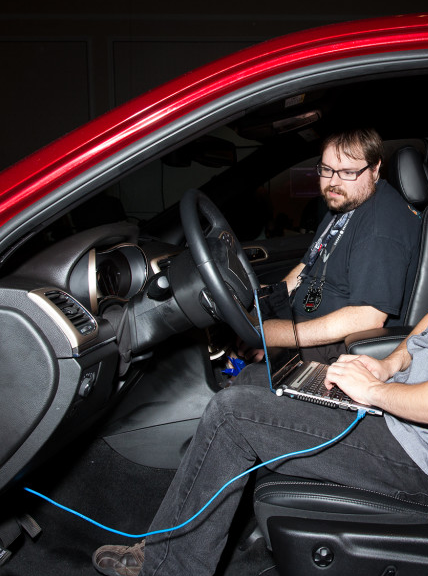
Wired magazine: UW CSE’s and UCSD’s original car hack “far ahead of its time”

Karl Koscher hacking a car

UW CSE alum Karl Koscher is still hacking cars

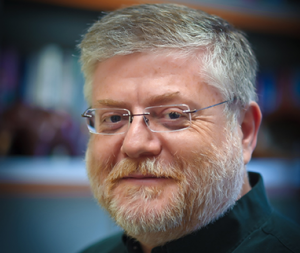
Wired published a fascinating article today on the car industry’s slow response to security flaws revealed by the car hack led by UW CSE professor Yoshi Kohno and UCSD professor (and UW CSE Ph.D. alum) Stefan Savage five years ago. The article notes that it took the affected manufacturer, General Motors, five years to issue a fix to its millions of vehicles equipped with the OnStar system that the team demonstrated was vulnerable to attack.

From the article:

“When a pair of security researchers showed they could hack a Jeep over the Internet earlier this summer to hijack its brakes and transmission, the impact was swift and explosive….

“But when another group of researchers quietly pulled off that same automotive magic trick five years earlier, their work was answered with exactly none of those reactions….

“For nearly half a decade, millions of GM cars and trucks were vulnerable to that privately known attack, a remote exploit that targeted its OnStar dashboard computer and was capable of everything from tracking vehicles to engaging their brakes at high speed to disabling brakes altogether.

“ ‘We basically had complete control of the car except the steering,’ says [UW CSE Ph.D. alum and UCSD postdoc] Karl Koscher, one of the security researchers who helped to develop the attack. ‘Certainly it would have been better if it had been patched sooner.’ ”

The article explains how the research team chose to notify GM and federal regulators of the vulnerability, instead of publicizing it widely as was the case with more recent car hacking demonstrations. Although it took five years for GM to issue a fix, that was less an issue of negligence than of a lack of preparation industry-wide. As the article explains it:

“GM’s glacial response is partly a result of just how far ahead of its time the UCSD and UW researchers’ OnStar attack was. Their technique, described in a pair of papers in 2010 and 2011, represented a brilliant and unprecedented chain of hacker attacks integrated into a single exploit.”

Read the full article here, and view our car hacking demonstration that aired on 60 Minutes here. Read more →

Come play with UW CSE’s Taskar Center for Accessible Technology at the Seattle Design Festival!

Seattle Design Festival logoThis weekend, people of all ages and abilities are invited to discover the Universal Play Kiosk presented by UW CSE’s Taskar Center for Accessible Technology as part of the Seattle Design Festival. In keeping with the festival’s theme, “Design for Equity,” the Universal Play Kiosk provides a configurable space designed to facilitate equal participation of all.

The kiosk, which is a partnership between the Taskar Center, Gensler Design Firm and Hoffman Construction Co., creates an immersive, collaborative environment that truly integrates children and adults with special needs. The modular structure accommodates wheelchairs and other assistive devices, is adjustable on the fly to welcome individuals of varying abilities, and provides rich sensory stimulation through colors, shadows, textures and sounds.

Check out the installation in Pioneer Square’s Occidental Mall and Park between 10:00 am and 6:00 pm this Saturday, September 12th and Sunday, September 13th at the Seattle Design Festival Block Party, a two-day street fair celebrating Seattle’s diverse design community. More details are available here. Read more →

UW CSE’s Franzi Roesner addresses NAE Frontiers in Engineering Symposium

Franzi Roesner at the NAE Frontiers of Engineering Symposium

Franzi Roesner at the NAE Frontiers of Engineering Symposium

Every year, the National Academy of Engineering invites roughly 100 of the top engineers under the age of 45 from around the country to participate in its Frontiers of Engineering Symposium, a two-and-a-half day event focused on cutting-edge research in various fields of engineering. The 2015 symposium, which is taking place this week in Irvine CA, features a diverse range of topics, including the search for exoplanets, metamaterials, forecasting natural disasters, and cybersecurity and privacy.

It is an honor to be invited to the symposium, and an even higher honor to be invited to speak. This year, professor Franzi Roesner, co-director of UW CSE’s Security and Privacy Research Lab, delivered one of the opening talks of the program.

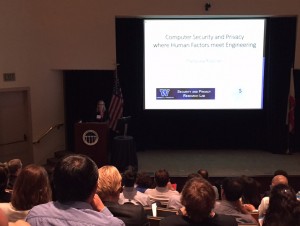
In her presentation, Computer Security and Privacy: Where Human Factors Meet Engineering, Franzi highlighted the challenge of designing technologies that match user expectations when it comes to security and privacy. She described a new model for granting permissions, “user-driven access control,” that removes the burden of making decisions from the user in favor of having the system automatically grant permissions based on how the user naturally interacts with existing applications.

Franzi is one of only 15 people who are giving talks at the symposium this week – yet more proof that UW CSE is home to some of the brightest rising stars in computer science and computer engineering! Read more →

UW CSE’s Haichen Shen wins inaugural Gaetano Borriello Best Student Paper Award at UbiComp 2015

Haichen Shen

UW CSE’s Haichen Shen

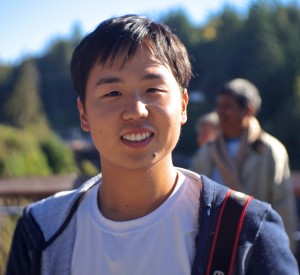
UW CSE faculty and students are on a roll when it comes to conference awards. Last week, we reported that a team of researchers in our natural language processing group earned one of only two Best Paper Awards granted from among 600 submissions at EMNLP 2015. This week, we are celebrating more recognition at UbiComp 2015, where UW CSE Ph.D. student Haichen Shen and his team captured a Best Paper Award and the inaugural Gaetano Borriello Best Student Paper Award, named this year in honor of the late, great UW CSE professor – a fitting tribute, given Gaetano’s devotion to students and leadership within the ubiquitous computing community.

The winning paper, Enhancing Mobile Apps to Use Sensor Hubs without Programmer Effort, presents MobileHub, a system that automatically rewrites applications to leverage a smartphone’s sensor hub to enable continuous sensing apps to function without draining the device’s battery. By buffering sensor data until an application needs to act on it, MobileHub conserves a device’s power by allowing the application and the main processor to remain idle. This is a critical area of research in ubiquitous computing: reducing power consumption is going to be vital in order to fully realize the potential of continuous sensing apps, such as those developed for health monitoring. The paper was co-authored by Shen and former postdoc Aruna Balasubramanian (now a faculty member at Stony Brook University), affiliate faculty member Anthony LaMarca of Intel Labs, and former faculty member David Wetherall (now at Google).

Gaetano_FP-copy

UW CSE’s Gaetano Borriello

Two other UbiComp papers with UW CSE connections were recognized with Honorable Mentions:

HyperCam: A collaboration between UW and Microsoft Research proposes a low-cost, easy-to-use hyperspectral imaging system that improves upon the typical RGB camera sensors used in ubiquitous computing applications. UW co-authors include CSE Ph.D. students Mayank GoelAlex Mariakakis, and Eric Whitmire, professor Gaetano Borriello, and CSE and EE professor Shwetak Patel.

DoppleSleep: Researchers at UW, Cornell and Michigan State University put forward a contactless sensing system that uses short-range Doppler radar to monitor sleep quality. UW co-authors include CSE and EE professor Shwetak Patel, HCDE professor (and CSE adjunct) Julie Kientz, and EE graduate student Ruth Ravichandran.

Congratulations to Haichen and the entire team at UbiComp 2015! You make UW proud!

And we once again remember our friend and colleague Gaetano and his extraordinary contributions to UW CSE, the field, and the world. Read more here. Read more →

UW CSE’s Zach Tatlock learns to wear shoes!

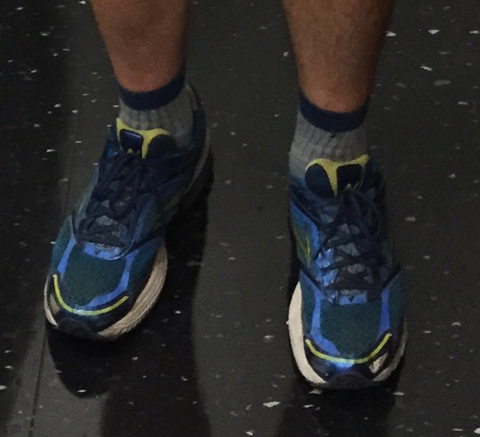
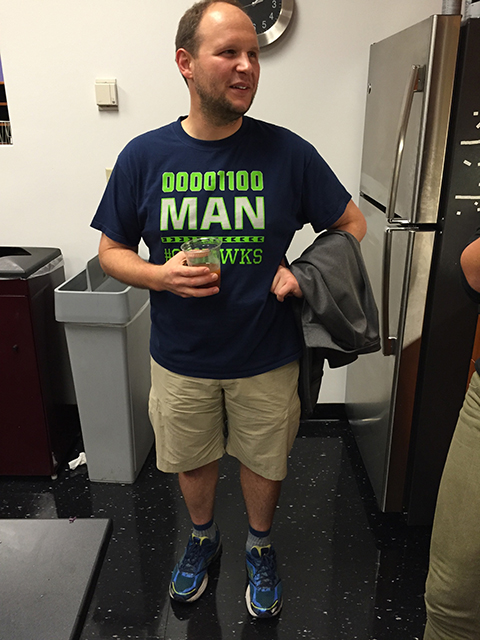
Closeup of Zach Tatlock's shoes and socksZach Tatlock wearing shoesUW CSE professor Zach Tatlock – a.k.a. Mr. “I wear open sandals even in the snow” – has finally succumbed to peer pressure from his colleagues and is trying out a new foot covering technology known as “shoes.”

As part of the experiment, Zach even learned to tie shoestrings by watching YouTube videos on the topic. (Note the use of so-called “socks” as well!)

Way to go, Zach! Read more →

New wearable technology from UW tracks your carbon footprint, and so much more

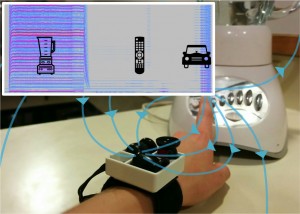
MagnifiSenseUW researchers have developed a prototype of a low-power, wearable system that can sense an individual’s interactions with different devices, from household appliances to motor vehicles. The new technology, MagnifiSense, analyzes near-field electromagnetic radiation from common components to measure usage in a variety of indoor and outdoor settings – and with a high degree of accuracy.

MagnifiSense was developed by a team of researchers at UW’s Ubiquitous Computing Lab, led by CSE and EE professor Shwetak Patel, that includes UW EE Ph.D. students Edward Wang and Tien-Jui Lee, CSE Ph.D. students Alex Mariakakis and Mayank Goel, and CSE Ph.D. alum Sidhant Gupta (now at Microsoft Research). The team submitted a paper outlining MagnifiSense’s effectiveness and potential applications as part of the UbiComp 2015 conference taking place in Osaka, Japan this week.

From the UW news release:

“In today’s smart home, technologies can track how much energy a particular appliance like a refrigerator or television or hair dryer is gobbling up. What they don’t typically show is which person in the house actually flicked the switch.

“A new wearable technology developed at the University of Washington called MagnifiSense can sense what devices and vehicles the user interacts with throughout the day, which can help track that individual’s carbon footprint, enable smart home applications or even assist with elder care….

“‘It’s another way to log what you’re interacting with so at the end of the day or month you can see how much energy you used,’ said Shwetak Patel, Washington Research Foundation Endowed Professor of Computer Science & Engineering and Electrical Engineering, who directs the UW Ubicomp Lab.

“‘Right now, we can know that lights are 20 percent of your energy use. With this, we divvy it up and say who consumed that energy,’ Patel said.”

The researchers plan to test MagnifiSense on more devices and to reduce their proof-of-concept so that the technology is small enough to be embedded in wrist-sized devices, such as a smartwatch.

Read the entire news release here. Read the research team’s paper here.

Magnificent work, team! Read more →

UW CSE captures Best Paper honors at EMNLP 2015

Yoav Artzi, Kenton Lee and Luke Zettlemoyer Yoav Artzi, Kenton Lee and Luke Zettlemoyer of UW CSE’s natural language processing group have captured a Best Paper Award at EMNLP 2015 – one of only two best papers selected from more than 600 submissions to the conference on empirical methods in natural language processing.

The paper, Broad-coverage CCG Semantic Parsing with AMR, describes an approach for learning parsers that build Abstract Meaning Representations (AMRs), a recently proposed, general formalism for representing core aspects of sentence meaning. The team’s work is a significant step over previous CCG grammar induction algorithms, as it learns to analyze a much wider range of sentence types and scales to much larger data sets. The paper will be presented at EMNLP 2015 in Lisbon, Portugal later this month.

This latest award continues UW CSE’s enviable winning streak at leading conferences, and is the second paper award for the NLP group in 2015 (just one shy of repeating the systems group’s hat trick). It is also a great start for Yoav’s new faculty career at Cornell!

Read the paper here.

Congratulations Yoav, Kenton and Luke! Read more →

UW CSE student and football freestyler Cory Black in the Seattle Times

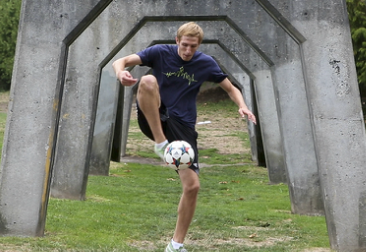
Cory Black with soccer ballFor anyone wondering if hard-working UW CSE students have lives outside of their academic studies: check out the great Seattle Times story on our very own Cory Black, computer science major and “freestyle magician.” Cory is competing in the Super Ball World Open Championships this week in Liberec, Czech Republic.

From the article:

“After years playing soccer, Cory Black realized he enjoyed doing tricks with the ball more than the game itself.

“Fortunately for Black, 19, a Bellevue resident and former Newport High School soccer player, he wasn’t alone. A few years back, he discovered the fledgling sport of freestyle football, where competitors perform individualized, trick-laden routines with a soccer ball that never touches their hands or the ground….

” ‘No matter how many tricks you learn to do with a ball, you can’t really use all of it in games,’ Black said of transitioning to this offshoot of the sport, which he stumbled onto while seeking out new soccer-ball tricks on YouTube. ‘So, it made sense, given that this was what I was really good at.’ ”

Read the entire article and watch a video of Cory performing here. Good luck, Cory! Read more →

UW eScience Institute’s data science do-gooders featured in Xconomy

eScience Institute logo“What did you do on your summer vacation?” is a common refrain as students and faculty return to campus. For the students who took part in the UW eScience Institute’s Data Science for Social Good program, they can honestly say they spent their summer trying to make the world a better place – and they did it with data.

DSSG gave students from a range of disciplines the opportunity to work with data scientists and public stakeholders to apply the latest data analysis and visualization techniques to address challenges faced by urban communities. Ben Romano of Xconomy was on hand last week as the teams presented the results of their work. From his excellent article posted today:

“Earn a degree in the field of data science these days and your ticket is punched: Google, Amazon, Facebook, leading-edge academic research, a well-funded startup—they’re all clamoring for people proficient in the tools and techniques needed to sift through today’s endless streams of digital data in search of something valuable.

DSSG-Predictors-Permanent-Housing-1-e1440390961495

Family homelessness team (project sponsored by the Bill & Melinda Gates Foundation and Building Changes)

“Social service organizations and local governments are confronting the data deluge, too, often without the capacity to pay the salaries that profit-driven companies can offer these sought-after experts.

“Enter the University of Washington’s just-concluded Data Science for Social Good summer internship. The program set interdisciplinary student teams, guided by professional data scientists and subject-matter experts, to work on thorny, real-world urban problems including family homelessness, paratransit bus service, community well-being, and sidewalk mapping for accessible route planning.

“During their final presentations last week, four student teams showed off tools they built over the summer that should provide lasting value to the organizations whose data they worked with, and the community at large. In sharing their process, the teams also highlighted the challenges inherent in drawing insight from big data.”

The article highlights the enthusiastic response to DSSG when it was announced: more than 140 students applied to the summer program, of which 16 students drawn from 10 disciplines were selected to participate. One team developed tools to help identify the programs that are most helpful to families facing homelessness. Another, advised by Anat Caspi of UW CSE’s Taskar Center for Accessible Technology, sought to improve the reliability and cost-effectiveness of local paratransit services for people with disabilities.

Read the complete article here and learn more about the DSSG student projects here.

Congratulations and thanks to all of the DSSG participants – students, faculty and community representatives – who demonstrated the power of data science to serve the social good! Read more →

« Newer PostsOlder Posts »