The LA Times discusses the Internet and the government’s role in basic research.
“Since it’s so fashionable these days to question whether government can do anything right … it’s worth noting that we’re about to celebrate the 40th anniversary of one of the most important federal initiatives of our time … the Internet.
“[Bob] Taylor tried to interest private industry in his project, but the companies he approached dismissed the idea. IBM told him its computers already talked to one another, completely missing his point that their computers should talk to everyone else’s. AT&T, then the monopoly proprietor of the phone system over which the network would operate, fought Taylor’s project tooth and nail, contending that the network’s ‘packet switching’ technology (a method of transmitting data in discrete blocks) wouldn’t work on its phone lines and might even damage them. Packet switching remains the Internet’s governing technology to this day.
“[Taylor’s] experience underscores the importance of a government role in fields like basic research, which profit-seeking enterprises tend to shun.
“‘Industry generally avoids long-term research because it entails risk,’ the veteran computer scientist Ed Lazowska told Congress a few years ago. Why? Because it’s hard to predict the results of such research, and since it has to be published and publicly validated, corporations can’t capitalize on their investments in isolation. Yet once the research reaches a certain point, private industry piles in – Lazowska cited a National Research Council list of 19 multibillion-dollar industries that had been incubated with federal funding, generally via university grants – including the Internet, Web browsers and cellphones – before becoming commercially viable. Taylor’s ARPAnet was eventually turned over to the National Science Foundation, which in 1991 opened what was then known as NSFnet to commercial exploitation. Four years later, the dot-com boom was underway.
“The real world brims with other examples.”
Complete article here. Read more →
 The Seattle Times discusses college costs. “Still, undergraduate tuition and fees at the UW — $7,700 this year — remain a bargain when compared to what people pay at private colleges, says UW computer-science professor Ed Lazowska: ‘Why is a parent willing to pay $35,000 for an education that’s not any better? I don’t understand the psychology of it.'”
Read the article here. Read more →
 2008 UW CSE Ph.D. alumnus Noah Snavely, now on the computer science faculty at Cornell University, has received the University of Washington Graduate School “6th Chapter” Dissertation Award.
Named by former Dean of the Graduate School Suzanne Ortega, the 6th Chapter Award refers to the five-chapter length of most dissertations. In a hypothetical sixth chapter, Ortega reasoned, candidates would propose practical applications resulting from their research, translating their insights into real-world policies or programs.
Noah’s Ph.D. work, co-supervised by Steve Seitz and Rick Szeliski (Szeliski, an affiliate professor in CSE, is at Microsoft Research), concerned recovering 3D structure from large community photo collections. Microsoft’s widely-praised Photosynth offering represents technology transfer from Noah’s work. Very recently, another Snavely / Seitz / Szeliski collaboration, “Building Rome in a Day,” has received widespread attention.
Congratulations Noah! Read more →
 “Geekiest title you’ve ever had: I dabble in rapping in some of my lectures under the name of Vicious D Marty Slick …
“Geekiest thing you’ve ever done: I won a Nintendo competition in Phoenix when I was young. The games were Super Mario Bros., Rad Racer, and Tetris …
“Mac or PC? I wanted to get a Mac, but I’m saving for a new kidney …”
There’s more! Read it here! And don’t miss Monica Guzman’s blog, which includes Marty’s rap video, here! Read more →
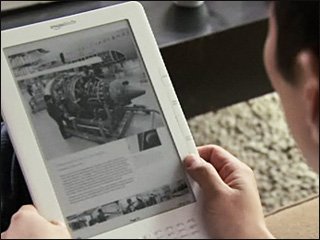 KOMO news reports on the UW CSE Kindle DX pilot project.
“‘Our students are going to have these devices. They are going to use them. They are going to share with us their experiences. I can assure you they will give us an honest appraisal,’ said Grossman.
“Lazowska says whether its an Amazon device, an Apple device or another company’s technology, he believes the textbook is heading the way of the blackboard.
“There may be no more pencils and no more books. But as for teacher’s dirty looks, even a Kindle can’t promise to do away with them for good.”
Read the story here. Learn more about the UW CSE Kindle DX pilot project here. Read more →
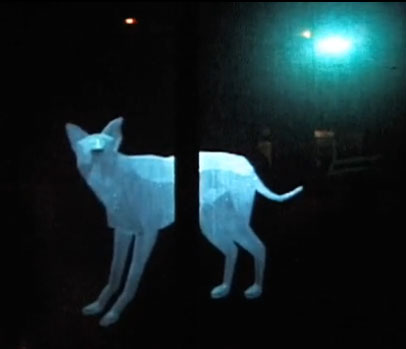 2009 UW CSE Bachelors alumnus Jim George writes to faculty members Brian Curless and Raj Rao: “Since graduating this spring I’ve been working with an artist in New York to make an interactive dog for storefront windows. The project has been accepted into a few festivals and is really well received by the public. I couldn’t have done it without the great background in computer vision and computer graphics I got from your classes this spring, it’s been incredible to see so many of the topics we covered pivotal for making this fun art project happen.”
Jim worked with artist Karolina Sobecka to bring her concept to “life.”
Check it out at http://www.gravitytrap.com/sniff/! Read more →
A brochure introducing the three new members of the UW CSE faculty is now available – you can download it here.

Su-In Lee, whose research focuses on devising machine learning techniques for understanding the genetic basis for complex traits, will have appointments in CSE and the Department of Genome Sciences. She received her Ph.D. from Stanford and spent the following year as a visitor at Carnegie Mellon.

Anup Rao joins our theory group. He received his Ph.D. from UT-Austin, and is now completing 2.5 years as a postdoc, divided between the Institute for Advanced Study and Princeton University.

Luke Zettlemoyer received his Ph.D. from MIT, followed by a one-year postdoc at the University of Edinburgh. He works on a variety of topics in artificial intelligence, including problems in natural language processing, machine learning, and decision making under uncertainty.
Read more →
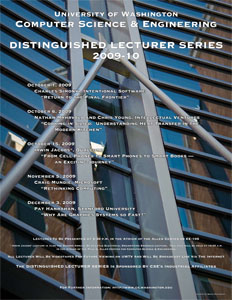 Spaceflight, molecular gastronomy, wireless, and computer science:
- Charles Simonyi (Intentional Software), “Return to the Final Frontier”
- Nathan Myhrvold and Chris Young (Intellectual Ventures), “Cooking in Silico: Understanding Heat Transfer in the Modern Kitchen”
- Irwin Jacobs (Qualcomm), “From Cell Phones to Smart Phones to Smart Books – An Exciting Journey” (also the 2009-10 UW Electrical Engineering Dean Lytle Memorial Lecture)
- Craig Mundie (Microsoft), “Rethinking Computing”
- Pat Hanrahan (Stanford), “Why are Graphics Systems So Fast?”
Be there!
See the schedule here. See the poster here. TechFlash post here. Xconomy post here. Read more →
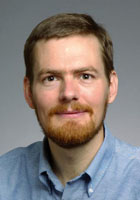 UW CSE professor Michael Ernst has received the inaugural John Backus Award from IBM Research for his research contributions to enhancing programmer productivity. Ernst is best known for his work on dynamic invariant detection, testing, type systems, and security.
Created by IBM to honor mid-career university faculty members, the award is named for IBMer John W. Backus, the creator of the Fortran programming language.
Ernst received his Ph.D. from UW CSE in 2000, working with David Notkin. He was co-advised by Bill Griswold, a previous Notkin Ph.D. student on the faculty at UCSD, with assists from UW CSE professors Craig Chambers, Pedro Domingos, and Dan Weld. He spent eight years as a professor at MIT before returning to Seattle and the UW CSE faculty.
Read the Dr. Dobb’s post here.
Congratulations Mike! Read more →
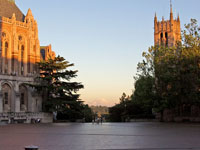 There’s a new UW 30-second promo video that’s a huge improvement over its predecessors. Take a look here (Silverlight) or here (Flash)! Read more →