 A KUOW (Seattle NPR) segment on new directions in information technology, featuring UW CSE professors Ed Lazowska and Oren Etzioni. Topics include robotics, mobile computing, entrepreneurship, much more. Download the 20-minute segment here. Read more →

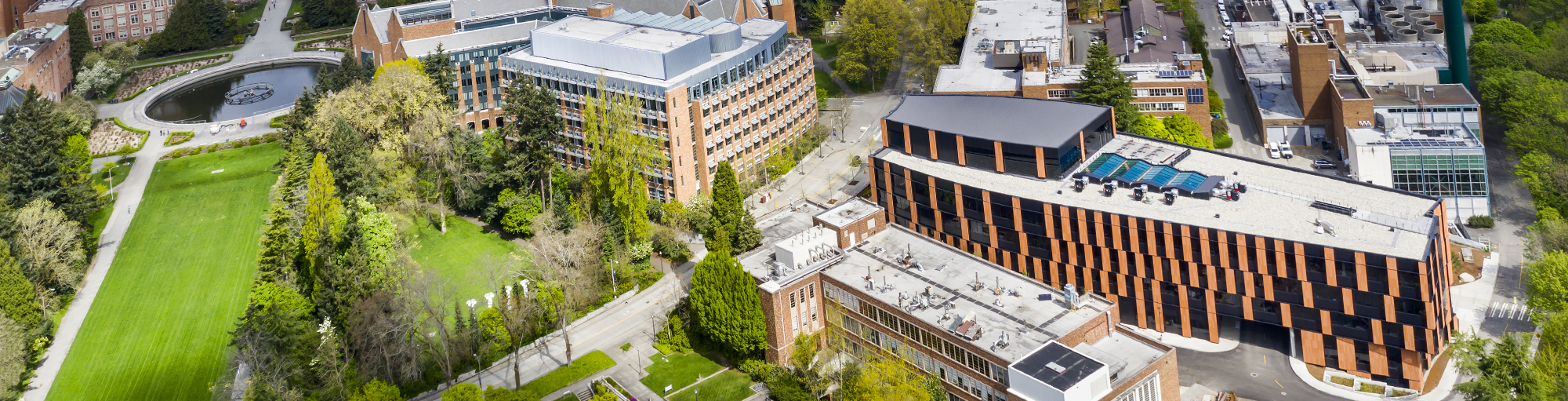
CSE’s Ed Lazowska and Oren Etzioni on NPR
“McGraw-Hill Education and Amazon Expand Strategic Alliance to Include Higher Education Content on Kindle and Kindle DX”
“‘The Kindle DX enables our students to access their course content anytime, anywhere,’ said Ed Lazowska, professor of computer science & engineering at the University of Washington. ‘We look forward to seeing how the device affects the engagement of both students and faculty in the educational experience.'”
Full article here. Read more →
“Meet the ‘Quantum Pontiff'”
 University Week highlights the widely-read “Quantum Pontiff” blog, authored since 2003 by UW CSE professor Dave Bacon.
“Q: What is its purpose and who is its intended audience?
“A: My number one purpose is to slow down my fellow researchers. Every time I spend a few minutes writing a blog post, thousands of others spend a few minutes reading the post. Many of those are my fellow researchers in quantum computing.”
Read the article here. Even better, follow the Quantum Pontiff blog here! Read more →
“Summer program opens high tech world to deaf students”
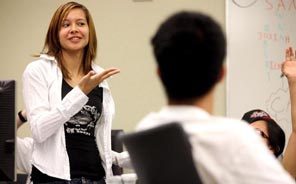 The Seattle Times describes UW CSE’s Summer Academy for Advancing Deaf and Hard of Hearing in Computing, organized by Professor Richard Ladner with support from the National Science Foundation.
“The summer academy – the only one of its kind in the country – introduces deaf and hard-of-hearing students to careers in computer science. For many of the participants, it’s their first glimpse inside the high-tech world. For some, it is the first time as students that they have been able to spontaneously talk to their classmates.
“‘It’s inspiring,’ said 17-year-old Johanna Lucht, of Anchorage, through an interpreter. ‘It’s opening a whole new world for me.'”
Read the rest of this terrific article here. Read more →
CSE’s Jonathan Carlson wins 2009 UW Distinguished Dissertation Award
 Recent UW CSE Ph.D. alumnus Jonathan Carlson has received the 2009 University of Washington Graduate School Distinguished Dissertation Award. Carlson’s thesis work on “Phylogenetic Dependency Networks: Inferring Patterns of Adaptation in HIV,” co-supervised by Larry Ruzzo of UW CSE and David Heckerman of Microsoft Research, seeks to enable improved HIV vaccines by identifying HIV adaptations that the virus employs against the immune system. Carlson now works with Heckerman in the Microsoft Research eScience Group in Los Angeles. Read more →
Bing Travel = UW CSE spinoff Farecast
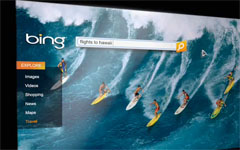 Microsoft’s Bing Travel technology – which provides advice on when to buy in order to minimize cost – represents technology from UW CSE spinoff Farecast, acquired by Microsoft for more than $100 million last year. See a new spot that captures the magic of Bing Travel, here. Read more →
Hydrosense on NPR
 NPR’s “Living on Earth” features UW CSE’s Hydrosense technology:
“In the heat of summer, droughts bring water rationing and limits on outdoor use. A new household sensor could soon detect every drip coming out of your pipes, making it easier to conserve water.
“Professor Shwetak Patel from the University of Washington has invented a gadget that he calls Hydrosense … A single Hydrosense device can detect water use from anywhere in the house.”
Listen to the story here. Read more →
“UW Profs, Tech Execs Talk Next-Generation Graphics, Imaging, and Interfaces for Games”
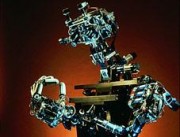 Xconomy reports on the UW Tech Showcase, where faculty members Yoky Matsuoka, Zoran Popovic, Brian Curless, and Steve Seitz demo’d their latest innovations to leaders of the gaming industry.
“In my time, I’ve seen dozens of really cool academic projects in graphics, imaging, and robotics that would never see the light of day in a commercial game, despite their best intentions. Because of the caliber of the UW labs and the nature of their applications, I wonder if they’ve actually turned the corner on some very tough problems that will have major implications for game developers.”
See the full post here. Read more →
“Vanish” in the news!
 Widespread press coverage of UW CSE’s “Vanish” project. From the New York Times: “A group of computer scientists at the University of Washington has developed a way to make electronic messages ‘self destruct’ after a certain period of time, like messages in sand lost to the surf. The researchers said they think the new software, called Vanish, … will be needed more and more as personal and business information is stored not on personal computers, but on centralized machines, or servers.”
Researchers on the project include CSE PhD candidate Roxana Geambasu, CSE undergrad Amit Levy, and CSE professors Tadayoshi Kohno and Hank Levy.
Read the UW press release here.
See research project information here.
Read the NY Times article here. (It was the 4th most emailed science article, ranking just ahead of “Toilet is Fixed on Space Station.”)
TechFlash here. KUOW (Seattle NPR) here. KING-5 TV here. Ars Technica here. UPI.com here. Network World here. The Chronicle of Higher Education here. Science Daily here. Discovery Channel blog here. CRA/CCC “Computing Research Highlight of the Week” here. Science Friday NPR interview here. Economist here. USA Today Technology blog here. Read more →
“Forget computer hacking, your brain may be next”
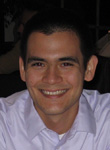 UW CSE’s Yoshi Kohno is featured in the Times of India — a report on Yoshi’s recent paper in the journal Neurosurgical Focus. Read the article here (pdf). Read more →