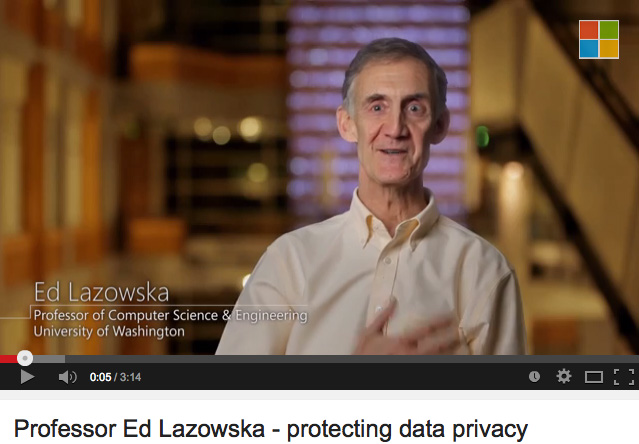
UW CSE’s Ed Lazowska leads academic amici supporting Microsoft in key privacy case

video clipMicrosoft General Counsel and Executive Vice President Brad Smith writes:

“Today represents an important milestone in our litigation concerning the U.S. Government’s attempt to use a search warrant to compel Microsoft to obtain and turn over email of a customer stored in Ireland. That’s because 10 groups are filing their ‘friend of the court’ briefs in New York today.

“Seldom has a case below the Supreme Court attracted the breadth and depth of legal involvement we’re seeing today. Today’s ten briefs are signed by 28 leading technology and media companies, 35 leading computer scientists, and 23 trade associations and advocacy organizations that together represent millions of members on both sides of the Atlantic.”

UW CSE’s Ed Lazowska led the 35 academic amici in the case, working with attorneys from Klarquist in Portland OR.

A video in which Lazowska explains the thrust of the academic amici’s argument is here.

The academic amici’s brief is here.  A list of all amici – academic and other – is here.

The Microsoft News website with a variety of background material is here. Read more →
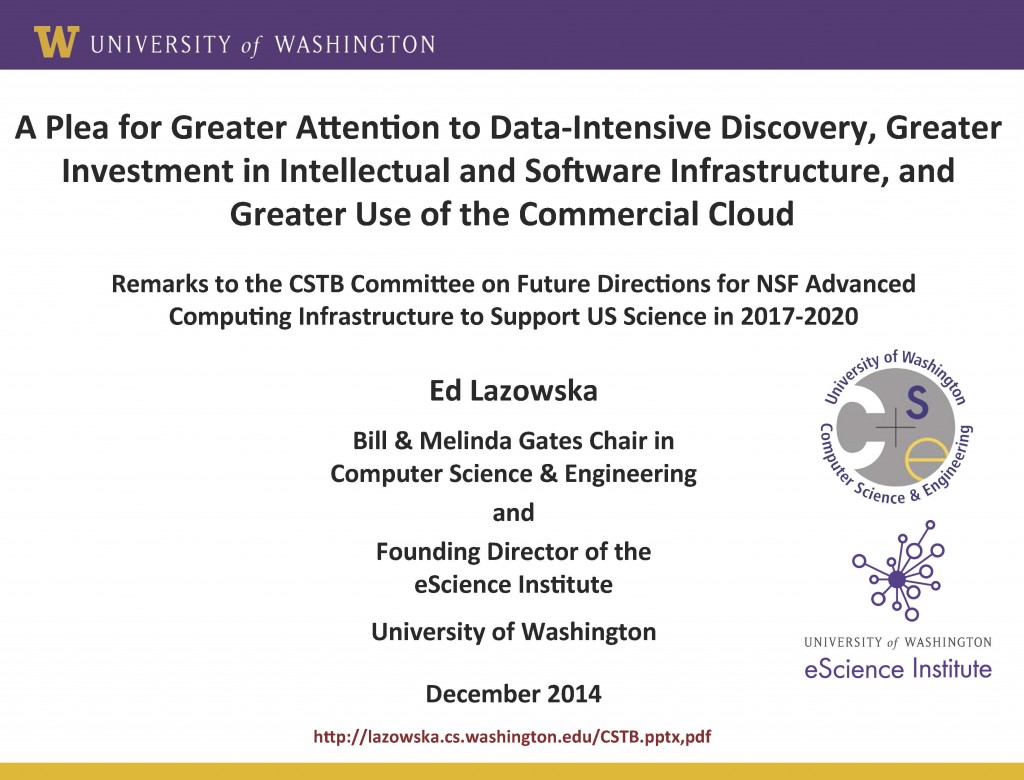
UW CSE’s Ed Lazowska to NRC Computer Science & Telecommunications Board: “Use the commercial cloud!”

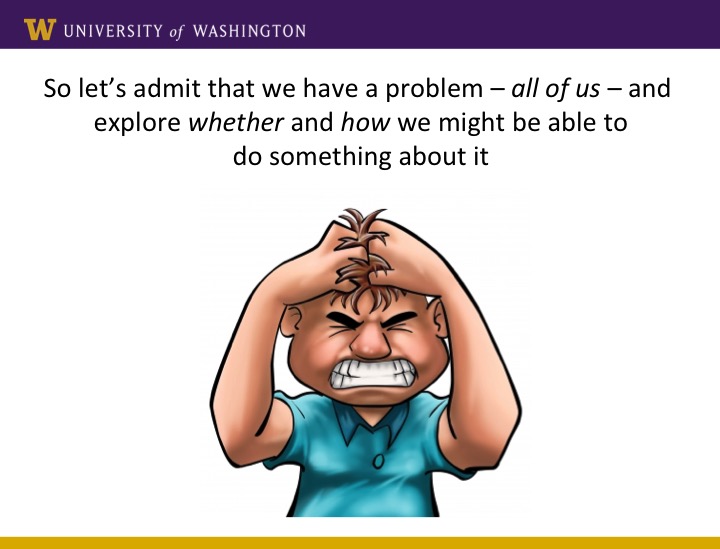
Pages from CSTBUW CSE’s Ed Lazowska addresses the National Research Council Computer Science and Telecommunications Board’s “Committee on Future Directions for NSF Advanced Computing Infrastructure to Support US Science in 2017-2020.”

  • “We have a crazy obsession with buying shiny objects – the bigger and more expensive, the better!”
  • “We’re investing 9:1 in hardware over software – it ought to be the reverse!”
  • “We have a dogged resistance to utilizing commercial software, services, and systems. We purchase our own. We operate our own. We roll our own. Often with amateurs. Why?”
  • “Establish the use of commercial cloud services as the strong default for science at all scales. Every request to purchase computing equipment that won’t fit on a desktop should be rigorously justified. Invest in intellectual infrastructure, software infrastructure, and outsourced services, not big shiny objects.

Check out the slides here. Read more →

UW CSE’s Stuart Reges in GeekWire: “This professor bakes 1,400 cookies for his computer science students during finals week”

reges-stuart“Many students in Stuart Reges’ computer science classes pull all-nighters, cramming in hopes of acing the introductory courses at the University of Washington.

“Little do they know that their professor is doing the same – just in front of an oven and with spatula in hand.

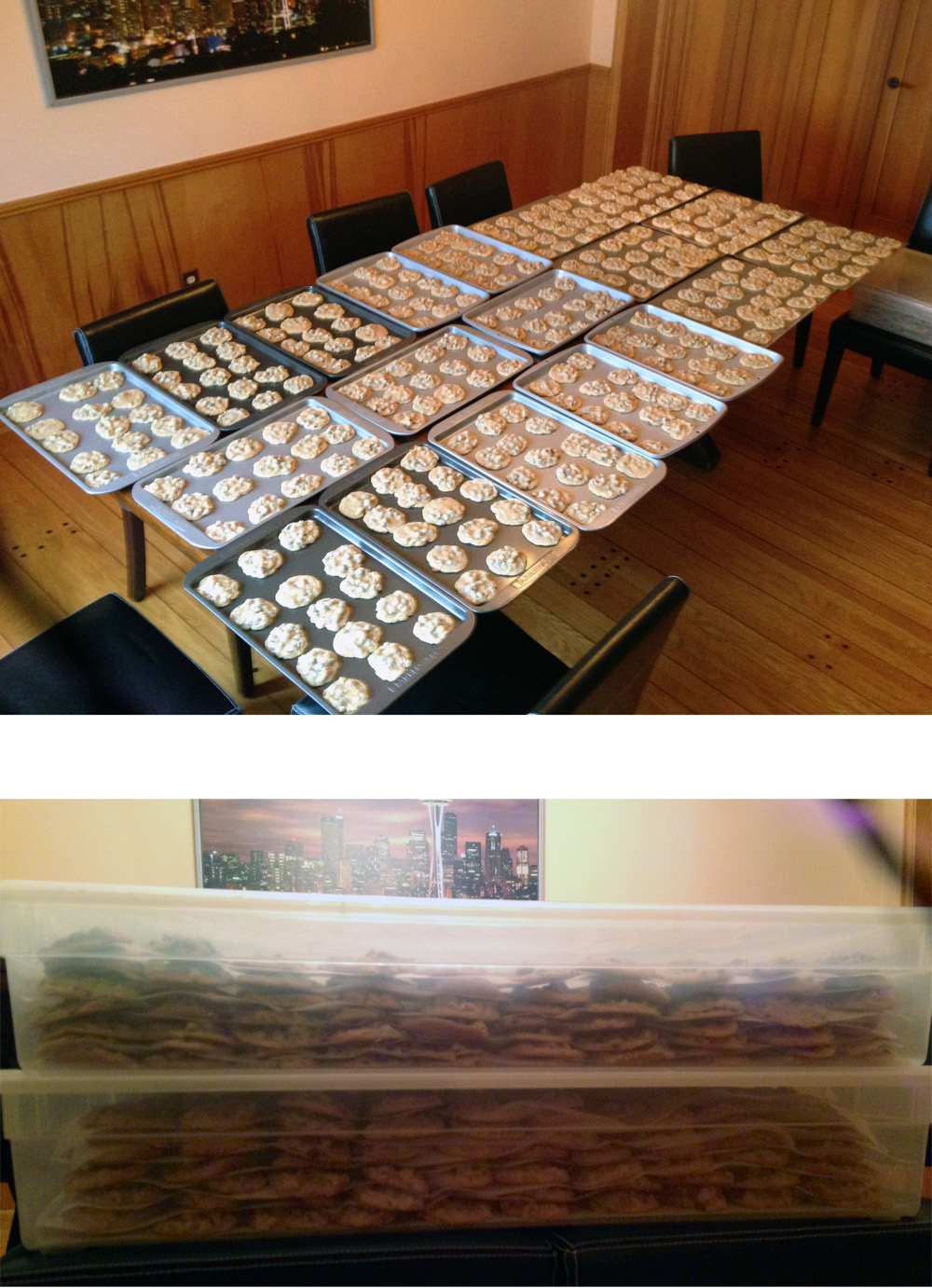
“A principal lecturer at the UW, Reges has baked chocolate chip cookies for his students during finals week for the past six years, a tradition that first began when he taught at Stanford in the early 80s. Back then, he had about 25 students in his class …

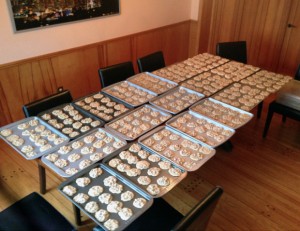
“But now – as the interest in computer science has grown and the UW program expands – class sizes have swelled. This year, Reges is teaching CSE 142 – a class with 1,000 students – and CSE 143 — a class with 400 students. (In fact, he’s responsible for about 1.5 percent of all credit hours at the university!)

cookies111-620x479“That means he baked 1,400 cookies for his students during finals week. That’s 116 dozen, or as colleague Ed Lazowska notes: 154,000 calories.

“Reges is not just a master cookie maker. He’s a darned good computer science professor, too. He won the UW Distinguished Teaching Award in 2011.

“No word yet on whether the sugar high helped students perform better on the finals.”

Read the full article in GeekWire here. Read more →

UW CSE’s Raj Rao on brain-to-brain communication, in Scientific American Mind

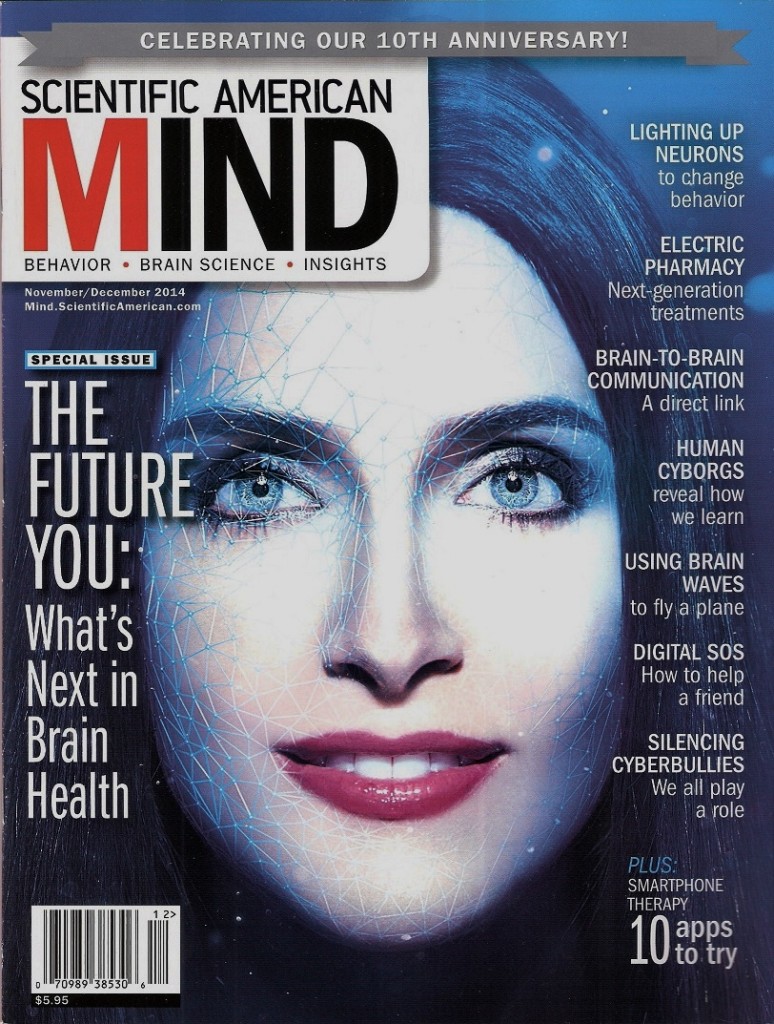
SciAmMindCover-NovDec-2014“The gist of our strategy was to use electrodes arranged on one person’s scalp to pick up brain waves, a technique known as electroencephalography … The signal would dictate how to electrically stimulate the recipient’s brain.”

Read more here.

  Read more →

UW CSE’s Justin Bare and Alan Borning create carbon tax impact calculator

20618_nota_carbontaxUW News reports:

“University of Washington computer scientists have partnered with members of the Carbon Washington grassroots campaign to create an online tool that lets residents calculate how a state carbon tax swap proposed by the organization would impact them financially.

“The calculator offers information users can’t find elsewhere and is meant to be a neutral, unbiased tool.

“‘The tool should be very useful to voters trying to decide their position on the carbon tax policy. Many people will have broader societal motivations to vote one way or the other, but some may have serious worries about the impact of the tax on their own finances,’ said the tool’s creator, Justin Bare, a UW doctoral student advised by Alan Borning, a professor of Computer Science & Engineering.”

Read more here. Read more →

“Cracking the gender imbalance code”

womencoding770UW CSE Ph.D. alum Anne Condon, Head of the Department of Computer Science at the University of British Columbia, offers thoughts on addressing the gender imbalance in the field.

“It’s still the case today that anybody with a good high school background in science can get into computer science without any programming experience. But people probably think that without a computer background, they will get behind. That really isn’t true …

“High school students get very little exposure to computer science. I think they have preconceived ideas that are not accurate – that it’s not as interesting as science or engineering. But it’s really a very exciting field with huge opportunities. I’m also not sure girls are getting encouragement from teachers, counselors and parents.”

Read more here. Read more →

UW CSE’s Hank Levy – “He has a Masters degree!”

Hank

(Not really …) Read more →

UW CSE Ph.D. alum Andrei Alexandrescu: “The Next Big Programming Language You’ve Never Heard Of”

Andrei Alexandrescu. Photo: Ariel Zambelich/WIREDAn article in Wired from July that we missed at the time:

“[2009 UW CSE Ph.D. alum] Andrei Alexandrescu didn’t stand much of a chance. And neither did Walter Bright.

“When the two men met for beers at a Seattle bar in 2005, each was in the midst of building a new programming language, trying to remake the way the world creates and runs its computer software …

“The result is a programming language that just might defy the odds. Nine years after that night in Seattle, a $200-million startup has used D to build its entire online operation, and thanks to Alexandrescu, one of biggest names on the internet is now exploring the new language as well. Today, Alexandrescu is a research scientist at Facebook, where he and a team of coders are using D to refashion small parts of the company’s massive operation.”

Read more here. Read more →

Computer Science: The Ever-Expanding Sphere

Slide68UW CSE’s Ed Lazowska received the following invitation from a colleague at UCSD’s Department of Computer Science and Engineering: “Our CSE department would like to invite you to visit as part of our Distinguished Lecture Series to give a talk on your department’s experience in growing diversity – we are both interested in demographics (increasing the number of women and underrepresented students and faculty) as well as diversity of thought (how your department has benefited from growth in non-traditional areas).”

Here is the result – pdf and pptx. Many of the slides will be difficult to interpret in isolation, but the statistics starting at slide 47 may be of interest. Read more →

Stuart Reges = Cookie Monster

StuartFor many years, CSE professor Stuart Reges has baked chocolate chip cookies for his students to enjoy while taking the final exam.

It was a lot easier before the enrollment in CSE 142 (our “CS 1” course) reached 1,000 this fall, and enrollment in CSE 143 (our “CS 2” course) reached 400. But Stuart, who is teaching both, was undaunted!

After all, what’s 154,000 calories (1,400 cookies) among friends?!?! Read more →

« Newer PostsOlder Posts »