UW News reports:
“University of Washington computer scientists have partnered with members of the Carbon Washington grassroots campaign to create an online tool that lets residents calculate how a state carbon tax swap proposed by the organization would impact them financially.
“The calculator offers information users can’t find elsewhere and is meant to be a neutral, unbiased tool.
“‘The tool should be very useful to voters trying to decide their position on the carbon tax policy. Many people will have broader societal motivations to vote one way or the other, but some may have serious worries about the impact of the tax on their own finances,’ said the tool’s creator, Justin Bare, a UW doctoral student advised by Alan Borning, a professor of Computer Science & Engineering.”
Read more here. Read more →
UW CSE Ph.D. alum Anne Condon, Head of the Department of Computer Science at the University of British Columbia, offers thoughts on addressing the gender imbalance in the field.
“It’s still the case today that anybody with a good high school background in science can get into computer science without any programming experience. But people probably think that without a computer background, they will get behind. That really isn’t true …
“High school students get very little exposure to computer science. I think they have preconceived ideas that are not accurate – that it’s not as interesting as science or engineering. But it’s really a very exciting field with huge opportunities. I’m also not sure girls are getting encouragement from teachers, counselors and parents.”
Read more here. Read more →
An article in Wired from July that we missed at the time:
“[2009 UW CSE Ph.D. alum] Andrei Alexandrescu didn’t stand much of a chance. And neither did Walter Bright.
“When the two men met for beers at a Seattle bar in 2005, each was in the midst of building a new programming language, trying to remake the way the world creates and runs its computer software …
“The result is a programming language that just might defy the odds. Nine years after that night in Seattle, a $200-million startup has used D to build its entire online operation, and thanks to Alexandrescu, one of biggest names on the internet is now exploring the new language as well. Today, Alexandrescu is a research scientist at Facebook, where he and a team of coders are using D to refashion small parts of the company’s massive operation.”
Read more here. Read more →
UW CSE’s Ed Lazowska received the following invitation from a colleague at UCSD’s Department of Computer Science and Engineering: “Our CSE department would like to invite you to visit as part of our Distinguished Lecture Series to give a talk on your department’s experience in growing diversity – we are both interested in demographics (increasing the number of women and underrepresented students and faculty) as well as diversity of thought (how your department has benefited from growth in non-traditional areas).”
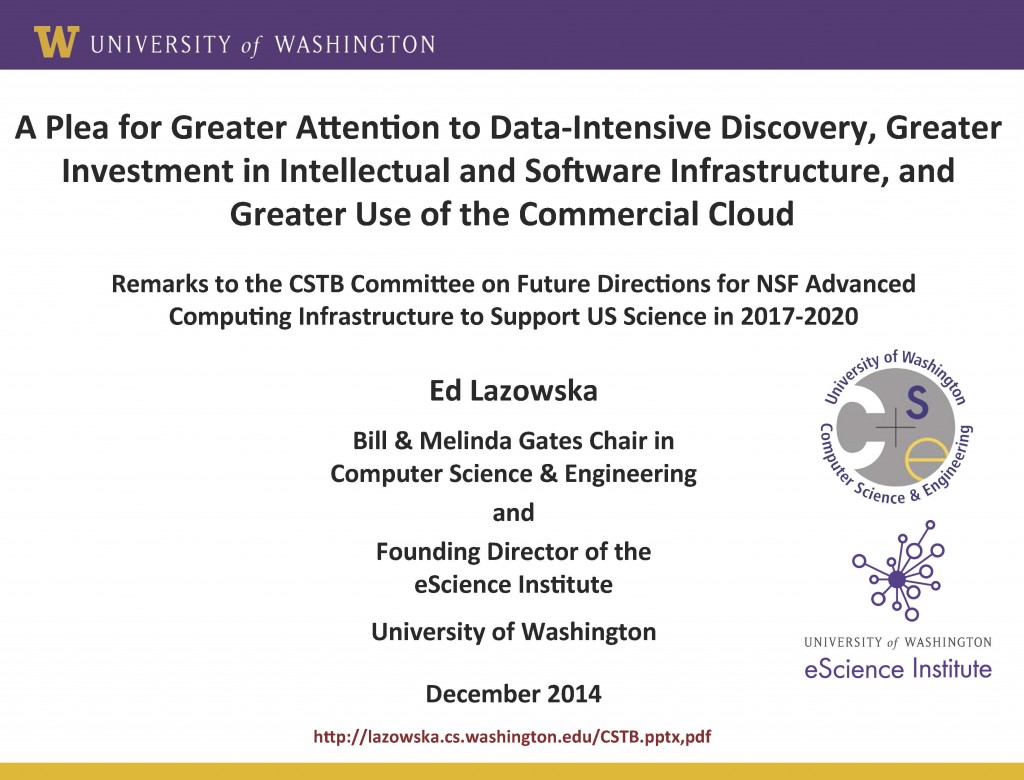
Here is the result – pdf and pptx. Many of the slides will be difficult to interpret in isolation, but the statistics starting at slide 47 may be of interest. Read more →
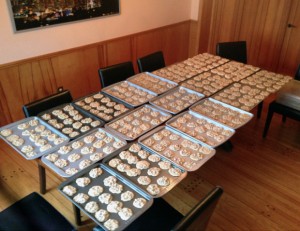
For many years, CSE professor Stuart Reges has baked chocolate chip cookies for his students to enjoy while taking the final exam.
It was a lot easier before the enrollment in CSE 142 (our “CS 1” course) reached 1,000 this fall, and enrollment in CSE 143 (our “CS 2” course) reached 400. But Stuart, who is teaching both, was undaunted!
After all, what’s 154,000 calories (1,400 cookies) among friends?!?! Read more →
It’s Computer Science Education week, and President Barack Obama is the latest newsmaker to join the challenge to learn to code. The “Coder in Chief” sat down with Code.org – the Seattle non-profit that created the Hour of Code event — to become the first president to write a few lines of Javascript. Read about it in GeekWire here.
Hadi Partovi (Code.org CEO), you are amazing!
Do your own Hour of Code here! Read more →
UW CSE’s Oren Etzioni, CEO of Seattle’s Allen Institute for Artificial Intelligence, refutes the AI fear-mongering of Elon Musk and Stephen Hawking:
“The popular dystopian vision of AI is wrong for one simple reason: it equates intelligence with autonomy …
“To say that AI will start doing what it wants for its own purposes is like saying a calculator will start making its own calculations …
“So where does this confusion between autonomy and intelligence come from? From our fears of becoming irrelevant in the world …
“We’re at a very early stage in AI research. Our current software programs cannot even read elementary school textbooks, nor pass science tests for fourth-graders …
“We have challenging technical work to do and, frankly, both the fear mongering and the grandstanding are missing the point: Much of what is easy for an average human child is extremely difficult for AI software – and will be for many years to come. We humans are a lot smarter than we look! …
“If unjustified fears lead us to constrain AI, we could lose out on advances that could greatly benefit humanity—and even save lives. Allowing fear to guide us is not intelligent.”
Read more here. Read more →
Columns, the University of Washington alumni magazine, reports on research by UW CSE+EE professors Shwetak Patel and Matt Reynolds:
“Mobile phones have become second-nature for most people. What’s coming next, say UW researchers, is the ability to interact with our devices not just with touchscreens, but through gestures in the space around the phone … The technology – developed in the labs of Matt Reynolds and Shwetak Patel, UW associate professors of electrical engineering and of computer science and engineering – uses the phone’s wireless transmissions to sense nearby gestures, so it works when a device is out of sight in a pocket or bag and could easily be built into future smartphones and tablets.”
Read more here. Read more →
Columns, the University of Washington alumni magazine, writes:
“On a leafy street corner in Pacific Grove, Calif., an old Victorian house – formerly the headquarters of Digital Research Inc., the company started by Gary Kildall, ’67, ’68, ’72 – is now adorned with a plaque from the Institute of Electrical and Electronics Engineers (IEEE) to mark a Milestone in Electrical Engineering and Computing.
“The IEEE designation is a big deal; a quick scan of some of the prior milestones reveal names like Volta, Edison, Marconi and Tesla. While Kildall, who died in 1994 at age 52, made numerous contributions to computer science, it is his innovations in personal computing that have proven to be seismic.
“In the fall of 1974, Kildall – with the help of another UW computer science grad, John Torode, ’72 – successfully booted his CP/M operating system from a floppy diskette. Not long after, Kildall developed BIOS, an interface that allowed different hardware devices to communicate with the same operating system. In short, these developments allowed for programming that was machine independent, a huge boost to hobbyists and the real launch of the third-party software industry.”
Read more here. Read more →