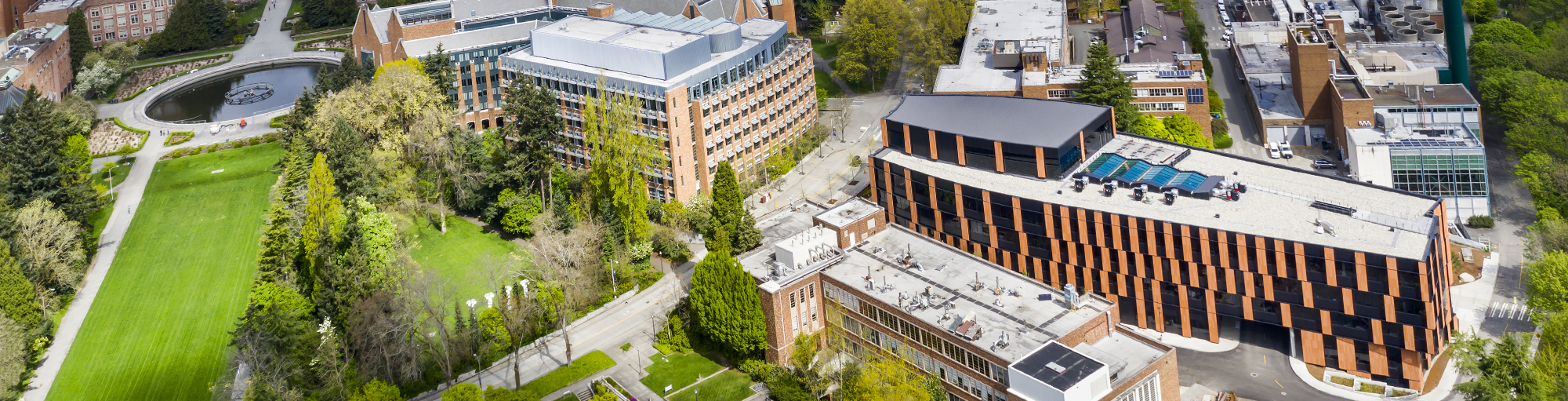
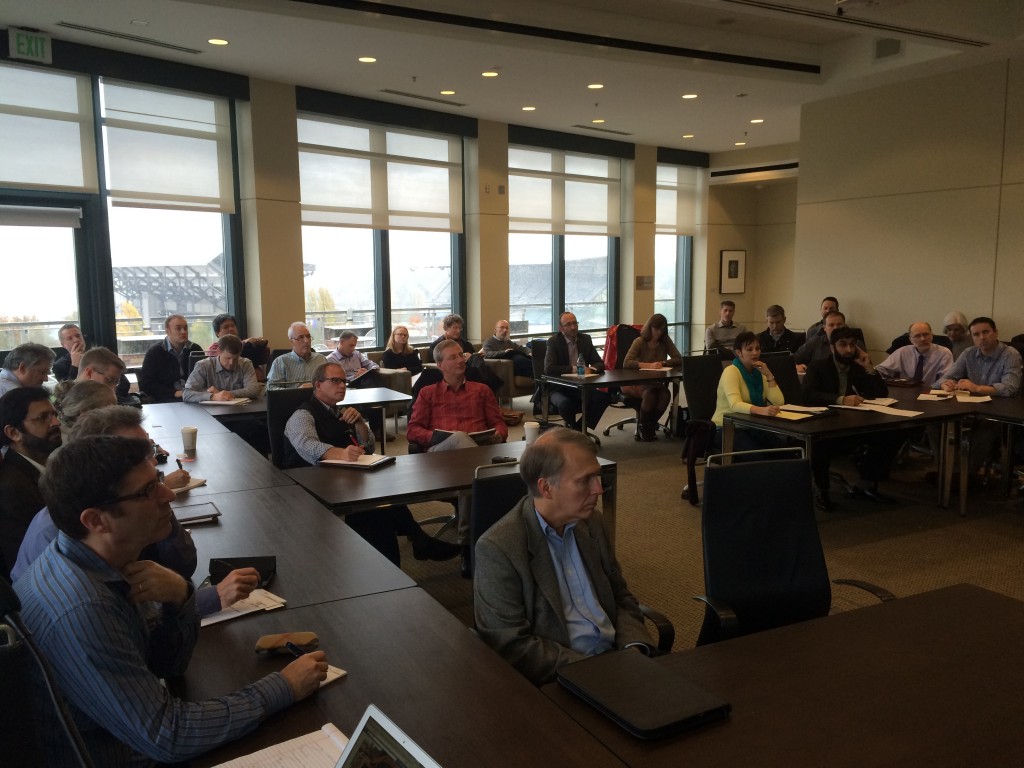
 The room was packed with representatives from architectural and engineering firms who came to learn about the CSE-II project – the project formerly known as LevyTown.
Check out reports on the project in GeekWire and the UW Daily. And listen to Ed Lazowska’s statement of the case on GeekWire Radio. Read more →
 Brian Koepnik and Vikram Mulligan – two of the scientists behind FoldIt, the award-winning protein-folding game developed by members of UW CSE’s Center for Game Science and the UW Department of Biochemistry – will be at the Pacific Science Center this Friday through Sunday to help celebrate Life Sciences Research Weekend.
FoldIt is an online game that has effectively crowd-sourced scientific discovery of the 3-D structure of proteins that play a role in diseases such as cancer, AIDS, and Ebola. Players are presented with a model of a protein to fold using a selection of tools. The game then evaluates the fold and uploads each player’s score to a leaderboard.
FoldIt has grown into a robust online community, and the competition sometimes can get fierce. This competitive streak yielded results in 2011 when FoldIt players discovered the protein structure of an AIDS-like virus. The virus had stumped scientists for a decade, but the FoldIt community unlocked its structure in just three weeks. More than 100,000 people around the world have played the game since it was released in 2008, and the game recently reached 1,000 puzzles.
Life Sciences Research Weekend is a three-day event November 7-9 at the Pacific Science Center in Seattle. The FoldIt team is taking part in a robust program of live demonstrations and interactive exhibits designed to engage families and citizen scientists in learning more about the role of life sciences research in our daily lives. Help spread the word, and stop by to say hi!
Learn more about the Center for Game Science here, and try your hand at protein folding here. Find directions to the Pacific Science Center to join in the fun this weekend here. Read more →
 The UW Daily reports:
“The UW Computer Science & Engineering department (CSE) recently proposed a dramatic expansion to satisfy the demand for its education and research.
“On Oct. 24, the UW backed the department by submitting an official request to architects for the design of a new, additional CSE building (CSE II) …
“‘We have built one of the best computer science departments in the country and I think we’ll continue to improve, to provide better education and more opportunities for more students,’ [CSE chairman Hank] Levy said …
“‘We have a value proposition … [which] is great education, great research, and also broad impact [of these],’ [CSE professor Ed] Lazowska said. ‘Computer science is at the heart of just about everything these days …’
“With CSE II, the department will be able to provide more interdisciplinary activities for interested students from all majors, according to Gaetano Borriello, CSE undergraduate admissions chair.”
Read more here. Read more →
 Rising Stars in EECS is an annual workshop that brings together women who are advanced graduate students and postdocs in electrical engineering and computer science and are interested in careers in academia, for two days of scientific interactions and career-oriented discussions.
Student participants included Tamara Bonaci (UW EE), Nicki Dell (UW CSE), and Justine Sherry (UW CSE Bachelors alum, now a Ph.D. student at UC Berkeley). UW CSE professor Anna Karlin participated on a faculty panel.
UW CSE was a sponsor of this year’s Rising Stars in EECS workshop, which was held at UC Berkeley. Read more →
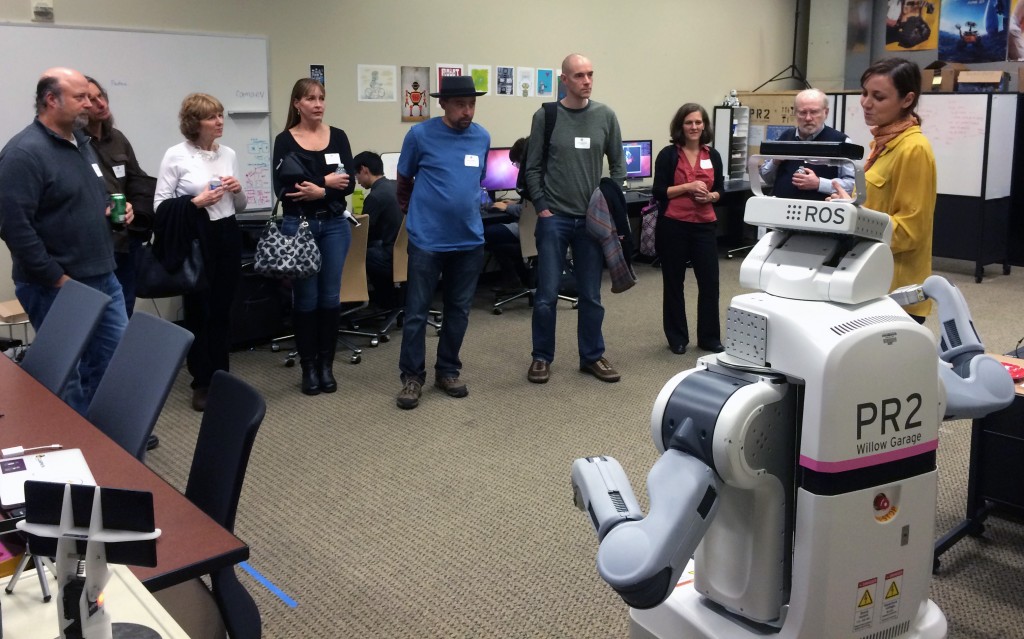
Rosie the Robot demonstrates how she has trained UW CSE professor Maya Cakmak
A group of UW CSE alums and friends toured four UW CSE robotics labs this evening: Emo Todorov’s Movement Control Lab, Dieter Fox’s Robotics and State Estimation Lab, Raj Rao’s Neural Systems Lab, and Maya Cakmak’s Human-Centered Robotics Lab. Read more →
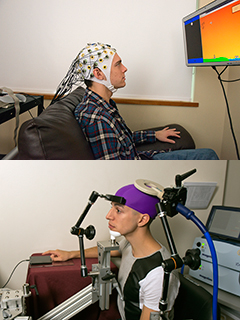
Photo credit: Mary Lanvin, UW
Last summer, an interdisciplinary team of UW researchers became the first to demonstrate two human brains communicating directly without using language. Today, having completed a more comprehensive test of its brain-to-brain interface, the team published its results in the journal PLOS ONE. UW CSE professor Raj Rao is lead author of the study.
The researchers used a combination of non-invasive instruments and software to connect two human brains over the Internet in real time. Six participants were paired off, with one designated as sender and one as receiver, and placed in separate locations on campus. Each member of the pair was unable to communicate with the other except by the link between their brains as they cooperated remotely to execute a command in a computer game. The researchers transmitted signals from one person’s brain to the other, using them to control the hand motions of the recipient – successfully replicating the results of the initial demonstration.
In addition to measuring the accuracy of their communication, researchers were able to quantify the amount of information transmitted between participants. Thanks to a new $1 million grant from the W.M. Keck Foundation, the team will be able to take its work a step further: in the next round, the researchers will increase the complexity of information transmitted between brains.
Rao, undergraduate CSE researcher Joseph Wu, and CSE alumnus Matthew Bryan co-authored the study with Andrea Stocco and Chantel Prat of the UW Institute for Learning & Brain Sciences and Devapratim Sarma and Tiffany Youngquist of the UW Department of Bioengineering.
Read the UW press release and watch a video demonstration here. Read the study published in PLOS ONE here. NBC News report here. Read more →
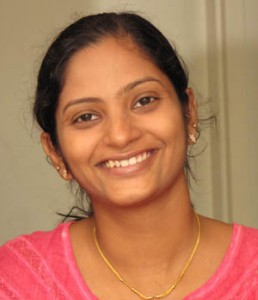 Congratulations to UW CSE Ph.D. student Rajalakshmi Nandakumar, who just received the “Best Presentation” Award at SenSys 2014, the 12th ACM Conference on Embedded Networked Sensor Systems.
The paper, “Feasibility and Limits of Wi-Fi Imaging,” describes work done by Rajalakshmi and fellow UW CSE Ph.D. student Donny Huang as first-year students, working with UW CSE professor Shyam Gollakota. Read more →
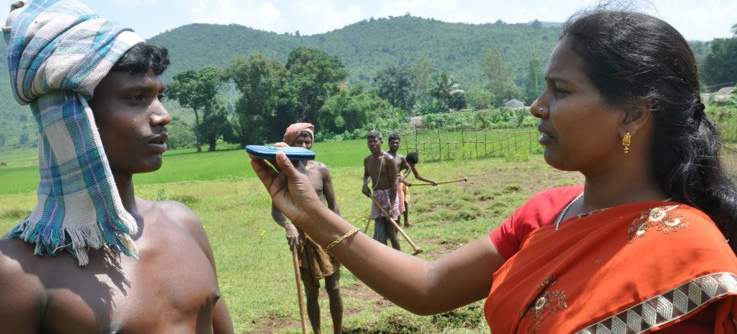 USAID has announced four new grants to winners of the joint USAID-Humanity United Tech Challenge for Atrocity Prevention. The grants will help recipients partner with an operational NGO or an established human rights group to further develop and pilot their innovations to document atrocities and facilitate communication for those at risk.
The award to UW CSE focuses on the work of Ph.D. student Aditya Vashistha, supervised by professor Gaetano Borriello. The project – Interactive Voice Response (IVR) Junction – is a flexible voice-communication tool that allows users with limited connectivity or literacy to record and listen to posts, while the global community can access them online. Aditya will partner with two local organizations in sub-Saharan Africa to connect low-tech users and members of marginalized communities, such as refugees and asylum seekers.Read more here. Learn about IVR Junction here. Read more →
 Several years ago, Belkin International acquired Zensi, a “smart home” energy and water sensing startup from the lab of UW CSE+EE professor Shwetak Patel. Zensi’s technology became the heart of Belkin’s WeMo home automation ecosystem.
Today, Belkin announced the creation of WeMo Labs in Seattle.
“‘With a thriving tech industry and an immense talent pool surrounding UW’s world-renowned Computer Science & Engineering and Electrical Engineering programs, Seattle is ground zero for recruiting the top data scientists, software engineers, and developers in the country,’ said Patel, who also serves as Belkin’s Chief Scientist. ‘WeMo Labs will continue to benefit from a long-standing relationship with the Ubicomp Research Lab and other UW organizations such as the eScience Institute.’
“‘Establishing a larger presence in Seattle and collaborating with the University of Washington is a direct investment in the future of WeMo,’ said Chet Pipkin, founder and CEO of Belkin. ‘We’re looking for this team to help us fast track groundbreaking technologies from the lab to the marketplace, keeping WeMo at the forefront of the Internet of Things.'”
Read more here. GeekWire article here. Seattle Times article here.
And check out a great GeekWire compendium of companies that have recently opened engineering offices in Seattle – here. Read more →
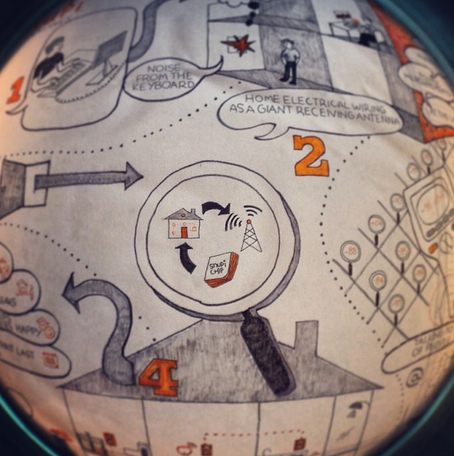
UW CSE startup SNUPI Technologies’ creative cocktail napkin from the 2013 Seattle 10
“Education. Big data. Health. Telecommunications. Clean tech.
“Seattle is producing groundbreaking startups in a host of industries, generating a crop of impressive entrepreneurs who are truly attempting to change the world.
“Getting to tell these startup stories at GeekWire is an honor and a privilege, and that’s one of the reasons why we are so excited to once again partner with the Museum of History & Industry to bring you The Seattle 10.
“This list showcases 10 of the most promising startup companies in the region – highlighting the best and brightest.”
UW CSE startup GraphLab is one of the 10. And last year’s darling, UW CSE startup SNUPI Technologies, is used to illustrate the article.
Read more here. Read more →