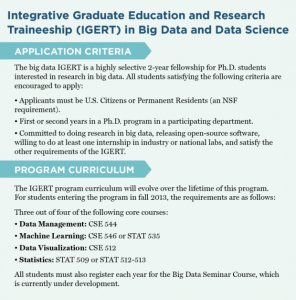
 The UW Daily reports on our new graduate program in Data Science, funded by an NSF IGERT (interdisciplinary graduate education) award:
“The big data Ph.D. track is a new interdisciplinary program at the UW … Five departments are participating in the track: computer science and engineering, statistics, astronomy, oceanography, and chemical engineering. Students who are accepted into the program take courses in data management, data visualization, statistics, and machine learning, in addition to the degree requirements laid out by their home department.”
Magda Balazinska, Carlos Guestrin, and Emily Fox are quoted.
“‘The key to discovery … is increasingly centered around data analysis,’ Balazinska said.”
Read more here. Learn about our Data Science activities here. Read more →
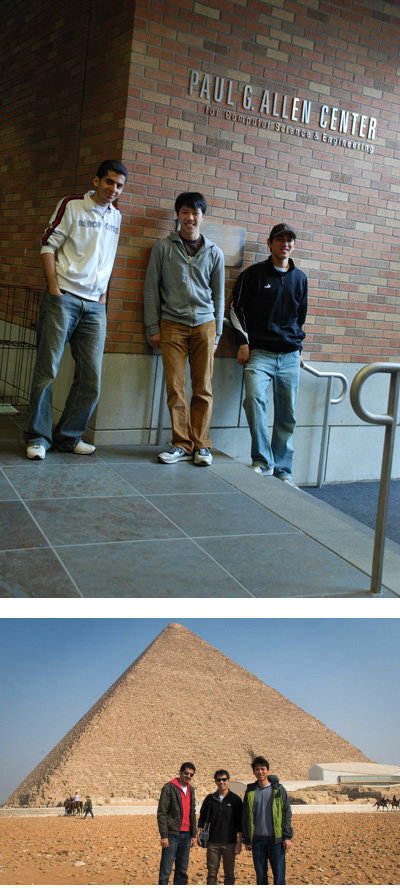
The CloudPress team in 2007 (top) and 2014 (bottom)
TechCrunch reports:
“CloudPress is a year-old startup which has emerged from the chaos of the Egyptian revolution, only to be acquired by one of the world’s biggest media companies: News Corp. Indeed, the media giant was so impressed with the team and the product, that it scooped it up in a fast acqui-hire …
“The three founders of CloudPress – Allen Chen (UW CSE ’07), Mohamed El-Zohairy (UW CSE ’07), and Bobby Mathews (UW CSE ’08) – started the company in Egypt early 2013 and were incubated by Flat6Labs, one of the very few tech accelerators in the Middle East and the only one we’re aware of that is based in Cairo.
“The idea behind CloudPress is pretty clever. It’s a cloud platform designed to easily create and share rich visual content, in particular: visual storybooks, recipes, how-to-guides, buying guides and similar kinds of content.”
Read more in TechCrunch here. Check out CloudPress here. GeekWire article here. Read more →
 The goal of the Access Facebook Award is to reward innovative projects using the Facebook platform to deliver a human rights or social good outcome.
At this week’s RightsCon, IVR Junction – a free and open-source tool that enables marginalized communities to be heard on the Internet through phone-based reporting and automated content updating and sharing on Facebook – was named the winner of the 2014 Access Facebook Award.
IVR Junction was developed in the Technology for Emerging Markets group at Microsoft Research India by Microsoft researcher Bill Thies and UW CSE Ph.D. student Aditya Vashistha.
Congratulations to Bill and Aditya! Learn more about IVR Junction here. Read more →
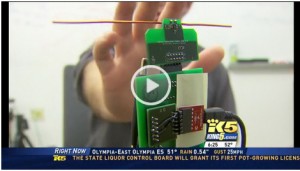 “A new technology … may give users a new way of providing … interactivity … a gesture recognition system that can control a wide range of devices.
“The ‘AllSee’ system uses wireless signals for both power and gesture recognition. Sensors in the system read changes in the signals created by the gestures, and transforms them into specific commands. The UW team’s prototype is now using TV and RFID (radio frequency identification) signals for showing off AllSee’s capabilities, but they hope one day to use WiFi signals as a source of power.”
Watch the segment here. Learn more about AllSee here. Read more →
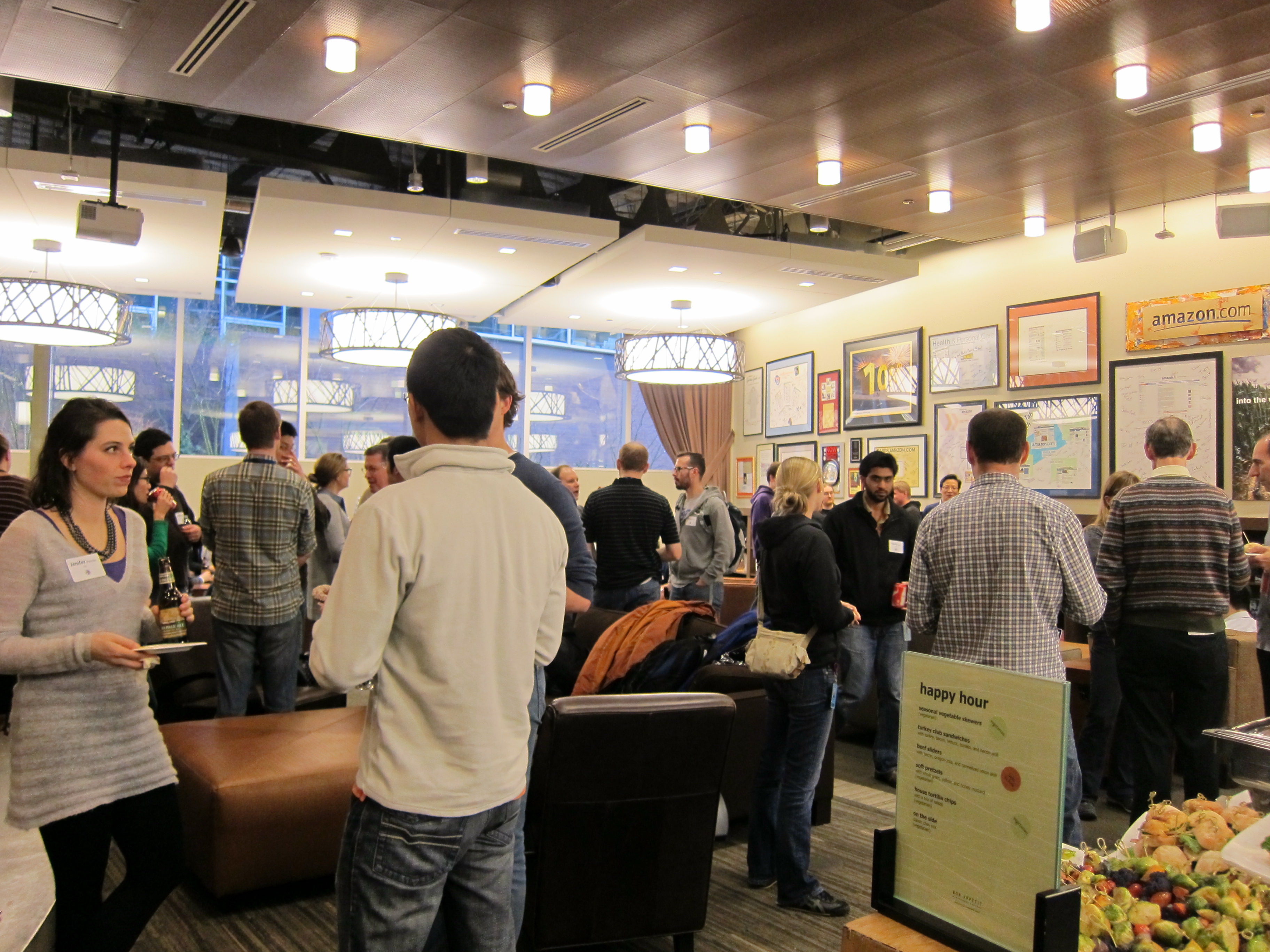
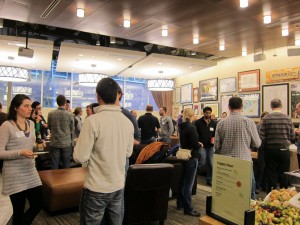 UW CSE hosts annual “happy hours” at a number of companies where our alums have a significant presence. Yesterday, CSE faculty (Tom Anderson, Dan Grossman, Ed Lazowska, Hal Perkins, and Zach Tatlock), advising staff (Crystal Eney, Jen Pesicka, and Dave Rispoli) and outreach staff (Kay Beck-Benton, Karen Howard, and Sergey Smirnov) joined a big crowd of alums at Amazon.com.
We have a number of alums who’ve been at Amazon.com for more than a decade (they get cool colored employee badges!), and Amazon.com is currently the largest recruiter of new UW CSE graduates (and we are their largest supplier of new graduates).
It’s great to be in Seattle! Read more →
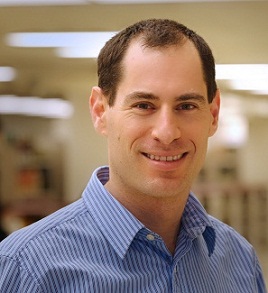 UW CSE professor Dan Grossman has been elected to the Board of Directors of the Computing Research Association (CRA).
CRA is an association of more than 200 North American academic departments of computer science, computer engineering, and related fields; laboratories and centers in industry, government, and academia engaging in basic computing research; and affiliated professional societies.
CRA’s mission is to enhance innovation by joining with industry, government and academia to strengthen research and advanced education in computing. CRA executes this mission by leading the computing research community, informing policymakers and the public, and facilitating the development of strong, diverse talent in the field.
UW CSE has a long history of close involvement with CRA:
- Ed Lazowska, Board member 1992-2004, Chair 1997-2001
- David Notkin, Board member 2005-12
- Bob Ritchie, Board member 1987-96, Chair 1981-83
- Larry Snyder, Board member 1996-2005
- Paul Young, Board member 1983-92, Chair 1989-91
UW CSE Ph.D. alums who have been members of the Board include:
- Greg Andrews, Board member 1991-98
- Anne Condon, Board member 2005-08, 2013-16
- Carla Ellis, Board member 2003-09
Biographies of Dan and the other newly-elected CRA Board members here. Read more →
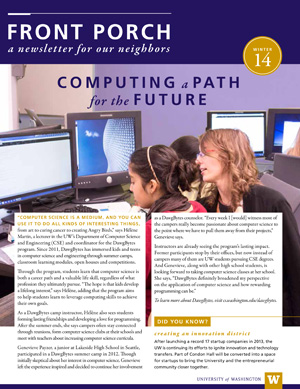 Front Porch – UW’s publication for U-District neighbors – features UW CSE’s DawgBytes K-12 outreach program as this month’s cover story.
Read the article here. Learn more about DawgBytes here. Read more →
![CSElogo_Color Optio 1]](http://news.cs.washington.edu/wp-content/uploads/2014/03/CSE-logo-new-sm.jpg) We ask applicants to our Computer Science and Computer Engineering major programs to tell us why they’re interested in Computer Science & Engineering. Here are some responses from this quarter’s incoming students:
We ask applicants to our Computer Science and Computer Engineering major programs to tell us why they’re interested in Computer Science & Engineering. Here are some responses from this quarter’s incoming students:
- After taking CSE 143 and creating a Sudoku game application, it sparked a latent interest within me for programming. In addition, I developed a mentality for programming and I knew that was what I wanted to pursue as a career. I believe computer science will have a capacity for an immense and worthwhile impact in the future, and I would love to be a part of it.
- I chose computer engineering because I wanted a major where my future classes and future career would be challenging and engaging. In addition to this, I know that computer engineering is a growing and versatile field.
- Personally speaking, CSE is probably the best thing ever happened to the human race. Simply put, it is the closest thing we have to true superpower.
- I like computers, and I like things that are both technical and creative, and software development is that to a tee.
- I chose CSE because the CSE classes I’ve taken are far and away more interesting than any others. I knew I had found what I wanted to do when I was excited to go to class every day because I enjoyed what we were learning so much. Also, I knew I wanted to find a growing and exciting field and nothing meets those criteria more than computer science. Additionally, it helps that the department at UW is so prestigious and an opportunity that I wouldn’t want to pass up.
- It’s so cool making a computer do what you want! I always feel like a wizard.
- Since I was little I’ve always found technology really interesting, and I love the problem solving techniques used in CSE, especially in developing algorithms.
- I chose Computer Engineering because I believe that the people and the faculty in CSE are like-minded, community-oriented, and committed to being critical thinkers both in and out of the classroom.
- It’s simple – after writing my first line of code I was hooked!
- I enjoy working through rigorous course material and growing intellectually from it. Additionally, the breadth of subject matter that CSE reaches is extremely appealing to me.
- After I took CSE 142, I knew that CSE would suit both my skills and my passion, despite my parents’ wish for me to become a pharmacist. I started to program for fun in my free time, looking up programming tutorial videos on YouTube, building my own software projects with friends and on my own. Learning new languages and technology is challenging but at the same time being able to build something meaningful out of what I learn is the most rewarding feeling.
- I see a huge potential for computer science to help solve medical problems, and I hope to use it in this manner in the future. I also really enjoyed the introductory series here at UW and I have no reason to think that the other courses within the department won’t be as challenging and satisfying.
- With CSE, you can always be working on the newest and most innovative projects. There is limitless potential with technology, and CSE allows one to harness this potential.
- I’ve always been fond of problem solving, and it’s incredibly interesting to work with formalized, explicit “thought processes”. Also, as a creative thinker, I’m drawn to the whole new world that programming offers. I can make as many programs as I want, with my computer and willing mind being the only resources I need!
- I love the possibilities and applications of CS to other areas of study.
- Computer Science has appealed to me like no other subject. To be able to instruct a computer to be able to do what I want was very inspiring. Since then, I have tried to make applications that benefit a huge number of people with access to technology. I want to couple my interests in Education, Math, Research with Computer Science and develop programs to benefit society!
“From the mouths of babes …”
Learn more about majoring in Computer Science & Engineering at the University of Washington here. Read more →
 We remember our friend and colleague Ben Taskar on what would have been his 37th birthday, March 3 2014.
His wife Anat asks, “I was hoping we could, as a community, each take a moment this week to perform a simple, random act of kindness to commemorate Ben’s life and giving spirit.” Read more →
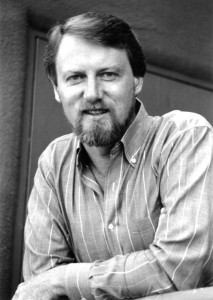
[Copyright Tom O’Neal, Carmel Valley CA]
David Laws of the Computer History Museum has written a lovely history of UW CSE Ph.D. alum Gary Kildall’s seminal role in the PC revolution:
“Late one afternoon in the fall of 1974, in the sleepy California seaside town of Pacific Grove, programmer Gary Kildall and electronic engineer John Torode [also a UW CSE Ph.D. alum] ‘retired for the evening to take on the simpler task of emptying a jug of not-so-good red wine … and speculating on the future of our new software tool.’ By successfully booting a computer from a floppy disk drive, they had just given birth to an operating system that, together with the microprocessor and the disk drive, would provide one of the three fundamental building blocks of the personal computer revolution. While they knew it was important, neither realized the extraordinary impact it would have on their lives and times.”
An IEEE Milestone plaque recognizing Gary’s contributions will be unveiled on Friday April 25 at 801 Lighthouse Avenue in Pacific Grove, the home of Digital Research, Inc. (DRI).
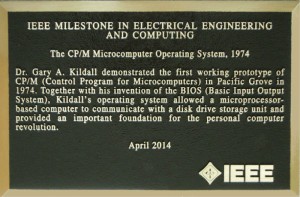 (In addition to Gary and John, who created CP/M, Tim Paterson, who created QDOS (which became 86-DOS, and then PC DOS, and then MS-DOS), was a UW CSE alum. “We were there.”)
Read David Laws’ wonderful account here.
Read a history of CP/M in Gary’s own words here.
Previous post with additional information here. Read more →