UW CSE Ph.D. alum Roxana Geambasu is runner-up for inaugural SIGOPS Dennis M. Ritchie Doctoral Dissertation Award

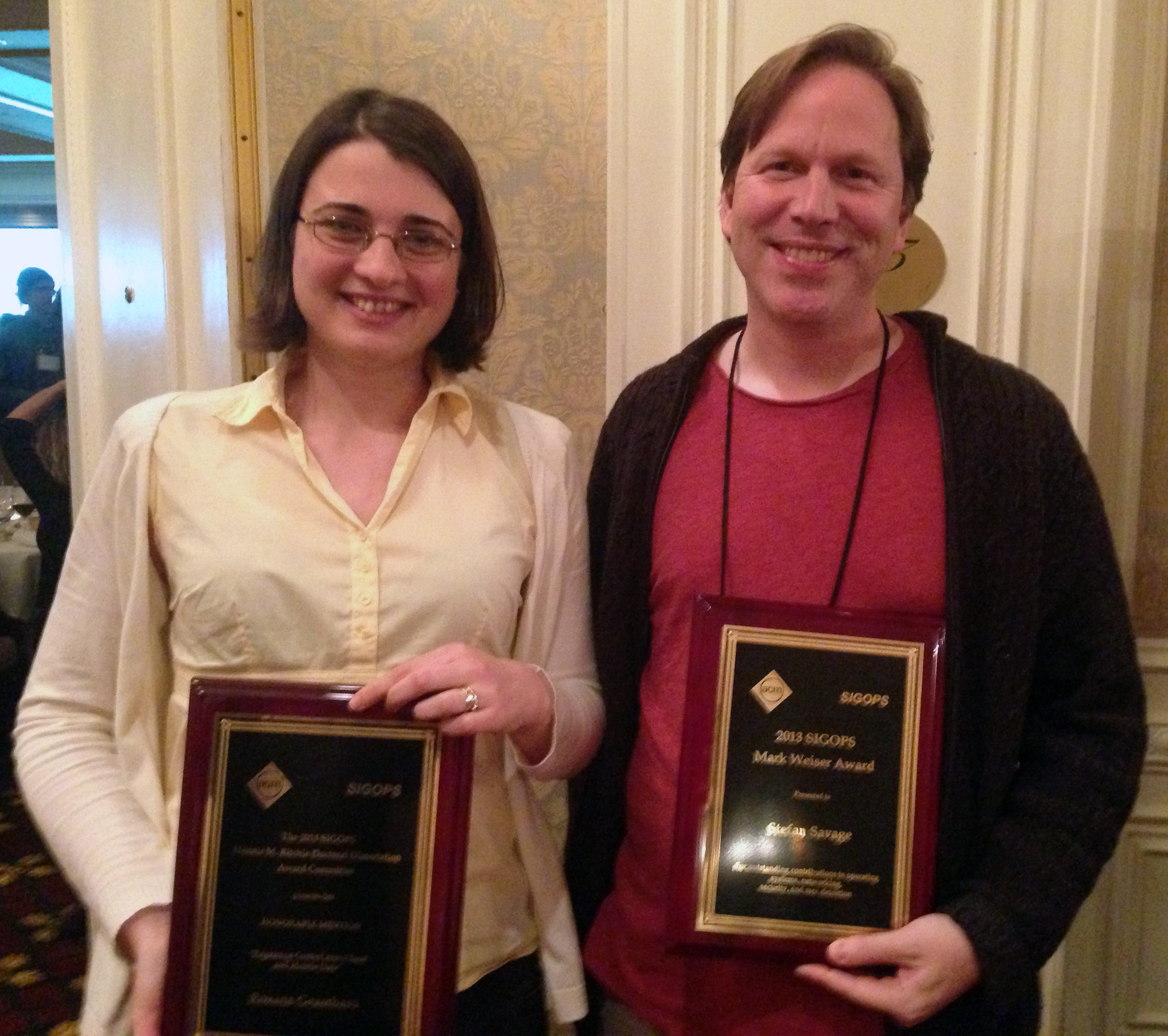
Roxana.and.Stefan

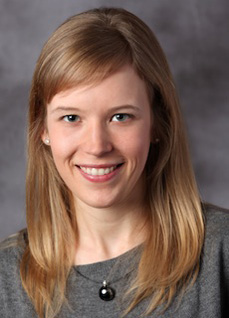
Roxana Geambasu and Stefan Savage

The Dennis M. Ritchie Doctoral Dissertation Award was created by the computer systems research community in 2013 to recognize research in software systems and to encourage the creativity that Dennis Ritchie embodied, providing a reminder of Ritchie’s legacy and what a difference one person can make in the field of software systems research.

At the ACM Symposium on Operating Systems Principles today, UW CSE Ph.D. alumna Roxana Geambasu, a professor in the Computer Science Department at Columbia University, was recognized as runner-up in the inaugural Ritchie Award competition. The winner was Mona Attariyan, a University of  Michigan Ph.D. alumna now at Google Seattle.

We congratulate Roxana, and we note that Dennis Ritchie, like Roxana’s UW CSE Ph.D. advisor Hank Levy, never received a Ph.D. Read more →

UW CSE Ph.D. alum Stefan Savage wins 2013 SIGOPS Mark Weiser Award

The Mark Weiser Award was created in 2001 by the computer systems research community, to be given annually to an individual who has demonstrated creativity and innovation in computer systems research. The recipient must have begun his or her career no earlier than 20 years prior to nomination. The award is named in honor of Mark Weiser, a computing visionary recognized for his research accomplishments during his career at Xerox PARC.

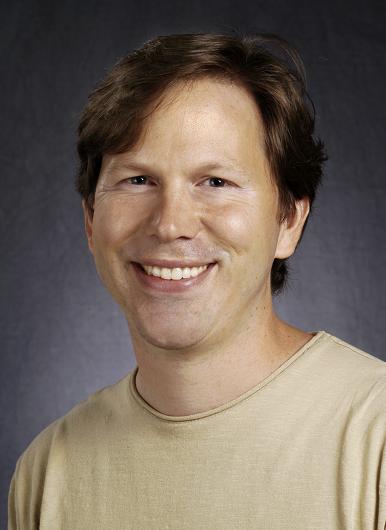
Today, the 2013 SIGOPS Mark Weiser Award was presented to UW CSE Ph.D. alumnus (and UCSD professor) Stefan Savage. Quoting from the nomination materials:

“In the last decade, as we have grown increasingly dependent on the Internet, the Internet has become a vehicle for large-scale attacks – worms, viruses, botnets, massive flooding attacks, etc.

“Stefan Savage is, by far, the most creative person working in the hugely important fields of network security, privacy, and reliability. He has an uncanny ability to ask exactly the right question, propose exactly the right solution, and see that solution through to impact.

“Stefan’s work has not been a single contribution, but rather a collection of individually high-impact contributions that point in a single critically important direction: analyzing Internet attacks and attackers as elements of an integrated technological, societal, and economic system, and recognizing that no one-dimensional intervention has a prayer of succeeding. Our inability to select a single ‘greatest hit’ does not make The Beatles a lesser band; rather, we recognize that any one of their better songs would have been sufficient to catapult a lesser band into the Rock & Roll Hall of Fame …

“Stefan stands in the very top echelon of the extraordinary group of previous Weiser Award recipients.”

Savage is the fourth UW CSE Ph.D. alum to receive the Weiser Award in its 13-year history – an incredible affirmation of UW’s track record in preparing leaders in computer systems. Brian Bershad (now with Google in Moscow) was recognized in 2004. Tom Anderson (now a UW CSE faculty member) was recognized in 2005. Jeff Dean (Google) was recognized in 2012.

Congratulations Stefan! Thanks for making us look good!

Read more →

Qazzow scores $500,000 seed investment

qazzowQazzow – a UW spinout founded by iSchool professors (and CSE Adjunct Professors) Amy Ko and Jake Wobbrock and their Ph.D. alum (and University of Waterloo professor) Parmit Chilana – has announced a $500,000 seed investment from UW’s W Fund.

Qazzow is a Q&A SaaS offering that websites use to increase sales conversions by answering customer questions.  The system is being tested by Ben Bridge Jeweler, Game House, Big Fish Games, PetHub, Yapta, and PlayOn.

Congratulations, team!  Read the GeekWire post here. Read more →

“Coding for Success”

large_news874342_711739Seattle’s Lakeside School profiles UW CSE Ph.D. alumna Lauren Bricker, who has transformed the school’s computer science programs since arriving in 2007.

“In junior high, Lauren Bricker insisted on being allowed to take shop instead of home ec – and ran away with the top prize. In high school, introduced to programming in math class, she spent every lunch hour seeing what she could make old Apple IIGs and TRS-80s do. In college, she sped through a theoretical math major in three years. In industry, she advanced as a self-taught software engineer before returning for a Ph.D. in computer science …

“As a teacher at Lakeside, she enlists that same fierce determination on behalf of her students.”

The article is an element of a Lakeside fundraising appeal, and we need the money more than they do, but still, it’s great!  Read it here.  Learn about UW CSE’s vibrant K-12 outreach initiative, DawgBytes, here and here. Read more →

SNUPI announces Wally

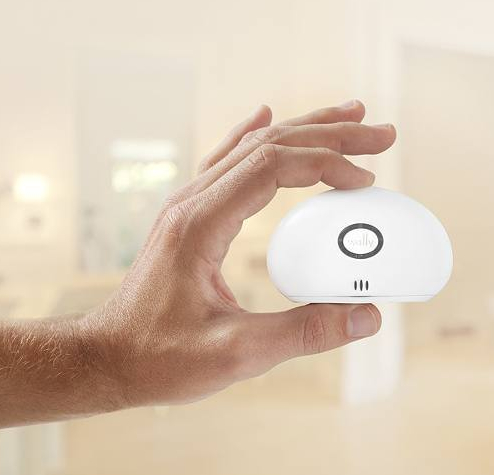
wally3UW CSE startup SNUPI has announced Wally.  Our friends at GeekWire write:

“Worried about toxic mold or pesky water leaks in your home?

“Never fear, Wally is here.

“That’s the new consumer brand from SNUPI Technologies, the latest startup effort from Seattle serial entrepreneur [and UW CSE alumnus] Jeremy Jaech …

“WallyHome – which works in conjunction with an always-on Internet connection – is designed to detect environmental hazards around the home by monitoring moisture, temperature and humidity changes. The wild thing is that the company says no batteries are needed, with the system set to work continuously for 10 years. It does this by bypassing traditional Wi-Fi and Bluetooth connections, instead using the copper wiring in the walls of a home as an antenna. (More on the technology behind the system here.)

“Jaech has partnered with some of the top minds at the University of Washington on SNUPI, including [CSE and EE] professors Shwetak Patel and Matt Reynolds, as well as doctoral student Gabe Cohn.”

Read more here.  Check out the Wally webpage here. Read more →

UW CSE’s Franzi Roesner, Shiri Azenkot kick off MIT’s 2013 “Rising Stars in EECS”


shiri

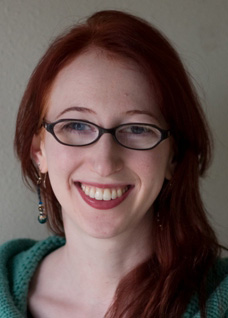
Shiri Azenkot

franzi

Franzi Roesner

MIT’s “Rising Stars in EECS” is an annual workshop that brings together top graduate and postdoc women in EECS for two days of scientific discussions and informal sessions aimed at navigating early stages of the academic career.

UW CSE Ph.D. students Franzi Roesner and Shiri Azenkot will present their research in the first session of the workshop.  Franzi will speak on “Third-Party Web Tracking: Detection, Measurement, and Prevention.”  Shiri will speak on “DigiTaps: Eyes-Free Number Entry on Touchscreens with Minimal Audio Feedback.”

Congratulations Franzi and Shiri! Read more →

“Welcome to the Mind-Meld: Our Future of Brain-to-Brain Communication”

plugged-in-brainThe brain-to-brain interface experiment of UW CSE’s Rajesh Rao continues to attract extraordinary attention.

Discover features an in-depth explanation of the experiment and its implications, here:

“Finally, in August 2013, University of Washington scientists Rajesh Rao and Andrea Stocco succeeded in making one leap everyone was waiting for: A human-to-human brain-to-brain interface. By strapping one person into a non-invasive EEG helmet, and strapping the second into a transcranial magnetic stimulation (TMS) helmet, the researchers mind-melded themselves – for the sake of science.

“The experiment went like this: Rao and Stocco sat across campus from one another, watching the same video game. Rao, wearing an EEG helmet, was at the controls – but instead of using his hand to hit the spacebar to fire, he simply imagined moving his hand.
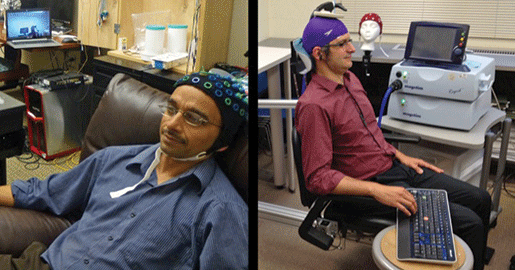
F1.medium“Every time he did this, with near-instantaneous speed, a computer converted Rao’s brain signals into a digital signal and beamed it to Stocco’s TMS helmet. That helmet converted the signal into a burst of magnetic stimulation delivered to the precise region of Stocco’s motor cortex that controlled his right hand. Stocco’s hand would then twitch involuntarily, tapping the spacebar and (sometimes) scoring a hit in the game.”

Science focuses on the implications, here:

“Restoration of normal function has driven development of devices such as cochlear implants for deafness, deep-brain stimulators for Parkinson’s disease, and bionic eyes for the blind, but there has long been a fascination with using similar technologies to “neuroenhance” healthy individuals, helping them control emotions, improve memory and cognition, and even communicate wordlessly with others …” Read more →

Best Paper at HCOMP 2013

palm-springs-plazaThe paper “Crowdsourcing Multi-Label Classification for Taxonomy Creation” by UW CSE’s Jonathan Bragg, Mausam, and Dan Weld has been selected as the recipient of the Best Paper distinction at the AAAI Conference on Human Computation and Crowdsourcing (HCOMP-2013).

Congratulations to Jonathan, Mausam, and Dan! Read more →

Xconomy on Northwest Institute for Advanced Computing

Xconomy-logo1The Northwest Institute for Advanced Computing – NIAC – is a joint initiative of the University of Washington and the Department of Energy’s Pacific Northwest National Laboratory (PNNL).  Xconomy reports on “NIAC Day” – a day of seminars and working sessions inaugurating NIAC:

“Ed Lazowska, UW computer science professor, director of the eScience Institute, and a key link between PNNL and the university, put aspirations for NIAC—unveiled early this year—in context of the ‘dawn of a new era of discovery.’

“Data-intensive scientific discovery, he says, joins computational science as another arrow in the quiver for researchers, complementing the older methods of theory, experiment, and observation.

“A proliferation of low-cost sensors and simulations is creating a torrent of data that presents enormous opportunities and huge challenges. Smart homes, smart cars, smart health, smart robots operating in unstructured environments—all are enabled by advances in areas such as machine learning, computer vision, and cloud computing.

“‘The big data revolution is what’s putting the smarts in everything,’ Lazowska says. (He is leading a discussion on data-driven discovery at Xconomy’s upcoming public forum: Big Insight—Making Sense of Big Data in Seattle on Nov. 19.)

“For data-intensive science to reach its potential, the onus is on computer scientists to build tools that can be used directly by oceanographers, biologists, geologists, and even sociologists and researchers in other fields, without having to wait for a data scientist to run reports for them. (He likened this potential bottleneck to the database administrators who sat between researchers and their data in the 1970s.)”

Read more here.  See Lazowska’s slides here. Read more →

Best Paper at ASSETS 2013

Microsoft Word - ASSETS2013_BusStopAccessibility_CR_v1c_KH.docxThe paper “Improving Public Transit Accessibility for Blind Riders by Crowdsourcing Bus Stop Landmark Locations with Google Street View” has received the Best Paper Award at the 2013 ASSETS conference – the annual conference of the ACM Special Interest Group on Accessible Computing.

Among the authors: Shiri Azenkot and Megan Campbell are UW graduate students. Kelly Minckler and Rochelle Ng are UW undergraduates.  Cynthia Bennett is a staff research assistant working with Professor Richard Ladner.  Jon Froehlich is a former Ph.D. student at UW, now an Assistant Professor at the University of Maryland.  Groups at the University of Washington and University of Maryland were working on similar projects using crowdsourcing with Google Street View to identify physical landmarks at bus stop locations that would be useful for blind bus riders.   They combined forces to study areas of Seattle and Washington DC in several interesting studies.

UW researchers also received the Best Paper award at ASSETS 2012.

  Read more →

« Newer PostsOlder Posts »