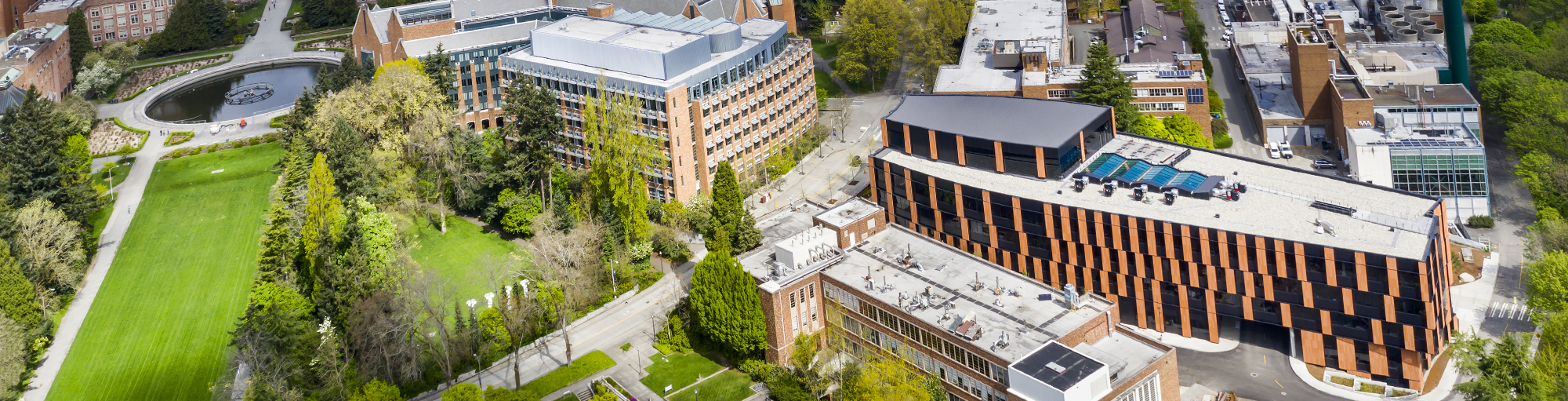
 GeekWire reports on the newly-established Northwest Institute for Advanced Computing (NIAC), a joint venture of the University of Washington and the Pacific Northwest National Laboratory:
“The University of Washington is already a budding hub for computer science. Now, with some help from a national laboratory, the Seattle campus will become even more of a CS powerhouse.
“The UW and Pacific Northwest National Laboratory have formed the Northwest Institute for Advanced Computing. Researchers there will jointly focus on developing solutions related to big data for challenges from climate change to energy management.
“‘The expanded partnership between UW and PNNL will create tremendous new opportunities for both organizations,’ Ed Lazowska, UW’s Bill & Melinda Gates Chair in Computer Science & Engineering, said in a press release. ”Big data’ is transforming the process of discovery in all fields. UW and PNNL have significant and complementary strengths; together we’ll be able to do amazing things.'”
Read more here. Read more →
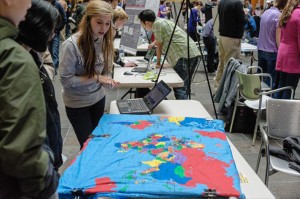
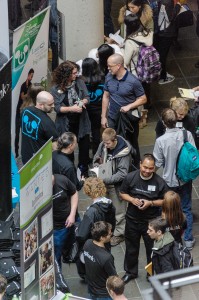 Following on yesterday’s UW CSE Startup Recruiting Fair was today’s recruiting fair for established companies. Participation was again capped at 50 companies (and gosh knows how many UW CSE students) due to space limitations.
These events are held for UW Computer Science & Engineering students, and for companies that are members of the UW CSE Industry Affiliates Program.
See the participating companies here. See the participating startups here. Learn more about the UW CSE Industry Affiliates Program here. (Recruiting fairs are held twice annually, in October and January.) Become a CSE major here. And check out lots of Bruce Hemingway photographs here. Read more →
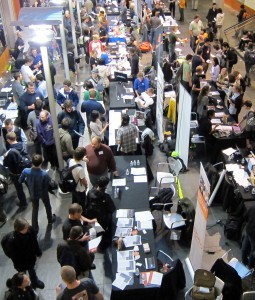 Today was the UW CSE Startup Recruiting Fair – an event devoted to startup companies (50 employees or fewer) seeking to employ UW Computer Science & Engineering students as interns or permanents. Participation was capped at 50 companies (and gosh knows how many UW CSE students) due to space limitations.
Tomorrow: a recruiting day for established companies.
These events are held for UW Computer Science & Engineering students, and for companies that are members of the UW CSE Industry Affiliates Program.
See the participating startups here. See the participating established companies here. Learn more about the UW CSE Industry Affiliates Program here. (Recruiting fairs are held twice annually, in October and January.) Become a CSE major here. Read more →
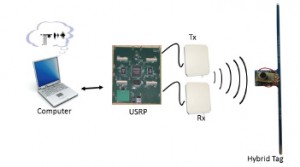 Vamsi Talla – an EE graduate student advised by CSE and EE faculty member Josh Smith – won the Best Student Paper award at WiSNet 2013, the IEEE Topical Meeting on Wireless Sensors and Sensor Networks. In addition to Vamsi and Smith, the co-authors are Michael Buettner (2012 CSE Ph.D., now at Google Seattle) and CSE professor David Wetherall. The work was funded by the Intel Science and Technology Center for Pervasive Computing, and by the NSF.
The paper, entitled “Hybrid Analog-Digital Backscatter Platform for High Data Rate, Battery-Free Sensing,” shows that by combining digital and analog techniques, it is possible to combine desirable features of digital (such as addressability) and analog (high data rate sensing at very low power). The paper presents battery-free, uniquely identified microphones that can be read at about 4m. The microphones are powered, controlled, and read by specially designed Software Defined RFID readers.
Learn more about the work of the Sensor Systems Research Group here. Read more →
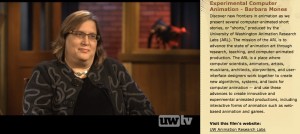 A UWTV interview with UW CSE’s Barbara Mones, describing our interdisciplinary digital animation curriculum, and showing several animated shorts.
Watch this wonderful piece here. Read more →
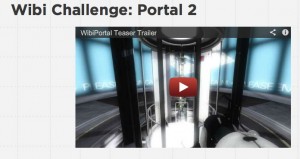 WibiData – a Bay Area “big data” startup launched by Christophe Bisciglia and multiple other UW CSE alums – is featured in the NY Times for its unique recruiting approach:
“If you want to signal to software engineers that your tech start-up is a cool place to work, you can let them bring their dogs to the office, offer free energy drinks or put up a billboard with a Web address that can only be accessed after solving a math equation.
“WibiData, a 22-person San Francisco start-up that develops big data applications, has come up with its own gimmick for telegraphing its engineering street cred to job applicants: a custom version of c, a devilishly addictive cult video game from Valve.”
Read the NY Times article here! Play the game here! Read more →
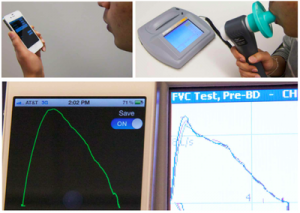 UW CSE’s SpiroSmart is described in MIT Technology Review:
“Today, a deep sigh at your smartphone could reveal a well-developed emotional connection with your gadget. But one day those sighs could tip off your doctor to a latent or worsening lung condition.
“A group at the University of Washington, in collaboration with Seattle Children’s Hospital, is developing a way to check how healthy your lungs are when you breathe out at your smartphone.”
Read more here. Learn about SpiroSmart here. Read more →
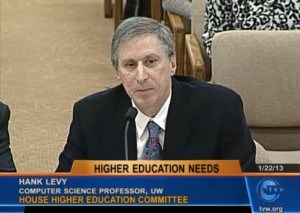 CSE chair Hank Levy today testified to the Washington State Legislature on high tech workforce needs. His remarks are a terrific summary of Seattle’s high tech scene and the role of UW CSE in supporting it.
Watch Hank’s testimony here. Read more →
 The current issue of SIGCSE Bulletin (the publication of the ACM Special Interest Group for Computer Science Education) features the Computer Science Education Week outreach activities of six colleges and universities, including UW.
UW’s activities included an Open House that attracted more than 750 middle school and high school attendees, and a programming competition (organized in conjunction with the local chapter of the Computer Science Teachers Association, and sponsored by Microsoft) that featured 74 teams representing 26 different schools.
Read the short article here. Learn more about UW CSE’s outreach activities here. Read more →
 Many of the nation’s leading researchers in advanced computer architectures – including UW CSE professors Luis Ceze and Dan Grossman – have joined together to form C-FAR, the Center for Future Architectures Research.
C-FAR is focused on innovation to create future generation scalable computing systems. The center is working on research that maximally leverages emerging circuit fabrics to enable whole new application areas. It accomplishes this goal through a highly collaborative research agenda that brings together researchers from many universities, including Michigan (the lead institution), Columbia, Duke, Georgia Tech, Harvard, MIT, Northeastern, Stanford, UC Berkeley, UCLA, UC San Diego, Illinois, Washington and Virginia.
C-FAR is funded at a level of $28M by the Semiconductor Research Corporation (SRC) and the Defense Advanced Research Projects Agency (DARPA) through the Semiconductor Technology Advanced Research network (STARnet). Read more →