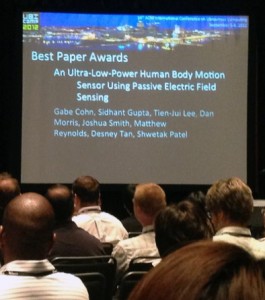
 The paper “An Ultra-Low-Power Human Body Motion Sensor Using Static Electric Field Sensing” by Gabe Cohn (UW, and Microsoft Research consultant), Sidhant Gupta (UW, and MSR consultant), Tien-Jui Lee (UW), Dan Morris (MSR, and UW affiliate professor), Josh Smith (UW), Matt Reynolds (Duke), Desney S. Tan (MSR, and UW affiliate professor), and Shwetak Patel (UW) has just received a Best Paper Award at the 14th ACM International Conference on Ubiquitous Computing. (Lead author Gabe Cohn is a Ph.D. student advised by Shwetak Patel.)
Congratulations, team! Read more →
 The Royal Society of Canada, founded in 1882, celebrates the nation’s leading scholars in the Arts, Humanities and Sciences through election as Fellows.
This week, the Class of 2012 was announced – 69 new Fellows: 15 in the Arts and Humanities, 15 in the Social Sciences, and 39 in the Sciences.
Among them – one of only two computer scientists – is 1987 UW CSE Ph.D. alum Anne Condon, Head of the Department of Computer Science at the University of British Columbia and a leading figure in computational biology. Anne’s citation reads:
Anne Condon, a researcher in computational complexity theory and algorithms, has advanced understanding of the computing time and memory needed to solve classical computational problems. She has also developed creative means for programming at the nanometer scale with DNA molecules. Her algorithms for predicting and designing nucleic acid secondary structures have had significant practical impact.
Warm congratulations to Anne Condon, FRSC! Read more →
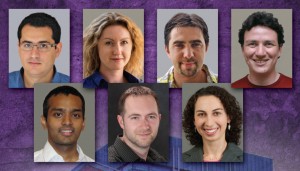 A new booklet describes UW CSE’s bumper crop of faculty hires:
- Carlos Guestrin, Amazon Professor of Machine Learning in Computer Science & Engineering (machine learning)
- Ben Taskar, Boeing Professor of Computer Science & Engineering (machine learning)
- Jeffrey Heer, Associate Professor of Computer Science & Engineering (data visualization)
- Emily Fox, Amazon Professor of Machine Learning in the Department of Statistics (machine learning)
- Ira Kemelmacher-Shlizerman, Assistant Professor of Computer Science & Engineering (computer vision)
- Ali Farhadi, Assistant Professor of Computer Science & Engineering (computer vision)
- Shyam Gollakota, Assistant Professor of Computer Science & Engineering (computer systems)
Quoting the New York Times, “Although Stanford is considered the Hogwarts of techdom, UW has quietly established itself as the other West Coast nexus of the information economy.”
Read more here. Read more →
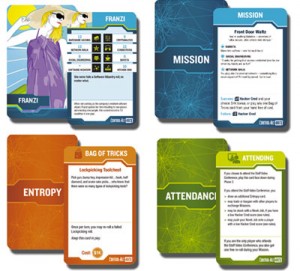 NetworkWorld has identified and profiled “25 of today’s coolest network and computing research projects.” Among them is Control-Alt-Hack, a card game created by UW CSE researchers to introduce computer security topics.
Read the article here. Learn more about Control-Alt-Hack here. Read more →
 “Last fall, when LearnSprout cofounder and one-time Facebooker Frank Chien called up his college buddies Joe Woo, previously with Microsoft, and Anthony Wu, a former Googler, he didn’t necessarily have an education startup in mind.
“The trio could have tackled healthcare or energy instead, he said. What mattered was that they go for something big — dent-the-universe, shake-up-the-system significant.
 “‘I [told them], let’s do something crazy,’ he said. ‘We can stay at our jobs forever or we can swing for the fences.’
“Not too much later, the three engineers, who met at the University of Washington, quit their jobs. Over the past ten months, they’ve built a startup taking on a major obstacle facing innovators interested in K-12 education: the siloed way in which student data is stored.”
Congratulations to UW alums Frank Chien (Business), Joe Woo (CSE), and Anthony Wu (CSE)!
Read the GigaOm article here. Learn more about LearnSprout here and here. Read more →
 MemCachier, a “Memcached-in-the-cloud” startup created by UW CSE alum Alex Loddengaard working with UW CSE alum Amit Levy, was profiled today in GigaOm.
(MemCachier shares San Francisco space with WibiData, a data analytics startup created by UW CSE alum Christophe Bisciglia working with UW CSE alum Aaron Kimball. Christophe, Aaron, and Alex previously worked together at Cloudera, the first startup created by Christophe after he left Google. Memcached – the pre-cloud progenitor of MemCachier, used worldwide to speed up dynamic database-driven websites by caching data and objects in RAM – was originally created by UW CSE alum Brad Fitzpatrick at his startup Danga Interactive to support LiveJournal. Get the message?)
Read the GigaOm profile here. Learn more about MemCachier here. Read more →
 John Cook in GeekWire has done a terrific analysis of the Washington State data from a new national study of where tech jobs are located in the United States. Some key observations:
- Overall, Washington State was the top state for tech job concentration, at 11 percent.
- Snohomish County (home to Boeing’s Everett plant and several biotechnology companies) leads the state with a 25 percent concentration, and a whopping tech job growth rate of 14 percent. King County isn’t too shabby either, coming in at a 17 percent concentration and 4.2 percent growth rate. Benton County shows a 7.9 percent concentration of tech jobs. Tech is everywhere in our state!
- Nationally, the story is the same. While areas such as Seattle, San Francisco and Austin remain hot, rust belt cities such as Dayton, Ohio and Troy, Michigan also show high concentrations.
- A minimum of 61% of counties nationally had at least some high-tech jobs in 2011. In 2009, more than 72% of counties had at least one new business establishment in the high-tech sector.
- High-tech startups have held relatively steady during the economic downturn, even while new business establishments across the entire private sector have declined.
Read John’s post here – it includes links to the national study. Read more →
 “College football teams in the six major conferences (Southeastern Conference, Big Ten, Big 12, Pac 12, Atlantic Coast Conference and Big East) spent an average of $2.46 million per victory over the three-year period.
“But some schools have got a lot more for their money than others …
“Then, there’s the other end of the spectrum. Washington State University spent an average of $5.4 million for its five victories between 2008 and 2010, narrowly edging its Apple Cup rival, the University of Washington, which spent $4.9 million.”
Read it here. Read more →
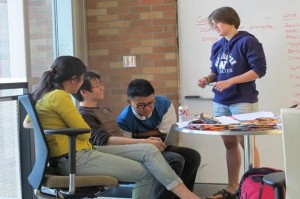 UW News reports on CSE’s World Lab Summer Institute:
“Health care? Environmental sustainability? Education? There’s an app for that. At least there may be soon, thanks to a new collaboration between UW and Chinese students.
“The University of Washington this July and August hosted the first World Lab Summer Institute, which brings together computer science, human-computer interaction and design students from the UW and Beijing’s Tsinghua University. Together they spent seven weeks developing ways that technology could be used to address global issues in health, environment and education.
“Students from China and the U.S. worked in teams of four to brainstorm ideas and develop apps.
“The summer exchange is the inaugural activity of the The World Lab, which aims to promote closer collaboration between the UW and Tsinghua, one of the top universities in mainland China, on issues of computer science and design.
“The World Lab was founded by James Landay, a UW professor of computer science, and colleagues at Tsinghua, after Landay spent a sabbatical year living in Beijing and working at Microsoft Research Asia.
“‘In China I saw a lot of excitement and rapid development in computing,’ Landay said. ‘I also saw ways that China and the U.S. could learn from one another.'”
Read more here. Read more →
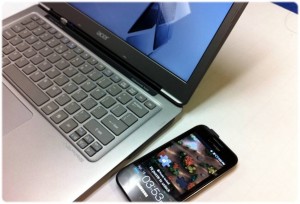 Intel today announced its intention to actively commercialize Wireless Charging Technology (WCT), which lets you charge your smartphone wirelessly from your notebook PC.
WCT was pioneered by UW CSE and EE professor Josh Smith and colleagues at the late Intel Labs Seattle.
Read the Intel announcement here. Read more →