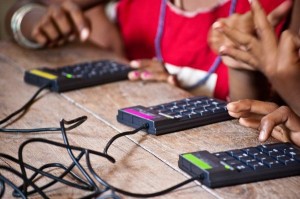
 While it will be long time before “one laptop per child” is true everywhere in the world, UW CSE undergraduates have developed a system that lets up to four students share a single computer to do interactive math problems.
UW undergraduate students Clint Tseng, Heather Underwood, and Sunil Garg, who participated in Joyojeet Pal‘s computer science project course, decided to try building a system for a numeric keypad similar to Microsoft MultiPoint platform, which connects multiple mice to one computer. Their system, developed over the past year, connects four numeric keypads, each of which costs about $4, to a standard computer running Windows software. The screen is split into four columns. Each student looks at one column, where he or she is given math problems based on performance on previous answers. Early qualitative tests of the system in India, which were presented earlier this year in Qatar at the International Conference on Information and Communication Technologies and Development, showed positive results.
Read the full U Week article here. Read more about MultiLearn here. Read more →
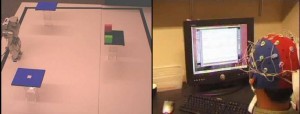 Even though James Cameron’s movie Avatar is still a few weeks away from opening, there already exist real-life systems for controlling another body remotely. UW CSE’s Raj Rao has developed an elegant mind-controlled robot that takes care of the boring, low-level stuff so the controller can concentrate on more interesting, higher level goals. The little humanoid bot is controlled by the human brain. By measuring electric signals through the surface of the skull (no surgery required), you can command the robot to perform a simple task.
Read the Wired UK post here. Read the Singularity Hub post here. Read more →
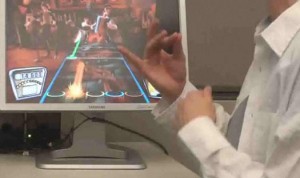 A research collaboration between UW CSE’s James Landay and graduate student Scott Saponas, Microsoft Research, and the University of Toronto is developing a muscle-controlled interface enabling gesture-driven interaction with computers. “It’s perhaps the most promising of the billion or so Minority-Report-aspiring prototype interfaces,” says Popular Science.
“The new muscle-sensing project is ‘going after healthy consumers who want richer input modalities,’ says Desney Tan, a researcher at Microsoft and UW CSE affiliate faculty. As a result, he and his colleagues had to come up with a system that was inexpensive and unobtrusive and that reliably sensed a range of gestures.”
Read the MIT Technology Review article here. Read the Popular Science article here. Read the paper presented at the User Interface Software and Technology 2009 here. Read more →
 December 6-12 is Computer Science Education Week. Learn more here! Read more →
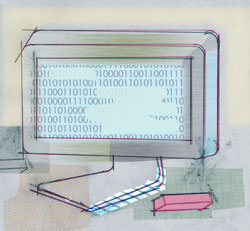 Columns, the University of Washington’s alumni magazine, writes on UW CSE’s Vanish project:
“The Vanish program encrypts a message, breaks the encryption key into many tiny pieces, and then sprinkles these pieces throughout a large peer-to-peer network that consists of more than a million computers all over the world. As individual computers leave the network and those that remain purge their memories, pieces of the key are gradually lost. Once a certain number of pieces are lost, the key can never be reassembled and the message can’t be decrypted.”
Read the full article here. Learn more about Vanish here. Read more →
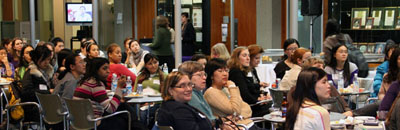 On Thursday December 3, UW CSE hosted more than 100 women in technology from the Seattle area for the Seattle Girl Geek Dinner. CSE’s Magda Balazinska and Yoky Matsuoka provided the technical content. CSE’s Susan Eggers and Justine Sherry coordinated the event.
A terrific brochure prepared for the event is here. Read more →
 “12:42 a.m. Having had one too many margaritas to drive, you open OneBusAway, created by UW students Brian Ferris and Kari Watkins, to find the closest bus route, nearby stops and exactly what time it will arrive to whisk you safely home.”
(Why else would you take the bus?)
Read the article here. Read more →
 More than 100 women are members of the UW Computer Science & Engineering student and faculty community. This brochure was prepared for a meeting of the Seattle Girl Geek Dinner group that we’re hosting tonight. Read more →
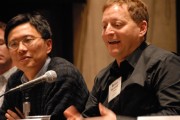
Harry Shum, Brian Bershad
TechFlash reports on the Xconomy-sponsored “Future of Search” event held at the University of Washington on November 30. UW CSE’s Ed Lazowska moderated a panel of four experts: Google Seattle site director (and UW CSE affiliate professor) Brian Bershad, UW CSE professor (and Farecast founder) Oren Etzioni, Vulcan investment manager Steve Hall, and Microsoft Bing engineering director Harry Shum.
” … the primary challenge facing any company thinking about getting into the business was summarized succinctly in a zinger from panelist Harry Shum … ‘Google is like smoking cigarettes. It’s a habit that’s going to be difficult to give up.’ [Etzioni] joked in response: ‘It is a known fact that more Google users die every year than users of all other search engine combined.'”
The TechFlash article — a terrific synopsis of the evening — is here.
An Xconomy photo gallery is here.
Two Xconomy articles here and here. Read more →

 Each year the Computing Research Association recognizes a small number of the nation’s undergraduates with the CRA Outstanding Undergraduate Research Awards.
In the 2010 competition, CSE’s Justine Sherry was selected as the national winner among females.
CSE’s Rita Sodt was selected as a finalist.
And CSE’s Eric Kimbrel received an honorable mention.
Congratulations to Justine, Rita, and Eric! They join 32 previous CSE undergraduates who have been recognized by CRA since the inception of this award in 1995. As of a year ago, UW CSE ranked #1 in the nation in the number of undergraduates recognized with CRA Outstanding Undergraduate Research Awards in the preceding decade; that record should continue. Read more →