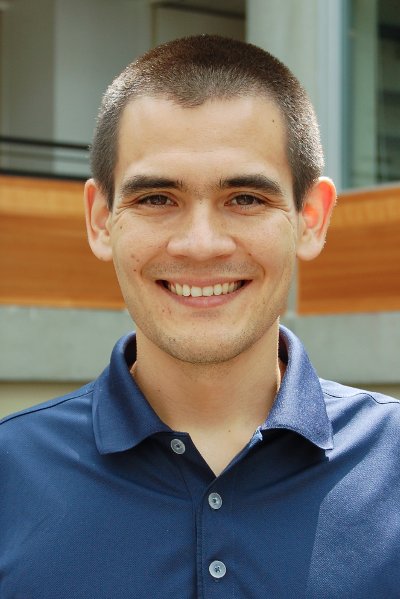
UW CSE’s Yoshi Kohno talks to Xconomy reporter Rachel Tompa about computer security and privacy.
“‘We’re seeing computers in all aspects of our lives, in medical devices, exercise equipment, cars, airplanes, utility systems, power lines, everywhere,’ Kohno said. ‘One of my main concerns is that while we’ve thought a lot about security for our desktop computers, computing is much broader than that, and we need to address security for all of it.'”
Kohno, who is kicking off the Technology’s Alliance’s Science and Technology Discovery Series with a lecture this morning, also teaches undergraduate and graduate classes on computer security and privacy at UW, and has received National Science Foundation for a computer security and privacy outreach effort for middle school and high school students in the next year.
Read the full article here. Read more →
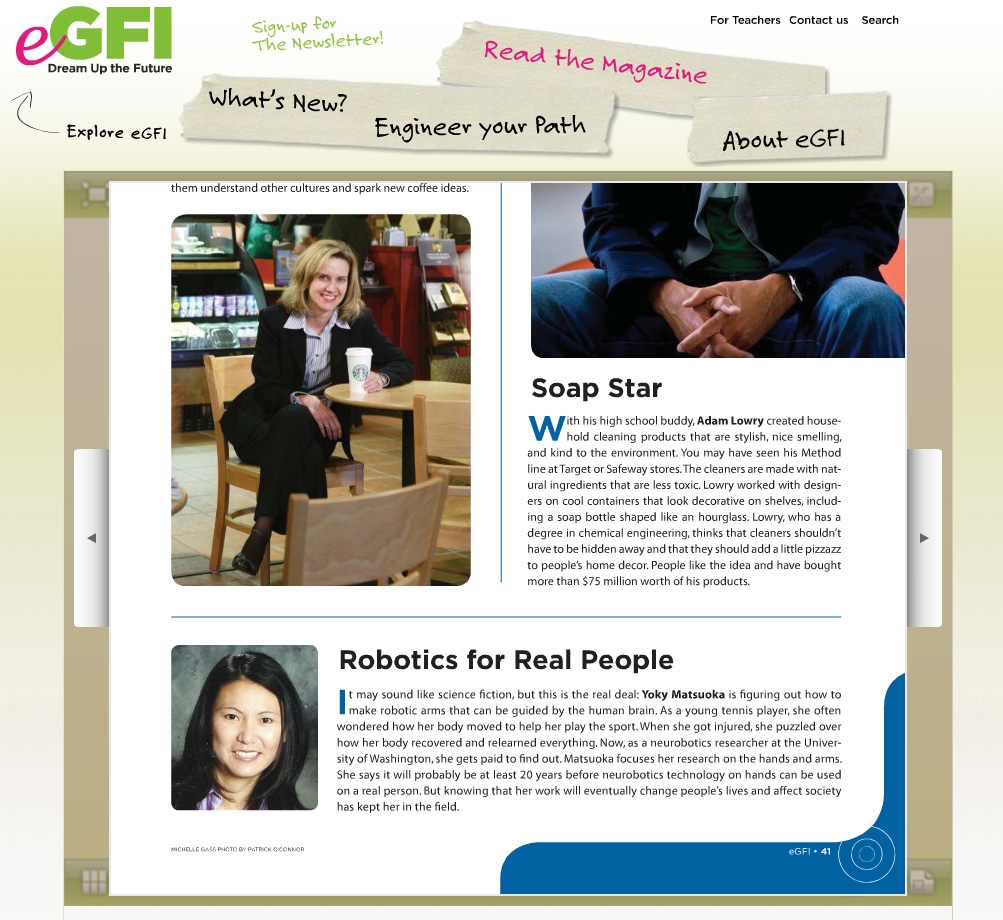 UW CSE’s Yoky Matsuoka is featured in the “Fresh Faces” section of Engineering: Go for It, a publication that opens up the world of engineering for students, their parents, teachers, and counselors. eGFI is published twice a year by the American Society for Engineering Education.
View the eGFI magazine here.
Interactive eGFI 1-12 site here. Read more →
 UW CSE’s Shwetak Patel‘s “pinpoint utility meter” is featured on the National Academy of Engineering’s weekly radio broadcast and podcast.
“Ever wonder why you can get itemized bills for credit cards and telephone calls but not electricity and water? A new technology promises that possibility.
“The engineering breakthrough would allow just one easy-to-install sensor per utility. Simply plug into an outlet to monitor your house’s entire electric system. The inventor, Shwetak Patel of the University of Washington, says everything that draws power – down to a lightbulb – has its own electrical signature.”
Listen to the full interview here. Read more →
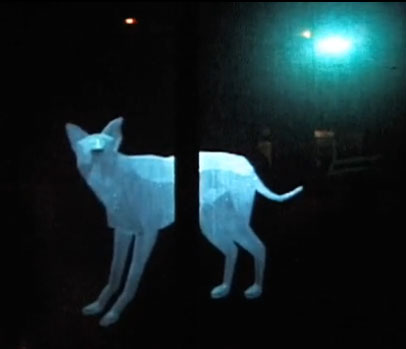 2009 UW CSE Bachelors alumnus Jim George writes to faculty members Brian Curless and Raj Rao: “Since graduating this spring I’ve been working with an artist in New York to make an interactive dog for storefront windows. The project has been accepted into a few festivals and is really well received by the public. I couldn’t have done it without the great background in computer vision and computer graphics I got from your classes this spring, it’s been incredible to see so many of the topics we covered pivotal for making this fun art project happen.”
Jim worked with artist Karolina Sobecka to bring her concept to “life.”
Check it out at http://www.gravitytrap.com/sniff/! Read more →
 Cloud services propose to save companies money by allowing them to run new applications without having to buy new hardware. Now researchers from UCSD and MIT, including UW CSE Ph.D. alumnus Stefan Savage, have launched a “side-channel” attack on data stored in the cloud.
“‘A virtual machine is not proof against all of the kinds of side-channel attacks that we’ve been hearing about for years,’ said [UW CSE Ph.D. alumnus] Stefan Savage, associate professor with UC San Diego, and one of the authors of the paper.”
The side-channel research brings a whole new set of problems, according to UW CSE’s Yoshi Kohno, who is quoted in the article. “‘It’s exactly these types of concerns – the threat of the unknown – that is going to make a lot of people hesitant to use cloud services such as EC2.'”
Full PCWorld article here. Read the research paper here. Read more →
A brochure introducing the three new members of the UW CSE faculty is now available – you can download it here.

Su-In Lee, whose research focuses on devising machine learning techniques for understanding the genetic basis for complex traits, will have appointments in CSE and the Department of Genome Sciences. She received her Ph.D. from Stanford and spent the following year as a visitor at Carnegie Mellon.

Anup Rao joins our theory group. He received his Ph.D. from UT-Austin, and is now completing 2.5 years as a postdoc, divided between the Institute for Advanced Study and Princeton University.

Luke Zettlemoyer received his Ph.D. from MIT, followed by a one-year postdoc at the University of Edinburgh. He works on a variety of topics in artificial intelligence, including problems in natural language processing, machine learning, and decision making under uncertainty.
Read more →
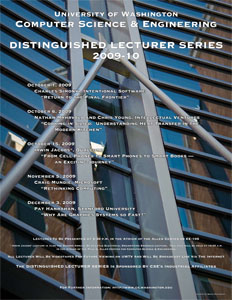 Spaceflight, molecular gastronomy, wireless, and computer science:
- Charles Simonyi (Intentional Software), “Return to the Final Frontier”
- Nathan Myhrvold and Chris Young (Intellectual Ventures), “Cooking in Silico: Understanding Heat Transfer in the Modern Kitchen”
- Irwin Jacobs (Qualcomm), “From Cell Phones to Smart Phones to Smart Books – An Exciting Journey” (also the 2009-10 UW Electrical Engineering Dean Lytle Memorial Lecture)
- Craig Mundie (Microsoft), “Rethinking Computing”
- Pat Hanrahan (Stanford), “Why are Graphics Systems So Fast?”
Be there!
See the schedule here. See the poster here. TechFlash post here. Xconomy post here. Read more →
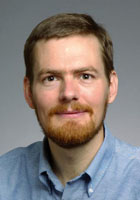 UW CSE professor Michael Ernst has received the inaugural John Backus Award from IBM Research for his research contributions to enhancing programmer productivity. Ernst is best known for his work on dynamic invariant detection, testing, type systems, and security.
Created by IBM to honor mid-career university faculty members, the award is named for IBMer John W. Backus, the creator of the Fortran programming language.
Ernst received his Ph.D. from UW CSE in 2000, working with David Notkin. He was co-advised by Bill Griswold, a previous Notkin Ph.D. student on the faculty at UCSD, with assists from UW CSE professors Craig Chambers, Pedro Domingos, and Dan Weld. He spent eight years as a professor at MIT before returning to Seattle and the UW CSE faculty.
Read the Dr. Dobb’s post here.
Congratulations Mike! Read more →
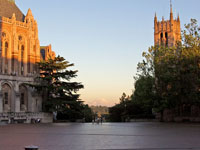 There’s a new UW 30-second promo video that’s a huge improvement over its predecessors. Take a look here (Silverlight) or here (Flash)! Read more →
 Business Week discusses data visualization, including UW CSE’s Zoetrope, created by graduate students Eytan Adar (now on the faculty at the University of Michigan) and Mira Dontcheva (now a researcher at Adobe) and faculty members James Fogarty and Dan Weld.
“Today algorithmically inspired artists are re-imagining the art-science continuum through work that frames the left-brain analysis of data in a right-brain creative story. Some use data visualization as a bridge between alienating information and its emotional impact … Others take a more technological angle and focus on cultural utility — the Zoetrope project offers a temporal and historical visualization of the ephemeral Web.” Read more →