“Robotics: International Science and Systems Conference comes to UW”

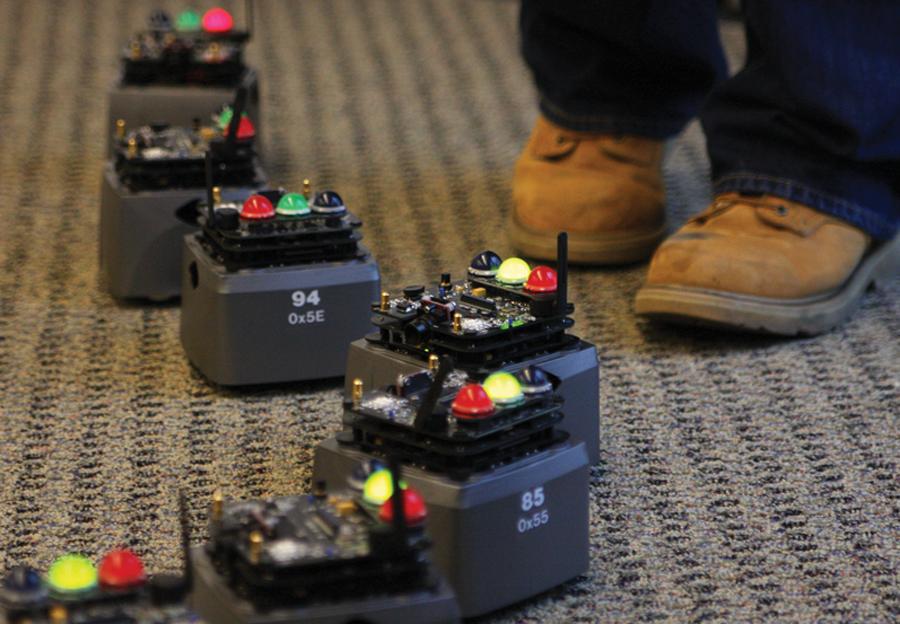
Robotics Conference In each of the past four years, experts from all over the world have flocked together to share ideas on a broad range of concepts within the field of robotics. This year, UW hosted the Robotics: Science and Systems (RSS) conference, which last year was held at ETH Zurich and next year will be held in Spain.

UW CSE’s Yoky Matsuoka served as the conference program committee chair, and UW CSE’s Dieter Fox and Rajesh Rao served as the local arrangements co-chairs.

According to Stanford faculty member and RSS founder Sebastian Thrun, “The UW has a very strong presence in robotics and has a unique robotics faculty; we have been very eager to host the conference here; it was a perfect fit for us.”

Read the full article in The Daily here. Read more →

UW CSE’s Hydrosense in Technology Review

hydrosense_x220“When a cell phone or credit-card bill arrives, each call or purchase is itemized, making it possible to track trends in calling or spending, which is especially helpful if you use a phone plan with limited minutes or are trying to stick to a budget. Within the next few years, household utilities could be itemized as well, allowing residents to track their usage and see which devices utilize the most electricity, water, or gas. New sensor technology that consists of a single device for each utility, which builds a picture of household activity by tracing electrical wiring, plumbing, and gas lines back to specific devices or fixtures, could make this far simpler to implement.

Shwetak Patel, a professor of computer science and electrical engineering at the University of Washington, in Seattle, developed the sensors, which plug directly into existing infrastructure in buildings, thereby eliminating the need for an elaborate set of networked sensors throughout a structure. For example, an electrical sensor plugs into a single outlet and monitors characteristic ‘noise’ in electrical lines that are linked to specific devices, such as cell-phone chargers, refrigerators, DVD players, and light switches. And a gas sensor attaches to a gas line and monitors pressure changes that can be correlated to turning on a stove or furnace, for instance.

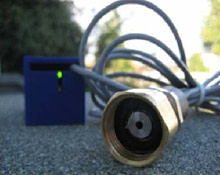
“Now, Patel and his colleagues have developed a pressure sensor that fits around a water pipe. The technology, called Hydrosense, can detect leaks and trace them back to their source, and can recognize characteristic pressure changes that indicate that a specific fixture or appliance is in use.

“Patel hopes to incorporate electrical, gas, and water sensors into a unified technology and has cofounded a startup, called Usenso, that he hopes will start offering combined smart meters to utility companies within the next year or so. The goal, says Patel, is to make a ‘smart home’ universally deployable.”

Read the full article here. Read more →

UW CSE’s Raj Rao on brain-machine interfaces

UW CSE professor Raj Rao is quoted extensively in this article in TechNewsWorld concerning Toyota’s thought-guided wheelchair.

“‘The promise still remains, and there’s been considerable progress made in the last 10 years in the field,’ Rao said. ‘Now we’re getting better and better at decoding these signals … on the recording side, with better hardware to decrease the amount of noise in the [brain] signal. And we’re getting better at understanding the signals once we receive them, and the computer algorithms used. There’s progress on all these fronts.'”

Read the full article here. Read more →
Balazinska receives HP Labs Innovation Research Award

magdaUW CSE’s Magda Balazinska has been selected as one of 59 professors to receive a 2009 HP Labs Innovative Research Award.  Her research, entitled “Data Intensive Scalable Computing (DISC) as a Cloud Service,” will investigate some of the challenges behind offering MapReduce and similar data intensive scalable computing (DISC) systems as a cloud service. These challenges include (1) running DISC systems in highly dynamic environments with virtualized resources and competing workloads and also (2) performing data intensive computations that span multiple data centers.

HP reviewed nearly 300 proposals from more than 140 universities in 29 countries on a range of topics within the eight high-impact research themes at HP Labs.  More details about the HP Labs Innovation Research Program and worldwide award recipients are available here.  Press release located here. Read more →

Forbes ranks UW #1 for alumni remaining in-state

forbes_home_logoMost states suffer a significant “brain drain” of graduates from their flagship universities.  Not so for the University of Washington!  Forbes Magazine ranks UW #1 in the nation for the proportion of its graduates that are still working in-state 5 years after graduation.

The state doing the best job of holding onto its top public university graduates is Washington. No fewer than 74% of University of Washington grads remain in the Evergreen State, well ahead of second-ranked Minnesota, which retains 67% from the University of Minnesota.”

UW CSE contributes strongly to this, even at the graduate level.  At the June 2009 commencement, UW CSE awarded 82 Masters degrees and 24 Ph.D. degrees.  Of these 106 graduate degree recipients, 60 (57%) came from Washington State, and 89 (84%) remained in Washington State after receiving their degrees.

Read the Forbes article here.  See the data on various flagship public universities here. Read more →

“UW helped seed IBM’s new cloud offerings”

cloudburstbox530x155The Seattle Times interviews Dennis Quan, IBM’s director of autonomic computing development in Raleigh, N.C., regarding IBM’s new “CloudBurst” offering:

“Blueprints for IBM’s cloud offerings came from a joint research project with Google.  It initially explored business intelligence at big schools and large-scale analytics, which led to the creation of a cloud-computing cluster at the UW and two run by IBM in 2007.  ‘The work that was done as part of that project really informed how we can put together large cloud datacenters that can efficiently process terabytes, petabytes, of information across thousands of machines,’ he said.  The early clusters also ‘kind of provide the blueprints for the designs we base these new clouds on,’ he said.”

UW’s cloud computing course was profiled in Business Week in December 2007.  The web materials from the most recent version of the course, CSE490H, are here.  The startup company Cloudera involves a number of the principals of the original UW course.

Read the Seattle Times article here. Read more →

Xconomy: Dan Weld on the Future of Search

Dan Weld Rachel Tompa talks with UW CSE professor and search specialist Dan Weld about the future of search in an interview in Xconomy.

Weld explains the significance of the new Microsoft Bing search service in terms of its success in delivering integrated “vertical” search. “All the engines are trying to do it, but the way Microsoft has done it with Bing is somewhat better than what Google has done.”

What does the future of search look like? Weld says “I think what we’ll see more of in the future is the ability to ask a question and have the search engine actually answer your question… Soon I hope I can tell you about some of the research we’re doing which I think will eventually revolutionize search.”

Read the full interview at Xconomy here. Read more →

5 Cool Cloud Computing Projects

hotcloud09_bannerNetwork World previews this week’s HotCloud conference in San Diego, which boasts a slew of fresh research into this hottest of computer science research topics.  UW CSE’s Hank Levy, Steve Gribble, and Roxana Geambasu will present CloudViews, a public version of the cloud that shares resources without sharing data.

Read the full article in here. Read more →

Pavan Vaswani wins UW President’s Medal!

20090604_pid50125_aid49938_vaswani_w2501CSE’s graduating senior Pavan Vaswani has won the University of Washington President’s Medal, awarded annually to the top student in UW’s 7,500+ person graduating class.

Pavan is majoring in CSE, neurobiology and biochemistry. His decision to come to the UW was heavily influenced by the assurance that he could become involved in research the day that he arrived on campus. Indeed, his experience working with faculty in a research setting caused him to broaden his degree ambitions, which had begun with computer science.

Pavan is a Goldwater Scholar, a Mary Gates Scholar and a Washington Scholar. He also has received the Research Fellowship for Advanced Undergraduates and is a Space Grant Scholar. He is currently working in a laboratory in the Department of Neurological Surgery, where he is developing a device to measure brain pressure non-invasively using ultrasound.

Pavan plans to attend The Johns Hopkins University in an M.D.-Ph.D. program. He is ultimately planning a career in medical research.

Previously, Pavan was the UW Sophomore Medalist and the UW Junior Medalist (awarded to the top student in each of those classes).  Recently he was awarded the UW Arts & Sciences Dean’s Medal for the Sciences, given to the top graduating student in the sciences.  Read more about Pavan and his accomplishments here. Read more →

Etzioni’s Farecast moves forward “with a Bing, not a wimper”

01moneyTechFlash discusses Microsoft’s newly launched Bing Travel — which combines UW CSE’s Farecast’s airfare-prediction and travel-search tools with MSN editorial content — as “a key chess piece in Microsoft’s new effort to challenge Google in Internet search.”

“It’s also a high-profile example of Microsoft benefiting from technology developed in its backyard. Oren Etzioni, the University of Washington computer scientist who founded Farecast in 2003, is watching with pride.”

Read the TechFlash post here. Read more →

« Newer PostsOlder Posts »