 We need a new language for artificial intelligence, writes UW CSE’s Pedro Domingos. He proposes a new mathematical language that combines logic and probability.
“The goal of artificial intelligence (at least according to the field’s founders) is to create computers whose intelligence equals or surpasses humans’. Achieving this goal is the famous ‘AI problem.’ To some, AI is the manifest destiny of computer science. To others, it’s a failure: clearly, the AI problem is nowhere near being solved. Why? For the most part, the answer is simple: no one is really trying to solve it.”
Read the full article in Technology Review here. Read more →
UW CSE graduate student Tamara Denning has been named one of ten winners of the inaugural Microsoft Research Graduate Women’s Scholarship. Congratulations Tamara! Read more →
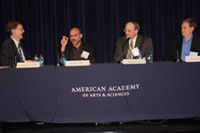 CNET News reporter Charles Cooper reports in his Coop’s Corner blog on a panel that looked at the impact of information technology on democracy. UW CSE professor Ed Lazowska organized the panel, which included Princeton University professor and 1993 UW CSE PhD Ed Felten and two others. The panel was held as part of a meeting of the American Academy of Arts & Sciences exploring the information technology and the public good.
Ed Felten offered some hopeful comments:
There will be many fewer newspapers…partly due to fact that people can read newspapers from far away. We’ll see smaller outlets which focus on the local and operate in a low-budget way, more like a community paper than a big city newspaper. And we’ll see a lot of non-profit or low-profit punditry.
Read more →

Change is a group of faculty, students, and staff at the University of Washington who are exploring the role of information and communication technologies (ICT) in improving the lives of under-served populations, especially in the developing world. Change was started to better frame ICT for Development research in CSE, but is now being extended to bring together everyone at UW who cares about technology in developing regions.
The group hosted a poster session on February 26th in the Atrium. This event brought together ICTD researchers from the CIS, iSchool, HCDE and CSE to share their work and highlighted research on 16 current projects. This kick-off event also launched the group’s new website at http://change.washington.edu/ and its weekly seminar series. Join the mailing list at https://mailman.cs.washington.edu/mailman/listinfo/change to find out more!
[Update 4 March: Flickr photostream of the event is here. Follow uwchange on twitter here. -SMR] Read more →
 Metro bus service could be cut by as much as 20 percent. With this prospect looming, Seattle NPR affiliate KUOW‘s program The Conversation recently spoke with CSE grad student Brian Ferris about his bus-tracking tool, OneBusAway. The segment appears around minute 40.
Earlier coverage on OneBusAway may be viewed here. Read more →
 Current popular peer-to-peer networks suffer from a lack of privacy. OneSwarm is a new file-sharing application that improves privacy in peer-to-peer networks. It was developed by UW computer scientists Tom Anderson and Arvind Krishnamurthy and PhD students Michael Piatek and Tomas Isdal.
Read the Slashdot post here.
Read earlier coverage of BitTorrent here. Read more →
 The January/February 2009 issue of IEEE Micro is a Special Issue containing the sixth annual “Top Picks from Computer Architecture Conferences.” Quoting from the Guest Editors’ Introduction, “This issue has become an important tradition in the computer architecture community, and one of the most important forms of recognition of research excellence.”
Two of the 12 papers selected for this prestigious recognition were authored by UW CSE’s Luis Ceze: “Atom-Aid: Detecting and Surviving Atomicity Violations” and “SoftSig: Software-Exposed Hardware Signatures for Code Analysis and Optimization.” UW CSE second-year graduate students Brandon Lucia and Joseph Devietti and UW CSE affiliate professor Karin Strauss were among Ceze’s co-authors. Read more →
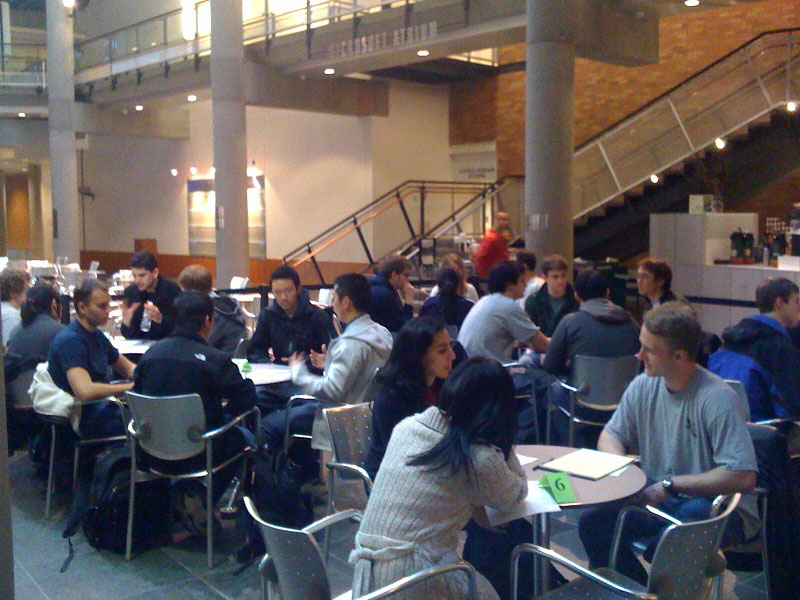
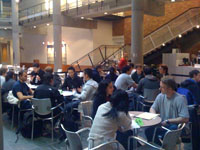 On the evening of Wednesday February 25, more than 50 UW CSE undergraduates participated in a Technical Interview Coaching event held in the atrium of the Paul G. Allen Center for Computer Science & Engineering. Students spent 20 minutes with each of 3 company representatives in “mock interview” sessions, learning what companies look for in interviews. Our thanks to engineers from Amazon.com, Eggsprout, Google, and Microsoft for participating in this event! Read more →
 “What is the most exciting company in Seattle?” Gregory Huang of Xconomy recently asked this question of Patrick Ennis, head of technology for Bellevue, WA-based Intellectual Ventures, and was surprised at the answer: Impinj. Impinj, founded in 2000 by UW CSE’s own Chris Diorio, is well-known for its focus on radio-frequency identification (RFID) technologies. Diorio, a student of microelectronics pioneer Carver Mead at Caltech (and current CSE affiliate faculty), serves as Impinj’s chairman and chief technology officer. ‘“He’s a fantastic professor and entrepreneur,” Ennis says. “Usually, professors just want to be professors. When you find an entrepreneur professor, it is heaven.”‘
Read the full article here. Read more →
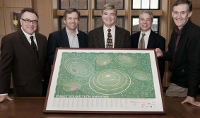 University Week reports on the fabulous Puget Sound Tech Universe map recently published by a collaboration of Seattle University, the Washington Technology Industry Association, and Virginia Tech. The map shows the geneology of over 700 local technology companies, institutions, and organizations represented as astronomical bodies. Most orbit one of six “suns,” of which the University of Washington is one. (Interactive version of the map is available online here.)
Read the full article here.
We previously covered the Puget Sound Tech Universe project here. Read more →