Magda Balazinska and Evan Welbourne are interviewed in this KIRO TV 7 report on RFID and privacy.
Article here. Read more →

Magda Balazinska and Evan Welbourne are interviewed in this KIRO TV 7 report on RFID and privacy.
Article here. Read more →
Read the article here.
“Members of the UW’s Design:Use:Build (DUB) Center for Human-Computer Interaction and Design swept the top conference in their field, which explores the interface between human and machine. UW researchers nabbed three out of seven Best Paper Awards selected from more than 700 submissions to this April’s CHI 2008 meeting. Not only that – they had 16 papers accepted, more than any other university.” Read more →
Read the article here.
 This award honors the late A. Nico Habermann, who headed NSF’s Computer and Information Science and Engineering Directorate and who was deeply committed to increasing the participation of women and underrepresented minorities in computing research. Ladner, Boeing Professor of Computer Science & Engineering at UW, is recognized for his lifelong, strong and persistent advocacy on behalf of people with disabilities in the computing community. Read more →
Read the article here.
 Samuel Karlin, a Stanford professor emeritus of mathematics and father of UW CSE professor Anna Karlin, died December 18 at Stanford Hospital. He was 83.
According to UW CSE professor Martin Tompa: “Karlin was one of the pioneers who applied mathematics and statistical models to problems in biological sequence analysis. He worked in this field for the last 20 years or so. He wrote many important papers, but probably the most influential was a series of papers with Stephen Altschul in the early 1990s laying out the statistical foundation for BLAST, the most important piece of software in computational biology. Their work is known as the Karlin-Altschul Theory and is taught in many computational biology courses.”
Karlin was a member of the American Academy of Arts and Sciences and the National Academy of Sciences, and was awarded the National Medal of Science in 1989. He was the author of 10 books and more than 450 articles.
Earlier article from Stanford News Service here. Read more →
Read the article here.
“With New Year’s Eve a week away, our thoughts turn to bubbles and the year that was … We asked a panel of technology party guests to review a list of 25 events, trends and products that made the scene in 2007 and rate them on a scale of ‘forget about it’ (1) to ‘game-changer’ (5) …”
UW CSE’s Ed Lazowska is quoted throughout. Read more →
Read the article here.
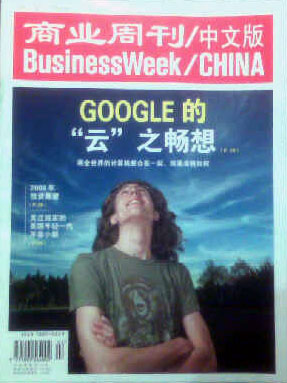
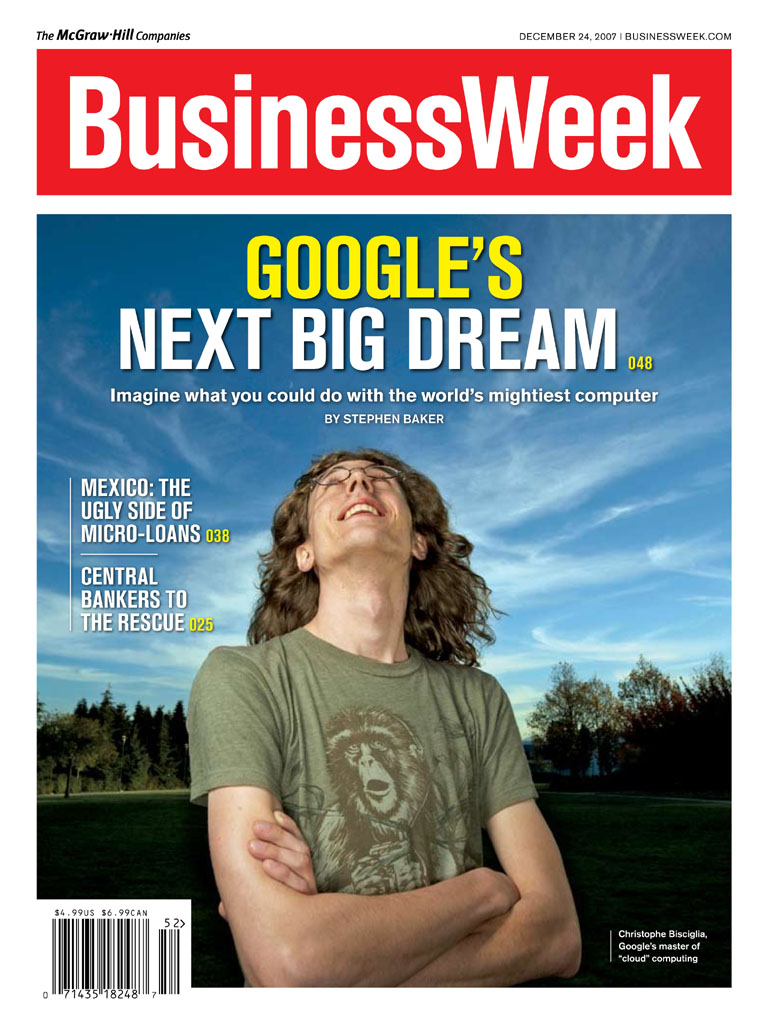 UW CSE alumnus Christophe Bisciglia is profiled in a Business Week cover story.
“What recruits needed, Bisciglia eventually decided, was advanced training. So one autumn day a year ago, when he ran into Google CEO Eric E. Schmidt between meetings, he floated an idea. He would use his 20% time, the allotment Googlers have for independent projects, to launch a course. It would introduce students at his alma mater, the University of Washington, to programming at the scale of a cloud. Call it Google 101. Schmidt liked the plan. Over the following months, Bisciglia’s Google 101 would evolve and grow. It would eventually lead to an ambitious partnership with IBM, announced in October, to plug universities around the world into Google-like computing clouds …
“How was Bisciglia going to give students access to this machine? The easiest option would have been to plug his class directly into the Google computer. But the company wasn’t about to let students loose in a machine loaded with proprietary software, brimming with personal data, and running a $10.6 billion business. So Bisciglia shopped for an affordable cluster of 40 computers. He placed the order, then set about figuring out how to pay for the servers. While the vendor was wiring the computers together, Bisciglia alerted a couple of Google managers that a bill was coming. Then he ‘kind of sent the expense report up the chain, and no one said no.’ … (“If you’re interested in someone who strictly follows the rules, Christophe’s not your guy,’ says Lazowska.”
Don’t miss the BusinessWeek / CHINA cover! Read more →
Read the article here.
UW CSE Ph.D. alumnus Stefan Saroiu, a faculty member in computer science at the University of Toronto, is one of three young faculty members featured on the University of Toronto home page.
“We all know now that the 20th century’s most influential innovation – electronic communications by way of your computer – has given rise to a whole new breed of criminals. They are the computer hackers who find nefarious ways to use information technology to rob you. Thankfully,computer scientists like Stefan Saroiu are preparing to do battle with these IT pickpockets.”
Click the home page image to read the article, or go directly here. Read more →
Read the article here.
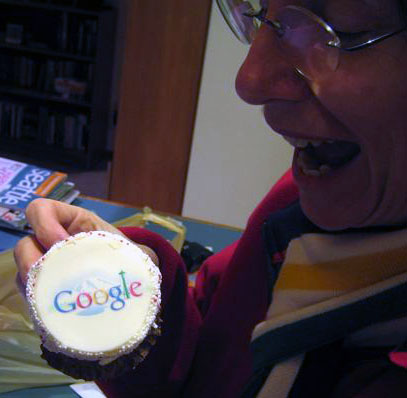 January 15th marked the official opening of Google Seattle. The office, located in Seattle’s Fremont neighborhood (“The Center of the Universe”) adjacent to the University of Washington, is led by UW CSE’s Brian Bershad.
“Alan Eustace, senior vice president of engineering and research, provided some of the reasons why Google wanted to expand in Seattle, which now represents the third largest U.S. office for Google behind Mountain View and New York.
“‘Seattle is an excellent example of the kind of place that makes sense for us to build. It has fantastic technologists. It has a world class research university here. It has got incredibly talented engineers. It has a great entrepreneurial culture and spirit. It’s got a thriving venture community. It’s got a history of great innovations. It has a very supportive government and organization here that actually cares about bringing business in and making businesses successful. And for all of those reasons we are extremely happy to be here.’
“Later, he even mentioned Seattle’s cost of living and its ‘family-friendly’ environment.
“‘This is a very attractive place to live and for people to bring families. … We try to give (people) the option of where they want to live and many of them actually choose the Seattle area. It is smaller. It is a friendly area. It is very family-friendly. The cost of living here is less than it is in Mountain View, and other things.'”
“Inside look at Google Seattle: Puppies, lava lamps, etc.” (Seattle PI)
“Google open house to draw crowds” (Seattle PI)
“The dogs of Google Seattle” (Seattle PI)
“Perks make Google office hardly feel like work” (Seattle PI)
“Google touts Fremont Engineering office, links to UW” (Seattle Times)
“Google rave in Fremont draws a crowd of techies” (Seattle Times)
“Google shows off new Seattle digs” (InfoWorld) Read more →
Read the article here.
“It’s no surprise that former Gig Harbor resident [and UW CSE alumnus] Christophe Bisciglia is leading one of the newest and biggest projects at Internet giant Google … he’s always been the enterprising sort.” Read more →
Read the article here.
“Virtualization software company SWsoft announced on Wednesday that a former Microsoft architect and pioneer software developer Mark Zbikowski has joined the company as a senior technical advisor … With the addition of this legend and 25 year Microsoft veteran to the team, SWsoft is truly providing themselves with a huge feather in their cap. Zbikowski previously led Microsoft’s efforts in MS-DOS, OS/2, Cairo and Windows NT. Zbikowski designed the DOS executable file format, and he was one of the main architects and developers of the Windows file system, NTFS. Since his retirement from Microsoft in 2006, Zbikowski has been a lecturer [in Computer Science & Engineering] at the University of Washington.” Read more →