“The University of Washington is one of three schools across the country sharing a major grant to spread ‘big data’ analysis skills beyond computer science and apply them to other fields …
“‘Our goal is to figure out how to rapidly evolve universities to support and utilize data-intensive discovery,’ Ed Lazowska, eScience Institute founder and Computer Science & Engineering professor, said via email. ‘We have been doing this on a small scale, but now we’ll be able to work the problem at a large scale, and as a collaboration among three teams that include some of the strongest faculty at some of the nation’s strongest universities’ …
“‘We see enormous potential in the cross-pollination that happens by having participants co-locate in the data science studio,’ Bill Howe, a UW affiliate assistant professor of Computer Science & Engineering, said in the UW release. ‘These projects will help expose common problems and enable collaboration as we continue to scale up our investment in data science expertise’ …
“The UW also received an additional $2.8 million ‘integrative graduate education and research traineeship’ grant from the National Science Foundation that will fund graduate students learning to analyze massive data collections in their research fields.”
“‘All across our campus, the process of discovery will increasingly rely on researchers’ ability to extract knowledge from vast amounts of data,’ said UW project lead Ed Lazowska, a professor of computer science and engineering and director of the eScience Institute. ‘To remain at the forefront, the UW must be a leader in advancing the methodologies of data science and putting them to work in the broadest imaginable range of fields.'”
Vicki Chandler, Chief Program Officer for Science at the Gordon and Betty Moore Foundation, write:
“Our hypothesis is that the greatest advances in tools and practices will result from meaningful interactions and sustained collaborations among data-intensive science researchers who build on one another’s work, leverage the best practices and tools in existence, and demonstrate solutions that can be used more broadly by others. It is also critical to establish long-term, sustainable career paths in academia for those scientists who take a multi-disciplinary approach to analyzing massive, noisy, and complex scientific data. Openly sharing practices, tools, lessons and discoveries will help to ensure that the network of experiments has impact greater than the sum of its parts.”
Includes an excellent profile of recent UW Astronomy Ph.D. Sarah Loebman as an exemplar of the sort of scientist we seek to create:
“She specializes in comparing the evolution of galaxies simulated on supercomputers with actual observations of the Milky Way from the Sloan Digital Sky Survey (SDSS) to learn about processes by which our own galaxy might have formed. For example, she is currently comparing the distribution of iron and oxygen in stars at the outer edges, or stellar halo, of simulated galaxies with the observed iron content of stars in the Milky Way …
“Loebman worked with data management experts from the UW computer science department. She became skilled in data science as she finished her Ph.D. in astronomy at the UW. It’s that multi-disciplinary expertise, she says, that helped her land a post-doctoral position at the University of Michigan.
“Loebman exemplifies the new scientist that the Moore/Sloan grant aims to help universities train in a more deliberate way. She spent the summer working with senior leaders in a range of scientific fields at the participating universities to help structure the program. They discussed common data-management approaches across disciplines, which tools can and can’t be shared among biologists and astronomers, for example.”
The headline of the article nails it: “Program Seeks to Nurture ‘Data Science Culture’ at Universities.” Continuing …
“The modern flood of data comes in a many forms — sensor data, genomic data, web click streams and credit card transactions, to name a few. The disparate data sources are often called ‘silos,’ suggesting the challenge of mingling different data sets to generate insights.
“But if the data is in a silo, so are the people, often isolated in their fields of expertise. In universities, that problem is a key obstacle to progress in data science, according to academic research scientists.
“And that problem, among others, is the focus of a new five-year project, involving three universities and supported by $37.8 million in funding from the Moore Foundation and the Sloan Foundation.”
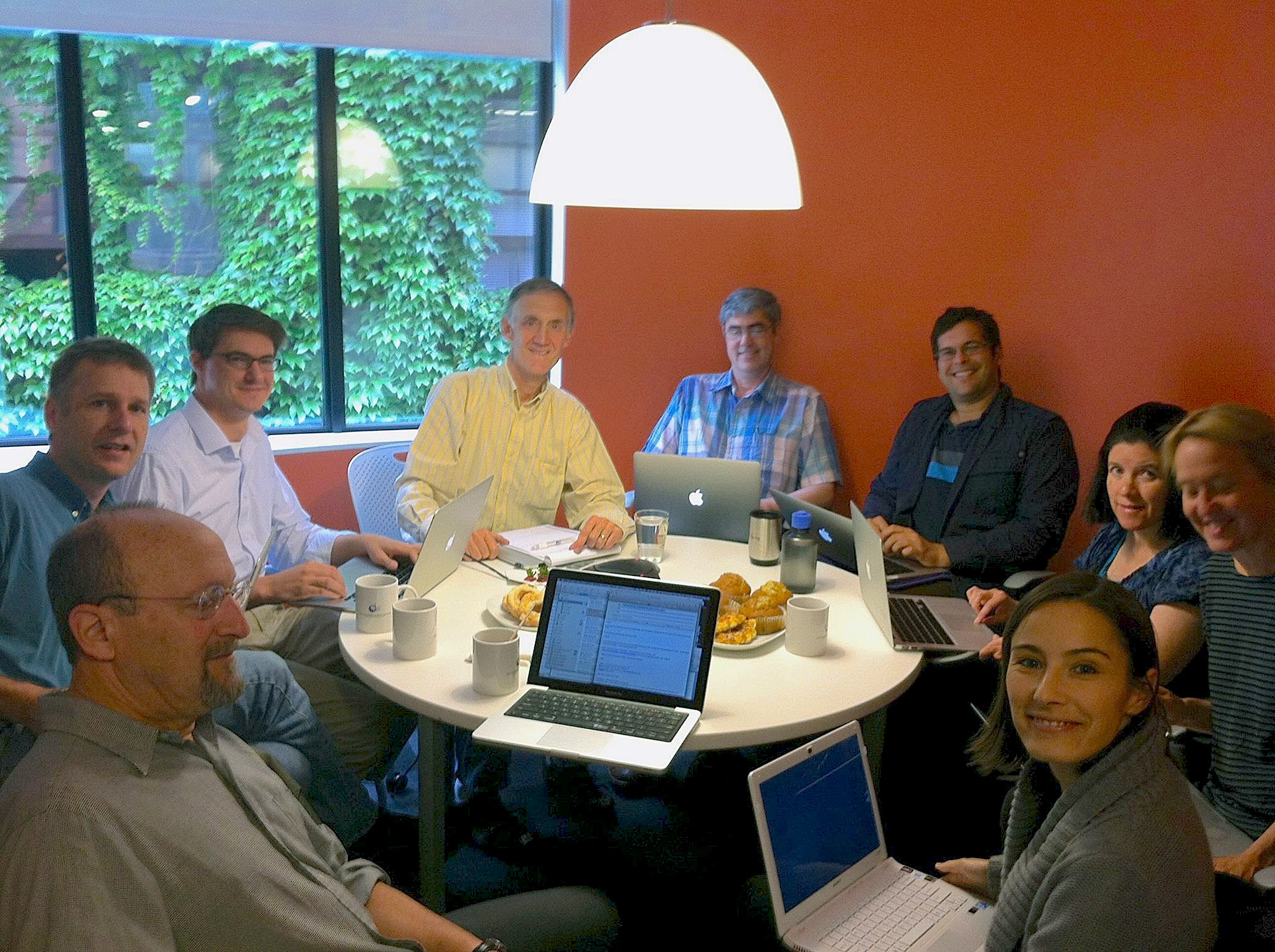
UW core team (clockwise from lower left): Tom Daniel (Biology + Computer Science & Engineering), Andy Connolly (Astronomy), Bill Howe (Computer Science & Engineering), Ed Lazowska (Computer Science & Engineering), Randy LeVeque (Applied Mathematics), Tyler McCormick (Statistics + Sociology), Cecilia Aragon (Human Centered Design & Engineering), Ginger Armbrust (Oceanography), Sarah Loebman (Astronomy). Missing: Magda Balazinska (Computer Science & Engineering), Josh Blumenstock (iSchool), Mark Ellis (Geography), Carlos Guestrin (Computer Science & Engineering), Thomas Richardson (Statistics), Werner Stuetzle (Statistics), John Vidale (Earth & Space Sciences).
The University of Washington, the University of California at Berkeley, and New York University are partners in a new five-year, $37.8 million award from the Gordon and Betty Moore Foundation and the Alfred P. Sloan Foundation whose goal is to dramatically accelerate the growth of data-intensive discovery in a broad range of fields.
UW’s team, which includes more than a dozen faculty from across the campus, is led by Ed Lazowska, Bill & Melinda Gates Chair in Computer Science & Engineering and Director of the UW eScience Institute. Berkeley’s team is led by Nobel laureate astrophysicist Saul Perlmutter, and NYU’s by neuroscientist and computer scientist Yann LeCun.
“All across our campus, the process of discovery will increasingly rely on researchers’ ability to extract knowledge from vast amounts of data,” Lazowska said. “In order to remain at the forefront, UW must be a leader in advancing the methodologies of data science, and in putting these methodologies to work in the broadest imaginable range of fields. This partnership with Berkeley and NYU – which builds on investments by UW in the eScience Institute and in the Center for Statistics and the Social Sciences – puts us in a leadership position.”
Under the partnership, cross-university teams will organize their efforts around six primary areas: strengthening an ecosystem of tools and software environments; establishing academic careers for data scientists; championing education and training in data science at all levels; promoting and facilitating reproducibility and open science; creating physical and intellectual hubs for data science activities; and measuring programs through directed ethnography and evaluation.
At UW, the grant will fund salaries for new research positions, including five data scientists who specialize in software and will work with researchers across campus, four postdoctoral data science fellows pursuing interdisciplinary research agendas, and four partially funded research scientists stationed in other departments and centers. A dedicated “data science studio” on campus will have meeting areas and drop-in workspaces to encourage collaboration across the UW’s colleges and schools.
This Washington Research Foundation video describes the transformational impact
of data science at UW.
To take advantage of these new resources, faculty members can submit short-term project proposals that require data science expertise: “analyzing a large dataset, accessing cloud resources, parallelizing an algorithm, or scaling up a statistical method,” said Bill Howe, co-lead of the new effort and a UW affiliate assistant professor of Computer Science & Engineering. Participants in the program would send a graduate student or research staff member to physically relocate for a period to work directly with the data scientists. The idea behind this embedded approach is to learn techniques, collaborate, then bring that knowledge back to individual labs and departments. “We see enormous potential in the cross-pollination that happens by having participants co-locate in the data-science studio,” Howe said. “These projects will help expose common problems and enable collaboration as we continue to scale up our investment in data science expertise.”
The UW also has received a $2.8 million Integrative Graduate Education and Research Traineeship (IGERT) grant from the National Science Foundation titled “Big Data U.” Together, the two grants will fund several dozen graduate students from a variety of departments to learn how to tackle big data in their research fields. The need to analyze vast amounts of data now touches nearly every department and discipline, and both grants will boost the university’s ability to prepare students.
The UW has been a leader in connecting big data experts with researchers in a variety of departments. This grant directly builds upon the UW’s eScience Institute, created in 2008 to focus on data-intensive discovery across campus, and the Center for Statistics and the Social Sciences, now more than a decade old.
Presentation by Ed Lazowska (UW), Saul Perlmutter (Berkeley), Yann LeCun (NYU), Josh Greenberg (Sloan), and Chris Mentzel (Moore) at the White House “Big Data Partnerships” event on November 12.
Faculty members see this new initiative as advancing the capacity for data-intensive scientific research and boost Seattle’s leadership in data science, while attracting more top data science talent back to universities at a time when big data is more pervasive than ever before. “These data scientists are coveted in industry as well as academia. One of the missions we have in this effort is to provide competitive career paths that allow these experts the freedom to remain in academia and apply their skills to the most important problems in science,” Howe said.
In addition to Lazowska and Howe, co-PIs on UW’s Moore/Sloan award include Cecilia Aragon (Human-Centered Design & Engineering), Ginger Armbrust (Oceanography), Magda Balazinska (Computer Science & Engineering), Josh Blumenstock (iSchool), Andy Connolly (Astronomy), Tom Daniel (Biology + Computer Science & Engineering), Mark Ellis (Geography), Carlos Guestrin (Computer Science & Engineering), Randy LeVeque (Applied Mathematics), Tyler McCormick (Statistics + Sociology), Thomas Richardson (Statistics), Werner Stuetzle (Statistics), and John Vidale (Earth & Space Sciences). Many additional faculty have contributed significantly.
Guestrin is the PI on the IGERT; co-PIs include Armbrust, Balazinska, David Beck (Chemical Engineering), Connolly, Emily Fox (Statistics), Dan Grossman (Computer Science & Engineering), Jeff Heer (Computer Science & Engineering), Howe, Željko Ivezić (Astronomy), Lazowska, Marina Meila (Statistics), Bill Noble (Genome Sciences), Ben Taskar (Computer Science & Engineering), and LuAnne Thompson (Oceanography).
Watch the UW presentation at the White House “Big Data” event on Tuesday at 11 a.m. PT, 2 p.m. ET, at http://live.science360.gov/.
Ed Lazowska (UW CSE) will join Saul Perlmutter (Berkeley Nobel laureate astrophysicist), Yann LeCun (NYU), Josh Greenberg (Alfred P. Sloan Foundation) and Chris Mentzel (Gordon and Betty Moore Foundation).
The Washington Research Foundation interviewed leading faculty in Astronomy, Biology, Oceanography, and Computer Science & Engineering to explore the impact of data science on discovery. Check out the video! (Many thanks to our friends at WRF!)
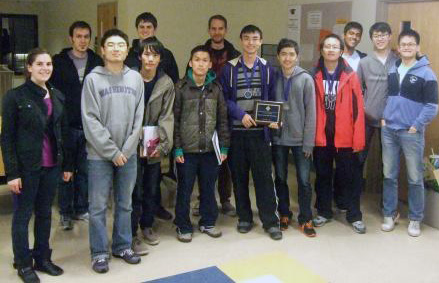
Five teams from UW CSE participated in the Pacific Northwest Regionals of the ACM International Collegiate Programming Contest, held last Saturday November 2nd. UW competes in a region that stretches from California up to Canada and over to Hawaii. The contest is held at several different sites simultaneously. Allison Obourn traveled with our five teams to the University of Puget Sound in Tacoma to compete.
We placed 1st, 2nd, 3rd, 4th, and 5th among the 15 teams competing at the UPS site. In the overall region – which included 117 teams – we placed three teams in the top ten (more than any other school), but were beaten by the usual powerhouses like Stanford, Berkeley, and UBC. Our five teams were:
Lightning (1st at site, 7th at region): Sun Zehao, Hu Jingcheng, Cui Wenbo
UW Sonic (1st at site, 8th at region): Stephen Jonany, Siwakorn Srisakaokul, Tom Guo
Amgems (3rd at site, 10th at region): Zachary Iqbal, Jeremy Teo, Sherman Pay’
aHBvb3CwBLMBieGyBM2A (4th at site, 22nd at region): David Mah, John Mackinnon, Omar Sandoval
Bit Vector Zero (5th at site, 25th at region): Evan Whitfield, Nicholas Shahan, David Swanson
To earn a spot in the top 10 is a great accomplishment, especially since many of the other schools train for the contest year-round (and we don’t). It is also noteworthy that UW’s top-placing team is composed of three freshmen who are taking the accelerated CSE143X class.
The complete set of results from the Regionals are available here.
UW’s five competing teams were picked at an in-school competition that was held on Saturday October 5. A total of 34 teams competed locally. Many thanks go to our official sponsor Google. Google bought pizza for over 100 people for the in-school contest and provided prizes for the top three teams and swag for everyone, including Nexus 7 tablets for the members of the number one team. Our thanks go to Marion Daly, our campus Google representative. Thanks also go to Allison Obourn who helped run the contest along with our student helper Cody Gibb. Below are the names of the teams that solved three or more problems in the in-school competition:
Place
Team name
Members
Problems solved
Total time
1
UW Sonic
Stephen Jonany, Siwakorn Srisakaokul, Tom Guo
10
1216
2
aHBvb3CwBLMBieGyBM2A
David Mah, John Mackinnon, Omar Sandoval
8
1285
3
Lightning
Sun Zehao, Hu Jingcheng, Cui Wenbo
8
1298
4
Bit Vector Zero
Evan Whitfield, Nicholas Shahan, David Swanson
6
924
5
Amgems
Zachary Iqbal, Jeremy Teo, Sherman Pay
6
1058
6
Wombat Combat
Ben Eggers, Noah Lindner
6
1192
7
U1dVRwo=
Sunjay Cauligi, Vimala Jampala, Lars Zornes
6
1307
8
elgoog
Yuxuan Zhang, Shuo Wang, Zhiting Zhu
5
969
9
PINE Is Nearly Elm
Ryan Drapeau, Simone Schaffer, Tanner Coval
5
996
10
SigmaPhiNull
Benjamin Blumberg, David Foulds
5
1012
11
Muffin Racoons
Brandon Edgren, Erik Chou, Eli Elefson
5
1024
12
☃
Brett Boston, Max Sherman, Jack Fancher
5
1068
13
Undefined
Mallika Mathur, Danny Vance, Grant Timmerman
4
656
14
HMB and David
Brian Griffith, Karthik Palaniappan, David Tran
4
817
15
Midgard
Michael Wiktorek, Colby Schimelfenig, Simon Baumgardt-Wellander
3
298
16
Soy Sauce
Kuangjie Sima, Shiying Xu, Zhongyue Zhang
3
366
17
Memory Leek
Nadav Ashkenazi, Roee Avnon, Hunter Zahn
3
383
18
The Freshmen
Stan Hu, Jiaying Jiang
3
389
19
Outlaw Mafia Clique
Daniel Gorrie, Aaron Nech, Andy Butler
3
423
20
justforfun
Christopher Tjong, Errol Limenta, Danny Christanto
3
513
21
420codeit
Sujit Packiaraj, Noah Siegel, John Stephenson
3
538
22
Elephant Ears
Jasmine Singh, Dalton Black, Mason Remy
3
606
23
The Blue Screens
Vinod Rathnam, Amit Burstein, William McNamara
3
661
Congratulations to all the participants! Read more →
Business Insider cites UW CSE’s Oren Etzioni among “14 Of The Most Successful People In Tech You’ve Probably Never Heard Of”:
“In September, Decide.com announced that it was being acquired by eBay. The site predicted when prices on electronics would drop.
“It was the sixth-in-a-row successful exit for co founder and CTO Oren Etzioni. His first was four years before Google was born, one of the web’s first search engines, MetaCrawler, bought by Infospace in 1999.
“He’s probably best known for FareCast. It sold to Microsoft in 2008 for $110 million and is now a part of Bing.”

 “The University of Washington is one of three schools across the country sharing a major grant to spread ‘big data’ analysis skills beyond computer science and apply them to other fields …

 Under the partnership, cross-university teams will organize their efforts around six primary areas: strengthening an ecosystem of tools and software environments; establishing academic careers for data scientists; championing education and training in data science at all levels; promoting and facilitating reproducibility and open science; creating physical and intellectual hubs for data science activities; and measuring programs through directed ethnography and evaluation.