UW CSE, Microsoft Research bring together the brightest minds in PLSE research in the Pacific Northwest

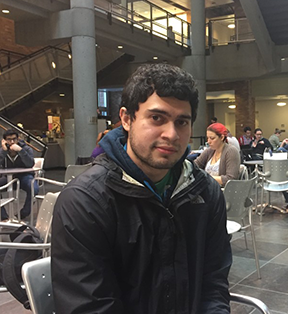
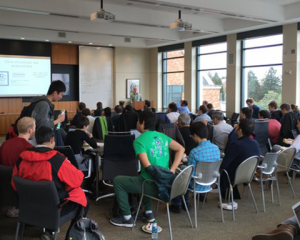
PLSE meeting attendees

A full house at the Pacific Northwest PLSE meeting

The Pacific Northwest is known to be a hotbed of programming language and software engineering (PLSE) innovation. Now, the brightest local minds in PLSE research have a forum in which to share their latest work and discuss emerging topics in the field with their colleagues from throughout the region, thanks to the efforts of professors Ras Bodik and Alvin Cheung of UW CSE’s world-class PLSE group and Rishabh Singh of the RiSE (Research in Software Engineering) group at Microsoft Research. Bodik, Cheung and Singh organized the inaugural Pacific Northwest PLSE Meeting held at the UW’s Paul G. Allen Center for Computer Science & Engineering last week—assembling a program that was chock full of new and noteworthy developments in PLSE research.

The agenda included sessions on tools and synthesis, chaired by Rishabh Singh; new languages, chaired by UW CSE professor Emina Torlak; and analysis and formal methods, chaired by Ben Zorn of Microsoft Research. UW CSE professor Zach Tatlock chaired the final session of the day, which was devoted to a series of lightning talks that illustrated PLSE’s expanding impact on fields outside of core computer science.
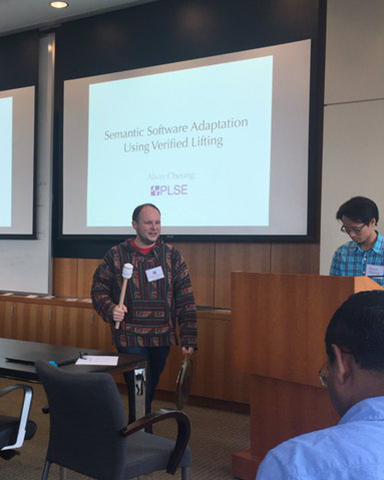
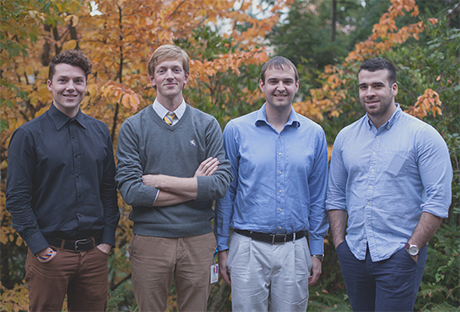
Zach Tatlock and Alvin Cheung

Zach Tatlock (left) and Alvin Cheung

In his presentation to conclude the program, Ben Zorn highlighted how PLSE research is becoming more relevant to people’s everyday existence. Given the proliferation of computers in our homes, in our cars and on our bodies—and the increasingly sophisticated software required for their operation—he noted that people’s lives depend upon the work of the PLSE research community.

“The software in these objects will be written in the next five years, but will have implications for the next 50 years,” Zorn said, issuing a call to action to his colleagues to focus on developing the languages, tools and processes to ensure their safety.

Other highlights of the day included technical talks by UW CSE Ph.D. student Calvin Loncaric and professors Alvin Cheung, Michael Ernst and Xi Wang; a presentation by Kartik Chandra, a high school student who has been working with Ras Bodik, on the use of symbolic execution to verify typecheckers; and a demonstration by Microsoft Research’s Rob DeLine of a new programming language for data scientists engaged in real-time data analysis.
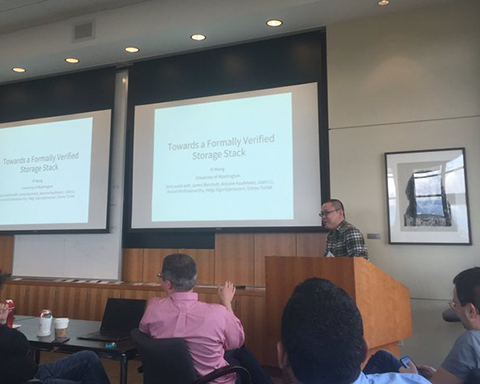
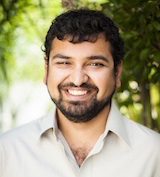
Xi Wang speaks at PLSE meeting

Xi Wang talks about his research

In all, more than 60 people participated in the meeting, including representatives of Amazon, Cray, Facebook, Google, NVIDIA, Oregon State University, Portland State University, Seattle University, Tableau, the University of British Columbia and the University of Victoria.

View the complete lineup of speakers, talk abstracts and slide decks on the 2016 PNW PLSE Meeting page here.

Thanks to everyone who helped make our inaugural event a great success! Read more →

UW CSE’s Shyam Gollakota: 1 of 5 CNN Money “Visionaries 2020”

Shyam GollakotaUW CSE professor Shyam Gollakota was selected by CNN Money as one of five innovators who are changing the world for a recent segment called Visionaries 2020. The segment highlighted Gollakota’s works on ambient backscatter, a groundbreaking technology that leverages existing TV and wireless signals to provide battery-free power and connectivity to enable the Internet of Things.

Watch the CNN Money video here.

Congratulations yet again, Shyam!! Read more →

UW continues winning ways at NSDI with Best Paper Award for Passive Wi-Fi

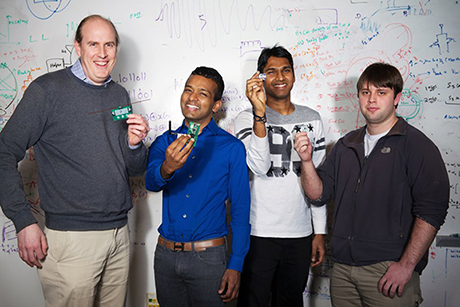
The Passive Wi-Fi team

Left to right: Josh Smith, Shyam Gollakota, Vamsi Talla and Bryce Kellogg. (Photo credit: Daniel Berman)

A team of UW CSE and EE researchers captured the Best Paper Award at the 13th USENIX Sympoxium on Networked Systems Design and Implementation (NSDI ’16) for Passive Wi-Fi: Bringing Low Power to Wi-Fi Transmissions. The Passive Wi-Fi project was developed in CSE’s Networks & Mobile Systems Lab by EE graduate students Bryce Kellogg and Vamsi Talla, CSE professor Shyam Gollakota, and CSE and EE professor Josh Smith.

Passive Wi-Fi is capable of generating Wi-Fi transmissions using 10,000 times less power than conventional methods. MIT Technology Review recently named Passive Wi-Fi among its 10 Breakthrough Technologies of 2016.

This is the second year in a row that UW CSE has taken home the big prize from NSDI, and our sixth NSDI Best Paper Award since 2007. UW ranks #1 among academic research institutions (and second only to Microsoft Research among all computing research organizations) in Best Paper Awards at major conferences in the field.

Read more about Passive Wi-Fi in our previous blog post here.

Congratulations Bryce, Vamsi, Shyam and Josh! Read more →

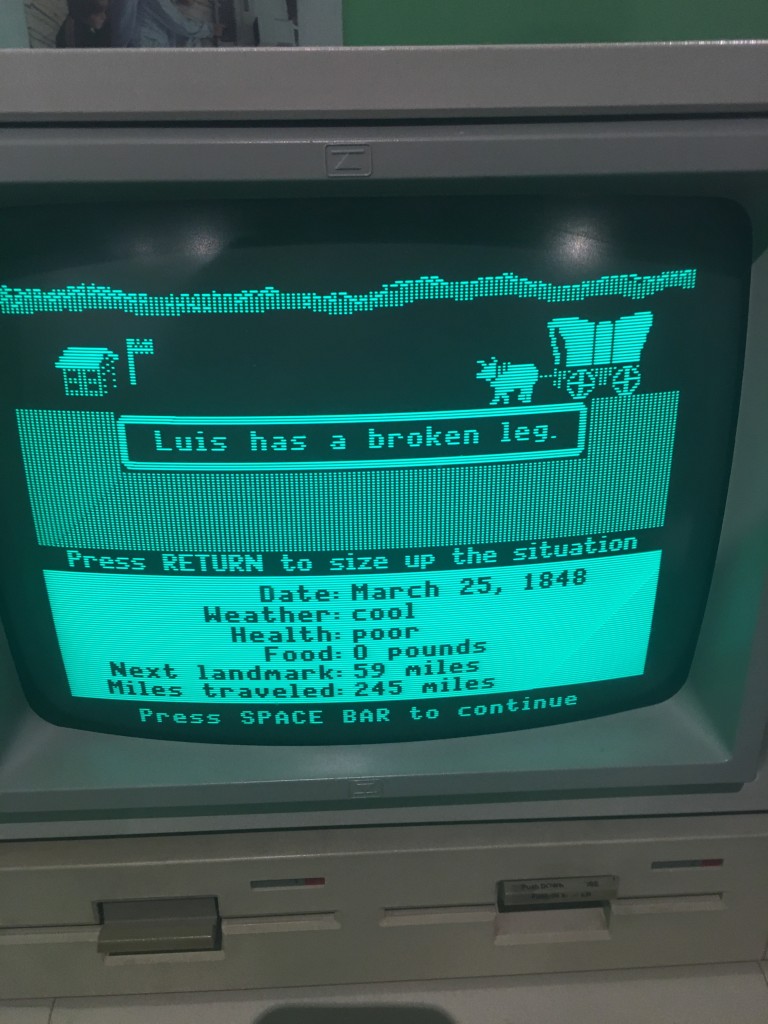
UW CSE’s Luis Ceze breaks leg on Oregon Trail

2016-03-02 14.52.24Today UW CSE’s Mark Oskin brought his graduate computer architecture class plus computer architecture faculty colleagues on an end-of-the-quarter expedition to Paul G. Allen’s phenomenal Living Computer Museum.

Student Amrita Mazumdar sends this photo documenting Luis Ceze’s downfall in the retro game Oregon Trail.

(A bit less than 2 years ago, Luis actually broke his leg, with a bit of help from CSE chair Hank Levy – check it out here.) Read more →

UW researchers cure fat-finger syndrome with sonar-based gesture tracking system

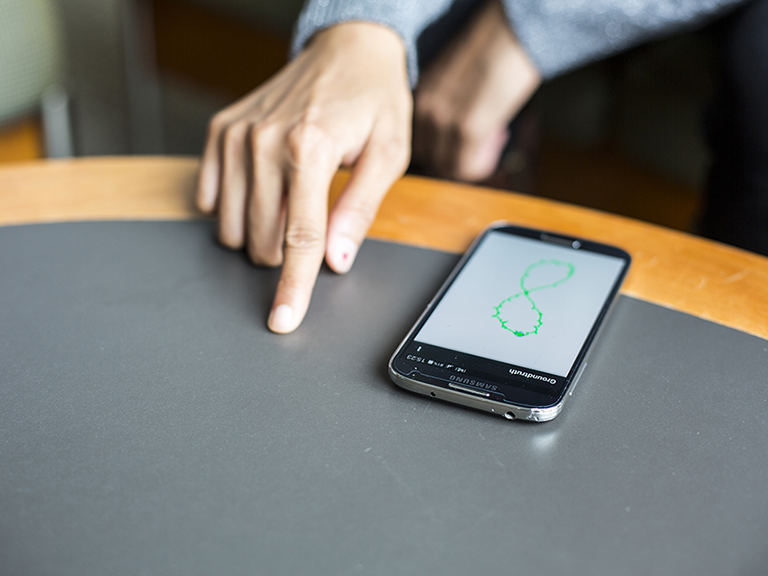
FingerIO demonstration on smartphoneA new technology developed by UW CSE and EE researchers could take the “touch” out of touchscreen and transform the way we interact with our mobile devices. FingerIO, which was developed in the Networks & Mobile Systems Lab led by CSE professor Shyam Gollakota, employs sonar to enable users to interact with their smartphones and smartwatches by gesturing or writing on any nearby surface.

From the UW news release:

“As mobile and wearable devices such as smartwatches grow smaller, it gets tougher for people to interact with screens the size of a matchbook.

“That could change with a new sonar technology developed by University of Washington computer scientists and electrical engineers that allows you to interact with mobile devices by writing or gesturing on any nearby surface—a tabletop, a sheet of paper, or even in mid-air….

“‘You can’t type very easily onto a smartwatch display, so we wanted to transform a desk or any area around a device into an input surface,’ said lead author Rajalakshmi Nandakumar, a UW doctoral student in Computer Science & Engineering. ‘I don’t need to instrument my fingers with any other sensors—I just use my finger to write something on a desk or any other surface and the device can track it with high resolution.'”

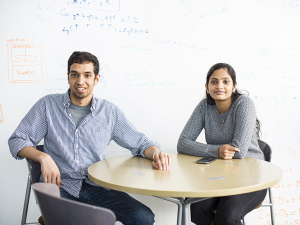
Vikram Iyer and Rajalaskhmi Nandakumar

Vikram Iyer (left) and Rajalakshmi Nandakumar

FingerIO uses the device’s own speaker, emitting an inaudible sound wave that bounces off the user’s finger and is then recorded using the device’s microphone. That signal is used to calculate the finger’s location in space. The researchers employed a common technique in wireless communication, Orthogonal Frequency Division Multiplexing, to achieve sub-centimeter tracking accuracy.

Sonar has significant advantages over other approaches. For example, unlike camera-based finger tracking, it does not require a direct line of sight—which means it can work through fabric, such as a pocket or a sleeve. And compared to radar, sonar does not require as much computing power or custom hardware to work.

“‘Acoustic signals are great—because sound waves travel much slower than the radio waves used in radar, you don’t need as much processing bandwidth so everything is simpler,’ said Gollakota…’And from a cost perspective, almost every device has a speaker and microphones so you can achieve this without any special hardware.'”

The team, which also includes EE Ph.D. student Vikram Iyer and CSE affiliate faculty member Desney Tan (Principal Researcher at Microsoft Research), will present its research paper on FingerIO at the upcoming CHI 2016 conference in San Jose, California, where it has been recognized with an honorable mention. Nandakumar previously was awarded Best Presentation for FingerIO at the Microsoft Research Student Summit on Mobility, Systems, and Networking.

Read the full news release here, and visit the FingerIO web page here. Watch a video demonstration here, and view the Discovery Channel Canada segment here. Also check out coverage by The Oregonian, GeekWireGizmagFastCompany and Motherboard. Read more →

Josue Rios’ journey from Venezuela to UW CSE

Josue RiosUW CSE senior Josue Rios was one of the first students to benefit from Washington State’s REAL Hope Act, an initiative that enables undocumented immigrants to access state financial aid for higher education. Nearly 20 years ago, Rios and his family left Venezuela in fear; these days, he is looking forward to graduating from UW CSE with a bachelor’s degree in computer engineering. An excellent article by UW journalism student Kayla Roberts that was published today in Seattle’s civic-focused online journal, Crosscut, highlights Rios’ journey and how the REAL Hope Act has lived up to its name:

“Josue Rios, a 21-year-old student at the University of Washington, escaped violence in Venezuela with his parents when he was two years old.

“The plan was to stay in Washington six months on a tourist visa. When his family home in Venezuela was invaded and sold on false documentation, this turned into 19 years.

“‘Because we had nothing to go back to, because everything was taken away from us, we decided to start over here,’ Rios said. This meant applying himself academically in high school and eventually pursuing a college education. He is set to graduate in the spring from the computer science and engineering department at UW.”

The author notes that because undocumented immigrants are ineligible for federal financial aid, the state program is the only government support available to enable students like Rios to pursue higher education. Read the full article here.

Rios has been an active contributor to the UW CSE community, serving as a teaching assistant in our Systems Programming and Introduction to Digital Design courses. He spent last summer as an intern at Amazon and has plans to work with Microsoft and a start-up company after graduation.

Thanks, Josue, for sharing your inspirational story. We look forward to celebrating your achievements with you in June! Read more →

UW CSE’s Tianqi Chen, Arvind Satyanarayan win 2016 Google Ph.D. Fellowships

Tianqi-ChenToday, Google announced that UW Ph.D. student Tianqi Chen has been chosen as a 2016 Google Ph.D. Fellow in machine learning. Chen works with professor Carlos Guestrin in the UW MODE Lab (Machine Learning, Optimization, Distributed Systems and Statistics) and is the creator of XGBoost, an open-source, end-to-end tree boosting system that is designed to be efficient, flexible and portable.

Tree boosting is a highly effective and widely used machine learning method. Researchers have embraced XGBoost because it is capable of running 10 times faster on a single machine and of scaling beyond billions of examples while using fewer resources compared to existing systems. More than half of the teams who won Kaggle machine learning challenges last year used it, as did every top-10 winning team at the 2015 KDDCup. Learn more about Chen’s work on the XGBoost project page here.

arvind-green-small-lessgreenArvind Satyanarayan, a Ph.D. student who works with UW CSE professor Jeff Heer in the Interactive Data Lab, also won a Google Ph.D. Fellowship – his in human-computer interaction. While technically a student at Stanford University (Heer moved from Stanford to UW several years ago), Satyanarayan spends the bulk of his time here in UW CSE; he is currently co-instructor with Jeff of the graduate course in User Interface Software & Technology in the Masters of Human-Computer Interaction & Design program. Learn more about Satyanarayan’s work here.

Read the Google announcement here.

Google Ph.D. Fellows are considered to be among the most promising young academic researchers across the globe. The competition has been particularly kind to UW CSE students, including past winners Aaron Parks and Kyle Rector (2015), Robert Gens and Vincent Liu (2014), Adrian Sampson (2013), Tom Bergan (2011), and Roxana Geambasu and Michael Piatek (2009).

Congratulations, Tianqi and Arvind, and thanks to Google for supporting UW CSE students and their work! Read more →

UW CSE’s Sergey Levine wins ONR Young Investigator Award

portrait_smallSergey Levine, who will join the UW CSE faculty this spring, has been recognized with a Young Investigator Award from the Office of Naval Research.

Sergey’s research focuses on the intersection between control and machine learning, with the aim of developing algorithms and techniques that can endow machines with the ability to autonomously acquire the skills for executing complex tasks. In particular, he is interested in how learning can be used to acquire complex behavioral skills, in order to endow machines with greater autonomy and intelligence.

Sergey received his Ph.D. from Stanford in 2014. He is spending the current year as a post-doctoral researcher at UC Berkeley working with Pieter Abbeel, and as a research scientist at Google.

Congratulations Sergey! Read more →

UW CSE students compete in the UW Health Innovation Challenge

The MultiModal Health team

Lars Crawford, Brian Mogen, Tyler Libey and Dimitrios Gklezakos

The finals of the inaugural Health Innovation Challenge, hosted by the UW Foster School of Business Buerk Center for Entrepreneurship, took place yesterday on campus. Three finalists with a UW CSE connection—FitTraction, HLTH, and MultiModal Health—were among the 18 interdisciplinary teams (out of a competitive field of 34) invited to pitch their ideas to improve health with technology to a roomful of judges drawn from the local community.

MultiModal Health, which captured third place, developed an interactive platform for physical rehabilitation. The company’s vHAB product line gamifies therapy exercises to improve patient engagement and outcomes and provide real-time data to providers. The MultiModal Health team includes UW CSE student Dimitrios Gklezakos, bioengineering students Tyler Libey and Brian Mogen, and neurobiology alum Lars Crawford.

FitTraction is a mobile and web app that could revolutionize the fitness industry by providing a way for gym members and their trainers to share and track workouts. The goal of FitTraction is to improve motivation and accountability—which will lead to improved health. The FitTraction team includes UW CSE students Ian Turner and Justin Lee, and entrepreneurship and information systems student Christian Taylor.

The HLTH app is designed to empower underserved and low-income populations to follow medically recommended preventative health schedules. HLTH was created by UW CSE student Travis Chen, medical student Daniel Dudley, HCDE student Anastacia Jaime, and international marketing student Yamato Abe.

Read more about the winning teams here, and check out the terrific GeekWire article on the competition.

Congratulations to Dimitrios and his teammates, and well-done to everyone from UW CSE and across the campus who participated! Read more →

In support of “institutes” at universities

eScience_Logo_HRUW faculty members David Baker (Biochemistry; Director of UW’s Institute for Protein Design), Tom Daniel (Biology; Co-Director of the Institute of Neuroengineering), Ed Lazowska (CSE; Director of the eScience Institute) and Dan Schwartz (Chemical Engineering; Director of the Clean Energy Institute) discuss the role of institutes at universities:

“University research institutes such as ours eliminate sclerotic silos and bureaucratic boundaries by deftly blending teams of super-smart students, faculty, and research scientists from interconnected subject areas. As a result, these institutions stand the best chance of identifying and solving the toughest scientific and technological challenges of our age – they are confronting tomorrow today….

“These institutes stand in stark contrast to the traditional university structures of schools, colleges, and departments, which take years to create and decades — if not centuries — to eliminate. Success in the 21st Century depends upon agility. When an opportunity presents itself, bring together the optimal set of individuals to respond. When another opportunity succeeds it, restructure.”

Read more here. Read more →

« Newer PostsOlder Posts »