Allen School set to amplify UW’s leadership in human-computer interaction with new hires Jennifer Mankoff and Jon Froehlich

Jennifer Mankoff

Jennifer Mankoff

The University of Washington is preparing to welcome outstanding new faculty hires who will bolster its reputation as a center of human-computer interaction research and teaching. Two of the impending arrivals, Jennifer Mankoff and Jon Froehlich, will join the Allen School faculty in advancing solutions to society’s greatest challenges, focusing on accessibility, education, health, sustainability, and more.

Jennifer Mankoff will join the Allen School as the Richard E. Ladner Endowed Professor in Computer Science & Engineering.  She is currently a Professor in Carnegie Mellon University’s Human Computer Interaction Institute, where she leads the Make4All Lab. Previously, Mankoff was a member of the faculty in Electrical Engineering & Computer Science at the University of California, Berkeley.

Mankoff’s research combines empirical methods and technical innovation to solve problems related to accessibility, health, and sustainability. Most recently, her work has focused on 3D printing and its potential for creating personalized assistive technologies for people with disabilities.

For example, Mankoff and her colleagues have shown that a 3D printed physical interface can augment a screen reader and improve interaction speed by a third. This do-it-yourself (DIY) theme is carried over into her work with e-NABLE, a collaborative effort to engage volunteers and clinicians in the design and fabrication of upper-limb assistive technologies. Mankoff’s assistive technology work also extends beyond fabrication. For example, she and her colleagues have explored navigation aids for the blind, and mobile sound capture and transcription tools for the deaf.

As is the case with a lot of accessibility research, Mankoff’s people-centric approach to technology and novel use of 3D printing will wind up benefiting everybody. Mankoff has studied and created solutions for addressing uncertainty in measurement during 3D printing, attaching adaptations to everyday objects (Encore and Reprise) and prototyping custom assistive technologies. Another stream of work aims to explore more natural materials, including embedding textiles in 3D printing, creating knitted objects programmatically, and printing using layers of fabric.

Mankoff’s work also extends to chronic illness. She has explored the impact of chronic disease on quality of life, predictors of trust in peer versus professionally produced health content, visualization techniques for infant oxygen monitoring, and the design of both mobile and web tools for managing chronic illness and physical therapy.

Mankoff has been recognized with an Alfred P. Sloan Fellowship, IBM Faculty Fellowship, and Best Paper awards from ASSETS, CHI, and Mobile HCI. She earned her B.A. in computer science from Oberlin College in 1995 and her Ph.D. in computer science from the Georgia Institute of Technology in 2001.

While she is eager to take advantage of new research opportunities as a member of the Allen School faculty and the university’s Design Use Build (DUB) group, Mankoff is particularly excited about the culture she encountered during her time on campus.

“I visited UW feeling that it would take a lot for me to leave my wonderful colleagues and position at CMU,” Mankoff admitted. “However, the wonderful welcome, fascinating research, many opportunities for collaboration, and warm community in the Allen School and DUB won me over.”

With Mankoff’s arrival, the Allen School adds an exciting new dimension to its accessibility research that will complement the existing efforts of its HCI research group and the Taskar Center for Accessible Technology.

Jon Froehlich’s arrival will be a homecoming of sorts. Froehlich, who earned his Ph.D. at the Allen School working with professors James Landay and Shwetak Patel, will return to his alma mater as an associate professor after having spent the past five years on the faculty of the computer science department at University of Maryland, College Park and director of the Makeability Lab.
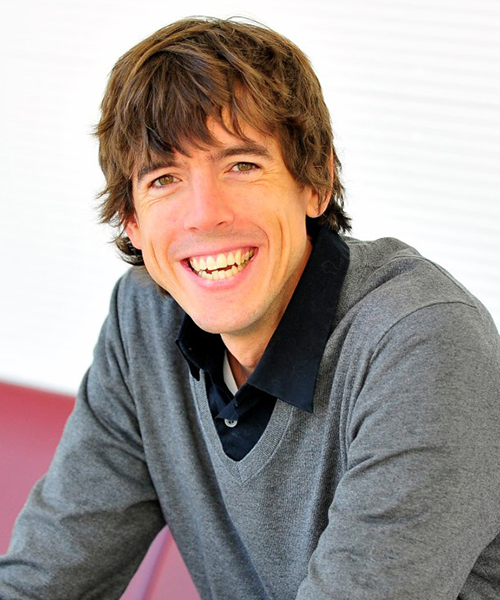
Jon Froehlich

Jon Froehlich

Froehlich focuses on the design of interactive tools and techniques that span the virtual and the physical to address pressing global challenges in accessibility, education, and environmental sustainability. He aims to invent or reappropriate methods for sensing physical or behavioral phenomena, leveraging techniques in computer vision and machine learning to interpret and characterize the data. He then builds software and hardware tools that are uniquely enabled by this approach for people of different ages and abilities.

One of Froehlich’s most recent projects, MakerWear, earned him a CAREER Award from the National Science Foundation. MakerWear is a modular toolkit that enables children without prior programming knowledge to create their own interactive wearables using tangible plug-and-play modules. Froehlich and his colleagues won a Best Paper at CHI 2017 for demonstrating how children between the ages of five and 12 can use MakerWear to create their own diverse, personally meaningful designs while developing computational thinking. Another project developed for children, BodyVis, explores how wearable sensing technology can help develop scientific inquiry skills and knowledge of anatomy and physiology. Froehlich and his team created a custom e-textile shirt that senses the wearer’s physiology in real-time and then visualizes this information via responsive anatomical models.

Froehlich is also interested in developing assistive technologies that support independent living. For example, as part of the HandSight project, Froehlich and his colleagues repurposed tiny, endoscopic cameras to augment a blind person’s hand with computer vision. The technology enables users to sense non-tactile information about the world — such as color, texture, and printed text — to support the activities of daily living and increase their independence. Froehlich also initiated Project Sidewalk to collect street-level accessibility information and develop new location-based tools to assist people with disabilities in navigating their communities.

Similar to Mankoff, Froehlich identified the collaborative culture — exemplified by the interdisciplinary DUB group, of which Froehlich was a founding member during his student days — as a motivating factor in his decision to join the UW faculty.

“I am delighted to rejoin the Allen School — a place that helped shape and support my desire to work on applied problems with social relevance,” Froehlich said. “The school has a reputation not just of research excellence and creative innovation, but of collegiality and a unique collaborative culture.”

“UW is a world-leader in HCI research and education, with top experts in nearly every facet of the discipline,” he continued. “I am excited to once again have the opportunity to work with the fantastic faculty and students not just in computer science and engineering, but also in art, geography, social science, HCDE, and the iSchool. Cross-campus collaborations like DUB are what make UW one of the top HCI institutions in the world.”

With the arrival of Froehlich and Mankoff, the Allen School adds leading-edge expertise in wearable technology, personal fabrication, and pervasive computing — and reinforces the school’s reputation as a destination for rising stars in HCI and accessibility research.

Mankoff and Froehlich will be accompanied by Anind K. Dey and Leah Findlater, respectively, in their moves to UW.
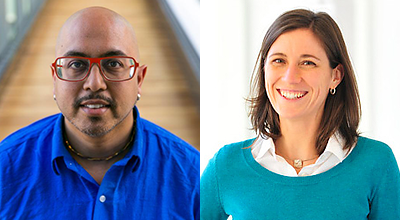
Anind Dey, Leah Findlater

Anind K. Dey (left) and Leah Findlater

Dey, who currently serves as the Director and Charles M. Geschke Chair of CMU’s Human Computer Interaction Institute, will join UW as Dean of the Information School. Dey’s research spans human-computer interaction, ubiquitous computing, machine learning, and sensing, with projects focused on intelligibility and end-user control in context-aware computing, active learning to improve usability and performance, modeling and predicting human behavior, and development of programming support for context-aware and sensor-rich environments.

Findlater, currently a faculty member in the University of Maryland College of Information Studies and Institute for Advanced Computer Studies, will join the faculty of UW’s Department of Human Centered Design & Engineering (HCDE). At UMD, Findlater leads the Inclusive Design Lab, where her research focuses on the design of new mobile and wearable technologies that can be adapted to accommodate individual users’ needs and preferences — including novel interfaces and interactions that are accessible to people with visual and motor impairments.

In addition to their primary appointments, both Dey and Findlater will be adjunct faculty members of the Allen School.
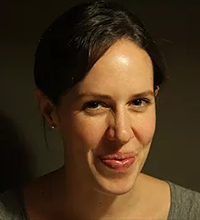
Alexis Hiniker

Alexis Hiniker

The group announced today are part of a larger HCI cluster hire by UW that includes Alexis Hiniker, who is joining the iSchool faculty after earning her Ph.D. at UW in human-centered design and engineering. Hiniker is an HCI researcher and full-stack developer who builds technologies to empower users by reducing vulnerability and fostering well-being, especially among children, including work in child-computer interaction, technology use in families, and technology for supporting children with atypical patterns of development.

Together, this group of new hires will significantly expand UW’s capacity to develop novel solutions to some of the most pressing problems facing society today and advance the Seattle region’s reputation as a center of innovation and real-world impact.

The Allen School previously announced the impending arrival of two other game-changing faculty hires — leading robotics researcher Siddhartha “Sidd” Srinivasa from CMU, and pioneering computer engineer Michael Taylor from University of California, San Diego. Read more →
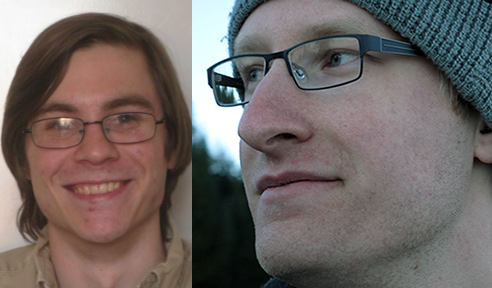
Allen School’s Martin Kellogg and Calvin Loncaric excel in ACM Student Research Competition

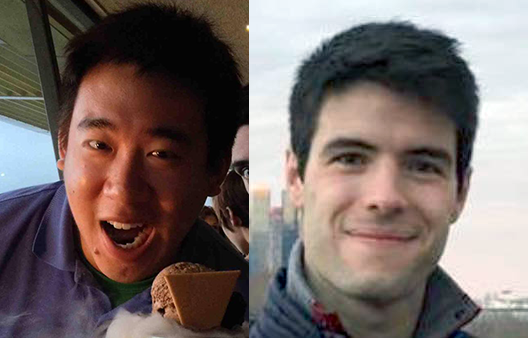
Martin Kellogg, Calvin Loncaric

Martin Kellogg (left) and Calvin Loncaric

Allen School students Martin Kellogg and Calvin Loncaric have earned national recognition as grand finalists in the Association for Computing Machinery’s 2017 Student Research Competition. The competition, which is sponsored by Microsoft, highlights exemplary student researchers and encourages their participation in top computing research conferences. Kellogg captured third place in the undergraduate category, and Loncaric placed third in the graduate category. A total of 330 students participated in this year’s competition by presenting their work at one of two dozen ACM conferences held around the world.

Kellogg is a first-year Ph.D. student who works with professor Michael Ernst in the Allen School’s Programming Languages & Software Engineering (PLSE) group. He presented his winning project, “Combining Bug Detection and Test Case Generation,” at the Foundations of Software Engineering (FSE 2016) conference in December. The paper, which was the result of work he initiated as an undergraduate at University of Virginia, presents N-prog, an efficient, new tool for the detection of software bugs.

Loncaric, who also works with Ernst, captured third place in the graduate competition for another project featured at FSE 2016, “Cozy: Synthesizing Collection Data Structures.” Cozy is a novel tool for implementing new data structures that uses counter-example guided inductive synthesis in place of the more tedious and error-prone process of handwritten implementation.

ACM recognized Kellogg, Loncaric and their fellow competition winners at its annual awards banquet this past weekend in San Francisco, California.

Read the ACM press release here and our prior blog coverage of the Allen School at FSE 2016 here.

Way to go, Martin and Calvin! Read more →

Allen School showcases undergraduate course projects at inaugural end-of-year poster fair

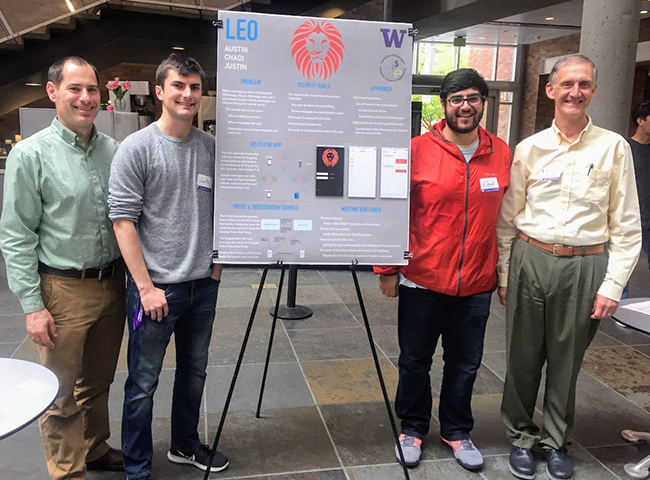
Dan Grossman, Justin Kotalik, Chadi Moussi, Ed Lazowska

From left: professor Dan Grossman, students Justin Kotalik and Chadi Moussi, and professor Ed Lazowska at the end-of-year poster fair

Each year our amazing Allen School undergraduates spend many hours combining their creativity and problem-solving skills with their technical computing acumen to design and implement course projects, particularly in our senior-level courses and capstone design courses. At the end of each quarter, the Microsoft Atrium in the Paul G. Allen Center hosts a variety of course-specific poster sessions where students describe what they have accomplished. Last week, we tried something new: a school-wide, end-of-year poster session where student teams from across the curriculum could reprise their posters and talk about their work with a broader audience.

Participating teams also competed for a prize awarded by Allen School alumni and friends serving as judges. Our volunteer panel evaluated the students’ work based on technical achievement, creativity, presentation, and potential for impact. After viewing all 19 projects on display — which spanned programming languages, natural language processing, data visualization, mobile apps, robotics, and more — the judges selected two for special recognition: “Leo,” a decentralized chat app for iOS that provides end-to-end encryption for mobile messaging, and “Global Terrorism,” an interactive data visualization tool for objectively presenting and analyzing information on terrorist attacks.

The winning project, Leo, was developed by computer science undergraduate Austin Bhisharat, computer engineering undergraduate Justin Kotalik, and combined bachelor’s/master’s student Chadi Moussi to address security concerns with popular mobile messaging apps. These apps typically rely on a central server to relay messages between sender and recipient, which enables them to collect metadata about users’ communications as the messages pass through a central server. With Leo, messages are encrypted and sent peer-to-peer, preventing any single entity from knowing who is communicating with whom or when.

Honorable mention went to the Global Terrorism data project, which was developed by computer science undergraduates Sheen Dudwadkar, Carson Gulledge, Michelle Lee, and Grace Qiu. The team created a narrative visualization tool that enables citizens to explore data and questions about terrorism themselves, without going through the filter of emotionally and politically charged media coverage.

Learn more about all 19 featured projects here.

Congratulations to our winners and to all the students who participated — and many thanks to the extended Allen School family for supporting our undergraduates! Read more →

Allen School’s Rajesh Rao receives Cherng Jia and Elizabeth Yun Hwang Endowed Professorship

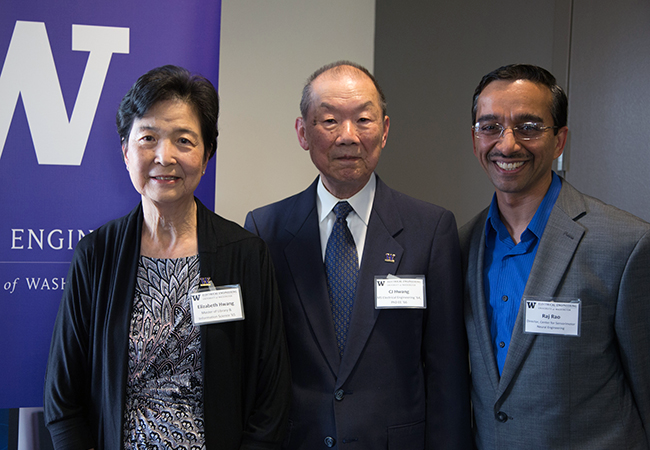
Elizabeth Yun Hwang, Cherng Jia Hwang, and Rajesh Rao

Left to right: Elizabeth Yun Hwang, Cherng Jia Hwang, and Raj Rao

Allen School professor Rajesh Rao has been named the Cherng Jia and Elizabeth Yun Hwang Endowed Professor at the University of Washington. The new professorship was established by the Hwangs in the UW Department of Electrical Engineering in honor of their daughter, Karen, who suffered a severe spinal cord injury in an automobile accident. The couple’s generosity will support Rao’s groundbreaking research on implantable devices to enable people suffering from paralysis to move again.

Rao is an adjunct faculty member in electrical engineering and bioengineering and directs the Center for Sensorimotor Neural Engineering, where he and his colleagues are developing bi-directional brain-computer interfaces (BCIs) that can wirelessly transmit brain signals across regions of the nervous system damaged through traumatic injury or illness. In addition to bridging those lost connections to enable movement, the technology also shows promise for promoting brain plasticity and targeted rehabilitation of affected areas — essentially, enabling the nervous system to repair itself.

The potential impact of this work on patients’ quality of life is what drew the Hwangs, both of whom are UW alumni, to Rao’s research.

“The selection of Professor Rao is ideal,” Mr. Hwang said in an interview. “His work lays the groundwork for research on developing a device-based rehabilitation technology to improve the quality of life of people with spinal cord injury and brain damage…We are very pleased to have him installed as the first endowed professor.”

“I am truly honored to be named the inaugural CJ and Elizabeth Hwang Professor of CSE and EE,” Rao said. “I regard the Professorship as a recognition of the great collaborative effort of the students, faculty and staff at our center over the past 6 years that has made UW a premier destination for neural engineering in the world. We are extremely grateful to the Hwang family for their generosity in accelerating the center’s efforts to build devices that will improve the quality of life of people with spinal cord injury and other neurological conditions.”

Read more about the professorship in the EE announcement here, and learn more about Rao’s work on BCIs in a UW News release here.

Congratulations, Raj — and thanks to EE Chair Radha Poovendran and to CJ and Elizabeth Hwang for their support of high-impact research! Read more →

Paul G. Allen School celebrates its first graduating class

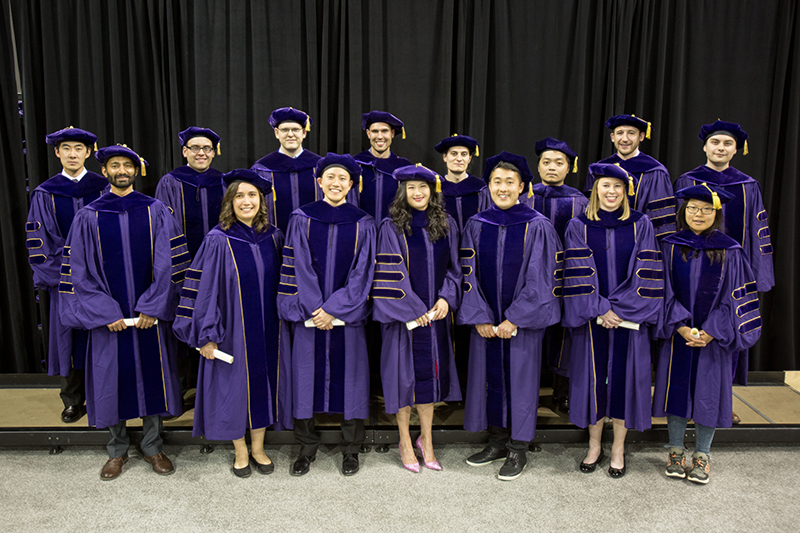
Group shot of Ph.D.s onstage

All smiles: some of the Allen School’s newly-minted Ph.D.s

Tonight marked a special milestone in the history of Computer Science & Engineering at the University of Washington, as we celebrated the first graduating class of the Paul G. Allen School and recognized the students, faculty, alumni, and friends who make the Allen School community great.

We were honored to have engineer and entrepreneur Rich Barton — founder of Expedia, co-founder and executive chairman of Zillow, and co-founder and non-executive chairman of Glassdoor — join us to help mark the occasion as our inaugural graduation speaker. Barton kicked off the celebration with some advice for the graduates in a commencement speech that drew upon Greek mythology, history, and the Wizard of Oz. Pointing to the behavioral phenomenon known as the Pygmalion Effect — after the figure in an ancient Greek myth — he urged the new graduates to set great expectations, because “Great expectations beget great results….Have a dream, gather or join a talented crew of fellow adventurers, and make it so.”

And how do they do that? By emulating the Scarecrow, the Cowardly Lion, and the Tin Man in the Wizard of Oz. What those three wished for, said Barton, “are what I wish for you as you begin your journey in pursuit of your big, audacious dreams.” First, like the Scarecrow, graduates would need brains — plural, he pointed out, because in computer-science speak, “networks are much smarter, more complex, and interesting than nodes.” A diverse team accomplishes more collectively than an individual or a homogeneous team can. They would also need courage, like the Lion, and they should call upon it to “take big swings,” Barton said. “Take a chance on pursuing a big, audacious dream now.” Last — but certainly not least — is heart. He suggested that while fear may be easier than hope when it comes to inspiring others, the latter is both happier and healthier. “As you become leaders yourselves, remember to risk showing and sharing your own heart.”

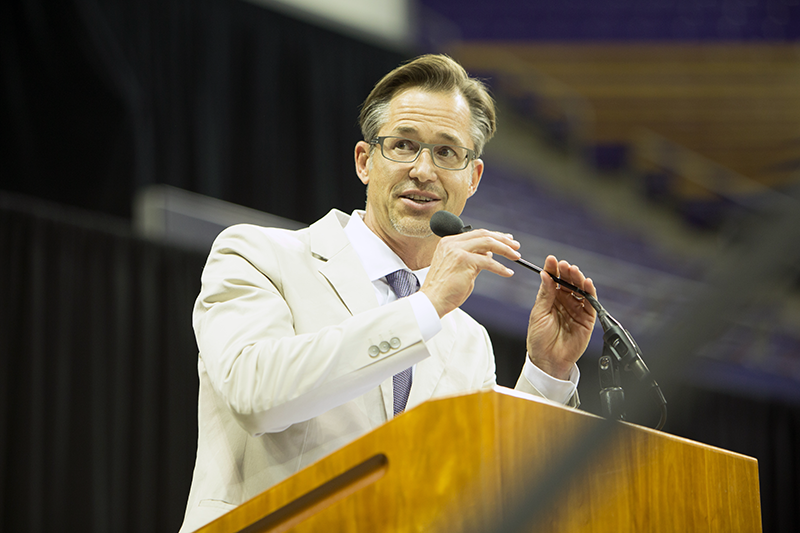
Rich Barton onstage

Rich Barton advises graduates, “You have brains. Take courage. Display heart.”

GeekWire has a complete transcript of Barton’s address, plus a video.

Barton’s words set a terrific tone for the evening as we honored outstanding scholars and alumni who epitomize the Allen School’s commitment to educational excellence, service to our community, and generating real-world impact through research and innovation.

Each year, we recognize members of the graduating class who demonstrate superior scholarship, leadership potential, and the ability to apply and create new knowledge in the field of computing with Outstanding Senior Awards. In past years, we have awarded one award each to a student in computer science and in computer engineering. This year — as a reflection of how much our program has grown and the quality of our students — we decided to expand the award to two students in each discipline: Pascale Wallace Patterson and Sarah Yu in computer science, and Nick Anderson and Pooja Sethi in computer engineering.

Sethi also received the Best Senior Thesis Award, which recognizes the very best in undergraduate research at the Allen School based on originality, quality, and impact. She earned the award for her thesis “Respeak: A Voice-based, Crowd-powered, and Accessible Speech Transcription System,” which she completed working with professor Richard Anderson and Ph.D. student Aditya Vashistha. Again, we opted to break with tradition and recognize two students instead of one: Kuikui Liu also received a Best Thesis Award for “The Method of Interlacing Polynomials,” which he completed working with professors Shayan Oveis Gharan of the Allen School and Rekha Thomas of UW Mathematics.

We also recognized Royden Lucky with our Undergraduate Service Award, which is given to a graduating senior who has taken an active role in the Allen School community during his/her time as a student—contributing time, expertise, and enthusiasm to our events and activities.

The UW student chapter of the Association for Computing Machinery (ACM) recognized lecturer Adam Blank with its Undergraduate Teaching Award, highlighting his enthusiasm, his responsiveness, and his constant drive to improve the educational experience through innovation. Students themselves also can be powerful teachers — especially those who serve as teaching assistants (TAs). Each year we recognize and thank a small group of particularly outstanding TAs with our Bob Bandes Memorial Award. Our 2017 winners were Francis Ge, Varun Vijay Mahadevan, Alexander Tsun, Pascale Wallace Patterson, and Michelle Yun, with honorable mention going to Justin Huang and Evan McCarty.

A.J. Bernheim Brush (Ph.D. ’02); Hakim Weatherspoon (B.S. ’99)

Our new graduates are joining a long line of leaders and innovators who are using their UW education to change the world. To highlight this fact and recognize our most accomplished alumni, each year we announce two winners of our Alumni Achievement Award. This year’s honorees were A.J. Bernheim Brush (Ph.D., ’02) and Hakim Weatherspoon (B.S., ’99).

Brush is a leader in computer-supported collaborative work. After spending 11 years leading a variety of influential projects in Microsoft Research, she is now part of the Cortana product group working on far-field speech interaction, natural language processing, and user interface design for the company’s in-home digital personal assistant.

Weatherspoon combined Computer Engineering with varsity football at UW, traveling to four bowl games as a Husky. He followed his UW education with a Ph.D. from the University of California, Berkeley and has spent the past nine years as a professor at Cornell University. He is internationally renowned for his work on web-scale distributed systems and has earned accolades for his commitment to promoting diversity in computing.

Read more about Brush and Weatherspoon in our newsletter article here. Check out the complete graduation program here. And see GeekWire’s video of the entire ceremony here.

Congratulations to all of our graduates, and thanks to everyone who made our first Allen School graduation such a special occasion!


Event photo credits: Matt Hagen

  Read more →

Allen School’s Vincent Lee and Max Willsey win Qualcomm Innovation Fellowship

Vince Lee and Max Willsey

Vincent Lee (left) and Max Willsey

Allen School Ph.D. students Vincent Lee and Max Willsey have been awarded a 2017 Qualcomm Innovation Fellowship for their proposal “Program Synthesis for Domain Specific Reconfigurable Accelerators.” Lee and Willsey, who were recommended by professors Ras Bodik, Luis Ceze, and Alvin Cheung, are one of only eight teams to receive a fellowship out of 33 finalists drawn from 116 original proposals received by the company.

Lee and Willsey are working with Bodik, Ceze, and Cheung on a project that aims to leverage solver-aided techniques and program synthesis ideas to design and build domain specific reconfigurable hardware accelerators. The goal of their research, which spans computer architecture, compilers, and programming languages, is to achieve significant performance improvements while simultaneously reducing the energy costs associated with computation. The project is housed in the Allen School’s inter-disciplinary SAMPA group, which advances research across multiple layers of the system stack, including hardware, programming languages, and applications.

The Qualcomm Innovation Fellowship program is designed to recognize and support Ph.D. students and their forward-thinking research in a variety of technical areas that are driving computing innovation. This is the fifth year in a row that an Allen School team has earned one of these coveted awards and the second win for Lee, who received a fellowship in 2015 with Carlo del Mundo for their work to develop systems and architecture support for large-scale video search. Winning teams each receive a $100,000 fellowship and mentorship by Qualcomm engineers.

Congratulations, Vincent and Max! Read more →

Allen School researchers shine brightly at SIGMOD

Group photo of UW Allen School at SIGMOD 2017

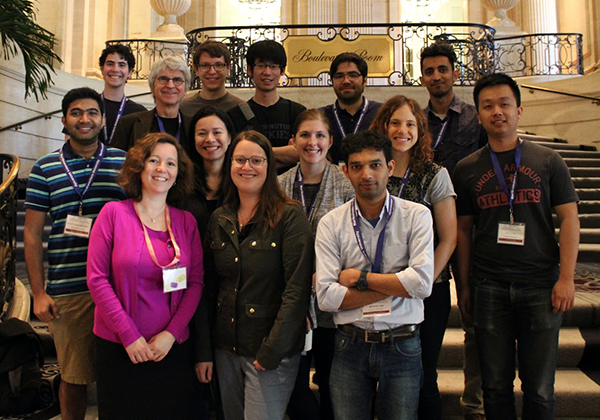
Allen School students and faculty at SIGMOD in Chicago

A delegation of Allen School researchers recently returned from the annual conference of the Association for Computing Machinery’s Special Interest Group on Management of Data (SIGMOD 2017). Several faculty and students from the Database and Programming Languages & Software Engineering groups were recognized for their work to advance the state of the art in data management.

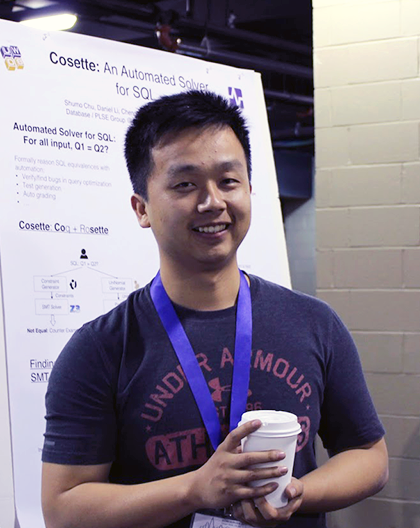
Ph.D. student Shumo Chu earned the Best Demo Award for his presentation of the Cosette Automated SQL Prover, a project developed by Chu, his fellow Ph.D. student Chenglong Wang, undergraduate researcher Daniel Li, and professors Alvin Cheung and Dan Suciu. Cosette is the first automated prover for determining the equivalence of two SQL queries. The team has demonstrated its usefulness by proving a number of real-world SQL rewrite rules ​that have not been shown correct before, along with disproving well-known bugs ​in SQL query optimizers, ​all in a matter of seconds. The team ​will  release the tool in the next few weeks.

Shumo Chu demonstrating Cosette

Two other students received Honorable Mentions for their demos. Brandon Haynes earned accolades for demonstrating VisualCloud, a database management system for efficient storage and delivery of virtual reality content at scale that he developed with 5th year master’s student Artem Minyaylov and professors Cheung, Magdalena Balazinska, and Luis Ceze. Maaz Bin Safeer Ahmad was recognized for his demo of Casper, a tool he developed with Cheung that automatically rewrites sequential Java applications to leverage parallel data processing frameworks such as Spark and Hadoop using verified lifting.

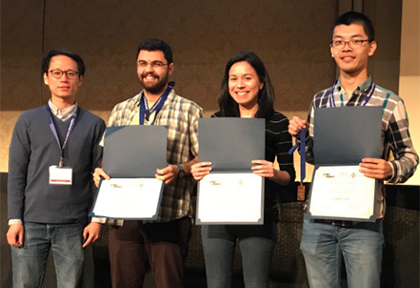
In the ACM Student Research Competition, Ph.D. student Jennifer Ortiz was named First Runner-Up in the graduate student category for her poster and research talk on PerfEnforce, a dynamic scaling engine for analytics with performance guarantees. Ortiz developed PerfEnforce in collaboration with Balazinska, master’s alum Brendan Lee, Microsoft Technical Fellow Johannes Gehrke, and Senior Data Science Fellow Joseph Hellerstein of the UW eScience Institute.

A team of Allen School researchers also earned one of three Reproducibility Awards, which recognize papers from the previous year’s conference that are deemed to be most reproducible, verifiable, flexible, and portable. The winning paper, “SQLShare: Results from a Multi-Year SQL-as-a-Service Experiment,” presented the results of a four-year deployment of a database-as-a-service platform aimed at scientists with minimal database experience and was co-authored by Ph.D. students Shrainik Jain and Dominik Moritz, Ph.D. alum Daniel Halperin, iSchool professor and Allen School adjunct faculty member Bill Howe, and Allen School professor Ed Lazowska.

ACM Student Research Competition honorees

Professor Alvin Cheung (left) with ACM Student Research Competition honorees Utku Sriin, Jennifer Ortiz, and Lingjiao Chen

Last but certainly not least, Balazinska collected SIGMOD’s Test of Time Award for her 2005 paper “Fault Tolerance in the Borealis Distributes Stream Processing System,” which pioneered a new approach for increasing the fault tolerance of stream processing applications. The award, which Balazinska shares with co-authors Hari Balakrishnan, Samuel Madden, and Michael Stonebraker of MIT, signals the enduring influence her work has had on the field of data management in the dozen years since its initial publication. Read more in our previous blog post here.

View more photos of the Allen School in action at SIGMOD here.

Great work, everyone! Read more →

Allen School researchers earn Best Robotic Vision Paper at ICRA 2017

Tanner Schmidt talks to ICRA attendees

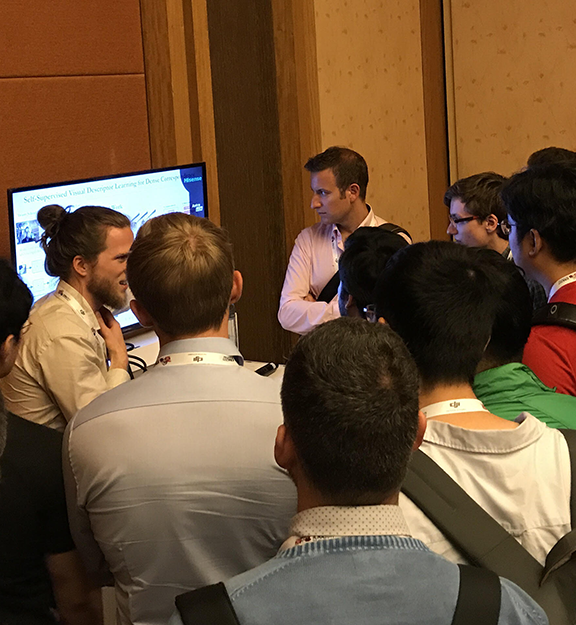
Tanner Schmidt (left) speaks to attendees at ICRA

A team of researchers in the Allen School’s Robotics and State Estimation Lab earned the award for Best Robotic Vision Paper at the recent IEEE International Conference on Robotics and Automation (ICRA 2017). The winning paper, “Self-supervised Visual Descriptor Learning for Dense Correspondence,” represents a significant step forward in robot learning by providing a framework for enabling robots to understand their local environments without human intervention.

In order for robots to operate safely and effectively in dynamic environments, they must be able to recognize objects and scenes they have encountered on previous occasions and apply that knowledge to their current situation. The process by which robots develop this human-like perception of their environment is known as correspondence estimation, which typically requires image descriptors that have been engineered by hand or the expensive collection of vast quantities of training data to take advantage of deep learning techniques.

The team from the RSE-Lab — Allen School Ph.D. student Tanner Schmidt, former postdoc and current affiliate professor Richard Newcombe of Oculus, and professor Dieter Fox — came up with an alternative that automates the generation of training data and enable robots to learn the visual features of a scene in a self-supervised way. Leveraging dense mapping techniques such as KinectFusion and DynamicFusion, the researchers were able to generate correspondence labels from raw RGB-D video data. The researchers then used the resulting labels and a contrastive loss to train a fully convolutional network to produce dense visual descriptors from novel images that are consistent despite variations in pose, viewpoint, or lighting conditions. This work, which represents the state of the art in descriptor learning, will be useful for researchers tackling a number of important problems in robot vision, including tracking, mapping, and object recognition.

Another Allen School paper, “SE3-Nets: Learning Rigid Body Motion using Deep Neural Networks” by Ph.D. student Arunkumar Byravan and Fox, was a finalist for the same award. That paper describes SE3-Nets, which are deep neural networks for modeling and predicting the motion of objects subject to applied force. Byravan and Fox demonstrated that SE3-Nets are able to learn scene dynamics from limited real-world data, generalize across different scenes, and more consistently predict object motion compared to traditional flow networks.

As Fox points out, vision is becoming an increasingly important area of robotics — and our showing at ICRA demonstrates that we are at the forefront of this exciting line of research. Way to go, team! Read more →

Allen School student Colin Summers is ready to reach new heights

Colin SummersOur latest installment of the Allen School’s Undergrad Spotlight features Colin Summers, a senior majoring in computer engineering with significant experience in chemical and mechanical engineering. The Seattle native, who is pursuing a minor in aeronautics and astronautics, will spend the summer as an intern at the National Aeronautics and Space Administration’s Jet Propulsion Laboratory (NASA JPL) in California.

Before taking off on his new adventure, Summers took time out from his busy schedule to share with us what inspires him as a student, what he learned while working on the award-winning UW Hyperloop project, and what’s next.

Allen School: What is your favorite thing about being an Allen School student?

Colin Summers: The excitement of the students. Of every academic program that I have been a part of — and there have been quite a few — I have not seen students more self-motivated and passionate than CSE students. Everywhere you look, students are chasing their interests whether it be robotics, video games, travel, theory, or any one of the wild things people pursue in this school.

Allen School: Who has inspired you the most as a student?

CS: There’s almost too many to list! Some recent inspirations might include fellow students Johan Michalove for sharing a giddy excitement over robotics, Meredith Lampe for helping to convince me to give CSE 142 a shot, and John Kaltenbach for continually stoking my love of travel; professor Dieter Fox, for sharing a glimpse of the future of robotics; Adam Blank, for demonstrating how to be yourself in the pursuit of what you love; Jonathan Lee, for getting me excited about computational theory and mathematics all over again…As I said, too many to list!

Allen School: What hobbies and interests do you have outside of school?

CS: I’m an avid skier and climber and have recently started to merge the two in the pursuit of mountaineering. I love travel and have spent a bit over a year living in South America, plus a bit of time in Indonesia.

Allen School: What is one of your favorite student memories so far?

CS: Flying to Texas last year with the UW Hyperloop team for the Design and Build competition was one of the most incredible experiences that I’ve had in college. There was about 15-20 of us that went down to pitch our design to a panel of over 100 judges from industry and academia, in the hopes of securing a spot in the final round of the competition. Of over 1,200 teams that applied, only 120 were selected to present — and fewer than 30 teams made it out with approval to build out their designs and race.

The competition is now over, and UW Hyperloop placed 4th in the US and 6th in the world. Hyperloop presented the opportunity to work on a radical new concept that had never been done before, alongside some of the most excellent engineers I’ve ever worked with. It challenged me to think outside the box and to recognize the importance of team dynamics and vision in leading an engineering project.

Allen School: How do you follow up an amazing experience like that — what’s next for you?

CS: Recently, Johan Michalove and I began a robotics project, Dub Car, as part of a new undergraduate program titled Cyber-Physical Systems Group (CPSG). What first started as a side project has since matured into a full-blown honors research project under professor Dieter Fox. Our task is to design, build, and program a 1/10th scale autonomous race car from commercial parts that can be used as a future platform for research in control theory, computer vision, systems development, and autonomy.

Through sponsorship, donations, and our own pockets we’ve managed to scrape together all of the parts needed for our platform and are in the final stages of assembly. A lot of work remains (especially if I keep blowing up the motor controller!), but we’re in it for the long haul and have loved every minute of it thus far. Luckily, we somehow both managed to land internships at NASA JPL for this summer, and we are excited to keep the progress going year-round!


We’re happy to have a star like Colin as part of the Allen School community. Good luck in your internship, Colin! Read more →

Allen School privacy researchers shed light on secret surveillance with SeaGlass

Peter Ney and Ian Smith

Researchers Peter Ney (left) and Ian Smith

A team of researchers in the Allen School’s Security and Privacy Research Lab have developed a new system, SeaGlass, which could bring more transparency and accountability to cell-phone surveillance. SeaGlass is capable of detecting anomalies in the cellular network that may indicate the presence of surveillance devices called IMSI-catchers (also known as cell-site simulators or Stingrays), which track individuals through their International Mobile Subscriber Identity by posing as a legitimate cell tower.

WIRED magazine recently talked to the researchers about SeaGlass and their hope that the findings contribute to the public discourse. From the article:

“Law enforcement’s use of the surveillance devices known as stingrays, fake cell towers that can intercept communications and track phones, remains as murky as it is controversial, hidden in non-disclosure agreements and cloak-and-dagger secrecy. But a group of Seattle researchers has found a new method to track those trackers: by recruiting ridesharing vehicles as surveillance devices of their own.

“For two months last year, researchers at the University of Washington paid drivers of an unidentified ridesharing service to keep custom-made sensors in the trunks of their cars, converting those vehicles into mobile cellular data collectors.”

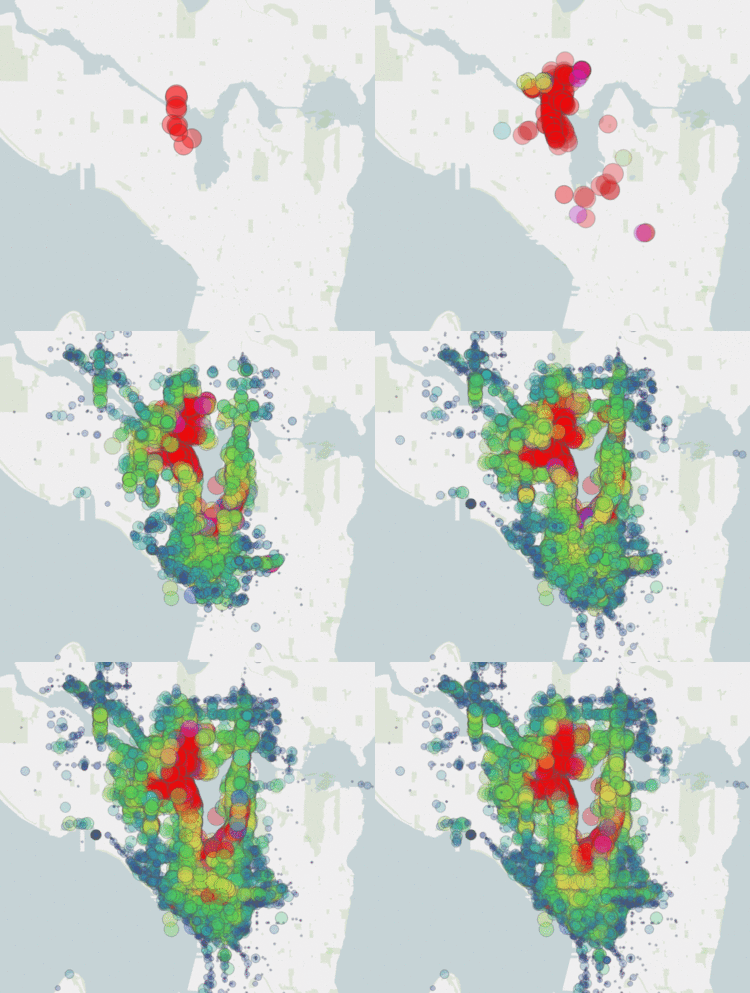
GIF of SeaGlass

Data collected from a single cell tower in Seattle over two months

The article explains how the information gathered by those mobile data collectors was analyzed to identify irregularities in the network compared to normal cell tower behavior, which could indicate that a surveillance device is active in the area. By using off-the-shelf parts and deploying the system on fleet vehicles that cover a lot of ground during their normal course of business, the researchers demonstrated SeaGlass to be an inexpensive and unobtrusive way to map the cellular landscape.

During the pilot, the system detected three anomalies in the greater Seattle area that piqued the team’s interest. Although the results do not offer conclusive proof of an IMSI-catcher, they do provide a good starting point for further exploration — and for an overdue conversation about surveillance practices.

“Up until now the use of IMSI-catchers around the world has been shrouded in mystery, and this lack of concrete information is a barrier to informed public discussion,” Ph.D. student Peter Ney said in a UW News release. “Having additional, independent and credible sources of information on cell-site simulators is critical to understanding how — and how responsibly — they are being used.”

The team, which also includes Allen School research scientist Ian Smith, Ph.D. student Gabriel Cadamuro, and professor Tadayoshi Kohno, hopes that its work will contribute to a more robust public debate over cell-phone surveillance. They describe in detail the SeaGlass technology and results of the pilot in a paper that will be published this month in the Proceedings on Privacy Enhancing Technologies.

“SeaGlass is a promising technology that — with wider deployment — can be used to help empower citizens and communities to monitor this type of surveillance,” said Smith.  “This issue is bigger than one team of researchers. We’re eager to push this out into the community and find partners who can crowdsource more data collection and begin to connect the dots in meaningful ways.”

Read the WIRED story here, the UW News release here, and additional coverage by TechCrunch, Gizmodo, and Engadget. Learn more at the SeaGlass website here. Read more →

« Newer PostsOlder Posts »