Allen School’s Aditya Vashistha wins Graduate Student Research Award

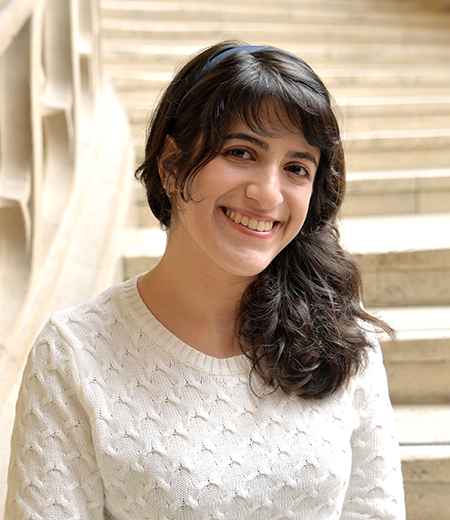
Aditya VashisthaAllen School Ph.D. student Aditya Vashistha has earned the 2017 Graduate Student Research Award from the UW College of Engineering. Vashistha, who is advised by professor Richard Anderson in the Information & Communication Technology for Development (ICTD) Lab, earned the award for his work on social media technologies for the developing world.

Vashistha’s research aims to extend the benefits of social computing to the roughly four billion people around the globe who have constrained internet access. One of his early projects was IVR Junction, a system that used interactive voice response technology to enable people with basic phones to participate in voice-based social networks. IVR Junction, which Vashistha developed while working with Bill Thies of Microsoft Research India, has been deployed in remote regions of Somalia, Mali, and India to share news, call attention to rights violations, and report lack of services. Vashistha built on this research with Sangeet Swara, a voice forum that enables low-income people in rural areas to curate and share content on voice-based social networks which earned a Best Paper Award at CHI 2015. One of his more recent projects, Respeak, is a voice-based speech transcription crowd-sourcing app to provide additional earning opportunities for low-income people that earned an Honorable Mention at the CHI 2017 conference.

Previously, Vashistha earned a Best Student Paper Award at ASSETS 2015 for his analysis of social media use by low-income blind people in India — an outgrowth of the Sangeet Swara project — and was awarded the prestigious Facebook Graduate Fellowship in 2016. In his letter of nomination for the College of Engineering award, Anderson cited Vashistha’s commitment to service and to producing research with important social impact as being particularly worthy of recognition.

“Aditya is a remarkable researcher who is already having tremendous impact in developing technology to reach under-served and marginalized communities,” Anderson wrote. “I am proud to have the opportunity to work with exceptional students like Aditya in the College of Engineering, and look forward to his future accomplishments.”

“My research experience so far has been exhilarating,” Vashistha said. “It’s all thanks to the amazing faculty, staff and students at the Allen School for creating a conducive environment for research.”

Each year, the College of Engineering Awards recognizes the extraordinary efforts of student researchers, teaching assistants, faculty, and staff members. Allen School nominees for this year’s awards included professors Carlos Guestrin and Josh Smith in Faculty Teaching and Research, respectively; Raven Alexander, Assistant Director for Diversity & Outreach, and software engineer Jason Howe of the Computer Science Lab, in the Professional Staff category; and Fiscal Specialist Chiemi Yamaoka in the Classified Staff category.

Vashistha and his fellow recipients from across the college will be honored at a campus reception for students, faculty and staff later today.

Congratulations to Aditya, and to all of this year’s winners and nominees for your commitment to excellence! Read more →

Allen School undergraduate Hannah Werbel marches into the spotlight

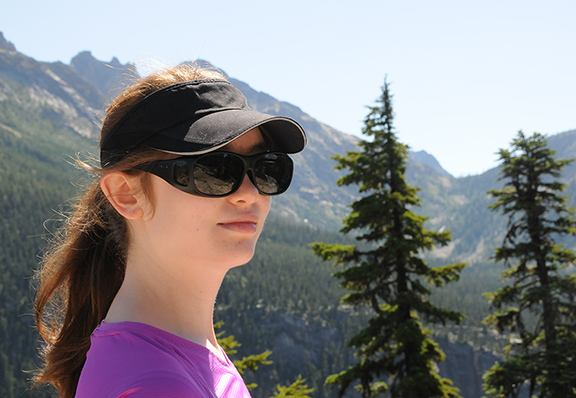
Hannah Werbel with trees and mountains in the backgroundFor this edition of the Allen School’s Undergrad Spotlight, we check in with sophomore Hannah Werbel, a computer science major from Sammamish, Washington. Werbel was named the Freshman Medalist in the UW President’s Medalist awards in recognition of her academic performance and extra-curricular involvement on campus. In addition to serving as a teaching assistant for our introductory programming courses, Werbel is a student assistant at the UW’s DO-IT Center, a member of the Husky Marching Band, and president of the Washington Association of Blind Students.

Allen School: First off, congratulations on being selected as a UW President’s Medalist!

Hannah Werbel: I was extremely surprised when I found out that I won this award. I was in class when I got the call to inform me that I had won. Checking the voicemail afterwards, I honestly thought that it was a prank call. It wasn’t until I got an e-mail and a letter that I realized that this was not a joke. I am incredibly honored and humbled to have received the Freshman Medal. It is extremely rewarding to have all the time and hard work I’ve put into my classes and extra-curricular activities recognized. My family and friends have all supported me throughout my time in college, and I cannot thank them enough for all that they’ve done to help me succeed.

Allen School: Why did you choose to major in computer science?

HW: I chose computer science because of all the creative problem-solving involved. In high school, I would tell people that I wanted to study something that “allowed me to be both creative and logical at the same time.” Computer science was actually the last thing I had on my mind when I would say this.

My dad works in technology, and believed that no matter what major I chose, I should know at least a little bit of computer programming. So, in the spring quarter of my freshman year, I enrolled in CSE 142 to satisfy my father’s requirement. I haven’t looked back since. I was surprised by the amount of creativity involved in computer science. I thought that programming was monotonously typing commands into the computer. In reality though, logical problem solving skills and creative thinking are both integral parts of this subject. Computer science encompasses exactly what I said I wanted to do in high school, and I am very happy that I have found something to study that I am passionate about.

Allen School: What do you find most enjoyable about being an Allen School student?

HW: My favorite thing is the amazing community. The professors, students, and advisers are all extremely supportive and genuinely care about our success as people, not just students. Knowing that I can go to the labs at any time and most likely find at least one person from my classes is really nice. I appreciate the collaborative nature of the major, and that we are encouraged to work together to solve problems. I’ve met so many new people this year from being in study groups and going to office hours. Everyone is motivated and passionate about what they do, and I love that I am constantly learning new things from both my professors and my peers.

Allen School: What activities and interests do you have outside of your studies?

HW: I play the piccolo in the Husky Marching Band. I perform at all of the home football games and occasionally travel for away games. I also played in the basketball pep band this year. Technically, since the band is in the athletic department, I can say that I’m a Division 1 college athlete! I find this amusing, although I believe wholeheartedly that marching band should be considered a sport. I am also a TA for CSE 142/143 and the president of the Washington Association of Blind Students. In my free time, I enjoy cooking, baking, reading, yoga, and hiking.

Allen School: Is there a unique perspective you’d like to share with the Allen School community?

HW: Well, I am blind, so the term “unique perspective” definitely applies here. I literally see the world differently from everyone else — that cliché actually works for me. In all seriousness though, I do believe that my vision has allowed me to “see” and understand things that my fully-sighted peers often miss.

Allen School: How so?

HW: I cannot see anything that is written or projected onto the board, but I can still take notes by listening. So I have come to view lecture as a giant puzzle game. I cannot simply look up to see the equation I didn’t quite catch, or the definition that the professor didn’t say out loud, but I can still fill in the information by finding “the missing piece” that fits with everything else. If I miss an equation, but know that A and B are related as such, and that now we are talking about C which relies on A and B, then I can usually make a pretty good guess at my missing equation and keep up with the rest of the class.

I cannot zone out during lecture and have to be completely engaged in the material in order for me to make the most of my time there. This is how my vision helps me. I have to work harder during class, and often have to put in more time and effort outside of class to make up for the information I missed during lecture, but overall I learn everything at a deeper level than I would otherwise. I also believe that often being viewed as “disabled” has exposed me to many misguided assumptions. This has helped me to personally maintain a more holistic perspective of people and their abilities, and allows me to interact with all types of people and situations more adeptly.

Allen School: Who or what in your Allen School experience so far have you found most inspiring?

HW: Thus far, the most inspiring thing for me is the challenge and rigor of the courses. I find the subject of computer science fascinating, and am constantly amazed at how much of it I don’t know. The subject expands far past basic Java programming, and it is inspiring to me to see all of the potential and possibilities that lie ahead. There is so much about computer science that is still to be discovered and implemented. Tackling challenging problems and attempting to comprehend abstract ideas inspires me to engage with the topics even more. I’ve always enjoyed puzzles, and I view computer science as a giant mystery that I am coming closer and closer to understanding.


Hannah embodies the UW’s commitment to excellence and engagement, and we’re proud to have her as a member of the Allen School community! Read more →

Allen School capstone film “Short Changed” to appear at the Seattle International Film Festival

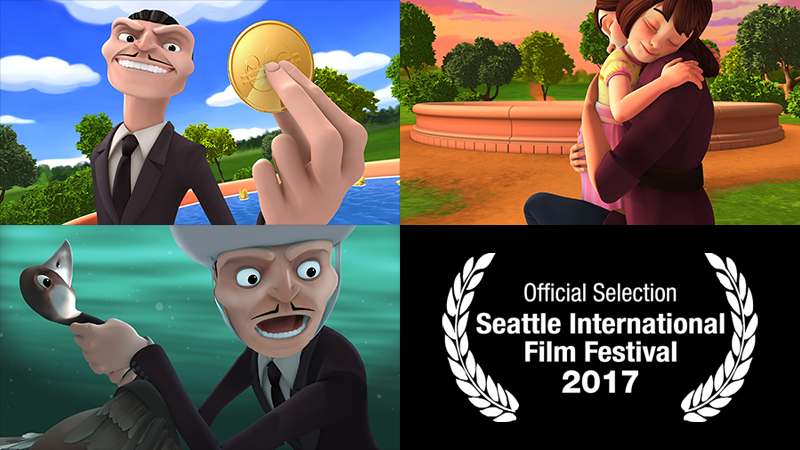
Stills from "Short Changed" and SIFF Official Selection laurelShort Changed,” a film created by a team of students as part of the Allen School’s Animation Capstone, has been designated an Official Selection of the 43rd Seattle International Film Festival (SIFF). The festival, which runs from May 18 to June 11, is the largest of its kind in the United States and will feature more than 400 works from filmmakers in over 70 countries. “Short Changed” was produced in the UW’s Animation Research Labs and directed by Allen School faculty member Barbara Mones.

“Short Changed” will be screened during The Family Picture Show, a collection of animated and live action shorts curated by festival organizers for “the young and the young at heart” as part of SIFF’s ShortsFest Weekend. The film tells the story of a greedy thief who comes up with a devious plan to profit from people’s hopes and dreams. The thief dons a disguise that enables him to gather the coins that people cast into a fountain as they make their wishes. However, one of the fountain’s regular inhabitants decides that there is something fishy about the newcomer — and our thief quickly discovers that when it comes to stealing a little girl’s wish, crime doesn’t pay.

SIFF is a qualifying festival for “Best Short Film” at the Academy Awards in the animation, narrative, and documentary categories. Earning designation as an Official Selection at SIFF is a terrific achievement for Mones and her students in the 2014 Animation Capstone course: the Allen School’s Chelsea Dallas, Anton Holmberg, Ashley Nguyen, Brian Park, Tina Pi, Simon Schaffer, and Benjamin Schiffler; Informatics majors Theodore Chin, Alex Constant, and Mikey Wong; Interaction Design majors Nicholas Stoermer, Randy Huynh, Noble Woods, and Hsuan-Ting Wu; Interdisciplinary Visual Arts majors Erin Caswell (who has since joined the staff of the Animation Research Labs), Amanda Cook, and Amanda Nelson; and Painting and Drawing majors Zixing Guo, Si Tao Li, and Rebecca Van-Den-Ende.

Short Changed” will be screened on Saturday, May 27 at the SIFF Cinema Uptown. This is the third Allen School capstone film to appear at SIFF, following the selection of “Catch and Release” in 2012 and “Kings” in 2010.

Check out the “Short Changed” SIFF page here and view the trailer here. Learn more about the Animation Capstone here.

Congratulations to Barbara, Erin, and the entire crew! Read more →

Allen School student Fereshteh Sadeghi wins NVIDIA Graduate Fellowship

Fereshteh SadeghiFereshteh Sadeghi, a Ph.D. student in the Allen School’s Graphics & Imaging Laboratory (GRAIL), has been named a 2017 NVIDIA Graduate Fellow. Sadeghi, whose research combines robotics, deep reinforcement learning, and computer vision, is one of only 10 student researchers across the United States selected to receive the fellowship.

The NVIDIA Graduate Fellowship program supports research that spans all areas of computing innovation, with particular interest in projects that will drive advances in artificial intelligence, deep neural networks, autonomous vehicles, and related areas. Sadeghi earned a fellowship for her work on autonomous robot controllers with Larry Zitnick, Allen School affiliate professor and research manager at Facebook AI Research (FAIR), and professor Sergey Levine of the EECS department at University of California, Berkeley, where Sadeghi is currently a visiting student. Her research combines recent developments in 3D graphics simulation and deep reinforcement learning to produce robot controllers capable of performing a variety of tasks in real-world settings.

Previously, Sadeghi worked with Zitnick and Allen School professor Ali Farhadi on advancing the state of the art in computer vision, including common-sense visual understanding, visual analogy, knowledge extraction, and scene recognition.

Congratulations, Fereshteh! Read more →

Allen School alum Frank McSherry wins Gödel Prize in Theoretical Computer Science

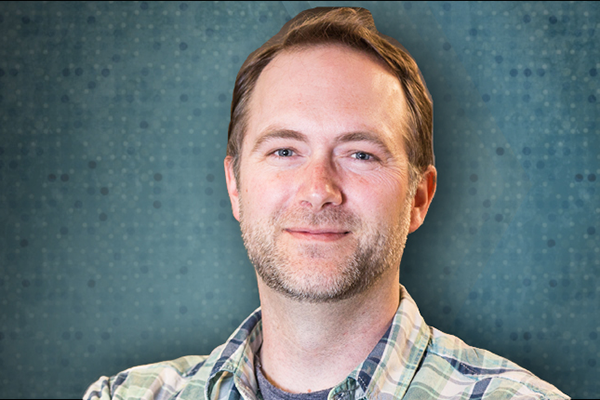
Frank McSherryAllen School alum Frank McSherry (Ph.D., ’04) has earned the prestigious Gödel Prize co-sponsored by the European Association for Theoretical Computer Science (EATCS) and the Association for Computing Machinery’s Special Interest Group on Algorithms and Computation Theory (SIGACT). The annual prize recognizes outstanding papers in theoretical computer science and is named in honor of the 20th century mathematician Kurt Gödel, who made significant contributions to mathematical logic and the theoretical foundations of computer science.

McSherry and co-authors Cynthia Dwork, Kobbi Nissim, and Adam Smith share the 2017 prize for their paper “Calibrating Noise to Sensitivity in Private Data Analysis” published in the Journal of Privacy and Confidentiality. The paper builds upon the team’s groundbreaking work initiated in 2006 that introduced a new framework, differential privacy, to protect private data contained in a statistical database.

McSherry and his colleagues showed that by applying random noise to the query results, calibrated to the sensitivity of the intended function, they could protect individual contributors and their data from attempts at deanonymization while still returning accurate results. As part of this work, they developed a set of tools for designing and combining differentially private algorithms to enable the construction of complex differentially private analytical tools from simple differentially private primitives. The team also demonstrated that privacy-preserving approximations could be extended to holistic functions operating on an entire database — broadening the application of differential privacy beyond a purely statistical context to enable privacy-preserving data analysis.

Differential privacy has also begun to influence the practice of sensitive data analysis. Examples include Google’s RAPPOR, Apple’s iOS data collection, and the US Census Bureau’s On The Map product.

McSherry, who completed his Ph.D. working with Allen School professor Anna Karlin, is a computer scientist whose research spans graph computation, differential privacy, and distributed and data-parallel computation. He spent 12 years as a research scientist at Microsoft Research’s Silicon Valley lab before its closure in 2014.

McSherry and his co-authors will collect the Gödel Prize at the 49th annual ACM Symposium on the Theory of Computing (STOC 2017) to be held in Montreal, Canada in June.

Congratulations, Frank! Read more →

Allen School faculty and alumni honored at the 2017 GeekWire Awards

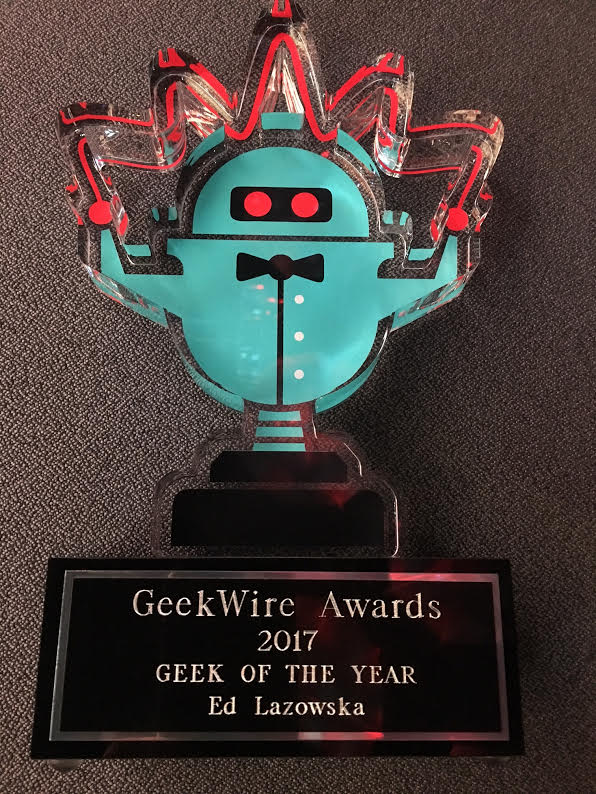
Geek of the Year trophyLast night was the annual GeekWire Awards bash, where everyone who’s anyone in local tech assembles to celebrate the best of the Northwest in entrepreneurship and innovation. A number of people and companies with connections to the Allen School were nominated for awards, which are decided by popular vote. At the end of the evening, Allen School professor Ed Lazowska emerged from an impressive field of nominees to take home the Geek of the Year trophy, while alum Andrew Putnam (Ph.D., ’09) and affiliate professor Doug Burger of Microsoft Research helped lead the team behind Project Catapult to victory in the Innovation of the Year category.

Lazowska earned his Geek of the Year title for being the driving force behind the campaigns to create the Allen School and to construct a second computer science and engineering building that will enable the program to expand in response to growing student and employer demand. Microsoft’s Project Catapult combines a field programmable gate array (FPGA) integrated into almost every new Microsoft datacenter server with a unique distributed architecture that creates an “acceleration fabric” throughout the datacenter; this elastic reconfigurable acceleration fabric provides the flexibility to harness an individual FPGA or up to thousands of them for a single service. (UW is well represented on the core Catapult team in addition to Andrew Putnam and Doug Burger: Adrian Caulfield is an Allen School bachelors alum and received his Ph.D. from UCSD working with Allen School Ph.D. alum Steve Swanson; Michael Haselman received his Ph.D. from UW EE working with Allen School Ph.D. alum and Adjunct Professor Scott Hauck; and Jack Lavier received his Masters from UW EE.)

Nominees – five in each award category – were selected by an expert panel; it’s a tremendous honor just to be nominated for a GeekWire Award. Other nominees with Allen School connections:

The field for App of the Year included Senosis Health, a UW spin-out co-founded by Allen School and EE professor Shwetak Patel to commercialize the mobile health apps that he and his students develop in the UbiComp Lab. The apps, which effectively turn an off-the-shelf smartphone into a hand-held medical device using the phone’s built-in sensors, include BiliCam, which detects newborn jaundice; SpiroSmart/SpiroCall, for monitoring lung function; and HemaApp, a non-invasive way to measure blood hemoglobin.

Two Allen School startups were among the nominees for Deal of the Year: RFID pioneer Impinj, which was co-founded by professor Chris Diorio, was lauded for its successful IPO last summer, and Turi, the machine learning startup founded by professor Carlos Guestrin that was acquired by Apple. Impinj and Turi are among the more than 15 Allen School startups funded by our friends at Madrona Venture Group.

Allen School alum Tim Prouty (B.S., ’06) was nominated in the Hire of the Year category after joining shipping technology company Convoy as head of engineering. It was a major coup for the startup, which has been referred to as the “Uber of trucking” — not least because Prouty grew the actual Uber’s Seattle engineering office from zero to 150 employees in the span of 18 months before changing direction to focus on freight.

Finally, a tip of the hat to Ben Gilbert, recognized as Young Entrepreneur of the Year for his work at Pioneer Square Labs, which he co-founded with Greg Gottesman, who teaches the Allen School’s entrepreneurship course annually.

See the complete list of winners here, and check out photos and videos of the event here. Read a terrific GeekWire Q&A with Lazowska here.

Congratulations to Ed, Andrew, Doug, and all of last night’s winners and nominees! And thanks to GeekWire for its amazing role as a catalyst for Seattle’s tech community! Read more →

Allen School’s Jeffrey Heer wins ACM Grace Murray Hopper Award

Jeffrey Heer Allen School professor Jeffrey Heer has been named the recipient of the Grace Murray Hopper Award from the Association for Computing Machinery (ACM). This prestigious award recognizes an outstanding early-career professional who has made a significant technical or service contribution to the field of computing. Heer, who leads the Allen School’s Interactive Data Lab, was chosen as this year’s winner for his work on visualization tools that have transformed how people interact with data — tools that are currently used by thousands of researchers, data enthusiasts, and media companies around the world.

“With the meteoric increase of data collection in recent years, tools are urgently needed to understand and see patterns within data,” says the ACM in its award announcement. “Jeffrey Heer, a Professor at the University of Washington, has been a leader in developing computer languages to create charts, graphs and other visualizations that help people explore and understand data.”

Heer’s contributions to the field of data visualization began as a graduate student at University of California, Berkeley, when he collaborated with Stuart Card at the Palo Alto Research Center and then-professor James Landay of the Allen School to develop Prefuse, one of the first software packages to enable developers to quickly and easily create and customize dynamic visualizations from structured or unstructured data. As a member of the Stanford University faculty, Heer worked with Mike Bostock on the development of the Protovis and D3.js graphical systems for constructing interactive visualizations for the web. The latter, as the ACM notes, was rapidly adopted as a primary tool for web developers worldwide.

At the Allen School, Heer and his team in the Interactive Data Lab launched the Vega project to advance an ecosystem of interoperable tools for data analysis and visualization design that is underpinned by Vega, a convenient but powerful tool for writing programs that generate visualizations. Heer and his team subsequently built upon the Vega foundation with higher-level tools such as Vega-Lite, a high-level grammar that enables the rapid and concise specification of interactive data visualizations which earned the Best Paper Award at InfoVis 2016, and Lyra, a graphical interface for designing custom visualizations for online publication without the need to write code.

The Grace Murray Hopper Award is one of four technical awards announced today by the ACM. Heer and his fellow recipients were selected by their peers for significant technical contributions “that have had a far-reaching impact on how we live and work.” The winners will collect their awards at the annual ACM Awards Banquet next month in San Francisco, California.

Learn more about the ACM awards here.

Congratulations, Jeff! Read more →

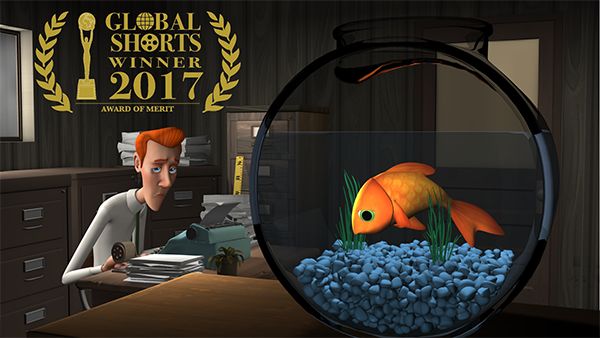
Allen School capstone film “Fish Out of Water” wins Global Shorts Award of Merit

Still shot from "Fish Out of Water"Fish Out of Water,” an animated film created by students in the Allen School’s interdisciplinary Animation Capstone, has won an Award of Merit in the 2017 Global Shorts competition. Global Shorts is an international competition based in Los Angeles that recognizes outstanding films with run-times of 50 minutes or less. It attracts works from filmmakers around the world, some of whom go on to earn nominations and awards in such prestigious competitions as the Golden Globes, Cannes Film Festival, BAFTAs, and British Independent Film Awards.

“Fish Out of Water” tells the story of Roy, an office worker who struggles with a demanding job and an even more demanding boss. His situation is not helped by his office-mate, whose relentlessly cheery attitude even as the paperwork piles up just compounds Roy’s misery. He gets through his days by fantasizing about the past — but when he comes to the realization that life is too short for such soul-destroying drudgery, he decides to chart a new course.

Each year, the Allen School’s Animation Capstone offers students an opportunity to put into practice what they learned in their digital animation classes by producing a short animated film. Participants work on all aspects of production, including scene planning, modeling, digital cinematography, character animation, and rendering.

“Fish Out of Water” is the latest in a line of award-winning films to emerge from the course. It was directed by Barbara Mones, Director for Animation Production at the UW’s Animation Research Labs, and produced by a multi-disciplinary team of 22 students enrolled in the 2015 capstone: the Allen School’s Bing Gan, Stanley Janicki, Aria Li, Vincent Liu, Alexa McLaughlin, Zhuonan Eric Sun, Ian Wagner Smith, Sarah Wai, and Cherry Chenwei Zhou; Electrical Engineering’s Kristine Lee and Riley O’Callaghan; Human Centered Design & Engineering’s Lucia ShinYoung Choi; Industrial Design’s Sindre Punsvik; Informatics’ Ying Dang, Jenna Han, and Vivyan Woods; Interdisciplinary Visual Arts’ Esmeralda Duenas, Brianna Fecarotta, Elizabeth Ong, Andrew Shin, and Lac Tranvu; and Medical Anthropology & Global Health student Marisa Katagiri.

View the trailer for “Fish Out of Water” here, and learn more about the Animation Capstone here.

Congratulations to Barbara, her students, and the entire production team! Read more →

Allen School’s Magdalena Balazinska wins SIGMOD Test of Time Award

Professor Magdalena Balazinska, member of the Allen School’s Database Group and Senior Data Science Fellow at the eScience Institute, has won the 2017 Test of Time Award from the Association for Computing Machinery’s Special Interest Group on the Management of Data (ACM SIGMOD). Balazinska earned the award for her 2005 paper “Fault-Tolerance in the Borealis Distributed Stream Processing System,” which drew upon her Ph.D. research and was co-authored by Hari Balakrishnan, Samuel Madden, and Michael Stonebreaker at MIT.

The Test of Time Award is given to a paper that appeared at SIGMOD between 10 and 12 years ago that has had a significant influence on the field of data management since its initial publication. In this year’s winning paper, Balazinska and her colleagues presented a novel approach for increasing the fault tolerance of an emerging class of distributed data-intensive applications known as stream processing applications.

At the time the paper was written, stream processing applications were being deployed in an increasing number and variety of domains, including computer networking, financial services, medical information systems, civil engineering, and the military. To make these applications more resilient, Balazinska and her colleagues developed a replication-based approach that enabled fault-tolerant distributed stream processing in the face of node failures, network failures, and network partitions. Unlike existing techniques that either neglected to address network failures or strictly favored consistency over availability, this new approach offered a configurable trade-off between availability and consistency — while guaranteeing eventual consistency.

Borealis was an early distributed stream processing system developed through a collaboration between MIT, Brown University, and Brandeis University. The project pioneered many new stream processing techniques, including the one put forward in the award-winning paper. These techniques remain critical today as the need for stream processing capabilities continues to grow and new streaming systems are developed.

Balazinska holds the Allen School’s Jean-Loup Baer Career Development Professorship and directs the IGERT Ph.D. program in Big Data and Data Science at the University of Washington. She has received multiple awards recognizing her contributions to the field of data management, including the inaugural Women in Database Research Award at last year’s Very Large Data Bases (VLDB) conference and a Most Influential Paper Award from the Working Conference on Reverse Engineering (WCRE). Balazinska will collect her latest honor at the 2017 SIGMOD/PODS conference in Chicago next month.

Congratulations, Magda! Read more →

Mozak from Allen School’s Center for Game Science and Allen Institute for Brain Science featured in The New York Times

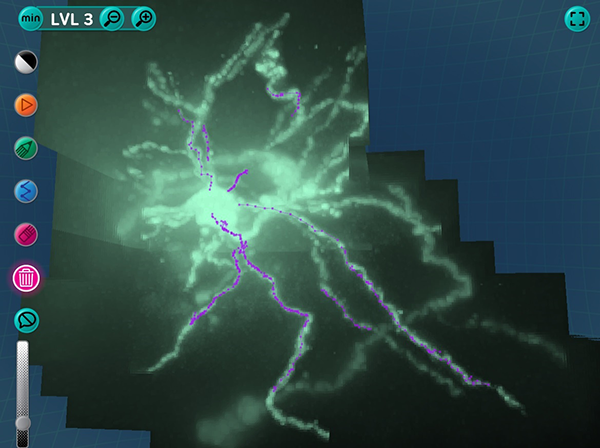
Mozak in-game screenshotMozak, a new scientific discovery game developed by Allen School professor Zoran Popović and colleagues at the Center for Game Science and the Allen Institute for Brain Science, is featured in a New York Times article today highlighting its success at engaging citizen scientists in advancing fundamental neuroscience research. Since Mozak first launched last November, more than 200 people have logged on each day to produce three-dimensional reconstructions of neurons — helping scientists gain a better understanding of the brain’s structure and function to fight diseases such as Alzheimer’s and Parkinson’s.

“New technologies have allowed us to create three-dimensional images of individual neurons, but our ability to catalog these brain cells, map their structure and understand the relationships between them has been shockingly slow,” explained Popović in a related UW News release. “There’s a big bottleneck in processing and analyzing the data coming in, which is where the Mozak community is making a big impact.”

That community is likely to make an impact on computer science in the process. Human eyes are better at distinguishing the fine details and complex shapes of a neuron’s structure, particularly when faced with visual noise, but computers can perform tedious tasks much more rapidly than humans when provided with clear data. Researchers hope that the human players’ more accurate reconstructions eventually can be used to make computers more effective at the task on a much larger scale through advances in artificial intelligence and computer vision — leveraging what humans and computers do best to tackle unsolved challenges in science.

“If we create a corpus of thousands of these neurons, the chances are the computational methods will become better,” Popović told The New York Times. “You can see this as symbiosis — computers learn from what people are doing and they do better.”

Mozak players trace the complex shapes of neurons, which were captured by Allen Institute researchers using high-powered microscopes, to create the reconstructions and receive real-time feedback from neuroscientists. In order to ensure the end product is accurate, the game requires consensus among multiple players. The collaboration between Mozak’s citizen scientists and the Allen Institute neuroscientists has more than tripled the rate of completed neuron reconstructions compared to what the researchers were able to do on their own. And the researchers are thrilled by the prospect.

“It’s really exciting that regular people out in the world can, in a short period of time, be taught how to reconstruct neurons on the same level as experts who have been doing this a long time,” said Allen Institute researcher Staci Sorensen.

Read the full article here, and the UW News release here. Read a related article the The Daily here. Watch a video demonstration of Mozak below, and test your skills in neuron reconstruction by playing Mozak here.

This is not the first time the Center for Game Science has harnessed the power of play to advance scientific discovery. Its award-winning puzzle game, FoldIt, has inspired more than 460,000 players to assist scientists in identifying the structure of various proteins to combat diseases such as AIDS and Ebola.

MozakBrainbuilderVideo Read more →

« Newer PostsOlder Posts »