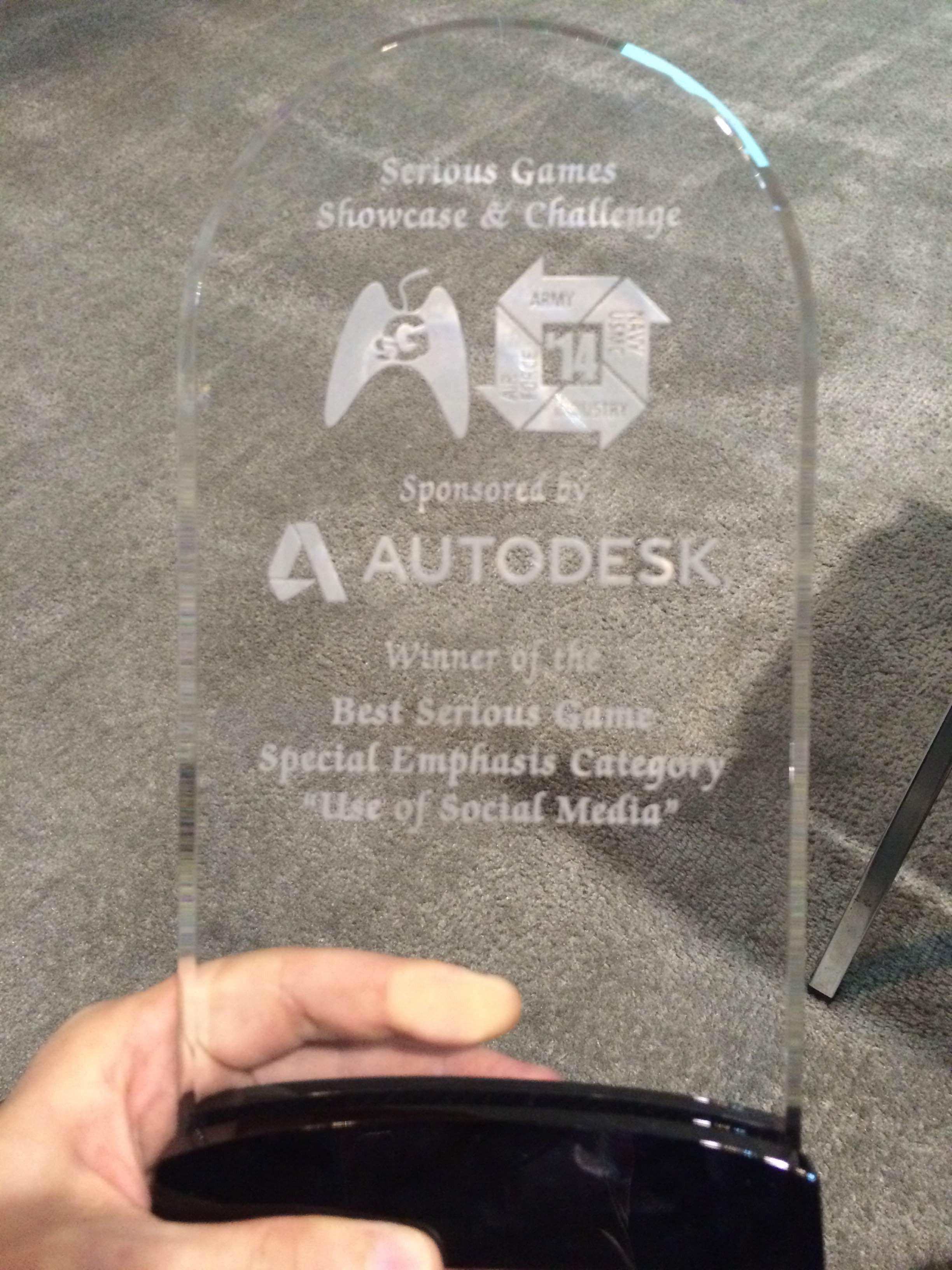
 Congratulations to the Nanocrafter team at UW CSE’s Center for Game Science, who picked up the award for “Best Serious Game, Special Emphasis Category, Use of Social Media” at the Serious Games Showcase and Challenge. The event, taking place today in Orlando, Florida, celebrates excellence in the field of serious games development.
Players of Nanocrafter build nanoscale devices using pieces of DNA. The game, in addition to being fun and educational, is helping to advance scientific discovery in the field of synthetic biology by leveraging the power of crowdsourcing.
Check out their shiny plaque! And if you haven’t joined the Nanocrafter community, you can learn more and test your skills here.
Way to go, team! Read more →
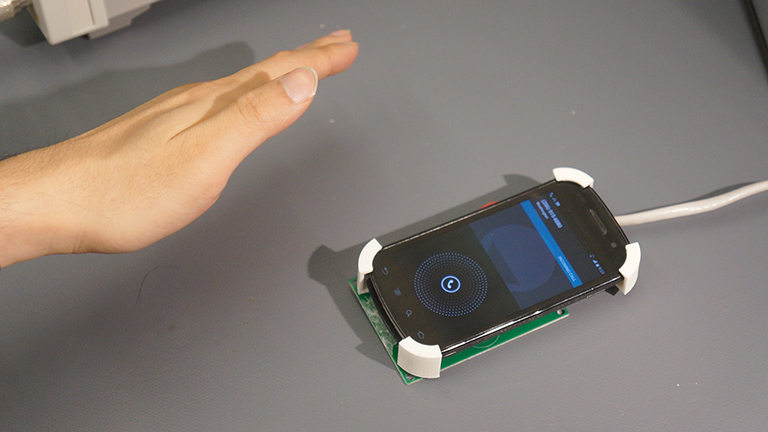
Euronews recently featured an article on SideSwipe, a new sensor technology developed by Chen Zhao and Matt Reynolds that enables smartphones to recognize hand gestures. As Matt Reynolds explains in the article:
“‘If you think about a radar on an aircraft or a boat or something like that … you have a transmitter that is sending energy out into the environment and it is being reflected by objects nearby … what we do is use a machine learning algorithm to match patterns of the changes due to gestures with previously recorded patterns and when we see a match we say ‘oh’ a particular gesture has been performed.’”
 Having demonstrated that its sensor works with 87 percent accuracy, the team is working on commercializing the new technology.
Read the article here, and check out the original media release announcing the technology here. Read more →
 Brian Koepnik and Vikram Mulligan – two of the scientists behind FoldIt, the award-winning protein-folding game developed by members of UW CSE’s Center for Game Science and the UW Department of Biochemistry – will be at the Pacific Science Center this Friday through Sunday to help celebrate Life Sciences Research Weekend.
FoldIt is an online game that has effectively crowd-sourced scientific discovery of the 3-D structure of proteins that play a role in diseases such as cancer, AIDS, and Ebola. Players are presented with a model of a protein to fold using a selection of tools. The game then evaluates the fold and uploads each player’s score to a leaderboard.
FoldIt has grown into a robust online community, and the competition sometimes can get fierce. This competitive streak yielded results in 2011 when FoldIt players discovered the protein structure of an AIDS-like virus. The virus had stumped scientists for a decade, but the FoldIt community unlocked its structure in just three weeks. More than 100,000 people around the world have played the game since it was released in 2008, and the game recently reached 1,000 puzzles.
Life Sciences Research Weekend is a three-day event November 7-9 at the Pacific Science Center in Seattle. The FoldIt team is taking part in a robust program of live demonstrations and interactive exhibits designed to engage families and citizen scientists in learning more about the role of life sciences research in our daily lives. Help spread the word, and stop by to say hi!
Learn more about the Center for Game Science here, and try your hand at protein folding here. Find directions to the Pacific Science Center to join in the fun this weekend here. Read more →
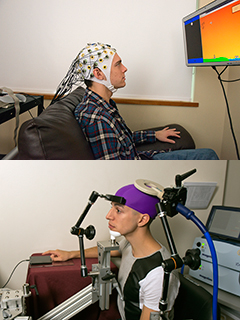
Photo credit: Mary Lanvin, UW
Last summer, an interdisciplinary team of UW researchers became the first to demonstrate two human brains communicating directly without using language. Today, having completed a more comprehensive test of its brain-to-brain interface, the team published its results in the journal PLOS ONE. UW CSE professor Raj Rao is lead author of the study.
The researchers used a combination of non-invasive instruments and software to connect two human brains over the Internet in real time. Six participants were paired off, with one designated as sender and one as receiver, and placed in separate locations on campus. Each member of the pair was unable to communicate with the other except by the link between their brains as they cooperated remotely to execute a command in a computer game. The researchers transmitted signals from one person’s brain to the other, using them to control the hand motions of the recipient – successfully replicating the results of the initial demonstration.
In addition to measuring the accuracy of their communication, researchers were able to quantify the amount of information transmitted between participants. Thanks to a new $1 million grant from the W.M. Keck Foundation, the team will be able to take its work a step further: in the next round, the researchers will increase the complexity of information transmitted between brains.
Rao, undergraduate CSE researcher Joseph Wu, and CSE alumnus Matthew Bryan co-authored the study with Andrea Stocco and Chantel Prat of the UW Institute for Learning & Brain Sciences and Devapratim Sarma and Tiffany Youngquist of the UW Department of Bioengineering.
Read the UW press release and watch a video demonstration here. Read the study published in PLOS ONE here. NBC News report here. Read more →

 Congratulations to the Nanocrafter team at UW CSE’s Center for Game Science, who picked up the award for “Best Serious Game, Special Emphasis Category, Use of Social Media” at the Serious Games Showcase and Challenge. The event, taking place today in Orlando, Florida, celebrates excellence in the field of serious games development.