 A terrific article on this summer’s Data Science for Social Good program spearheaded by the UW eScience Institute, which is led by CSE’s Ed Lazowska and Bill Howe.
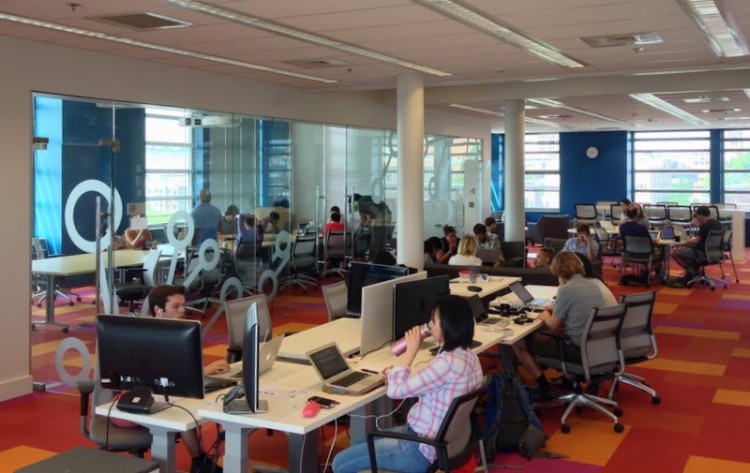
“In June, the Institute launched the Data Science for Social Good program, an initiative that paired data scientists with students and local nonprofit and government partners. These interdisciplinary teams worked on projects to reduce family homelessness, improve paratransit bus service, foster community well-being, and map better sidewalk routes for people with mobility challenges …
“Ed Lazowska, the Bill & Melinda Gates Chair in Computer Science & Engineering, said the initiative demonstrates the utility of data science in tackling a host of societal challenges that students are eager to work on.
“‘I think people are energized by the ability to work on something that is both technically challenging and makes the world a better place,’ he said. ‘That’s what Data Science for Social Good is about.'”
Read more here. Read more →
 The 2015 UW Engineering Lecture Series – three evening public lectures sponsored by the UW Alumni Association – is all CSE this year!
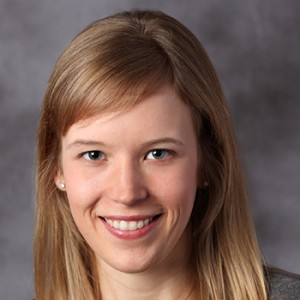
- Wednesday October 7: Franzi Roesner, “The Invisible Trail: Pervasive Tracking in a Connected Age”
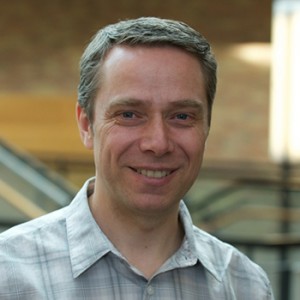
- Wednesday October 21: Dieter Fox, “Our Robotic Future: Building Smart Robots that See in 3D”
- Wednesday November 3: Yoshi Kohno (along with Batya Friedman from
 the Information School and Ryan Calo from the School of Law), “Responsible Innovation: A Cross Disciplinary Lens on Privacy and Security Challenges”
All lectures are at 7:30 p.m. in Kane Hall 130.
Learn more here.
 Read more →
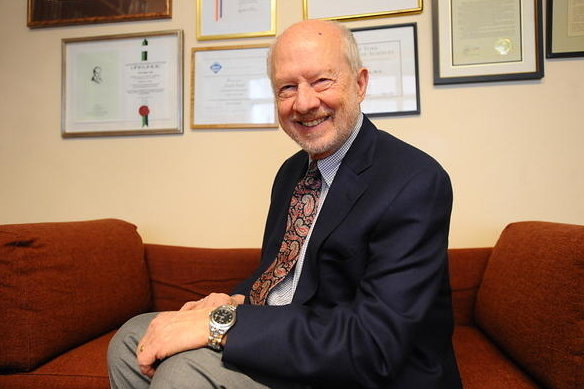 Joe Traub – Edwin Howard Armstrong Professor of Computer Science at Columbia University, as well as an External Professor at the Santa Fe Institute – passed away earlier this week.
Joe was a giant of the field, and an inspiration. After receiving his Ph.D. from Columbia in 1959, he was hired by Bell Laboratories. He continued at Bell Labs until 1970, when he began his professorial career at the University of Washington. Soon after, in 1971, he was offered the position of Head of the Computer Science Department at Carnegie Mellon University, a role in which he served until 1979. He left to help Columbia University build a Computer Science Department, and became its Founding Chair. In 1986, he was invited to start what is now the Computer Science and Telecommunications Board for the National Academies, serving as chair from 1986-92, then again from 2006-09.
Steve Lohr wrote a lovely tribute in today’s New York Times. Read more →
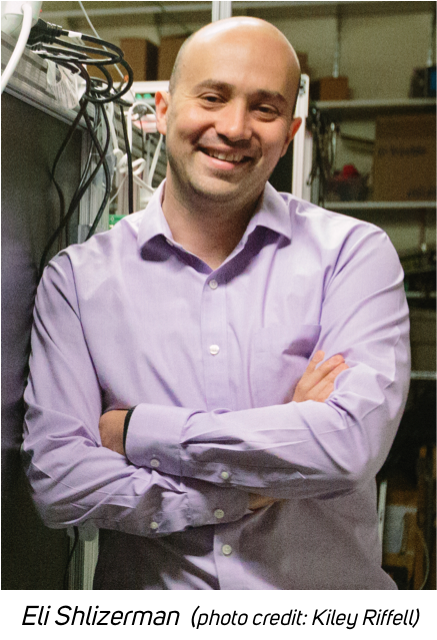 UW Electrical Engineering has just announced the hiring of data analysis expert Eli Shlizerman, joint with UW Applied Mathematics.
Shlizerman’s research focuses on analyzing complex dynamic networks, such as the nervous system. Typically, such networks are extremely challenging to study because of their complex structure and intricate time-dependent dynamics. To overcome these challenges, Shlizerman developed analysis methods that fuse data analysis with dynamical system theory, which uses various equations to determine the behavior of complex systems.
Congratulations to Eli, to UW EE, and to their chair Radha Poovendran for moving forward rapidly in key interdisciplinary areas! And thanks to the Washington Research Foundation, whose support of the UW eScience Institute contributed to this recruitment.
Read the UW EE announcement here. Read more →
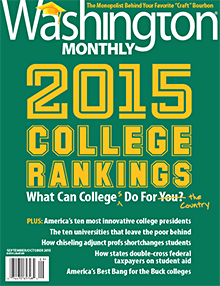 Washington Monthly’s College Guide and Rankings ranks four-year colleges in America on “three measures that would make the whole system better, if only schools would compete on them.” The first is upward mobility: Are schools enrolling and graduating students of modest means and charging them a reasonable price? The second is research: Are they preparing undergraduates to earn PhDs, and creating the new technologies and ideas that will drive economic growth and advance human knowledge? The third is service: Are schools encouraging their students to give back to the country by joining the military or the Peace Corps, or at least letting them use their work-study money to do community service rather than making them on-campus office slaves?”
The University of Washington is ranked among the top ten institutions in the nation – a group that includes UCSD, Berkeley, Stanford, Harvard, UCLA, and Georgia Tech, among others.
In a separate “Best Bang for the Buck” ranking – “the best value for your money based on ‘net’ (not sticker) price, how well they do graduating the students they admit, and whether those students go on to earn at least enough to pay off their loans” – Washington Monthly places UW first in the west.
Always remember: The rankings in which we do well are authoritative, and worth of coverage in this space. The others are methodologically flawed. Read more →
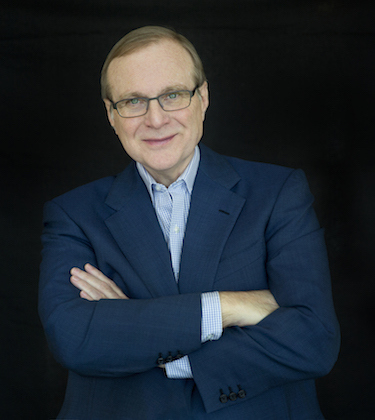 UW CSE friend and benefactor Paul G. Allen will receive a 2015 Carnegie Medal of Philanthropy.
The Carnegie Medal goes to those who use their private wealth to improve the greater public good. Paul was selected for his work to protect the oceans, fight Ebola, save endangered species, help expand educational opportunities for girls, research the human brain and support the arts, according to the Carnegie statement.
Plus, of course, there’s our building …
Congratulations Paul!
GeekWire post here. Read more →
 2010 UW CSE bachelors alum Justine Sherry – now completing her Ph.D. at UC Berkeley – is first author on this year’s Best Student Paper at SIGCOMM 2015, the premier conference in computer networking.
The paper – “Rollback-Recovery for Middleboxes” – is part of Justine’s Berkeley thesis work. Network middleboxes must offer high availability, with automatic failover when a device fails. Unlike routers, when middleboxes fail they most recover lost state about active network connections to perform properly; without this lost state clients face connection resets, downtime, or insecure behaviors. No existing middlebox design provides failover that is correct, fast to recover, and imposes little increased latency on failure-free operations. The FTMB system described in the paper adds only 30us of latency to median per packet latencies – a 100-1000x improvement over existing fault-tolerance mechanisms. FTMB introduces moderate throughput overheads (5-30%) and can reconstruct lost state in 40-275ms for practical system configurations.
UW CSE professor Arvind Krishnamurthy is one of the paper’s co-authors, along with Peter Xiang Gao, Soumya Basu, Aurojit Panda, Sylvia Ratnasamy, and Scott Shenker from UC Berkeley, Christian Maciocco and Maziar Manesh from Intel Research, Joao Martins from NEC Labs, and Luigi Rizzo from the University of Pisa.
“And remember – she’ll be on the job market this coming year.” Read more →
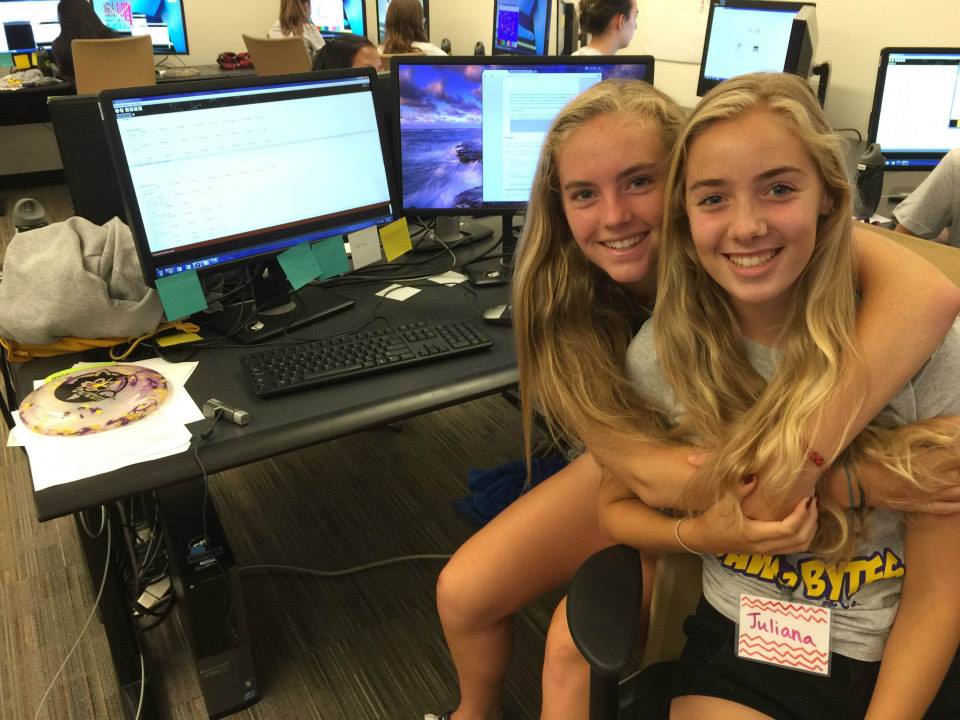 This week marked 2015’s 9th and final UW CSE summer computer science day camp for K-12 students.
During the week of June 29 we hosted a co-ed camp for students entering grades 3-5 for “Scratch Adventures,” and a co-ed camp for students entering grades 10-12 for “Physical Computing.”
During the week of July 6 we again hosted “Physical Computing.”
During the weeks of July 20 and August 10 we hosted students entering grades 7-9 for “Building Android Apps.”
During the weeks of July 27 and August 3 we hosted girls camps using Processing for students entering grades 10-12.
And during the weeks of August 10 and August 17 we hosted girls camps using Processing for students entering grades 7-9.
Learn more about our summer day camps here.
Learn more about Dawgbytes (“A Taste of CSE”), UW CSE’s broad-based K-12 outreach program, here.
For lots of photos of this year’s camps, check out the DawgBytes Facebook page here. Read more →
 Another great performance by UW CSE faculty and alums in the most recent Google Faculty Research Awards:
Human-Computer Interaction
- UW CSE Ph.D. alum (and former Creative Director of the UW Center for Game Science) Seth Cooper (Northeastern University)
- UW CSE affiliate professor Sean Munson (UW Human Centered Design & Engineering)
- UW CSE affiliate professor and Ph.D. grandchild Jessica Hullman (UW Information School, and the University of Michigan Ph.D. alum of UW CSE Ph.D. alum Eytan Adar)
Networking
Natural Language Processing
Physical Interactions and Immersive Experiences
Privacy
Software Engineering and Programming Languages
Congratulations, one and all! And thanks, Google, for your support! (See the full list of awardees here.)
Read more →
 We admit it … this is pretty close to us talking about ourselves … but not quite.
UW !MPACT, “Informed Advocates of the University of Washington,” blogs:
“Recent UW alums don’t have to get too far off-campus to find a use for their newly-minted technology degrees. Washington’s booming tech industry is responsible for employing 238,900 people, and bringing in over $37 billion in revenue, according to a recent Washington Technology Industry Association study.
“Not only are our grads located in the heart of the state’s tech hotbed, they also turn out to be among the best-equipped to make an impact in the tech world, according to a new tech.co ranking. The UW ranked #2 on a list of the public universities that produce the best startup talent.”
The post contains additional information on the need to increase CSE’s enrollment, and provide expanded facilities.
Thanks, UW !mpact. Read more here.
Read more →