Big, and Getting Bigger: UW CSE and Washington’s Leadership in Big Data

Ed Lazowska at the podium

UW CSE’s Ed Lazowska

On Tuesday, UW CSE, the non-profit Technology Alliance, and more than 150 business and research leaders participated in a day-long conference, “Insight to Impact: Transforming Washington’s Industries Through Big Data,” that examined the role of data science, sensing, machine learning, and data visualization in driving our economy. From optimizing airline routes and building efficiency, to personalizing health care and retail customer interactions, it is clear that our region has the infrastructure and expertise to take full advantage of rapidly expanding opportunities in big data.

The Ever-Expanding Sphere

UW CSE’s Ed Lazowska kicked off the program with an overview of the big data ecosystem, including how big data is enabling computer scientists to “put the smarts in everything” and empower people to put data to work for the civic good.

Characterizing computer science as an “ever-expanding sphere,” Ed pointed out the many ways the field is enabling the things that people care about. These include personalized recommendations, fraud detection, predictive pricing, real-time traffic guidance, and a host of other applications that are driven by big data infrastructure and services – many of them based here in Washington State.

The Democratization of Data

Ed Lazowska and Francois Ajenstat onstage

Ed Lazowska (left) and Tableau’s Francois Ajenstat

It is no surprise that Seattle is the epicenter of the big data revolution: it is home to Amazon Web Services and Microsoft Azure, two of the biggest cloud computing platforms in the world that enable big data, and UW CSE and the UW eScience Institute have built up critical expertise and launched new educational programs on the Seattle campus to stay at the forefront of the big data revolution.

Our region is also home to Tableau Software, the rapidly growing company that brought big data to the masses through user-friendly visualization tools. Tableau’s Vice President of Product Management, Francois Ajenstat, explained how Tableau’s tools empower people to work with their own data and share their findings with the world.

Big, and Getting Bigger

Carlos Guestrin and Joseph Sirosh onstage

UW CSE’s Carlos Guestrin (left) and Joseph Sirosh of Microsoft

Ewan Duncan from McKinsey & Company quantified Washington’s present leadership in big data and the future economic opportunity. He noted that Washington owns 40% of the cloud computing market and ranks second among its peer states, as defined by the Technology Alliance, in both venture investment in big data companies and the percentage of total state employment in big data fields.

On the flip side, Washington ranks low in production of graduates to fill these jobs – a situation we need to rectify in order to maintain our leadership position in the future.

According to McKinsey, the payoff could be huge: the firm estimates the global market for big data technologies to grow to between $24 billion and $45 billion by next year, and productivity gains and cost savings as a result of big data innovations in the U.S. alone to reach as high as $610 billion by 2020.

UW CSE’s Carlos Guestrin, who is also CEO of machine learning startup Dato, is particularly bullish on big data’s potential. In a panel discussion that followed the McKinsey presentation, he proclaimed 2015 as “the year intelligent applications transform how we interact with the world” and emphasized that we need two things to succeed in big data: talent (“We can’t mint these people fast enough!”) and tools.

Sarah Stone presents a poster on UW's eScience Institute

Sarah Stone of UW’s eScience Institute

Carlos was joined onstage by Madrona Venture Group’s Matt McIlwain, Joseph Sirosh of Microsoft, and panel moderator Dina Bass of Bloomberg News. All of the panelists were enthusiastic about the opportunities for our region when it comes to big data.

Matt highlighted opportunities up and down the stack, from enabling infrastructure, to data intelligence, to the development of data-driven applications and services, and he suggested that Seattle was a particularly attractive place for startups working in the last category. Joseph followed this up by noting that Microsoft has the muscle to build platforms at scale, upon which others can build.

Carlos noted that the market for data intelligence and machine learning is nascent and evolving, but that startups operating in this space have an advantage in their ability to be agile. When asked why he thought Seattle is the place to be for big data, Carlos observed, “There is a tremendous amount of energy, a tremendous amount of vision, and a real sense of going places.”

Spotlight on UW Research

Kanit "Ham" Wongsuphasawat presents a poster on UW's Interactive Data Lab

Kanit “Ham” Wongsuphasawat, a PhD student in UW’s Interactive Data Lab

Several UW CSE researchers, joined by colleagues representing interdisciplinary efforts from across campus, were on hand for a poster and demo session. Members of the audience had a chance to interact with the individuals doing cutting-edge research in a variety of fields either driving or driven by big data.

Mayank Goel and Edward Wang of the UbiComp Lab and Kanit “Ham” Wongsuphasawat and Dominik Moritz of the Interactive Data Lab represented UW CSE. The university’s multi-disciplinary initiatives were also well-represented by Sarah Stone of the eScience Institute; Jess Hamilton of the College of Built Environments; Tyler McCormick of the Center for Statistics and the Social Sciences; and Jevin West of the iSchool.

The breadth of projects featured during the session served to illustrate the increasing importance of big data in advancing innovation across a variety of fields, including medical diagnostics, scientific discovery, global development, public utilities management, and urban planning.

Getting Vertical

Jeremy Jaech at the podium

Jeremy Jaech of SNUPI Technologies

The remainder of the day was spent examining how specific industries are putting data to work to deliver better service, cut costs, and spawn the emergence of whole new industries, including deeper dives on big data in aerospace, retail, health care and building management.

Bryan Mistele of Inrix delivered a keynote on the growing use of data in the automobile industry and traffic management. Later, UW CSE alum Jeremy Jaech, CEO of SNUPI Technologies – a company spun out of UW CSE – took to the stage to explain how low-cost sensors are enabling the collection of new categories of data that inform the development of exciting new applications, such as systems for creating a “smart home.”

The afternoon culminated in a closing keynote by Matt Wood, general manager of data science at Amazon Web Services, which brought home the recurring theme of the day: our region’s indisputable leadership in big data.

UW CSE is proud to be a big part of that.

Read more about the McKinsey report on Washington’s leadership and opportunity in big data here.

Read an excellent summation of the session on big data in aerospace here.

Learn more about the event here. Read more →

Leaders write in support of K-12 Computer Science in WA

unnamedA group of top business, education, and non-profit leaders – including Ana Mari Cauce and Ed Lazowska from UW – have written in support of HB 1813, stating:

“House Bill 1813 offers a comprehensive solution: it establishes education standards for computer science and matches private funding to train teachers, who are critical to expanding access to this field – and prioritizes investments to reach underrepresented students first. Nine out of 10 Washington voters support these proposals. We encourage you to commit $1 million per year to support the computer science education grant program. The 1:1 private match requirement means your investment would be doubled, enabling every Washington school to teach computer science by 2025.”

Read more here.

And check out a related op-ed in today’s Seattle Times by Code.org’s Hadi Partovi:

“When I was 9, my father gave my brother and me a life-changing gift: a Commodore 64 computer. It didn’t have any games, so I would learn to make my own. A world of opportunity and creativity opened up to me when I began learning how to program that computer.

“By my teenage years, I landed jobs as a computer programmer when my friends were baby-sitting or waiting tables. I graduated with a job at Microsoft and went on to enjoy a successful career in technology. As an immigrant, I’m living the American dream.

hadi_partovi“Yet, 30 years after I came to the United States, I look around and wonder, why aren’t America’s schools offering the opportunity I had to every 21st-century child?”

Read more here.

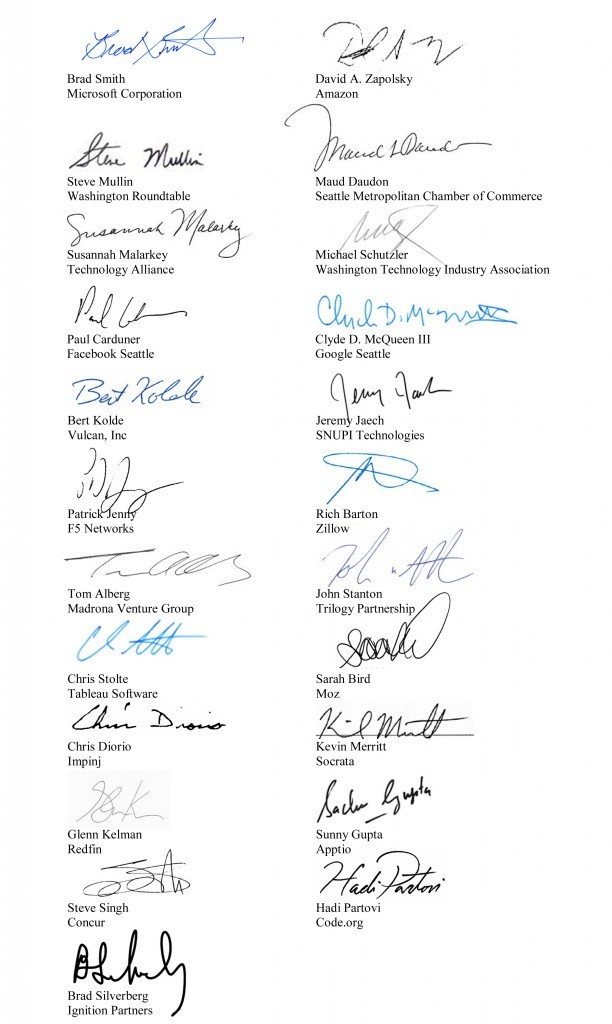
And be sure to check out a related letter regarding partial funding for an expanded facility for UW Computer Science & Engineering, signed last week by 23 leaders – here. Read more →

UW CSE’s Ed Lazowska on current efforts in the WA legislature to increase computer science educational opportunities

Picture 110UW CSE’s Ed Lazowska writes in the WTIA blog:

“Our industry creates a wide variety of jobs, employing people with a wide variety of preparation.  But at its heart, our industry (and our state’s overall economic growth) is powered by the “essential ICT occupations” as defined  in WTIA’s recent ICT Economic & Fiscal Impact Study

“There are several moves afoot in the current legislative session that would make a real difference if enacted.

“One is H.B. 1813, introduced by Reps. Drew Hansen and Chad Magendanz, which includes a number of smart provisions related to computer science in K-12.

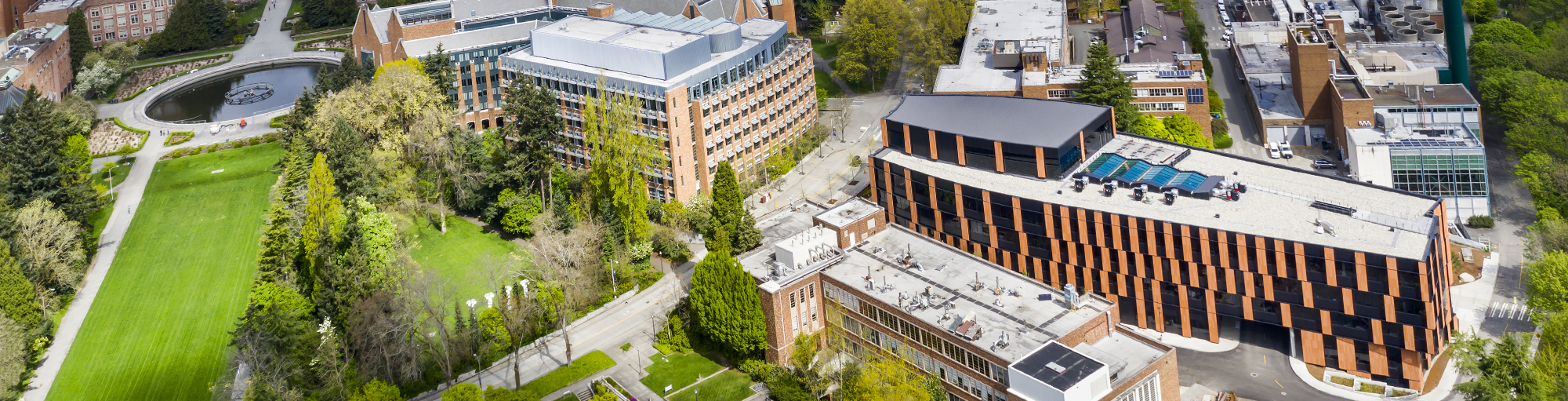
“A second is the Governor’s request, in his capital budget, for partial funding of a second building to accommodate growth for UW CSE …

“A third is work by Reps. Hansen and Magendanz that will hopefully lead to operating funds enabling expansion of the computer science programs at UW CSE, WSU EECS, and WWU Computer Science – the three programs that leading employers have told these legislators are their principal in-state suppliers of talent.”

Read more here. Read more →

“Insight to Impact: Transforming Washington’s Industries Through Big Data”

TAMatt McIlwain (Madrona Venture Group), Carlos Guestrin (UW CSE and Dato), Joseph Sirosh (Microsoft), and Dina Bass (Bloomberg News) engage the audience at “Insight to Impact: Transforming Washington’s Industries Through Big Data,” co-sponsored by the Technology Alliance and UW CSE.

More about the event here. Read more →

Welcome to Seattle, Uber engineering!

timOur alum Tim Prouty writes:

“It’s now official that I will be starting up Uber‘s Seattle engineering team! I’ll be working directly for Paul Mikesell [also a UW CSE alum], and we’re going to do an official launch in early April. I couldn’t be more excited! …

“At Uber one of my primary goals will be to grow the team very rapidly from 0 to 50+ people this year, so we’ll be working hard to make a splash in the Seattle technology community over the next few months …”

Welcome, Uber!  It’s great to have another top technology company in Seattle!

Many more details in a GeekWire post here. Read more →

Meet the next generation of UW CSE student

We better get a move on with the construction of our new building, if this photo is any indication of future demand! Kudos to mom, a former colleague in the UW College of Engineering, for steering him toward the right major. Maybe we should relax our early admission policy …

Cute baby wearing UW CSE t-shirt Read more →

UW CSE’s Richard Ladner receives Richard A. Tapia Achievement Award

rel

Richard Ladner receives the award from Valerie Taylor, Richard Tapia, and Charles Isbell.

On Friday February 20, UW CSE professor Richard Ladner received the Richard A. Tapia Achievement Award for Scientific Scholarship, Civic Science and Diversifying Computing.

Richard was honored “for his incredible commitment and contributions to the disability community in computing.” After many years of research in theoretical computer science, he turned his attention to accessibility technology research, especially technology for deaf, deaf-blind, hard-of-hearing, and blind people.

In addition to being a Guggenheim Fellow, a Fulbright Scholar, and a Fellow of ACM and IEEE, Richard has received the Presidential Award for Excellence in Science, Mathematics and Engineering Mentoring (PAESMEM), the Computing Research Association’s A. Nico Habermann Award, the Purpose Prize, and the University of Washington Outstanding Public Service Award.

Congratulations Richard! Read more here. Read more →

Nova Barlow of UW CSE’s Center for Game Science delivers straight talk on community management at GDC

Nova Barlow

Photo credit: J. Hayter

Next week, tens of thousands of interactive game industry professionals will converge on San Francisco for the annual Game Developers Conference® (GDC) – the world’s largest and longest-running event of its kind – for five days of lectures, roundtable discussions, tutorials, and celebrations of all things game-related. Among them will be Nova Barlow, community manager at UW CSE’s Center for Game Science, who is leading a panel of industry veterans in some straight talk about community management.

Noting that “community management is no longer a quiet job behind the scenes,” the organizers are staging the first-ever Community Management Summit and devoting an entire day to this aspect of the game industry. Nova’s panel will discuss the history and challenges of community management and identify ways to transition this increasingly popular role from stepping-stone job to viable career path.

“I was encouraged by my co-workers at the Center for Game Science to submit the idea for the panel – a topic I’ve been kicking about in my own head for a while – to the GDC organizers,” said Nova. “I’m looking forward to contributing to the conference and being able to draw upon the experience of my fellow panelists.”

The Game Developers Conference® is March 2-6.

Learn more about Nova’s GDC session here.

Check out the latest news from the Center for Game Science here. Read more →

SRO for UW CSE Ph.D. alum and Google Senior Fellow Jeff Dean

IMG_4755 copyThe fire marshal was blessedly AWOL for today’s UW CSE Distinguished Lecture featuring 1996 Ph.D. alum Jeff Dean, “Large-Scale Deep Learning For Building Intelligent Computer Systems.”

JeffJeff joined Google in 1999 and is currently a Google Senior Fellow in Google’s Knowledge Group, where he leads Google’s deep learning research team in Mountain View. He has co-designed/implemented five generations of Google’s crawling, indexing, and query serving systems, and co-designed/implemented major pieces of Google’s initial advertising and AdSense for Content systems. He is also a co-designer and co-implementor of Google’s distributed computing infrastructure, including the MapReduce, BigTable and Spanner systems, protocol buffers, LevelDB, systems infrastructure for statistical machine translation, and a variety of internal and external libraries and developer tools. He is currently working on large-scale distributed systems for machine learning. Jeff is a Fellow of the ACM, a Fellow of the AAAS, a member of the U.S. National Academy of Engineering, and a recipient of the Mark Weiser Award and the ACM-Infosys Foundation Award in the Computing Sciences. Read more →

UW CSE: Reaching more students than ever and expanding opportunities for women in computer science

14x growth in introductory course enrollment at UW CSEHere at UW CSE, we are experiencing record interest in our undergraduate major and record enrollments in our introductory courses. This explosion of interest is happening across the country, but UW is doing particularly well among a key demographic underrepresented in the field: women.

When principal lecturer Stuart Reges attended a recent meeting organized by the National Center for Women & Information Technology, he talked about the tremendous growth of student interest in computer science. He shared UW CSE’s enrollment data to illustrate his point: around 2,800 students per year enroll in our first intro course – representing nearly half of the freshman class – and around 1,800 students per year in our second course. These two courses alone account for about 1.6 percent of all undergraduate student units taught on UW’s Seattle campus.

Building on what is already a good-news story, UW CSE is also seeing record percentages of women taking our introductory courses and pursuing our undergraduate major. The 2013-14 Taulbee Survey found that, nationally, less than 15 percent of undergraduate computer science degrees were granted to women.  At the UW, 30% of bachelors degrees in the most recent year were granted to women. And we expect this trend to continue: In our first intro course (CSE142), the class is currently 35% women.

A key element of our success has been our undergraduate TA program. CSE has 83 undergraduate TAs helping us to teach the 1,800 students currently enrolled currently in CSE142. Thirty-nine of those TAs are women; at 47 percent, this is the highest concentration of women we have seen in the last 10 years. Seeing young women a year ahead thriving in the field provides the best possible encouragement!

There is more work to be done, but we are proud of the way our commitment to diversity in computer science is helping us to lead the nation in engaging more women in the field!

View our video about the explosive growth in student participation in CSE’s intro courses here.

Learn more about the steps UW CSE is taking to broaden participation in the field here. Read more →

« Newer PostsOlder Posts »